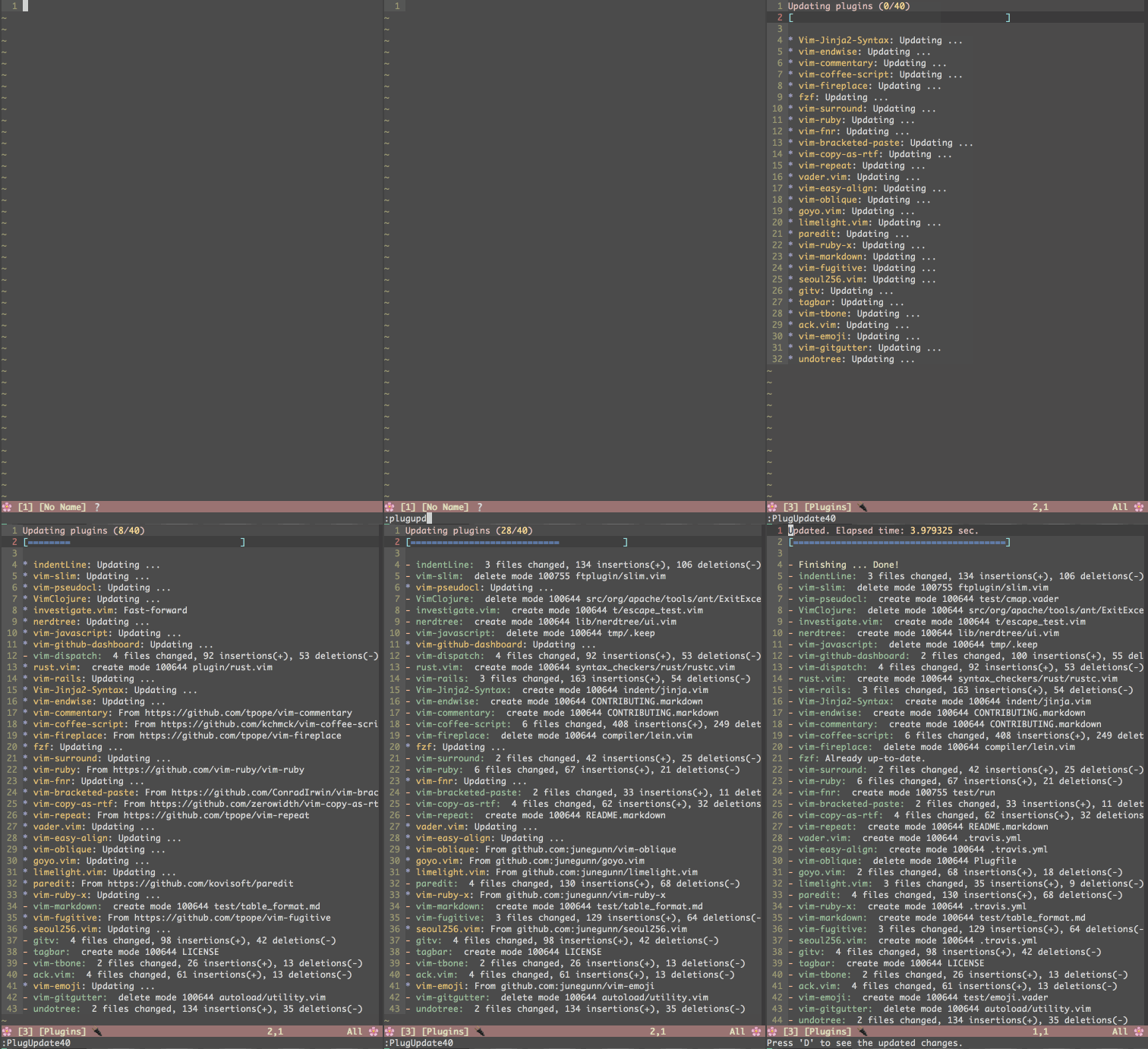
:hibiscus: Minimalist Vim Plugin Manager
35.7k
Stars
1.9k
Forks
86
Open issues
30
Contributors


AI Analysis
vim-plug is a minimalist plugin manager for Vim and Neovim, consisting of a single file with no external dependencies. It serves developers and sysadmins who use Vim/Neovim as their primary editor and need reliable, lightweight plugin management with fast parallel installation and on-demand loading. It is not intended for casual Vim users or those who prefer feature-rich plugin managers.
Inferred from signals mentioned in the README (tests, CI, type safety) — not a review of the actual code.
AI's overall editorial judgment — not an average of the bars above, can weigh other factors too.
vim-plug: the single-file Vim plugin manager that became the de facto standard for a generation of Vim users
vim-plug is a minimalist, single-file Vim plugin manager that handles installation, updating, and removal of Vim/Neovim plugins. Built for Vim and Neovim users who want a lightweight, zero-dependency setup experience, it gained massive adoption through its simple syntax, parallel installation, and on-demand loading capabilities. With 35,000+ stars and a decade of proven stability, it remains one of the most-referenced plugin managers in Vim tutorials, dotfiles repos, and community guides worldwide.
Created in September 2013 by junegunn, a prolific Vim ecosystem contributor also behind fzf and vim-easy-align. It emerged when Vundle was dominant but perceived as slow; vim-plug differentiated through parallel installs and a single-file, no-dependency design.
Growth was driven by early community adoption in the 2013–2018 period when Neovim was rising and users sought modern tooling. junegunn's reputation and cross-promotion through fzf amplified reach. Growth has since plateaued — only 1 star in the last 7 days — reflecting market maturation and competition from Neovim-native managers like lazy.nvim, not project decline.
vim-plug is referenced extensively in public dotfiles repositories on GitHub, Vim community wikis, and tutorials across platforms like Reddit r/vim, Medium, and Dev.to. Its installation snippet is among the most copy-pasted Vim configuration fragments in existence. Direct production usage metrics are not publicly available, but the scale of community references strongly suggests tens of thousands of active daily users.
Appears to be implemented as a single Vim script file (plug.vim) placed in the autoload directory, requiring no external dependencies. Likely uses Vim's job/async APIs or system calls to parallelize git clone/pull operations. On-demand loading appears to be implemented via Vim's autocommand and filetype mechanisms.
A CI badge linked to GitHub Actions test workflow is present in the README, suggesting automated testing exists. Specific coverage metrics or test framework details are not documented in the README.
Last push was 2026-05-22, approximately one month before the evaluation date. This indicates active maintenance. The project is mature and stable, so infrequent commits reflect feature completeness rather than abandonment. CI is actively configured.
ADOPT IF: you use classic Vim (not Neovim), want zero-dependency setup with a proven track record, or are configuring a shared/server environment where simplicity and stability matter most. Also reasonable for Neovim users who prefer VimL config and don't need Lua-native features. AVOID IF: you use Neovim exclusively and want the full modern ecosystem — lazy.nvim offers significantly better Neovim-specific features like structured lazy-loading and profiling. MONITOR IF: you have an existing vim-plug configuration and are considering migrating to lazy.nvim — the gap in Neovim-specific capability is real but migration cost may not justify it for stable setups.
Independent dimensions
Mainstream potential
3/10
Technical importance
7/10
Adoption evidence
8/10
- Neovim ecosystem has shifted toward Lua-native tooling; vim-plug's VimL foundation is increasingly seen as legacy in Neovim-focused communities.
- New Neovim users are overwhelmingly directed toward lazy.nvim in 2025–2026 tutorials, which may reduce vim-plug's mindshare with the next generation of users.
- The single-file architecture, while elegant, means all functionality must fit in one file — complex new features like UI dashboards or structured dependency graphs are architecturally difficult to add.
- If junegunn (a solo maintainer) reduces involvement, the project has no organizational fallback, though its maturity means this is a lower risk than for less-complete projects.
- On-demand loading in vim-plug is simpler than lazy.nvim's system; users with many heavy plugins may see startup time advantages in switching.
vim-plug will remain a stable, maintained tool with a loyal user base among classic Vim users and Neovim users who prefer simplicity. It is unlikely to reclaim growth momentum against lazy.nvim in Neovim circles, but will not disappear — its installed base and backward compatibility promise make it a long-lived utility.
Explore similar
Newsletter
Get analyses like this every Monday
Free weekly digest of the most interesting open-source discoveries.
Languages
Information
- Language
- Vim Script
- License
- MIT
- Last updated
- 2mo ago
- Created
- 156mo ago
- Analyzed with
- anthropic/claude-haiku-4-5
Stars over time
Contributors over time
Top 100 contributors only — repos with more will plateau at 100.
Open issues
Modify the "automatic installation" so it uses $XDG_CONFIG_HOME
PlugClean takes over 1 minute and eats 100% CPU
PlugInstall reports already up to date for plugins just installed
Allow specifying wildcard tag without getting a pre-release version
Monterey macOS vim9 cannot install vim plug
Top contributors
Recent releases
Similar repos
| Repository | Stars | Week Δ | Language | Score | Updated |
|---|---|---|---|---|---|
|
junegunn/vim-plug
this
|
35.7k | +16 | Vim Script | 9/10 | 2mo ago |
 nvim-mini/mini.nvim nvim-mini/mini.nvim
|
9.4k | — | Lua | 8/10 | 1d ago |
 LazyVim/LazyVim LazyVim/LazyVim
|
26.9k | — | Lua | 8/10 | 1mo ago |
 spf13/spf13-vim spf13/spf13-vim
|
15.5k | — | Vim Script | 6/10 | 4w ago |
 neovim/neovim neovim/neovim
|
101k | — | Vim Script | 9/10 | 16 min ago |
 vim/vim vim/vim
|
40.6k | — | Vim Script | 9/10 | 6d ago |
The dominant choice for new Neovim users as of 2024–2026. Offers a Lua-native API, advanced lazy-loading, profiling, and a UI dashboard. vim-plug cannot match its Neovim-specific feature depth, but lazy.nvim only works with Neovim, not classic Vim.
An older manager that vim-plug largely displaced. Vundle lacks parallel installs and has seen minimal maintenance. vim-plug is strictly preferable to Vundle for any current setup.
Even simpler than vim-plug — pathogen only adds directories to runtimepath. vim-plug provides actual lifecycle management (install, update, clean) that pathogen does not.
A Lua-based Neovim plugin manager that was popular circa 2021–2023 but has since been archived/superseded by lazy.nvim. vim-plug outlasted it in practical relevance due to broader Vim compatibility.
A feature-rich alternative with more configuration options but a steeper learning curve. vim-plug wins on simplicity and onboarding speed; dein.vim may appeal to power users wanting finer control.