Windows pod system for Linux
1.5k
Stars
68
Forks
36
Open issues
12
Contributors


AI Analysis
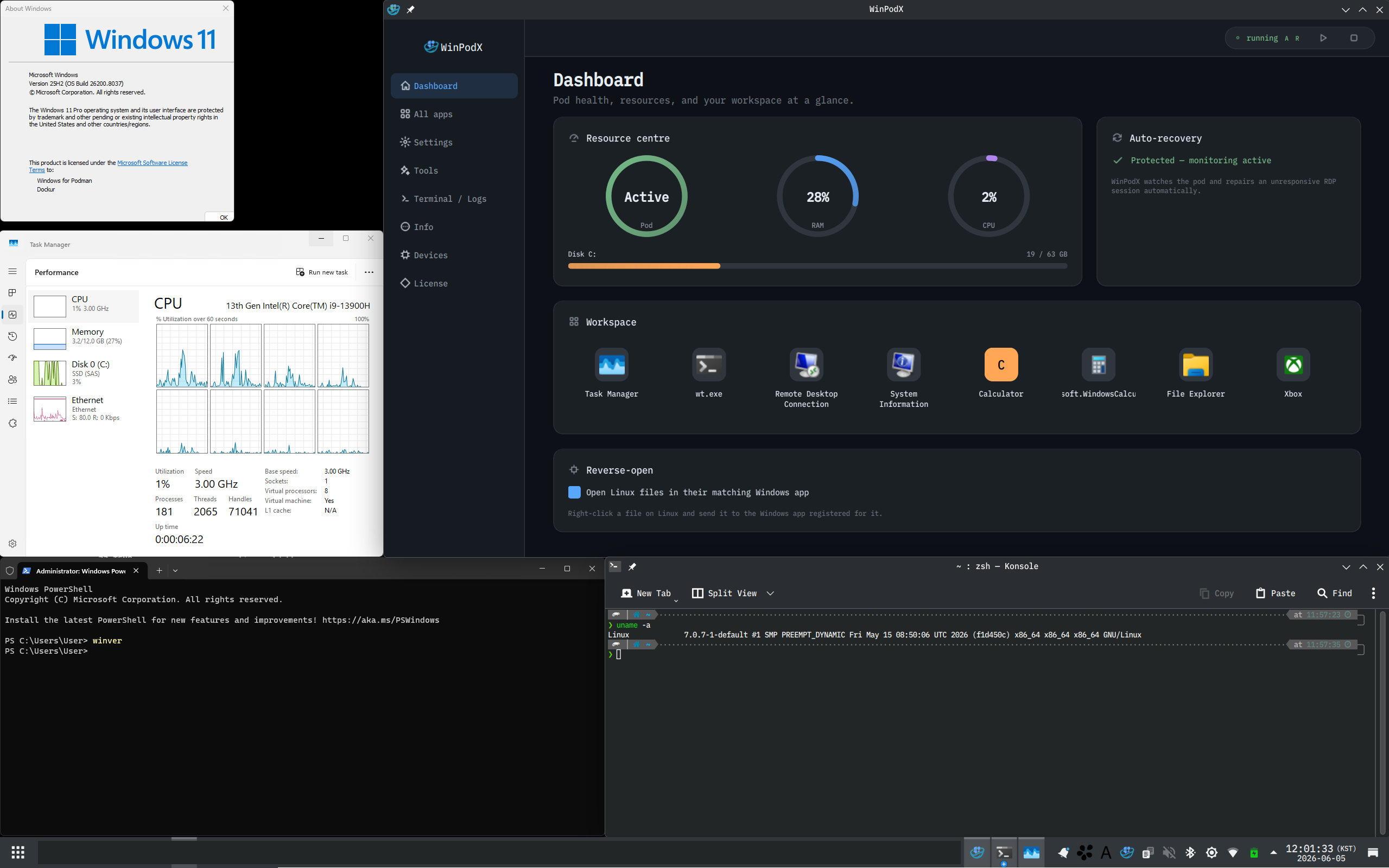
WinPodX enables running Windows applications as native Linux windows on Linux desktops by wrapping Windows apps in FreeRDP RemoteApp containers backed by a lightweight Windows VM. It's specialized for power users and Linux desktop enthusiasts who need seamless Windows app integration without dual-booting, offering real window decorations, taskbar pinning, and zero configuration.
Inferred from signals mentioned in the README (tests, CI, type safety) — not a review of the actual code.
AI's overall editorial judgment — not an average of the bars above, can weigh other factors too.
Python-based Windows app launcher for Linux using containerized Windows and RemoteApp
WinPodX runs individual Windows applications as isolated Linux windows on a Linux desktop by combining a containerized Windows VM (via dockur/windows) with FreeRDP RemoteApp. It integrates Windows apps into the Linux desktop environment—taskbar pinning, file associations, native window decorations—without requiring full-screen RDP. Created April 2026, it has gained 1,230 stars and 205 stars in the last week, indicating recent momentum. The project targets Linux users who need specific Windows applications but want a seamless desktop experience rather than a separate RDP session.
WinPodX emerged in April 2026 as a specialized tool combining existing technologies: dockur/windows (containerized Windows), FreeRDP RemoteApp protocol, and Podman/Docker. It is not a fork or major reimplementation of prior work, but rather a novel integration layer that makes RemoteApp + containerized Windows accessible via a single CLI/GUI with app discovery and lifecycle management.
The project accelerated from creation (2026-04-08) to 1,230 stars by mid-June 2026, gaining 205 stars in the final week. This velocity suggests either recent media attention, discovery by a niche community (Linux users needing Windows software), or both. The rapid star growth in a nascent project is atypical but plausible for a 'zero-config' wrapper around known components. README emphasis on 'zero config' and ease-of-use indicates positioning as a lower-friction alternative to manual RDP or full-VM setups.
Adoption not verified. No case studies, enterprise deployments, or community reports of large-scale usage are mentioned in README. GitHub stars and recent growth suggest awareness among Linux enthusiasts, but concrete production adoption—whether by individuals, teams, or organizations—is not documented. The disclaimer 'Status: Beta' and rapid version iteration (0.6 → 0.7.2 in weeks) may deter risk-averse users. Community forum activity, GitHub Discussions, or third-party reviews are not referenced.
Appears to be a Python 3.9+ application built around a desktop GUI (Qt, likely PyQt based on README), a CLI layer, and integration with Podman/Docker for container orchestration. Likely uses FreeRDP libraries (or shelling to FreeRDP binaries) for RemoteApp protocol. README mentions a Windows guest-side provisioning component and host-side orchestration. The post-create chain uses a single `winpodx provision` command. AppImage is described as 'Thin' (~110 MB), suggesting it bundles Python, Qt, and FreeRDP but relies on host Podman/Docker, which reduces binary size. Cannot assess code quality beyond architecture statements in README; actual implementation transparency is limited.
README claims '1800+' tests but provides no detail on coverage percentage, test types, or CI configuration. Badge shows CI passing on main branch. Cannot verify test quality, scope, or whether 1800+ count unit, integration, or both; assertion is unvalidated.
Last push 2026-06-21 (2 days before analysis date); repository is actively maintained. README indicates v0.7.2 (latest) released recently with bug fixes and UX improvements (v0.7.0 → 0.7.1 → 0.7.2 in rapid succession suggests post-launch iteration). CI badge is green. No evidence of abandoned issues or slow response times from metadata alone, but cannot verify issue triage depth. Project is young (11 weeks old), so 'active' must be contextualized—early-stage rapid iteration is normal and should not be conflated with long-term sustainability signals.
ADOPT IF: you are a Linux user who needs to run specific Windows applications without full-screen RDP or hypervisor overhead, are comfortable with beta software, and value zero-config setup and native desktop integration over stability guarantees. AVOID IF: you require production-grade reliability, need long-term vendor support, depend on features not yet released, or work in a regulated environment requiring mature, audited tooling. MONITOR IF: you are a Linux power user evaluating RDP-based Windows app launchers and want to track WinPodX as it matures beyond beta; the recent velocity and polish of recent releases (0.7.x) suggest it may solidify into a credible alternative within 6–12 months.
Independent dimensions
Mainstream potential
4/10
Technical importance
6/10
Adoption evidence
2/10
- Beta status and rapid version iteration (0.6 → 0.7.2 in ~6 weeks) imply incomplete feature stabilization and potential breaking changes; production users risk API drift or unexpected behavior shifts.
- Adoption not verified; no public evidence of real-world deployments at scale, making it difficult to assess how the system behaves under diverse hardware, distros, or edge-case usage patterns.
- Dependency on containerized Windows (dockur/windows) and Podman/Docker; if upstream breaks or diverges, WinPodX inherits risk. AppImage requires host Podman/Docker, complicating some deployment scenarios.
- RemoteApp protocol maturity; FreeRDP's RemoteApp support is functional but not universally reliable across all Windows features (mentioned in README: 'No full-screen RDP'). Some legacy Windows apps may not integrate cleanly.
- Project age (11 weeks) and small team implied by one primary author (kernalix7) and low fork count (56) suggest limited redundancy; key person risk if maintenance lapses.
If adoption accelerates beyond current niche (Linux users with Windows app needs), WinPodX is likely to consolidate into a stable 1.0 release within 6–12 months, with feature focus shifting from MVP polish to bug fixes and ecosystem integration (e.g., package manager distributions). Alternatively, if adoption remains modest, the project may plateau as a specialized tool maintained by a small community, similar to winapps' trajectory. Mainstream Linux desktop adoption is unlikely unless a major use case (e.g., enterprise app compatibility) drives demand.
Newsletter
Get analyses like this every Monday
Free weekly digest of the most interesting open-source discoveries.
Languages
Information
- Website
- https://www.winpodx.org/
- Language
- Python
- License
- MIT
- Last updated
- 2d ago
- Created
- 3mo ago
- Analyzed with
- anthropic/claude-haiku-4-5
Stars over time
Contributors over time
Top 100 contributors only — repos with more will plateau at 100.
Open issues
[Bug] git should probably installed as dep during setup
StarMoney and Adobe Acrobat fail to launch via winpodx app run but work from desktop
[Bug] Minor: App icon is always the FreeRDP icon instead of that for the app
[Bug] Info shows kio-fuse not installed even though it is
[Feature] Suggestion, make user usage docs available for view in a website online
Top contributors
Recent releases
Similar repos

winapps-org/winapps
WinApps enables seamless integration of Windows applications (Microsoft Office,...
| Repository | Stars | Week Δ | Language | Score | Updated |
|---|---|---|---|---|---|
|
kernalix7/winpodx
this
|
1.5k | +75 | Python | 7/10 | 2d ago |
|
winapps-org/winapps
|
15.5k | — | Shell | 7/10 | 3d ago |
 TibixDev/winboat TibixDev/winboat
|
21.9k | — | TypeScript | 6/10 | 2d ago |
 dockur/windows dockur/windows
|
52.4k | — | Shell | 9/10 | 2d ago |
 ExTV/Podroid ExTV/Podroid
|
1.7k | — | Kotlin | 7/10 | 1w ago |
 podman-desktop/podman-desktop podman-desktop/podman-desktop
|
7.8k | — | TypeScript | 8/10 | 7h ago |
Older, larger community project for running Windows apps on Linux via RDP. WinPodX appears to improve UX (zero config, auto app discovery, taskbar integration) but targets the same use case; winapps is more established and battle-tested.
Similar scope; appears to be a competitor offering. WinPodX is much newer and smaller; cannot infer feature parity from metadata alone.
The underlying containerized Windows runtime that WinPodX depends on. WinPodX is a higher-level orchestration layer; dockur/windows is a lower-level component.
Desktop container management; solves a different problem (general container admin) rather than Windows app integration. Not a direct competitor but operates in the same ecosystem.