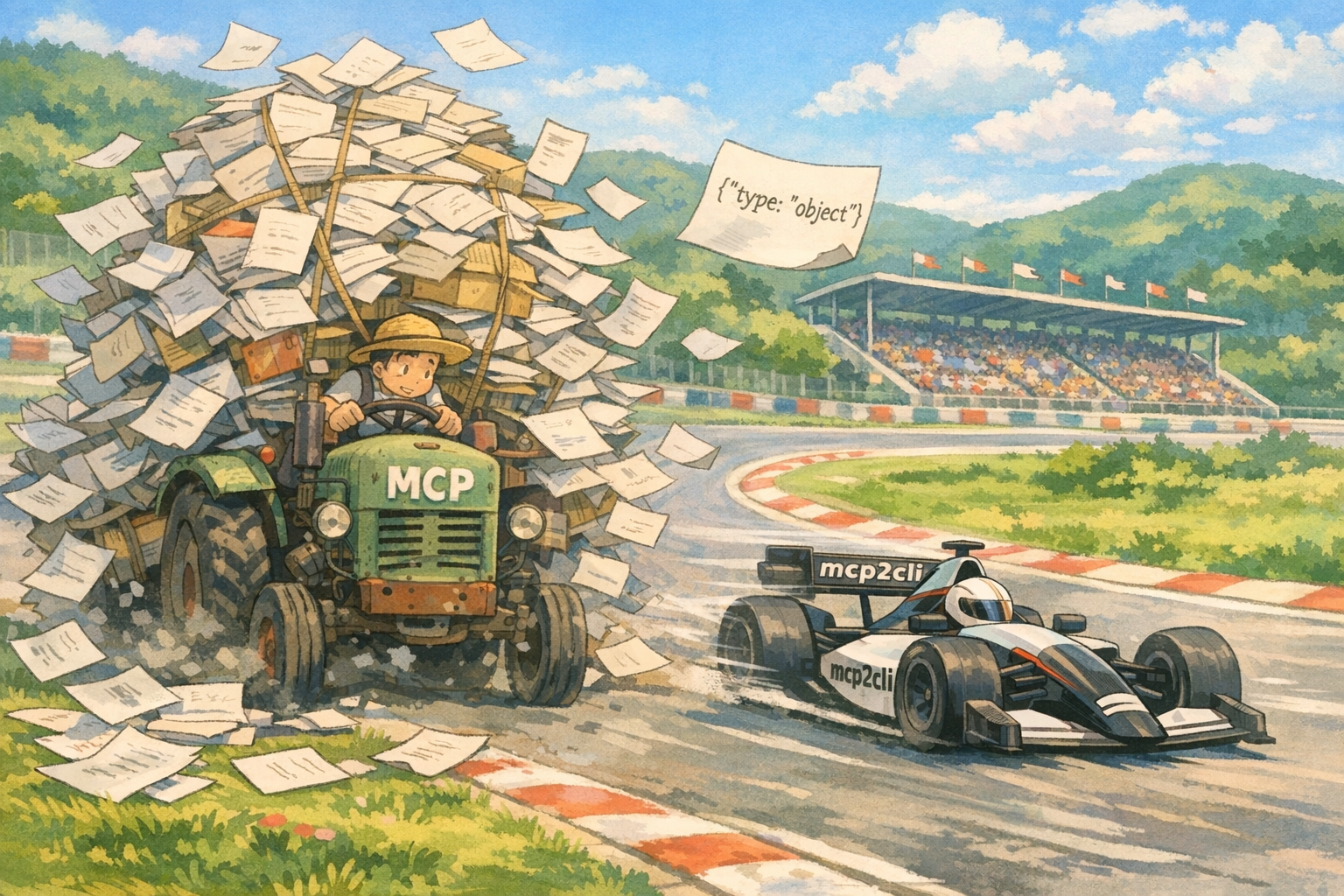
Turn any MCP, OpenAPI, or GraphQL server into a CLI — at runtime, with zero codegen
2.3k
Stars
164
Forks
2
Open issues
12
Contributors


AI Analysis
mcp2cli converts MCP servers, OpenAPI specs, and GraphQL endpoints into CLIs at runtime without code generation, designed specifically for AI agents and developers who need to expose APIs as command-line tools. It's particularly useful for AI coding agents (Claude Code, Cursor) that need to discover and interact with remote APIs, and for teams automating API access patterns. This tool is specialized for the AI tooling and API integration niche, not a general-purpose CLI framework.
Inferred from signals mentioned in the README (tests, CI, type safety) — not a review of the actual code.
AI's overall editorial judgment — not an average of the bars above, can weigh other factors too.
Python tool converting MCP/OpenAPI/GraphQL APIs to CLI at runtime, targeting token efficiency in AI agent interactions
mcp2cli is a Python utility that dynamically exposes MCP servers, OpenAPI specs, and GraphQL endpoints as command-line interfaces without code generation. Positioned primarily for AI agents (Claude Code, Cursor) and developers seeking to reduce token overhead in tool invocations. Repository shows rapid early growth (2,269 stars in ~4 months), active maintenance, and integration with agentic workflows. Adoption appears concentrated in AI coding agent communities rather than traditional DevOps/CLI tooling sectors.
Created March 2026, mcp2cli emerged during rapid MCP ecosystem expansion. Addresses specific pain point: AI agents waste 96-99% of tokens on repeated tool schema specifications. Part of broader trend toward runtime API introspection rather than static code generation in agent frameworks.
Strong trajectory from launch: 2,269 stars in ~4 months suggests product-market fit within AI agent developer segment. Recent activity shows consistent engagement (10 stars last 7 days, last push July 1 2026). Growth appears driven by: (1) direct positioning for Claude Code/Cursor workflows, (2) skills.sh integration enabling agent discoverability, (3) token efficiency value proposition resonating with cost-conscious AI teams. Not viral, but sustaining healthy momentum.
adoption not verified — README demonstrates clear use cases (AI agents, API automation, developer workflows) and advertises 'skill' distribution via skills.sh, but no public case studies, testimonials, or deployment counts provided. Claims about token savings (96-99%) are theoretical rather than documented from production deployments. Assumption: early-stage adoption within AI agent builder communities, but unconfirmed at scale.
Appears to implement runtime introspection across three protocol families (MCP via HTTP/SSE/stdio, OpenAPI via spec parsing, GraphQL via endpoint introspection). Based on README, uses dynamic CLI generation rather than static codegen. Supports auth patterns (basic headers, OAuth 2.0 with PKCE, client credentials, env/file secret injection) and result streaming. Likely employs UV for dependency management. Architecture not directly inspectable from metadata alone.
not documented in README
Active: last push July 1 2026 (within 24 hours of analysis date), consistent recent commit activity, responsive to features (bake mode, OAuth, secret handling). Repository age ~4 months places it in active development phase. No signals of abandonment or stagnation visible.
ADOPT IF: you are building AI coding agents (Claude Code, Cursor), need to reduce token overhead from repeated tool schemas, or want zero-codegen API exposure across MCP/OpenAPI/GraphQL. AVOID IF: you need production-grade stability guarantees (project is 4 months old), require TypeScript/Node.js first-class support, or serve non-agentic CLI audiences. MONITOR IF: you are evaluating MCP ecosystem standardization or considering mcp2cli as foundation for internal agent tooling—strong early signals but adoption verification pending.
Independent dimensions
Mainstream potential
4/10
Technical importance
6/10
Adoption evidence
2/10
- Project age: 4 months old; risk of breaking changes, undocumented limitations, or abandonment if early adopter enthusiasm wanes.
- Adoption unverified: no public case studies or deployment counts; growth metrics (stars) do not confirm actual production usage at scale.
- Dependency on external ecosystem: heavily coupled to MCP protocol stability, OpenAPI 3.x evolution, and GraphQL spec changes; breaking changes upstream could destabilize.
- Token efficiency claims unsubstantiated: README claims 96-99% token savings but provides no benchmarking, reference implementation, or peer-reviewed measurement.
- Narrow user base signal: designed primarily for AI agents rather than general DevOps/platform tooling; may face limited utility outside agentic workflows, restricting long-term growth.
Likely to remain actively maintained through 2026–2027 if MCP adoption accelerates and AI coding agents become standard in enterprise development. Could consolidate into AWS/Anthropic tooling or remain independent niche. Mainstream CLI tooling adoption unlikely unless non-agent use cases emerge.
Explore similar
Newsletter
Get analyses like this every Monday
Free weekly digest of the most interesting open-source discoveries.
Languages
Information
- Language
- Python
- License
- MIT
- Last updated
- 1w ago
- Created
- 4mo ago
- Analyzed with
- anthropic/claude-haiku-4-5
Stars over time
Contributors over time
Top 100 contributors only — repos with more will plateau at 100.
Open issues
Open pull requests
No open pull requests.
Top contributors
Recent releases
No releases published yet.
Similar repos
| Repository | Stars | Week Δ | Language | Score | Updated |
|---|---|---|---|---|---|
|
knowsuchagency/mcp2cli
this
|
2.3k | +16 | Python | 8/10 | 1w ago |
 awslabs/mcp awslabs/mcp
|
9.4k | — | Python | 7/10 | 12h ago |
 mcp-use/mcp-use mcp-use/mcp-use
|
10.3k | — | TypeScript | 8/10 | 14h ago |
 IBM/mcp-cli IBM/mcp-cli
|
2k | — | Python | 7/10 | 3w ago |
 lastmile-ai/mcp-agent lastmile-ai/mcp-agent
|
8.4k | — | Python | 8/10 | 6mo ago |
MCP reference implementation; mcp2cli builds on top of MCP as one input type. AWS's version establishes the protocol; mcp2cli adds runtime CLI wrapping across multiple API types.
Similar runtime MCP integration, larger TypeScript adoption. mcp2cli differentiator: unified OpenAPI/GraphQL/MCP interface; mcp-use appears protocol-specific. Both solve related but distinct positioning.
Predecessor in MCP CLI space with smaller footprint. mcp2cli differentiates via multi-protocol support (not MCP-only), OAuth, and agent skill integration. Direct competitor in MCP CLI niche.
Agent framework integrating MCP; mcp2cli is narrower (CLI tool, not full agent orchestration). Complementary rather than directly competitive.
Traditional API CLI tools lack runtime protocol negotiation and agent skill integration. mcp2cli targets modern agentic use case, not human API exploration (different workflow).