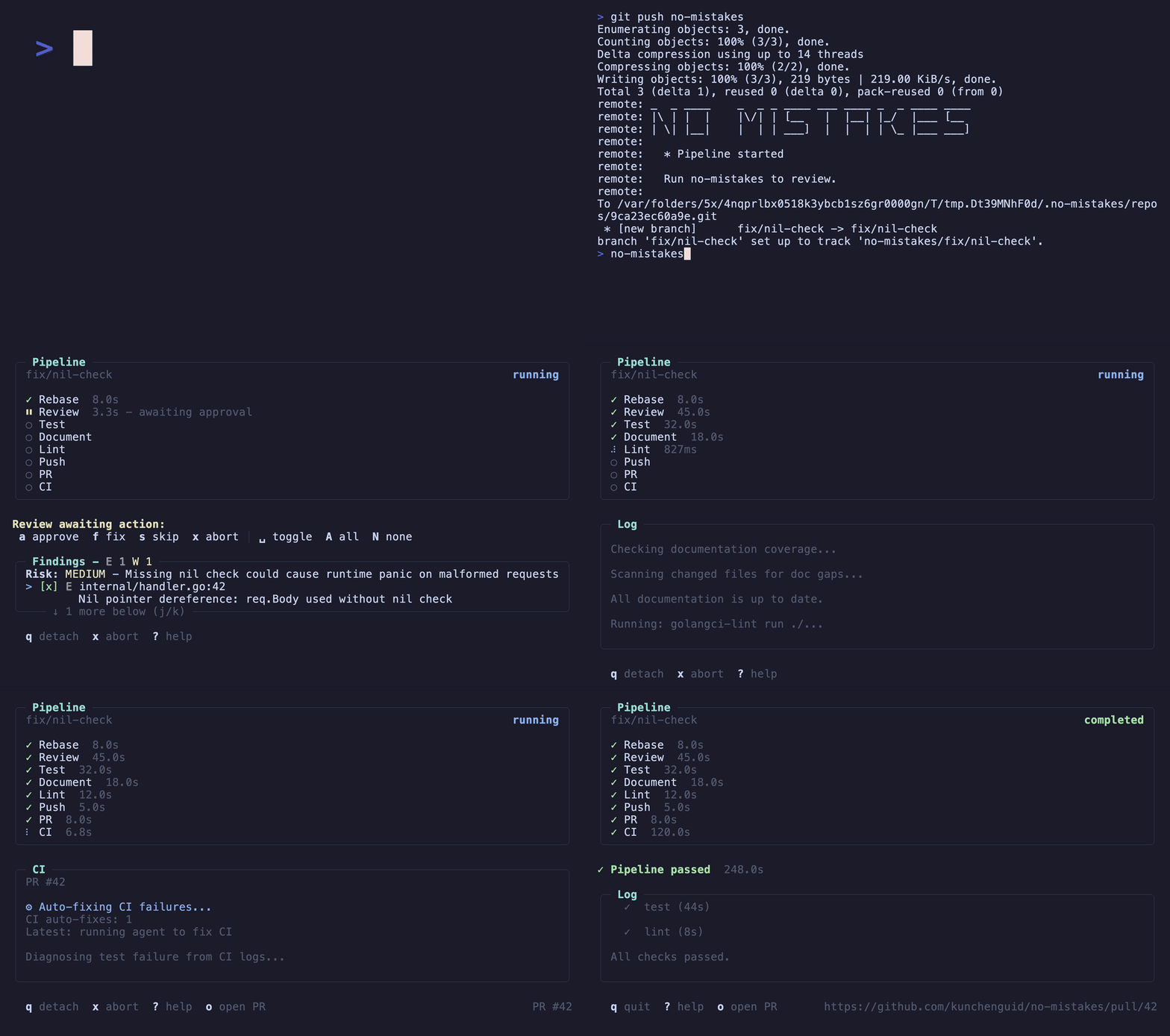
git push no-mistakes
5.7k
Stars
395
Forks
76
Open issues
16
Contributors


AI Analysis
no-mistakes is a local Git proxy that intercepts pushes to run an AI-driven validation pipeline (linting, testing, documentation checks, code review) in an isolated worktree before forwarding to the real remote and auto-opening PRs. It's purpose-built for development teams wanting to enforce quality gates and catch issues before they reach CI, with support for multiple AI agents (Claude, Copilot, etc.) and designed to keep humans in control of the final decision.
Inferred from signals mentioned in the README (tests, CI, type safety) — not a review of the actual code.
AI's overall editorial judgment — not an average of the bars above, can weigh other factors too.
AI-gated Git workflow that validates commits locally before pushing, catching issues early without blocking work
no-mistakes is a local Git proxy that intercepts pushes, spins up an isolated worktree, runs an AI-driven validation pipeline (linting, testing, code review, docs checks), applies safe fixes automatically, escalates judgment calls to the user, and opens PRs only when all checks pass. Built for developers and AI coding agents to reduce low-quality code reaching the main branch. Gained 2,267 stars in 7 days as of June 2026, suggesting rapid traction in a newly-emerging category.
Created April 2026. Positions itself as a git-native gateway that leverages LLM agents (Claude, Copilot, etc.) for pre-push validation. Part of a broader wave of agent-integrated developer tooling; similar projects (git-ai, gnhf) exist but this project emphasizes the gate-and-escalate model rather than pure code review.
Explosive 7-day growth (+2,267 stars) suggests viral adoption among early adopters and AI-enthusiast developer communities. Timing (April 2026) coincides with wider adoption of coding agents; likely driven by positioning as a bridge between agent-generated code and human review. Gained ~3,669 stars total in ~2.5 months — indicates strong product-market fit signal in the niche of AI-assisted workflows, though absolute numbers are modest compared to category leaders like git or pre-commit.
Adoption not verified in README. No case studies, company names, or deployment counts provided. Discord community exists but size unknown. GitHub forks (214) and stars (3,699) indicate interest, but real production usage at organizations is not documented. Rapid star growth may reflect hype/early-adopter interest rather than proven production adoption.
Likely implements a local Git remote that acts as a proxy: intercepts pushes to a `no-mistakes` remote, spawns a disposable worktree (Git feature), runs a pluggable validation pipeline (agent-driven, with steps for review/test/lint/docs), applies safe fixes in the worktree, and forwards only to the real remote on success. README indicates non-blocking design (isolated worktree) and agent-agnostic architecture (Claude, Codex, Copilot, custom via acpx). Appears to integrate with GitHub for PR creation. Exact implementation details not verifiable from README alone.
Makefile references `make test` (Go test suite) and `make e2e` (end-to-end agent journey suite) with fixture recording. Suggests test coverage includes unit and agent integration tests, but specific coverage percentage not documented in README.
Last push 2026-06-27 (current date), so actively maintained. Continuous integration workflow (release.yml badge present) suggests automated releases. README is thorough and well-structured with installation guides, quick start, and development instructions. Multi-language support (English + Chinese README). Active Discord community linked. Maintenance posture appears strong for a project this young.
ADOPT IF: you work frequently with AI coding agents (Claude Code, Copilot, etc.), want to reduce low-quality code reaching main, and value early automated feedback without blocking local work. AVOID IF: you need proven production adoption at scale, require deep vendor support, or your team already has mature pre-push validation (pre-commit, Husky). MONITOR IF: you are evaluating AI-integrated dev tools; the rapid growth and strong README suggest capability, but real-world adoption and long-term maintenance are not yet proven.
Independent dimensions
Mainstream potential
4/10
Technical importance
6/10
Adoption evidence
2/10
- Adoption not verified: rapid star growth may reflect hype rather than sustained production use; long-term viability unclear.
- Young project (2 months old): limited track record; API, config format, or behavior may change significantly.
- Agent dependency: requires access to external LLM APIs (Claude, Copilot, etc.); cost, rate limits, and API changes pose operational risk.
- Worktree overhead: isolated worktrees add latency and disk I/O; may not scale well on large codebases or slow machines.
- Escalation fatigue: if the pipeline surfaces too many manual approval decisions, may become a friction point rather than a relief valve.
Likely to remain a specialized tool for AI-assisted workflows. If adoption grows, will become most valuable in teams already committed to LLM-based coding (e.g., startups, research, rapid-prototyping shops). May face consolidation or absorption into larger agent frameworks (GitHub Copilot, JetBrains IDEs, etc.). Slow growth is also plausible if adoption plateaus outside AI-heavy niches.
Newsletter
Get analyses like this every Monday
Free weekly digest of the most interesting open-source discoveries.
Languages
Information
- Language
- Go
- License
- MIT
- Last updated
- 8h ago
- Created
- 3mo ago
- Analyzed with
- anthropic/claude-haiku-4-5
Stars over time
Contributors over time
Top 100 contributors only — repos with more will plateau at 100.
Open issues
axi run --intent routes to rerun IPC, fails "no previous run for branch" instead of starting a new run
Windows: intent extraction failed: intent: summarize: The filename or extension is too long.
Interrupted validation can leave live processes rooted under .no-mistakes/worktrees
Cygwin: gate is unusable end-to-end
review auto-fix agent fails with 'argument list too long'; axi status masks it as 'daemon crashed during execution'
Open pull requests
Top contributors
Similar repos

sunmh207/AI-Codereview-Gitlab
An automated code review tool for GitLab that leverages large language models...

git-ai-project/git-ai
Git AI is a Rust-based Git extension that automatically tracks and attributes...
| Repository | Stars | Week Δ | Language | Score | Updated |
|---|---|---|---|---|---|
|
kunchenguid/no-mistakes
this
|
5.7k | +757 | Go | 7/10 | 8h ago |
|
sunmh207/AI-Codereview-Gitlab
|
1.7k | — | Python | 7/10 | 2w ago |
|
kunchenguid/gnhf
|
3.1k | — | TypeScript | 7/10 | 1mo ago |
|
git-ai-project/git-ai
|
2.3k | — | Rust | 7/10 | 7h ago |
 kenn-io/roborev kenn-io/roborev
|
1.5k | — | Go | 7/10 | 1d ago |
 HexmosTech/git-lrc HexmosTech/git-lrc
|
1.4k | — | Go | 7/10 | 2d ago |
Similar goal (AI-driven Git workflows) but appears to focus on pure code review rather than a gating model. no-mistakes emphasizes the gate-and-escalate pattern with human approval loops.
Comparable star count and similar timeframe. Exact differentiation unclear from metadata; both are recent AI+Git hybrids. no-mistakes may focus on pre-push validation vs. post-commit review.
Established local hook framework. no-mistakes differs by integrating AI agents and a gate remote model rather than pure hook composition. Targets a different workflow (gate before push vs. hook before commit).
Runs validation after push. no-mistakes runs validation before push in an isolated worktree, reducing wasted CI runs and speeding feedback. Complementary, not replacement.
Runs checks before commit. no-mistakes runs after commit but before push, in an isolated worktree with agent-driven fixes and PR automation. Different hook point and integration model.