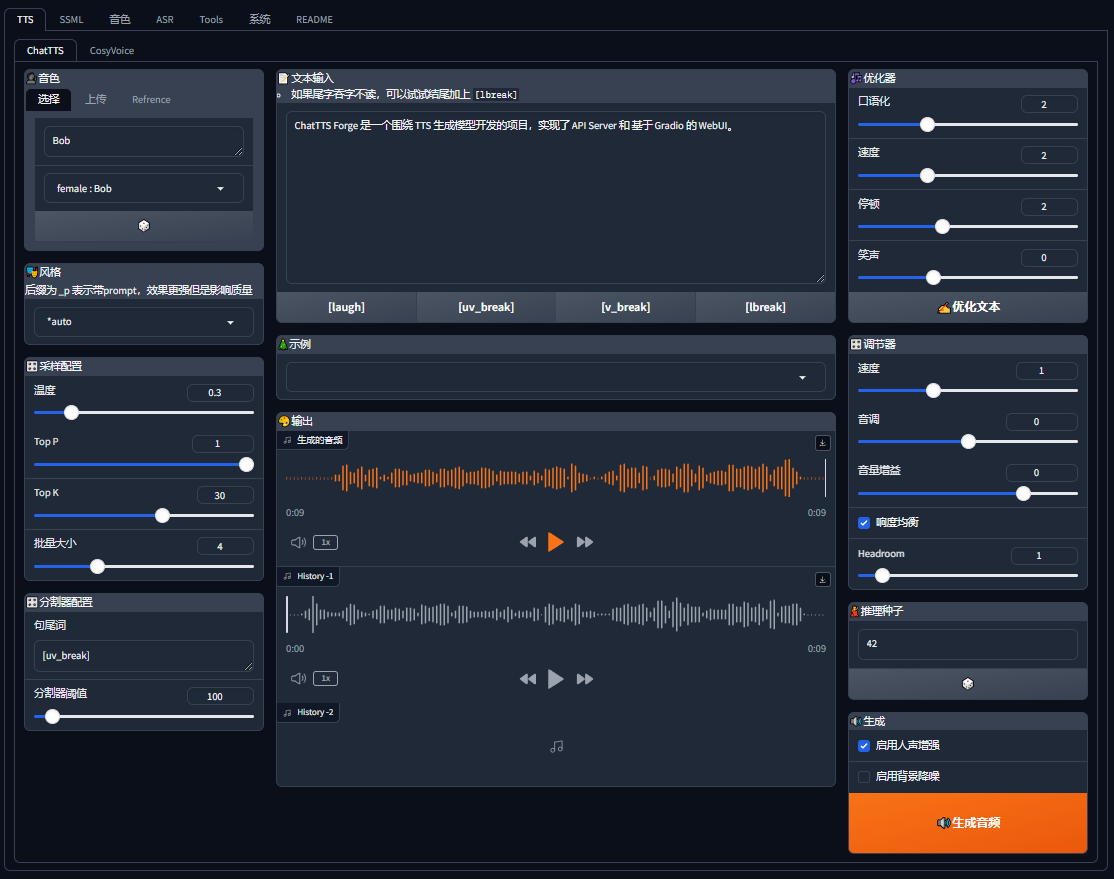
🍦 Speech-AI-Forge is a project developed around TTS generation model, implementing an API Server and a Gradio-based WebUI.
1.4k
Stars
186
Forks
77
Open issues
11
Contributors


AI Analysis
Speech-AI-Forge is a specialized text-to-speech (TTS) platform that integrates multiple AI voice generation models (ChatTTS, CosyVoice, F5TTS, FireRedTTS, and others) through both API server and Gradio WebUI. It serves developers and end users who need multi-model TTS capabilities with speaker customization and ASR integration, particularly for Chinese and English synthesis; it is not a general-purpose voice tool but rather a technical integration platform for TTS research and deployment.
Inferred from signals mentioned in the README (tests, CI, type safety) — not a review of the actual code.
AI's overall editorial judgment — not an average of the bars above, can weigh other factors too.
Python TTS aggregator with multi-model support and WebUI; modest adoption in specialized deployment scenarios
Speech-AI-Forge is a Python-based wrapper and API server around multiple text-to-speech models (ChatTTS, CosyVoice, F5-TTS, FishSpeech, Index-TTS, and others). It provides a unified Gradio WebUI and FastAPI server, targeting developers and end-users who want to experiment with or deploy multiple TTS engines without managing separate integrations. Adoption appears concentrated among hobbyists and small-scale Chinese-language projects rather than enterprise production workloads.
Created June 2024, Speech-AI-Forge emerged in the wave of open-source TTS model proliferation (following ChatTTS and CosyVoice releases). The project pivoted rapidly from single-model wrapper to multi-model aggregator, adding new model support approximately every 2–3 weeks based on the changelog.
The project gained approximately 1,412 stars over roughly 24 months. Star growth appears to have plateaued (only 2 stars in the last 7 days as of 2026-07-02), despite consistent maintenance. Rapid feature additions (new TTS models, SSML support, voice builder) suggest active development responding to user requests, but velocity has likely slowed relative to mid-2025. The presence of community communication channels (Telegram, Discord) indicates user engagement, but no scale metrics are documented.
Adoption not verified. Evidence suggests hobbyist and experimental use: Colab notebook provided for low-friction trial, Windows portable package offered, Docker support for simple deployment. No case studies, production user testimonials, commercial deployments, or performance benchmarks documented. Community channels suggest active user base, but scale and composition unknown. Integration with cloud TTS providers (MiniMax, Qwen3) added in 2026 may indicate expanding use beyond local-only inference.
Based on README, the project appears to be a FastAPI/Gradio wrapper layer orchestrating multiple external TTS model implementations. Likely architecture: (1) unified API interface abstracting different model SDK/APIs, (2) Gradio frontend for experimentation, (3) plugin-style model support (new models added via conditional imports and registration). Implementation details and internal consistency cannot be verified without source inspection.
Not documented in README. No mention of unit tests, integration tests, or CI/CD validation pipelines.
Last push was 2026-05-21 (11 days ago relative to evaluation date 2026-07-02), indicating active maintenance. However, changelog shows a spike in model additions in early 2025 (Jan–May) followed by slower cadence in Q2 2026. No metrics on issue resolution time, PR review speed, or test coverage are available. Slow star growth and absence of recent major feature announcements suggest maintenance is reactive (responding to user issues) rather than exploratory.
ADOPT IF: you are prototyping or experimenting with multiple TTS models locally, need unified API + WebUI for quick iteration, operate in Chinese-language contexts where model support is mature, and tolerate dependency on actively maintained open-source software with no SLA. AVOID IF: you require production stability guarantees, need long-term backward compatibility, operate in enterprise environments requiring security audits and vendor support, or depend on stability of multiple upstream TTS model APIs that may pivot or change. MONITOR IF: you are building a TTS product and considering Speech-AI-Forge as your aggregation layer—track whether the multi-model abstraction becomes a burden (dependency fragility, API churn, version conflicts) vs. an asset as new models are released.
Independent dimensions
Mainstream potential
3/10
Technical importance
5/10
Adoption evidence
3/10
- Dependency fragility: wraps multiple external TTS models and cloud APIs; breakage in any upstream model's API or discontinuation requires active patch maintenance. No documented mechanism for deprecating unsupported models.
- API stability: rapid model additions (changelog shows ~15 new models in 18 months) suggest limited API versioning discipline; applications built on top may face breaking changes when models are added or removed.
- Test coverage and quality assurance not documented; no evidence of automated testing, which raises risk of regressions when new models are integrated.
- Adoption scale unknown: single-author or small-team project (inferred from repo structure); scalability of maintenance and support unclear if user base grows significantly.
- License (AGPL-3.0): strong copyleft terms may limit commercial deployment or integration into proprietary systems; users must contribute modifications back.
Likely to remain a niche-specialist tool for TTS experimentation and hobbyist deployment. Growth will stabilize in the 1.5K–3K star range. Probability of mainstream adoption in enterprise is low unless (a) upstream TTS models stabilize their APIs, reducing maintenance burden, or (b) the project finds a corporate sponsor. Useful continuation as a community-maintained playground, but not a strategic infrastructure choice for production TTS infrastructure.
Newsletter
Get analyses like this every Monday
Free weekly digest of the most interesting open-source discoveries.
Languages
Information
- Language
- Python
- License
- AGPL-3.0
- Last updated
- 2mo ago
- Created
- 26mo ago
- Analyzed with
- anthropic/claude-haiku-4-5
Stars over time
Contributors over time
Top 100 contributors only — repos with more will plateau at 100.
Open issues
Top contributors
Recent releases
Similar repos

huggingface/speech-to-speech
Speech-to-Speech is a modular, low-latency voice-agent pipeline that chains VAD...

devnen/Chatterbox-TTS-Server
Chatterbox TTS Server is a self-hosted text-to-speech API server that wraps...
| Repository | Stars | Week Δ | Language | Score | Updated |
|---|---|---|---|---|---|
|
lenML/Speech-AI-Forge
this
|
1.4k | — | Python | 7/10 | 2mo ago |
 FunAudioLLM/CosyVoice FunAudioLLM/CosyVoice
|
22.1k | — | Python | 8/10 | 2mo ago |
|
huggingface/speech-to-speech
|
5.8k | — | Python | 8/10 | 22h ago |
 2noise/ChatTTS 2noise/ChatTTS
|
39.6k | — | Python | 7/10 | 3mo ago |
|
devnen/Chatterbox-TTS-Server
|
1.3k | — | Python | 7/10 | 1mo ago |
 rsxdalv/TTS-WebUI rsxdalv/TTS-WebUI
|
3.2k | — | TypeScript | 7/10 | 4d ago |
ChatTTS is the underlying TTS model; Speech-AI-Forge is a wrapper around it and others. ChatTTS repository focuses on model training/improvement; Speech-AI-Forge adds infrastructure (API, WebUI, voice management). ChatTTS dominates in raw attention; Speech-AI-Forge serves users wanting unified multi-model deployment.
CosyVoice is another core model wrapped by Speech-AI-Forge. Similar distinction: CosyVoice is the model repo, Speech-AI-Forge is deployment infrastructure. Speech-AI-Forge enables side-by-side comparison and orchestration of both models.
Functionally similar (WebUI wrapper for TTS models), but TTS-WebUI is TypeScript-based with different model focus. Speech-AI-Forge appears more frequently updated and supports more recent models; TTS-WebUI may target different ecosystem expectations (frontend dev vs. Python-native).
Comparable scope (TTS API server with WebUI), similar star count, Python-based. Differentiation not evident from README; likely both serve the same user segment with similar feature completeness.
Official CosyVoice repository; Speech-AI-Forge is third-party wrapper that *includes* CosyVoice alongside others. Upstream model repo vs. aggregator pattern.