OpenClaw: Use All Major AI Models NO API Token! Claude/ChatGPT/Gemini/DeepSeek/Doubao/Grok/Qwen/Manus/Kimi
5k
Stars
1.2k
Forks
12
Open issues
30
Contributors


AI Analysis
OpenClaw Zero Token enables free access to major LLMs (Claude, ChatGPT, Gemini, DeepSeek, Qwen, etc.) by automating browser-based login rather than requiring paid API tokens. It serves developers and power users who want unified access to multiple AI models without API costs, and is not suitable for applications requiring guaranteed uptime, rate limits, or commercial API guarantees.
Inferred from signals mentioned in the README (tests, CI, type safety) — not a review of the actual code.
AI's overall editorial judgment — not an average of the bars above, can weigh other factors too.
OpenClaw Zero Token: A browser-session bridge letting users access 13+ LLMs without API keys
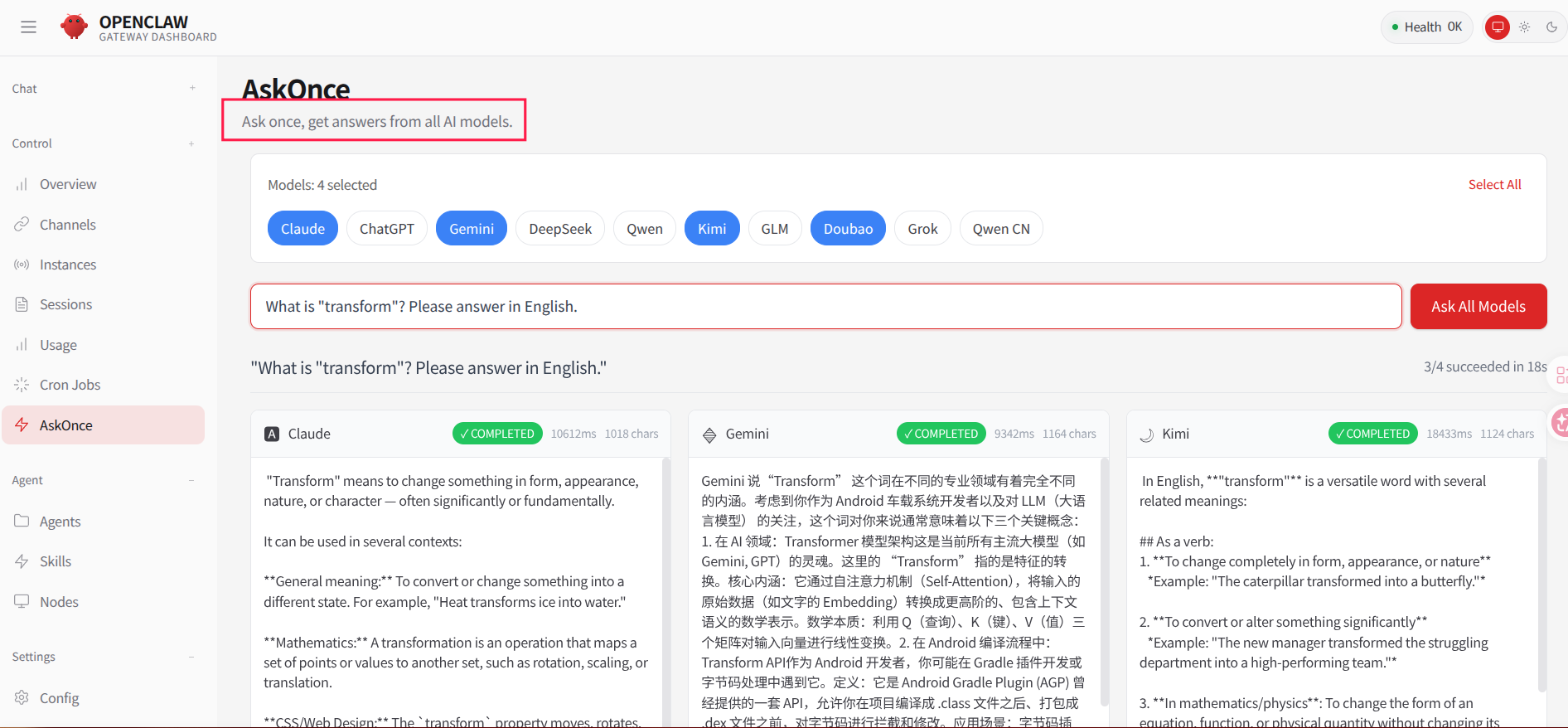
OpenClaw Zero Token is a TypeScript fork of the OpenClaw project that proxies requests to major LLM providers (ChatGPT, Claude, Gemini, DeepSeek, Qwen, Kimi, etc.) by driving their official web UIs through browser sessions rather than paid API keys. It targets developers and power users who want to experiment with or use frontier models without incurring per-token API costs. The project exposes a unified gateway API with tool-calling support injected via prompt engineering, and includes an 'AskOnce' feature for broadcasting a single query to multiple providers simultaneously.
Created in February 2026 as a fork of the openclaw/openclaw project (380k+ stars), this variant specializes in eliminating API token costs by automating browser-based logins. It reflects a growing niche of 'unofficial API' tools that emerged as commercial LLM API pricing became a barrier for casual and hobbyist use.
With 5,025 stars since February 2026, growth appears to have been driven largely by the parent openclaw project's massive visibility and the broad appeal of 'free LLM access.' Recent 7-day star velocity of 23 stars suggests the initial spike has subsided into a slow but steady long-tail audience. The 1,197 forks indicate active downstream experimentation, likely among developers exploring unofficial API automation patterns.
Adoption not verified in any documented production deployment. The 1,197 forks suggest experimentation is widespread, but there is no mention of enterprise use, integration case studies, or third-party testimonials. Usage appears concentrated among individual developers and cost-conscious hobbyists based on README framing.
Appears to be a middleware gateway (TypeScript/Node.js) that intercepts requests on a local port and routes them to provider-specific browser automation drivers. Tool-calling support is implemented via prompt injection middleware located in src/zero-token/tool-calling/, suggesting a modular, plugin-style design. A Web UI built with Lit 3.x, a CLI/TUI interface, and Telegram channel support are mentioned, indicating a layered client architecture. The upstream sync mechanism implies a branching strategy to absorb improvements from the parent openclaw repo.
not documented in README
Last push was 2026-06-26, approximately 2 days before the evaluation date, indicating active maintenance. The README includes a roadmap, product requirements doc, and upstream-sync tracking — all signs of structured, ongoing development rather than a one-off release.
ADOPT IF: you are an individual developer or researcher who wants to experiment with multiple frontier LLMs without API billing, accept the inherent fragility of browser automation, and are comfortable with the legal and ToS ambiguity of unofficial web UI scraping. AVOID IF: you need production reliability, SLA guarantees, rate-limit predictability, or enterprise compliance — browser-session scraping is inherently brittle and may break with any provider UI update or session policy change. MONITOR IF: you are building tooling around multi-model orchestration and are waiting to see whether this approach stabilizes enough to be a dependable development utility.
Independent dimensions
Mainstream potential
3/10
Technical importance
5/10
Adoption evidence
3/10
- Browser UI changes or anti-bot measures from any provider can silently break integration with no upstream fix timeline guarantee.
- Using unofficial web scraping to bypass API billing likely violates the Terms of Service of most covered providers, creating potential account ban or legal risk for users.
- Tool-calling is implemented via prompt injection rather than native API support, making it unreliable and model-version-sensitive — the README already flags Gemini chat as 'unstable' and Doubao as excluded.
- Dependency on the upstream openclaw project for core functionality means breaking changes there propagate here; the upstream-sync burden may become a maintenance liability as both projects evolve.
- Security posture is ambiguous: browser session credentials stored locally reduces API key exposure but introduces risks around session token storage and potential local filesystem access via the 'exec', 'read', 'write' tool primitives exposed to LLM agents.
Likely to maintain a steady niche audience of cost-sensitive experimenters and Chinese-market developers, but may struggle to grow beyond hobbyist use as providers increasingly harden their web UIs against automation. Project sustainability depends heavily on the upstream openclaw trajectory.
Newsletter
Get analyses like this every Monday
Free weekly digest of the most interesting open-source discoveries.
Languages
Information
- Language
- TypeScript
- License
- MIT
- Last updated
- 8h ago
- Created
- 5mo ago
- Analyzed with
- anthropic/claude-haiku-4-5
Stars over time
Contributors over time
Top 100 contributors only — repos with more will plateau at 100.
Open issues
No open issues — clean slate.
Open pull requests
build(deps): bump debian from `f065376` to `60eac75` in the docker-images group
build(deps): bump github.com/steipete/commander from 0.2.1 to 0.2.2 in /Swabble in the swift-deps group
build(deps): bump github.com/apple/swift-testing from 0.99.0 to 6.3.2 in /Swabble
Top contributors
Similar repos

Gitlawb/openclaude
OpenClaude is a terminal-first coding agent CLI that unifies access to multiple...

1186258278/OpenClawChineseTranslation
OpenClaw is a Chinese localization of the open-source AI assistant platform...
| Repository | Stars | Week Δ | Language | Score | Updated |
|---|---|---|---|---|---|
|
linuxhsj/openclaw-zero-token
this
|
5k | +11 | TypeScript | 7/10 | 8h ago |
|
Gitlawb/openclaude
|
29.9k | — | TypeScript | 7/10 | 11h ago |
 openclaw/openclaw openclaw/openclaw
|
382.4k | — | TypeScript | 8/10 | 3h ago |
|
1186258278/OpenClawChineseTranslation
|
3.8k | — | JavaScript | 7/10 | 7h ago |
 clacky-ai/openclacky clacky-ai/openclacky
|
1.1k | — | Ruby | 7/10 | 8h ago |
 miaoxworld/openclaw-manager miaoxworld/openclaw-manager
|
1.7k | — | TypeScript | 7/10 | 4mo ago |
The direct upstream parent. This fork differentiates solely on the zero-token/browser-session approach; everything else is derived from openclaw. Users choosing this fork accept reduced reliability for zero cost.
A similar TypeScript project in the same ecosystem. Likely targets API-key-based usage given the naming, making zero-token the key differentiator here. Relative adoption still strongly favors openclaude.
A TypeScript router in the same family, probably handling model routing/load balancing. Does not appear to offer the browser-session zero-cost angle, making these complementary rather than direct substitutes.
A localization fork rather than a functional alternative. Its popularity signals strong Chinese-market interest, which overlaps with openclaw-zero-token's explicit support for Chinese providers (Doubao, Kimi, Qwen CN, GLM, MiMo).
A Ruby implementation in the broader space, suggesting polyglot demand for similar functionality. Less relevant as a direct competitor given the language difference, but evidence that the niche has multiple active participants.