Laminar - open-source observability platform purpose-built for AI agents. YC S24.
3.1k
Stars
216
Forks
93
Open issues
25
Contributors


AI Analysis
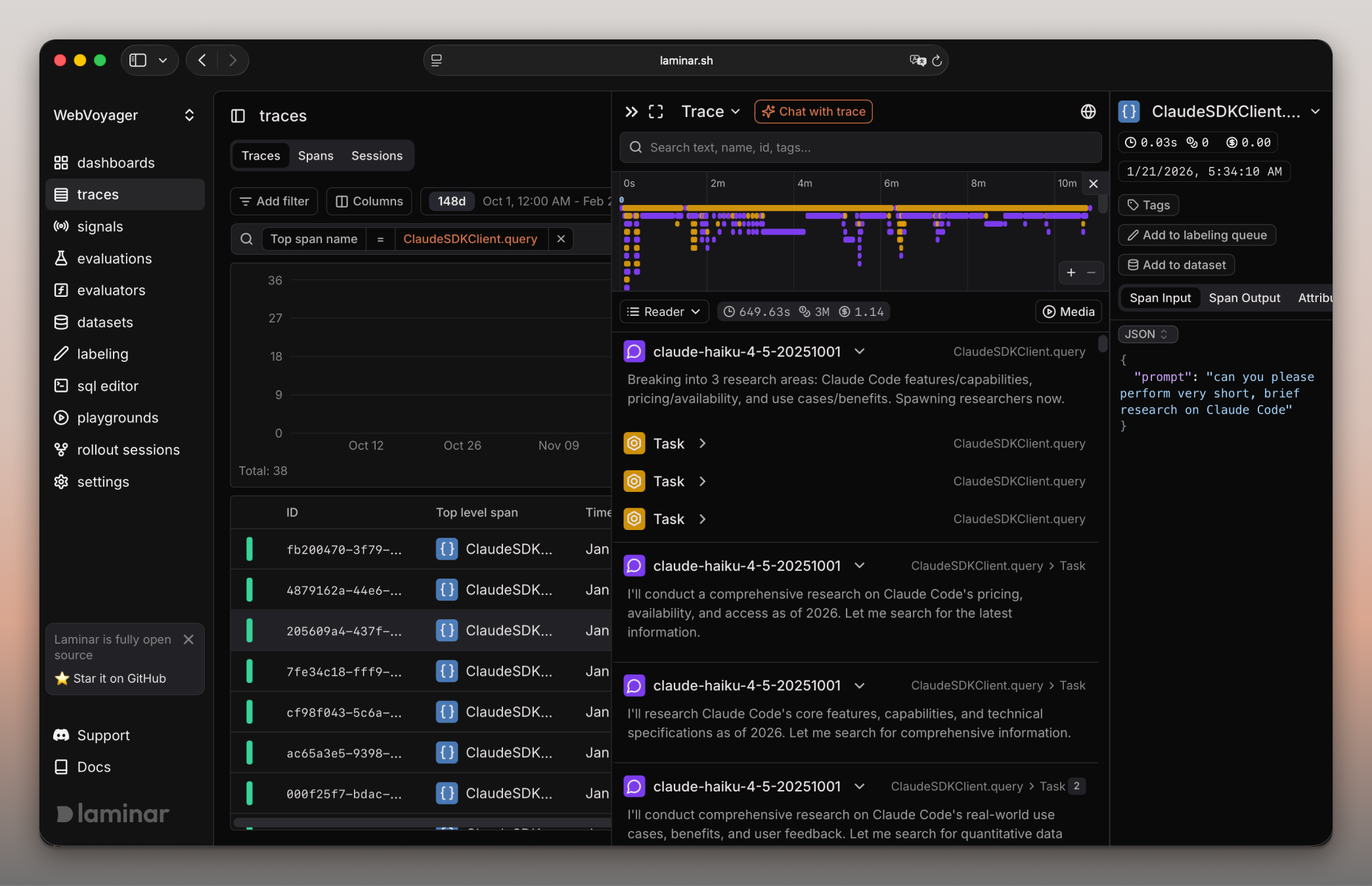
Laminar is an open-source observability platform purpose-built for AI agents, offering tracing, signals, evaluations, dashboards, and data annotation capabilities. It serves teams building and monitoring AI agent systems who need specialized observability rather than generic application monitoring. Best suited for AI/LLM practitioners and DevOps teams managing agent deployments; not a general-purpose APM tool.
Inferred from signals mentioned in the README (tests, CI, type safety) — not a review of the actual code.
AI's overall editorial judgment — not an average of the bars above, can weigh other factors too.
Open-source AI observability platform with agent-first tracing, evals, and SQL access—YC S24 startup with modest but growing adoption
Laminar is a self-hostable observability platform designed specifically for AI agents, offering tracing (with automatic instrumentation for LangChain, OpenAI, Anthropic, etc.), evaluation frameworks, custom monitoring via natural language, SQL query access to traces, and dashboards. Built by a YC S24 company, it competes in the crowded LLM observability space alongside LangWatch and similar tools. Adoption appears concentrated among teams actively building and debugging AI agents; real-world usage beyond early adopters remains unverified.
Laminar was founded in 2024 and accepted into Y Combinator S24 (summer 2024). Repository created 2024-08-29, suggesting public launch around that timeframe. The project targets the emerging category of AI agent-specific observability, which has seen multiple entrants since 2023–2024.
The project gained ~3,048 stars over approximately 22 months (Aug 2024–Jun 2026), averaging ~138 stars/month. Recent activity shows 21 stars in the last 7 days and a push on 2026-06-29, indicating active maintenance. Growth trajectory is modest but steady; no evidence of viral adoption, but aligned with a mature, young startup in active development. YC backing likely provided initial visibility and user acquisition.
Adoption not verified via public case studies, customer testimonials, or deployment announcements in README. YC S24 status indicates VC backing and internal traction sufficiently promising for admission, but this is not the same as documented production usage at scale. README describes managed platform (laminar.sh) and self-hosting options, suggesting commercial positioning, but no user counts or deployment scale metrics are provided. Repository forks (212) and star velocity are modest relative to category leaders (LangWatch has 3,315 stars), suggesting adoption is either early-stage or concentrated in a narrower niche than broader LLM observability platforms.
Based on README: backend appears to be Rust (mentioned for 'extremely high performance', gRPC exporter, realtime tracing engine). Frontend/SDK stack is TypeScript (Node.js SDK with auto-instrumentation packages). Supports PostgreSQL for data storage with configurable schema support. Exposes SQL editor for direct trace/metric querying. Likely uses OpenTelemetry as standard for trace collection. Self-hosting available via Docker Compose (lightweight and full production variants). Architecture is modular (separate concerns: tracing, evals, monitoring, dashboards, datasets).
Not documented in README. No mention of testing strategy, CI/CD practices, or code coverage metrics.
Very recent activity (last push 2026-06-29, one day before evaluation date). Repository is 22 months old; this is a young, actively developed project. TypeScript/Rust stack suggests professional development practices, though maturity is still establishing. Documentation site exists (laminar.sh/docs) and appears comprehensive. Discord and Twitter presence indicate community engagement. No evidence of abandonment or long gaps between releases.
ADOPT IF: you are building AI agent applications, require on-premises observability, want SQL-based trace querying, and are comfortable with a young (22-month-old) platform in active development. AVOID IF: you need proven, battle-tested stability at scale, require extensive production case studies, or prefer a category leader with large existing customer base and established vendor support. MONITOR IF: you are evaluating LLM observability tools now; Laminar's agent-first design and SQL access are compelling, but adoption breadth is still unverified and the vendor is pre-Series A. Technical quality appears solid (Rust backend, OpenTelemetry native, YC-backed team), but real-world production deployment data is not public.
Independent dimensions
Mainstream potential
4/10
Technical importance
6/10
Adoption evidence
3/10
- Vendor lock-in risk if deployed on managed platform (laminar.sh) without clear data export and portability guarantees; self-hosting mitigates this but adds operational overhead.
- Adoption concentration: if user base is primarily early YC-aligned teams, sustainability may depend on securing Series A funding and expanding beyond the AI agent hype cycle.
- Competitive pressure from well-funded observability incumbents (Datadog, New Relic, Honeycomb) adding LLM features and from other agent-specific platforms that may consolidate observability into their core offering.
- Limited production validation: no publicly documented large-scale deployments or long-term stability reports; early adopters may discover performance or reliability issues at their scale.
- Schema management complexity for self-hosted deployments (custom Postgres schema handling) may create friction for teams unfamiliar with database administration.
Laminar is likely to survive and grow modestly if it secures Series A and focuses on the AI agent developer niche. Mainstream adoption across all LLM app observability use cases is unlikely; instead, it may become the preferred choice for agent-specific workloads (long-running, multi-step reasoning, tool-calling scenarios). Consolidation risk: larger platforms may acquire or replicate agent-focused features, or Laminar may be acquired.
Newsletter
Get analyses like this every Monday
Free weekly digest of the most interesting open-source discoveries.
Languages
Information
- Website
- https://laminar.sh
- Language
- TypeScript
- License
- Apache-2.0
- Last updated
- 13h ago
- Created
- 23mo ago
- Analyzed with
- anthropic/claude-haiku-4-5
Stars over time
Contributors over time
Top 100 contributors only — repos with more will plateau at 100.
Open issues
Top contributors
Similar repos

latitude-dev/latitude-llm
Latitude is an open-source monitoring and observability platform designed...

traceloop/openllmetry
OpenLLMetry is an open-source observability framework built on OpenTelemetry...
| Repository | Stars | Week Δ | Language | Score | Updated |
|---|---|---|---|---|---|
|
lmnr-ai/lmnr
this
|
3.1k | +17 | TypeScript | 8/10 | 13h ago |
|
latitude-dev/latitude-llm
|
4.4k | — | TypeScript | 7/10 | 11h ago |
 langwatch/langwatch langwatch/langwatch
|
3.4k | — | TypeScript | 8/10 | 12h ago |
|
traceloop/openllmetry
|
7.3k | — | Python | 8/10 | 2d ago |
 Roy3838/Observer Roy3838/Observer
|
1.4k | — | TypeScript | 7/10 | 2d ago |
 openlit/openlit openlit/openlit
|
2.6k | — | TypeScript | 7/10 | 8h ago |
Functionally similar (tracing, evals, dashboards for LLM apps). LangWatch has ~3,315 stars (larger GitHub presence). Laminar's agent-first positioning and SQL access are differentiators; unclear which has better production adoption without access to company metrics.
Latitude-llm (4,330 stars) focuses on LLM application development platform; broader scope than Laminar's observability focus. Different problem domain, not direct replacement.
2,561 stars, also OpenTelemetry-native observability for LLMs. Appears less agent-specialized; positioning less clear from star count alone.
1,424 stars; appears to be a smaller, niche observability project. Limited README visibility suggests less mature community and documentation.
Laminar's open-source and self-hosting options appeal to teams wanting on-prem or cost-optimized solutions. Commercial tools have broader feature sets and customer bases but higher friction for small teams or privacy-sensitive workloads.