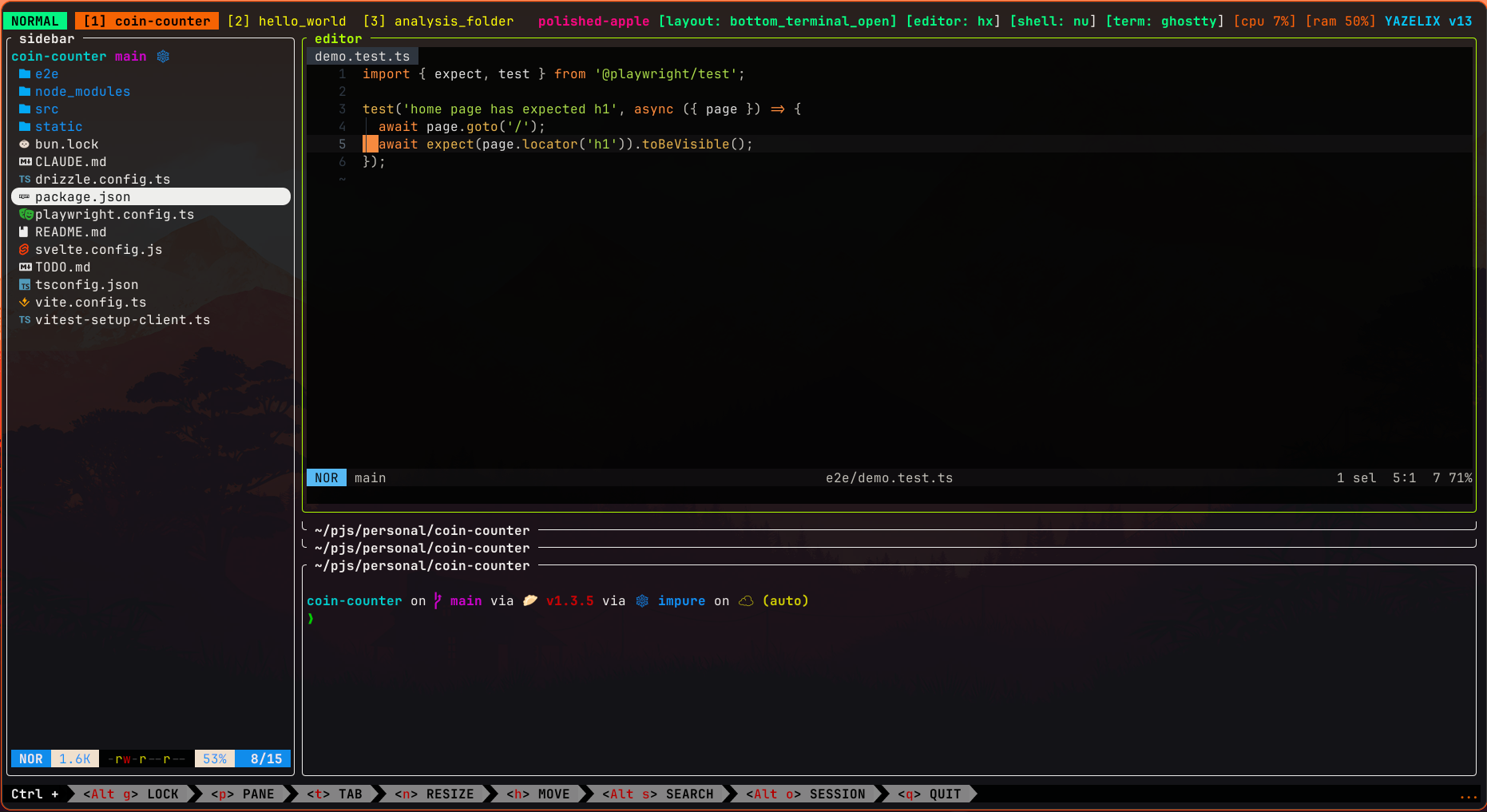
Yazi and Zellij with smart defaults & awesome plugins give helix/nvim a powerful yazi sidebar, git integrations, a configurable popup system (lazygit, a config ui, etc), zoxide integrations, zjstatus widgets, and more. Your terminal IDE. Written in rust and blazingly fast. Available via flake/home-manager. One line install.
1.1k
Stars
49
Forks
40
Open issues
10
Contributors


AI Analysis
Yazelix is a terminal IDE that integrates Yazi (file manager), Zellij (multiplexer), and Helix/Neovim (editors) with smart defaults, git integrations, and plugin support. It is purpose-built for developers who want a cohesive, Nix-based terminal development environment; it is not a general-purpose terminal emulator and requires familiarity with Nix/Flakes for installation.
Inferred from signals mentioned in the README (tests, CI, type safety) — not a review of the actual code.
AI's overall editorial judgment — not an average of the bars above, can weigh other factors too.
Rust terminal IDE integrating Yazi, Zellij, and Helix with preconfigured plugins and workflows
Yazelix is a Nix-distributed terminal workspace orchestrator that combines Yazi (file manager), Zellij (multiplexer), and Helix/Neovim (editors) with preconfigured layouts, keybindings, and integrations (LazyGit, zoxide, process viewer). Built for users seeking a cohesive terminal IDE experience without manual configuration. Adoption appears concentrated in Nix-using communities; mainstream reach remains limited outside that ecosystem.
Created January 2024, Yazelix emerged as a thin integration layer around three mature, independent Rust tools. The project matured rapidly from early concept to versioning (v17.8 as of June 2026), suggesting active development responding to user feedback. No public origin story or design document available in README.
Gained ~1,082 stars over ~2.5 years (approximately 430 stars/year), with recent velocity of 23 stars in 7 days (~3,300 annualized if sustained). This trajectory indicates modest but steady adoption, likely driven by Nix ecosystem visibility and by solving a specific pain point (terminal IDE setup complexity). Growth rate does not suggest viral adoption, but consistent organic interest.
Adoption not verified. No case studies, testimonials, or organization-level usage mentioned in README. The project appears in GitHub with modest stars (1,082), but stars do not confirm production deployment. The Nix ecosystem is relatively small (~5-10% of developer base), further constraining verifiable adoption. Evidence suggests community interest but lacks quantified real-world usage metrics.
Appears to be a Nix flake-based orchestration layer (installation via `nix profile add` and Home Manager support) that packages pre-tuned Yazi, Zellij, and editor configurations. Based on README, the system uses Zellij as the core multiplexer with managed layout templates, a file-tree sidebar (Yazi), editor pane orchestration, and popup surfaces for utilities. Likely written in Rust (noted in description), but README does not detail the orchestration mechanism or API. No architectural documentation linked.
Not documented in README. No mention of test suites, CI/CD verification, or quality gates visible in provided metadata.
Last push 2026-06-23 (current date 2026-06-24) indicates active maintenance within the last 24 hours. Repository shows 47 forks and recent star velocity. README references v17.8 and discusses update mechanisms (`yzx update upstream`, `yzx update home_manager`), suggesting ongoing versioning discipline. However, no public issue tracker, pull request activity, or release cadence visible in provided data. Update instructions are detailed, implying the team treats stability seriously.
ADOPT IF: you use Nix (flake or Home Manager), want a preconfigured terminal IDE without manual configuration, and are comfortable with Helix or Neovim as your editor and Zellij as your multiplexer. AVOID IF: you prefer tmux, have complex existing terminal configurations you want to preserve, use a non-Nix distribution, or need commercial support or a stable API guarantee. MONITOR IF: you are curious about terminal IDE trends in the Nix community but not ready to commit; the project is actively maintained but lacks mainstream adoption signals outside niche ecosystems.
Independent dimensions
Mainstream potential
3/10
Technical importance
5/10
Adoption evidence
2/10
- Dependency lock-in: Heavy reliance on Nix ecosystem and flakes for distribution; difficult to use on non-NixOS systems or for users without Nix expertise.
- Narrow user base: Adoption appears concentrated in Nix community; limited evidence of traction outside that ecosystem.
- Opinionated defaults: Pre-configured keybindings and layouts may conflict with user muscle memory or established workflows, creating friction for migration.
- Upstream breakage: Depends on three external projects (Yazi, Zellij, Helix); upstream incompatibilities or design changes could require reactive maintenance.
- Limited documentation**: README truncated; no linked guides for troubleshooting, contributing, or extending; unfamiliar users may struggle with less common use cases.
Yazelix will likely remain a specialist tool for Nix-fluent terminal users seeking an integrated IDE experience, with slow but steady growth. Mainstream adoption is improbable due to Nix distribution constraints and the existence of simpler alternatives (Zed, monolithic editors). The project may stabilize at 2,000–5,000 stars over the next 2–3 years, serving a well-defined niche rather than achieving broad reach.
Explore similar
Newsletter
Get analyses like this every Monday
Free weekly digest of the most interesting open-source discoveries.
Languages
Information
- Language
- Rust
- License
- Apache-2.0
- Last updated
- 11h ago
- Created
- 30mo ago
- Analyzed with
- anthropic/claude-haiku-4-5
Stars over time
Contributors over time
Top 100 contributors only — repos with more will plateau at 100.
Open issues
Open pull requests
No open pull requests.
Top contributors
Recent releases
Similar repos
| Repository | Stars | Week Δ | Language | Score | Updated |
|---|---|---|---|---|---|
|
luccahuguet/yazelix
this
|
1.1k | +14 | Rust | 7/10 | 11h ago |
 sxyazi/yazi sxyazi/yazi
|
40.2k | — | Rust | 8/10 | 2d ago |
 zellij-org/zellij zellij-org/zellij
|
34.2k | — | Rust | 8/10 | 23h ago |
 helix-editor/helix helix-editor/helix
|
45.3k | — | Rust | 8/10 | 3d ago |
 dj95/zjstatus dj95/zjstatus
|
1k | — | Rust | 7/10 | 2d ago |
 sinelaw/fresh sinelaw/fresh
|
7.8k | — | Rust | 8/10 | 19h ago |
Yazelix pre-integrates these tools with opinionated layouts and keybindings, eliminating manual glue code. Appealing to users who want 'batteries included'; risky for users with bespoke configurations who may find opinionated choices limiting.
Zed is a monolithic editor with built-in terminal/file-tree; Yazelix is a multiplexer-based composition of independent tools. Zed appeals to users seeking simplicity; Yazelix appeals to users comfortable with terminal multiplexing and wanting modularity.
Helix is an editor; Yazelix is an IDE-like environment layering on top of Helix (and Neovim). Yazelix adds workspace orchestration; users wanting just an editor choose Helix directly.
These pre-configure Neovim with plugins; Yazelix pre-configures a full terminal workspace (editor + multiplexer + file manager). Different scope: Yazelix is workspace-level, while Neovim distributions are editor-level.
Yazelix automates what users historically built manually with tmux, Vim, and file managers. Reduces friction for users who want structure; removes flexibility for users with existing muscle memory.