1k
Stars
246
Forks
36
Open issues
9
Contributors


AI Analysis
StackChan is an open-source AI desktop robot built on M5Stack's CoreS3 development kit, combining hardware (servo-driven animated body, touchscreen, camera, sensors) with firmware, mobile apps, and server components. It serves makers, hobbyists, and IoT enthusiasts who want a programmable companion robot with AI capabilities, animation, and extensive M5Stack ecosystem integration—not suitable for those seeking a production-ready consumer appliance or enterprise robotics solution.
Inferred from signals mentioned in the README (tests, CI, type safety) — not a review of the actual code.
AI's overall editorial judgment — not an average of the bars above, can weigh other factors too.
M5Stack StackChan: open-source AI desktop robot firmware and ecosystem built on ESP32-S3 hardware
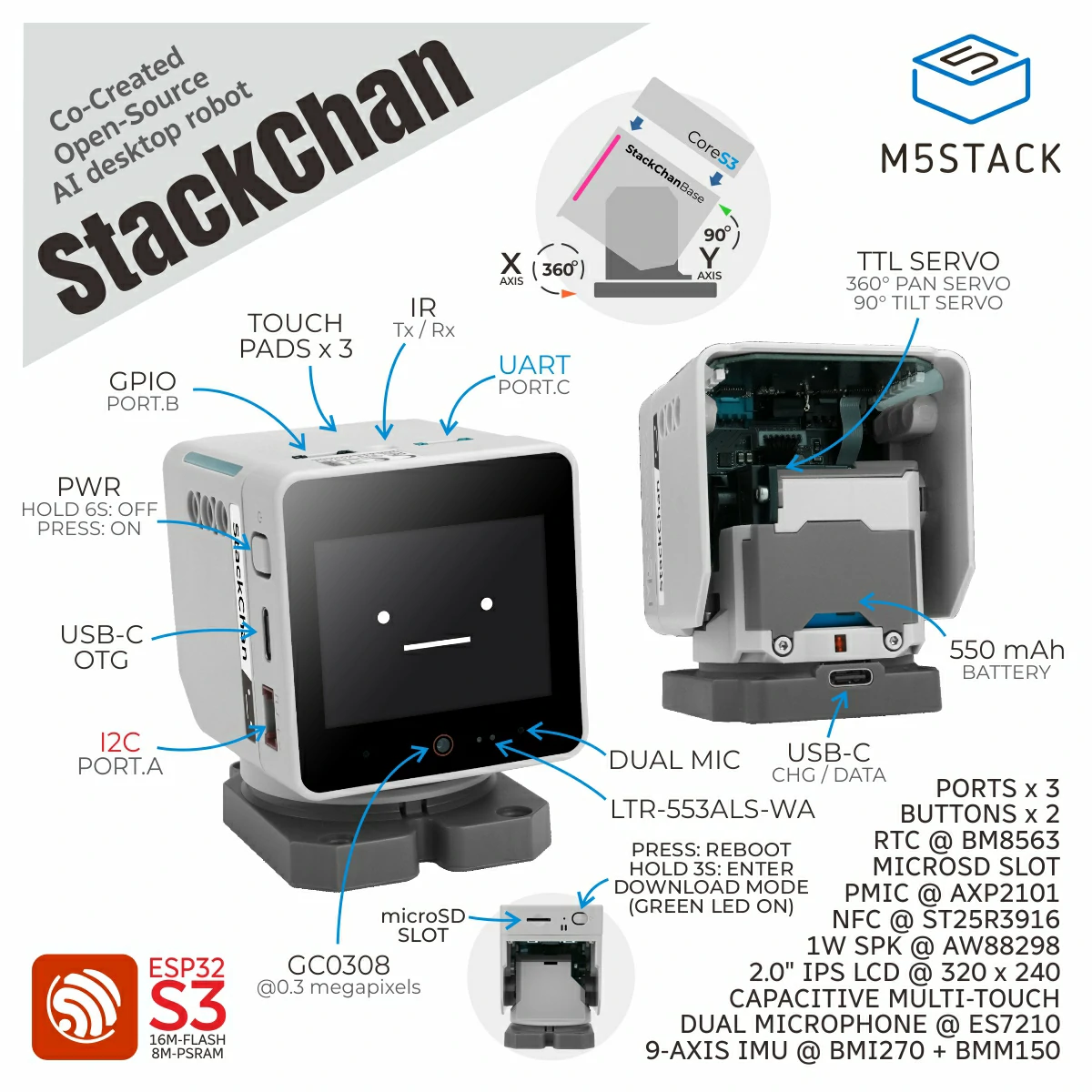
StackChan is a compact AI-powered desktop robot co-created by M5Stack and community contributors. It runs on M5Stack CoreS3 hardware (ESP32-S3) with servos, camera, display, and microphones. The project distributes firmware, mobile apps (iOS/Android), and server code in Go. Target users are hobbyists, makers, and educational contexts who want a customizable AI companion robot. Real-world adoption appears limited to M5Stack ecosystem users and hobbyist communities; mainstream enterprise or consumer adoption is not evident from available signals.
Repository created January 2026 as open-source release by M5Stack. The physical StackChan product predates this repo; the open-source release appears to be a strategic move to invite community contribution and customization around an existing hardware product line.
Gained ~1,000 stars in 6 months with 246 forks. Growth has plateaued recently (0 stars in last 7 days as of July 2026), suggesting initial launch buzz has subsided. Maintained with recent activity (last push July 2, 2026), indicating active stewardship but not viral expansion. Growth pattern consistent with niche hardware project rather than broad adoption curve.
Adoption not verified. Evidence exists that: (1) M5Stack sells StackChan hardware commercially, (2) community contributors are credited (@stack_chan, @mongonta555), (3) purchase links and documentation suggest active product support. However, no published case studies, deployment statistics, user testimonials, or enterprise usage are visible. Repository appears to serve M5Stack's existing hardware user base and hobbyist community rather than driving new mainstream adoption.
Based on README: monorepo distributing firmware (appears to be C/ESP-IDF), mobile apps (iOS/Android, likely Swift/Kotlin or cross-platform frameworks), and server components (explicitly stated as Go). Runs on ESP32-S3 with dual-core 240 MHz processor, 16 MB Flash, 8 MB PSRAM. Integrates with M5Stack BSP. README does not detail microservices structure, API contracts, or deployment topology; implementation details cannot be verified without source inspection.
Not documented in README. No CI/CD pipeline, testing framework, or test coverage metrics mentioned.
Last push July 2, 2026 (8 days before analysis date) indicates active maintenance. Repository is only ~6 months old; short history limits ability to assess long-term stewardship patterns. README states 'Update of this repo could be a little late than the released firmware and mobile app', implying firmware/app releases may outpace repository documentation. This is a yellow flag for documentation lag but not a sign of abandonment.
ADOPT IF: You are already invested in M5Stack ecosystem, want an open-source AI robot platform for hobby/education, accept that documentation may lag behind firmware releases, and can tolerate niche community support. AVOID IF: You need enterprise SLAs, expect extensive documentation, require cross-platform hardware compatibility beyond ESP32, or want a proven production-grade system with large operator base. MONITOR IF: You are considering StackChan for educational curricula or hackathons; adoption trajectory and community contributions over next 12 months will signal whether this becomes a standard maker platform or remains a boutique project.
Independent dimensions
Mainstream potential
3/10
Technical importance
5/10
Adoption evidence
2/10
- Documentation lag: README states updates may lag firmware/app releases; users may encounter outdated guides or config mismatches.
- Hardware dependency: Entire ecosystem locked to M5Stack CoreS3 + StackChan robot body; no portability to other microcontrollers or form factors without substantial rework.
- Community size: 1,000 stars and ~246 forks is modest; community support channels and troubleshooting resources may be limited compared to mainstream projects.
- Unknown license: License field is absent from metadata; legal status for derivative works and commercial use is unclear.
- Adoption concentration: Real-world usage appears confined to M5Stack hobbyist ecosystem; no evidence of educational institution adoption or enterprise pilots.
StackChan likely remains a specialized hobbyist platform with steady but slow growth. May gain traction in maker education and hackathon circuits if community contributions accelerate, but unlikely to achieve mainstream consumer or enterprise adoption without significant marketing push or killer use case. Most probable trajectory: stable niche project serving M5Stack enthusiasts, with periodic firmware updates and community experiments.
Newsletter
Get analyses like this every Monday
Free weekly digest of the most interesting open-source discoveries.
Languages
Information
- Language
- Go
- Last updated
- 1w ago
- Created
- 6mo ago
- Analyzed with
- anthropic/claude-haiku-4-5
Stars over time
Contributors over time
Top 100 contributors only — repos with more will plateau at 100.
Open issues
My StackChan is bricked after flashing, need help to recover. Can someone share the official firmware .bin file or a shared code for M5Burner?
Feature Request: Option to disable idle motion in AI Agent mode
Wake word "Hi, StackChan" not recognized + Request for custom wake word support
真的可以顺利build吗,我遇到许多组件问题
开源工程中,接近与环境光传感器 LTR-553ALS-WA和全功能 NFC ST25R3916 的驱动没有开源吗
Top contributors
Recent releases
No releases published yet.
Similar repos

chirpstack/chirpstack
ChirpStack is an open-source LoRaWAN Network Server written in Rust, designed...
| Repository | Stars | Week Δ | Language | Score | Updated |
|---|---|---|---|---|---|
 m5stack/StackChan
this m5stack/StackChan
this
|
1k | — | Go | 7/10 | 1w ago |
 stack-chan/stack-chan stack-chan/stack-chan
|
1.6k | — | TypeScript | 7/10 | 13h ago |
|
chirpstack/chirpstack
|
1.1k | — | Rust | 8/10 | 1d ago |
 TanStack/ai TanStack/ai
|
2.9k | — | TypeScript | 8/10 | 9h ago |
 codejunkie99/agentic-stack codejunkie99/agentic-stack
|
2.2k | — | Python | 7/10 | 2mo ago |
Broader ecosystem, more general-purpose, lower barrier to entry for non-IoT-specialist makers. StackChan bundles integrated hardware (servos, display, camera, AI accelerators) into a specific form factor; trades flexibility for convenience.
StackChan is a specialized variant within M5Stack's portfolio. Users can theoretically replicate StackChan's robot body on other M5Stack cores, but StackChan packages the reference implementation and community momentum.
Proprietary, closed-source, manufacturer-dependent. StackChan offers open-source alternative, but lacks Anki's polish and brand recognition; appeals to different audience (makers vs. consumers).
Academic/research-focused. StackChan is consumer/hobbyist-focused with physical product bundling. Different audiences and integration points.