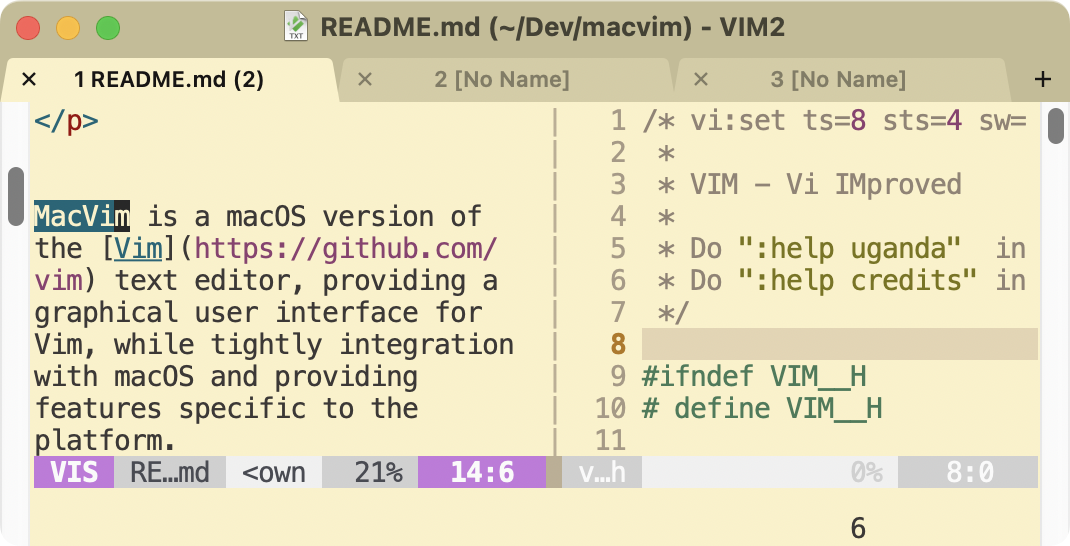
Vim - the text editor - for macOS
7.9k
Stars
693
Forks
194
Open issues
30
Contributors




AI Analysis
MacVim is a native macOS graphical interface for Vim, the terminal text editor. It serves macOS users who want Vim's power with platform-native GUI features like trackpad gestures, Touch Bar integration, and system service connectivity. It is specifically for macOS; Linux and Windows users cannot use it, and users who prefer terminal-only Vim or other editors are not the target audience.
Inferred from signals mentioned in the README (tests, CI, type safety) — not a review of the actual code.
AI's overall editorial judgment — not an average of the bars above, can weigh other factors too.
MacVim brings a native macOS GUI to Vim, serving power users who want platform integration without leaving the editor
MacVim is a macOS-specific fork of Vim that adds a native GUI layer — menus, dialogs, Touch Bar support, trackpad gestures, font ligatures, Apple Intelligence Writing Tools integration, and system service hooks — while tracking upstream Vim closely. It targets Vim users on macOS who want a graphical experience rather than terminal-only editing. The project is mature, well-maintained, and installable via Homebrew, making it a practical daily-driver for a specific but enduring slice of macOS developers and writers who are committed to Vim's modal editing model.
MacVim predates the current GitHub repository (created 2012) but the project itself dates to the mid-2000s. It has evolved through multiple maintainers and has tracked macOS platform changes, including Retina displays, Touch Bar, and Apple Silicon.
Growth has been slow and steady rather than viral — driven primarily by Homebrew discoverability and the persistent loyalty of Vim power users on macOS. The rise of Neovim and VS Code likely plateaued new adoption, but the existing user base appears stable. Star growth (1 star in 7 days as of evaluation date) reflects saturation of its natural audience, not abandonment.
Homebrew install metrics are not publicly exposed, but MacVim is a long-standing Homebrew formula and cask, suggesting substantial passive adoption. It appears frequently in macOS developer setup guides and dotfile repositories. Repology badge presence indicates multi-channel packaging. Concrete install count data is not publicly available.
Likely a native macOS Cocoa application wrapper around the Vim core, with an Objective-C or Swift GUI frontend communicating with a Vim process. The project appears to maintain its own Vim fork that periodically merges from upstream vim/vim. CI is present via GitHub Actions, suggesting automated build and test pipelines.
CI badge is present in README indicating automated builds are run on each push. Specific unit or integration test coverage metrics are not documented in README.
Last push was 2026-06-22, four days before evaluation date — highly active. The project has maintained continuous development for over a decade, tracks upstream Vim merges regularly, and integrates recent Apple platform features (Apple Intelligence Writing Tools), indicating healthy, ongoing maintenance rather than passive staleness.
ADOPT IF: you are a committed Vim user on macOS who wants native GUI integration — menus, Touch Bar, trackpad gestures, system services, ligatures — and prefer to stay on Vim rather than migrate to Neovim. AVOID IF: you are evaluating a general-purpose editor for a new workflow, or you are already invested in Neovim's plugin ecosystem (use VimR instead), or you are comfortable with terminal Vim and do not need GUI features. MONITOR IF: you use MacVim and want to track whether Apple platform changes (e.g., future macOS API deprecations) affect GUI stability or whether the maintainer base contracts.
Independent dimensions
Mainstream potential
2/10
Technical importance
6/10
Adoption evidence
5/10
- Single-platform scope means the maintainer must track both upstream Vim merges and macOS platform changes simultaneously, creating a compounding maintenance burden if contributor base shrinks.
- Neovim's growing dominance among new Vim-ecosystem users may reduce the pool of future MacVim contributors and users over time.
- macOS GUI API changes or Apple Silicon transitions could introduce periods of instability that a small maintainer team may be slow to address.
- The GUI Vim niche may further compress as terminal multiplexers (tmux) and terminal emulators improve rendering quality, reducing the GUI value proposition.
- No documented organizational or corporate sponsorship is evident, making the project dependent on volunteer maintainer continuity.
MacVim will likely remain a well-maintained, stable tool for its existing user base for the foreseeable future, with slow adoption decline offset by strong loyalty from long-term Vim users on macOS.
Explore similar
Newsletter
Get analyses like this every Monday
Free weekly digest of the most interesting open-source discoveries.
Languages
Information
- Website
- https://macvim.org
- Language
- Vim Script
- License
- Vim
- Last updated
- 3w ago
- Created
- 169mo ago
- Analyzed with
- anthropic/claude-haiku-4-5
Stars over time
Contributors over time
Top 100 contributors only — repos with more will plateau at 100.
Open issues
Unclear updater error message every time MacVim starts
The latest release MacVim_10.9.dmg is 9.2.321
MacVim not loading plugins from my ~/.vim directory
:shell with guioptions+=! not showing prompt
Multiple CVEs — including CVE-2026-34714 (fixed upstream in Vim 9.2.0272)
Top contributors
Similar repos

square/maximum-awesome
Maximum Awesome provides curated configuration files for vim and tmux optimized...
| Repository | Stars | Week Δ | Language | Score | Updated |
|---|---|---|---|---|---|
|
macvim-dev/macvim
this
|
7.9k | — | Vim Script | 8/10 | 3w ago |
 vim/vim vim/vim
|
40.6k | — | Vim Script | 9/10 | 6d ago |
 qvacua/vimr qvacua/vimr
|
7k | — | Swift | 7/10 | 4d ago |
 neovim/neovim neovim/neovim
|
101k | — | Vim Script | 9/10 | 1h ago |
|
square/maximum-awesome
|
5.7k | — | Ruby | 7/10 | 11mo ago |
 VSCodeVim/Vim VSCodeVim/Vim
|
15.2k | — | TypeScript | 8/10 | 16h ago |
The official Vim package in Homebrew covers terminal use cases and tracks upstream slightly faster, but offers no GUI. MacVim adds value specifically through macOS GUI integration — users who want GUI features choose MacVim; those who live in the terminal do not need it.
Neovim has dramatically higher star count and ecosystem momentum. For users who want a Lua-scriptable, extensible modal editor with modern plugin architecture, Neovim is the more active choice. MacVim targets traditional Vim users who are not migrating to Neovim and specifically want macOS GUI affordances.
VimR is a macOS GUI frontend for Neovim, filling a similar niche for Neovim users that MacVim fills for Vim users. MacVim has more stars and appears more actively maintained; VimR's fate is tied to Neovim's ecosystem rather than Vim's.
VSCodeVim offers Vim keybindings inside VS Code, appealing to users who want modal editing without leaving VS Code's GUI ecosystem. It does not provide a real Vim runtime, so compatibility and feature parity are incomplete. MacVim is a real Vim implementation, making it the better choice for users who depend on full Vim plugin and scripting compatibility.
Maximum Awesome is a configuration bundle for MacVim and tmux, not a competing editor. Its existence as a separate popular project suggests MacVim has historically had enough users to justify opinionated configuration tooling.