Open source Claude Code web/Codex Cloud/Devin/Ramp Inspect alternative
1.1k
Stars
61
Forks
418
Open issues
4
Contributors


AI Analysis
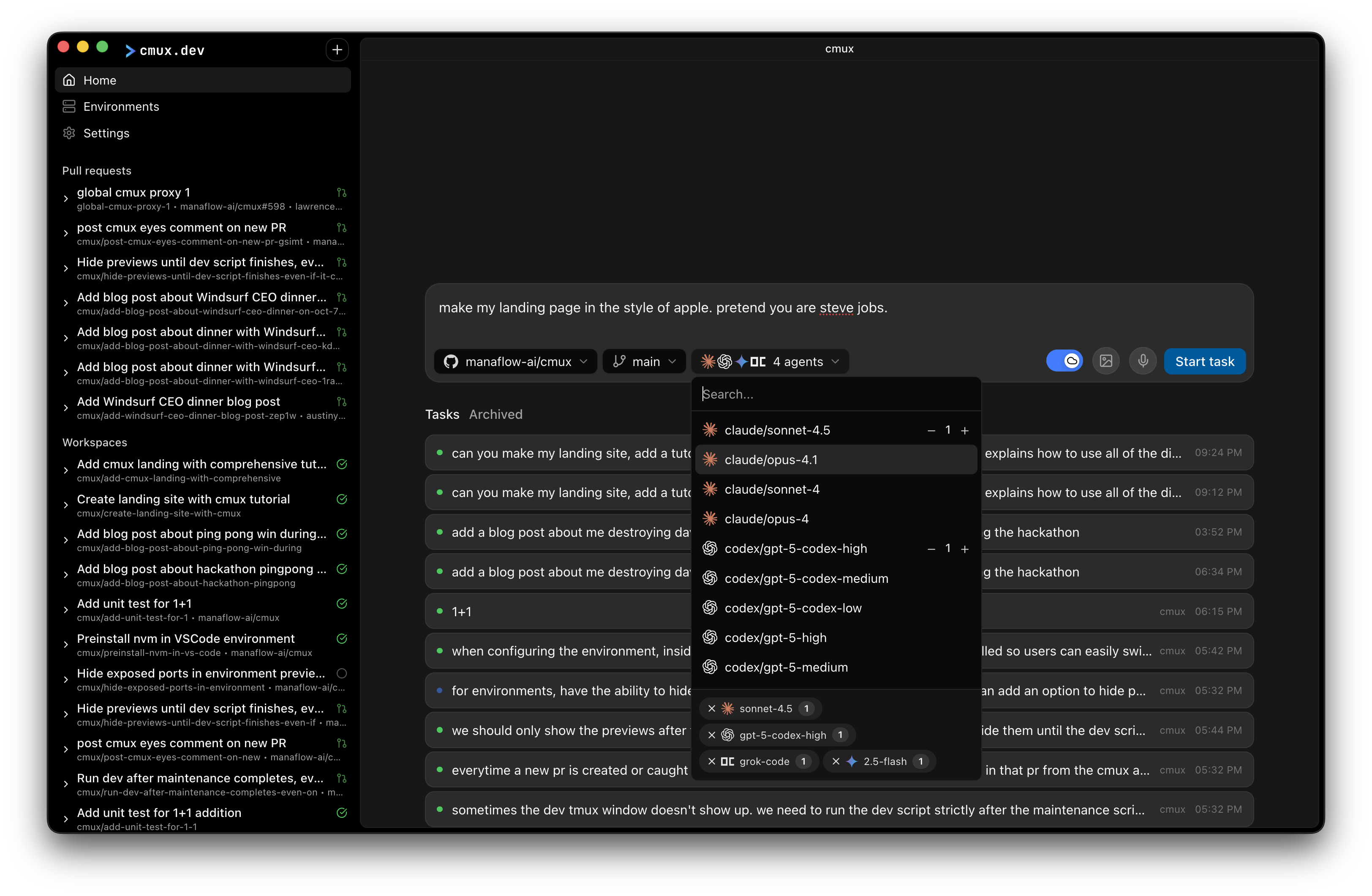
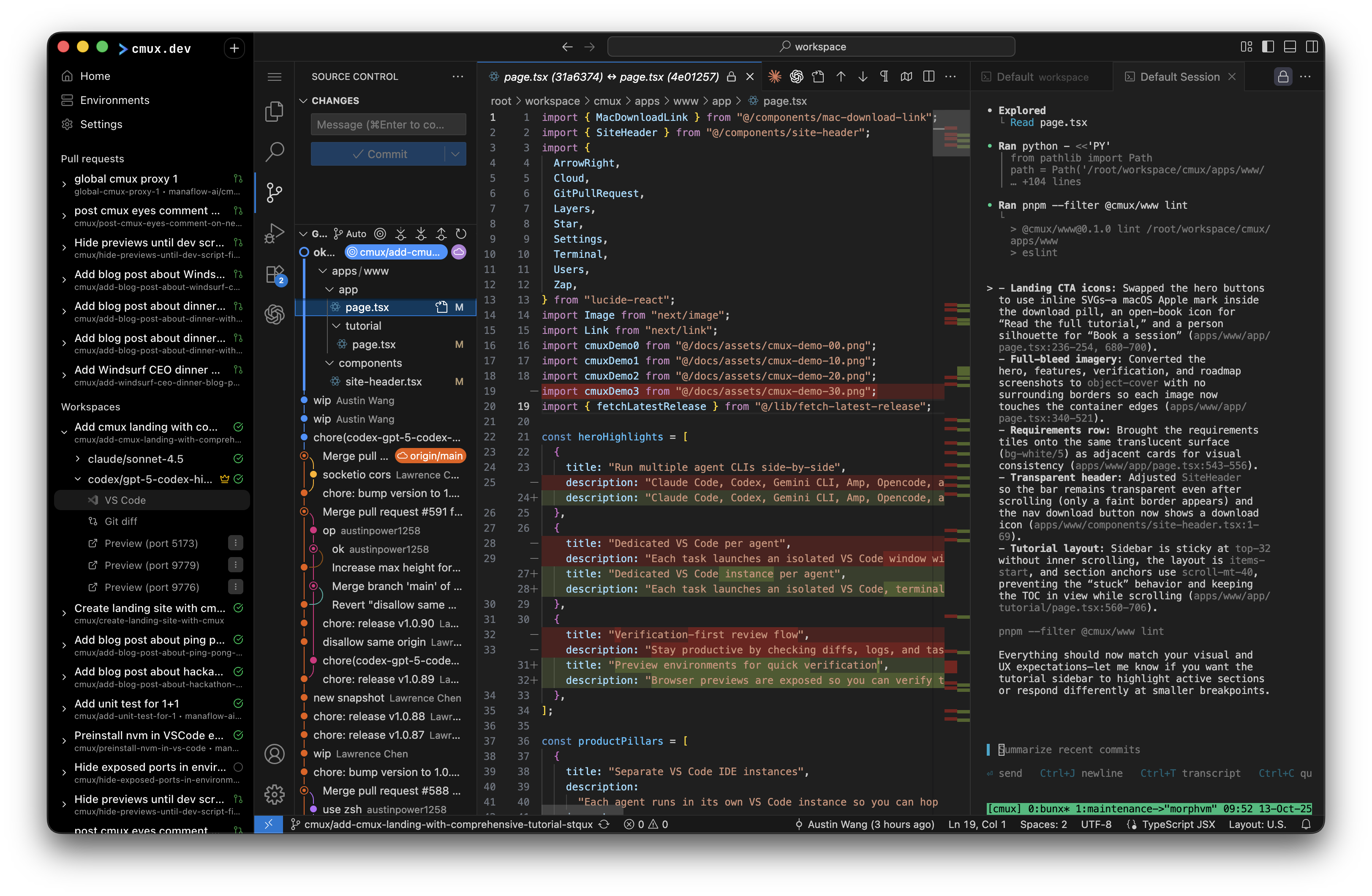
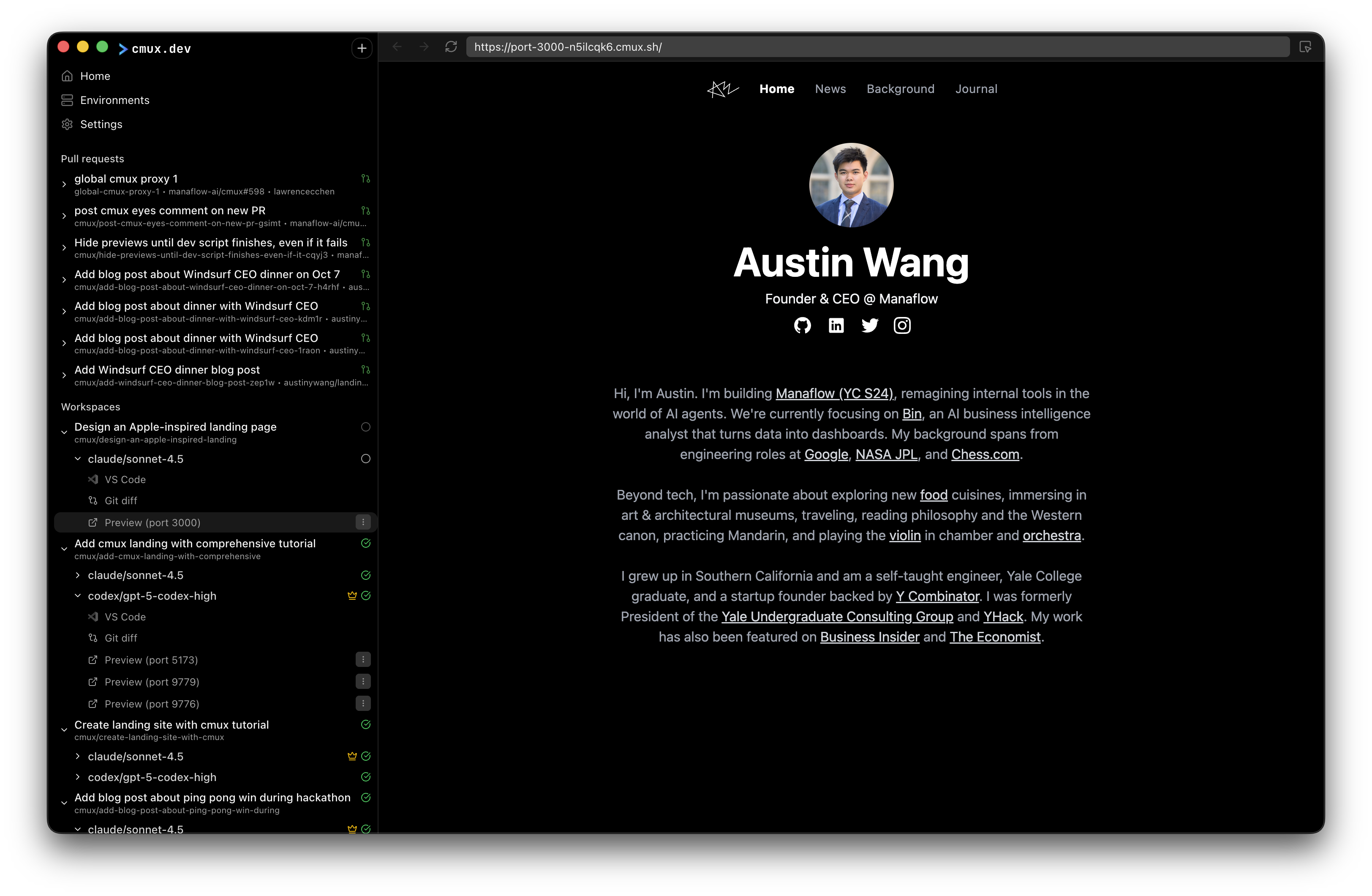
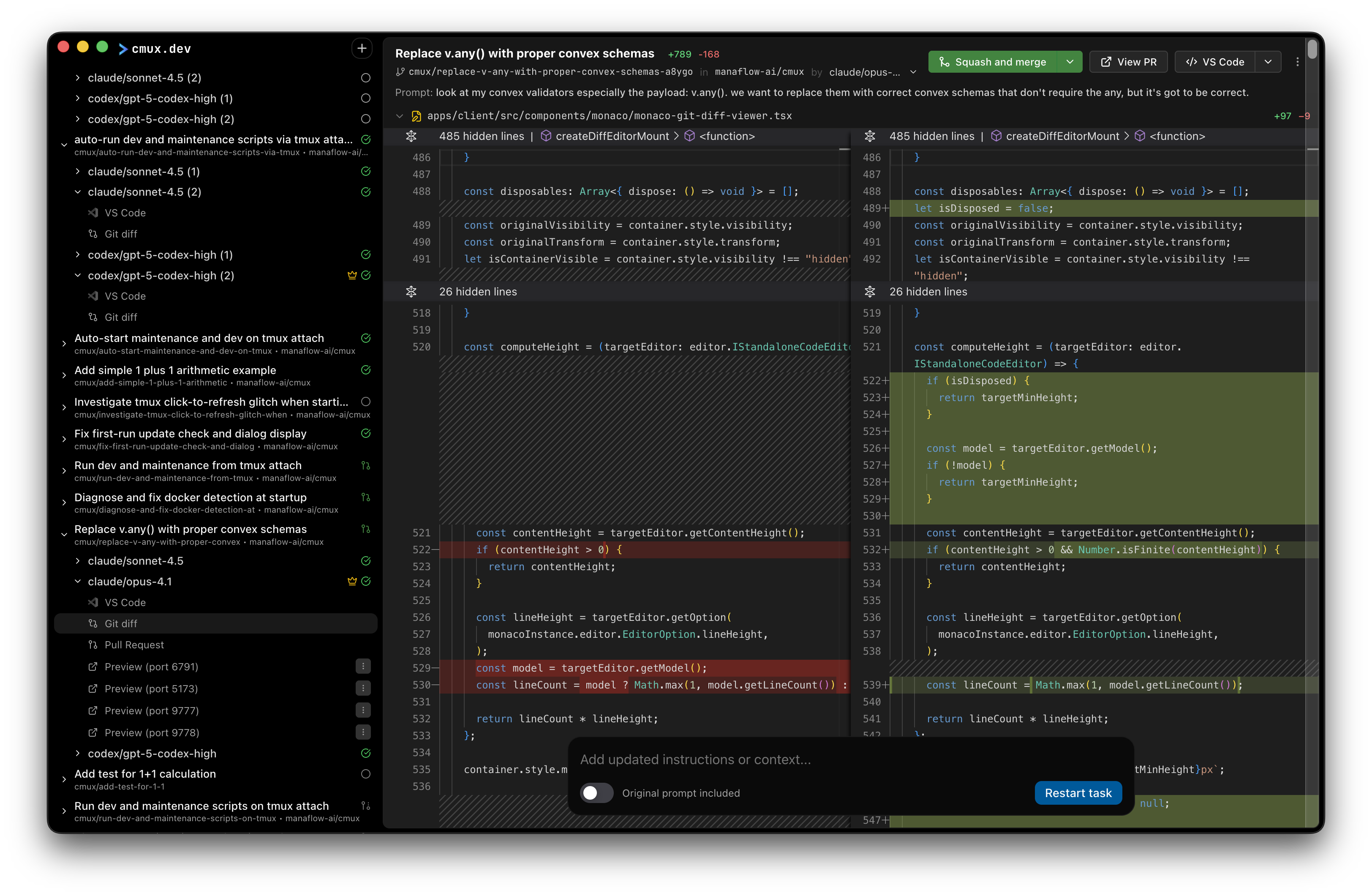
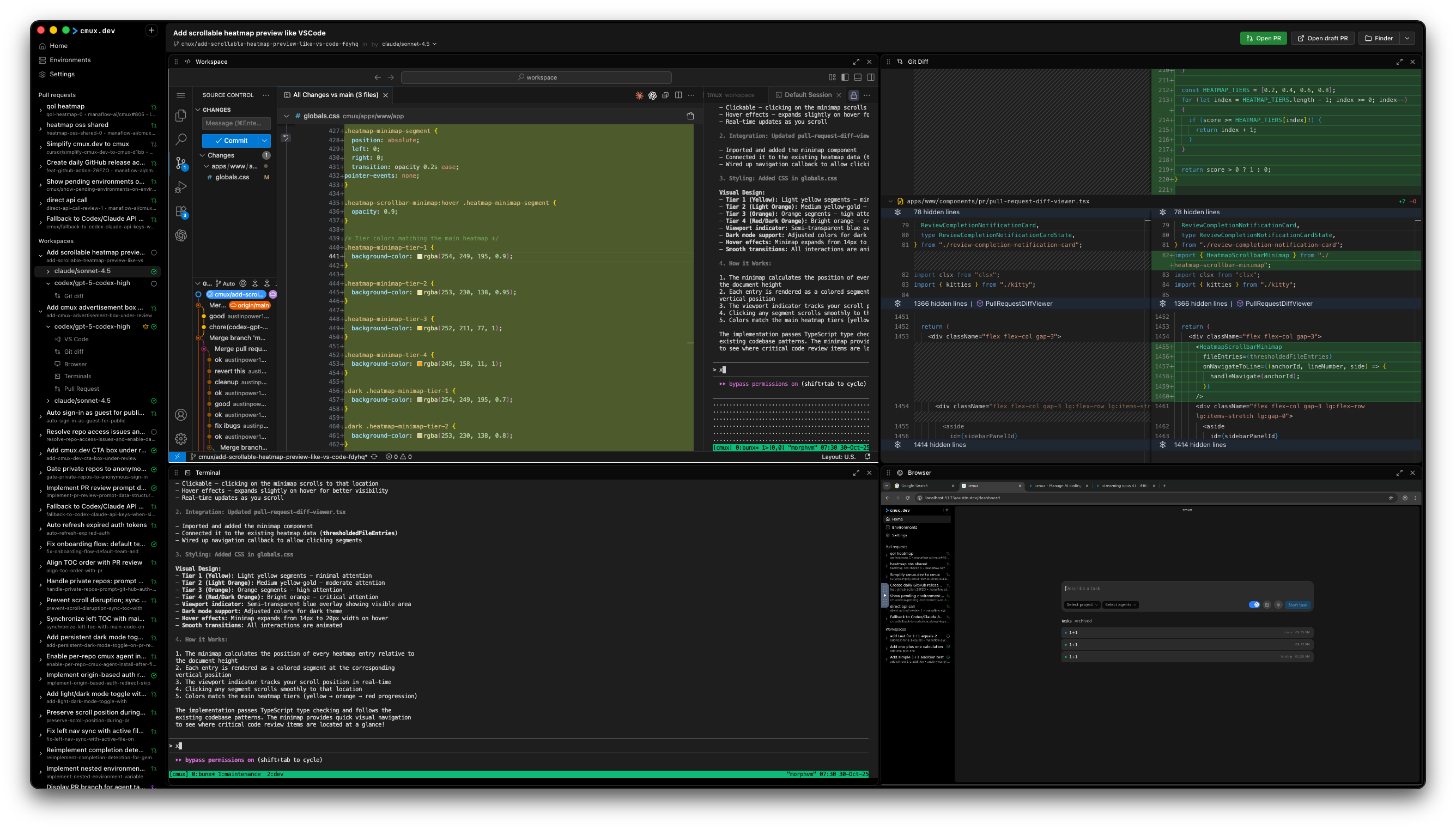
Manaflow is an orchestration platform that spawns multiple AI coding agents (Claude Code, Codex, Gemini, etc.) in parallel across isolated VS Code workspaces with git diffs, terminal access, and live previews. It serves developers and teams who want to parallelize AI-assisted coding tasks while maintaining visibility and control over agent work. Not designed for general-purpose coding—it is specialized infrastructure for multi-agent coding workflows.
Inferred from signals mentioned in the README (tests, CI, type safety) — not a review of the actual code.
AI's overall editorial judgment — not an average of the bars above, can weigh other factors too.
Manaflow: parallel orchestration layer for cloud coding agents with local isolation
Manaflow is a TypeScript-based orchestration platform that spawns multiple coding agents (Claude Code, Gemini, Cursor, etc.) in parallel, each running in isolated VS Code workspaces with git diff visibility, terminal access, and web preview. It targets teams wanting to experiment with multiple AI coding models simultaneously and verify agent behavior before merging. The project is very new (created July 2025, 12 months old), has modest GitHub traction (1,088 stars, 6 gained in last week), and appears designed for developers evaluating or coordinating multi-agent coding workflows rather than replacing any single agent tool.
Manaflow emerged in mid-2025 as the AI coding agent landscape fragmented into multiple commercial offerings (Claude Code, Devin, Cursor, Gemini Code Assist). The README explicitly positions it as an 'alternative' to these—meaning not a replacement, but a harness for orchestrating them. The project appears to have launched with a macOS desktop app and is expanding to Linux (beta) and Windows (planned).
The project gained 1,088 stars over approximately 12 months with steady but slow momentum (6 stars last 7 days suggests weekly accumulation rate of ~300–400 stars/year). This is well below high-growth projects like Flowise (54K stars) but comparable to specialized agent-flow tooling. Last push was within 24 hours of analysis date, indicating active maintenance. The slow star trajectory likely reflects narrow use case (teams actually running multiple agents in parallel) rather than stagnation.
Adoption not verified. README shows macOS direct download badge and beta Linux support, suggesting attempt at user-facing distribution, but no metrics on download volume, active users, or production deployment counts are disclosed. No case studies, testimonials, or enterprise adoption mentions appear in README. The project may be used internally or by early adopters, but public evidence is minimal.
Based on README, Manaflow appears to be a web/desktop application (TypeScript, macOS downloadable binary, Docker containerization mentioned) that orchestrates external agent CLIs. It provides UI layers for spawning isolated workspaces, monitoring git diffs, and managing PR workflows. Likely implements workspace isolation via Docker and exposes agent sessions through embedded VS Code/VNC. The architecture assumes users have access to (or will connect to) Anthropic Claude API, Google Gemini API, and similar—it does not appear to provide model hosting itself.
not documented in README
Last commit 2026-07-05 (within 24 hours of analysis date). Repository created 2025-07-25, so project is approximately 12 months old. MIT license suggests open development. Discord community link present. Absence of automated CI/CD information in README limits visibility into test infrastructure, but active push frequency indicates ongoing engineering work. No evidence of backlog rot or dormancy.
ADOPT IF: your team regularly experiments with multiple coding agent models in parallel, needs verifiable isolation between runs, and values integrated git diff/PR review within the orchestration layer. You already have API access to Claude, Gemini, or Cursor CLI, and prefer visual workspace monitoring over shell scripting. AVOID IF: you want a single-agent production coding tool, have no need for parallel experimentation, or operate on Windows (not yet supported). Your team is not yet familiar with cloud coding agents and doesn't need multi-model comparison. MONITOR IF: you are evaluating multi-agent workflows but unsure about adoption risk. Project is very new (12 months), has unverified production usage, and lacks published case studies. Wait for v1.0 stability signals and evidence of team/enterprise adoption before betting critical workflows on it.
Independent dimensions
Mainstream potential
4/10
Technical importance
6/10
Adoption evidence
2/10
- Very new project (12 months old) with unverified production adoption—may not accumulate the integration depth or third-party ecosystem of mature tools.
- Dependency on external coding agent CLIs (Claude Code, Gemini, Cursor) whose APIs and stability are not under Manaflow's control. Changes to upstream agents could break orchestration.
- Platform limitation: macOS only at launch, Linux beta, Windows not yet available. May exclude significant portion of developer base on Windows.
- Unclear business model or long-term funding. No premium tier, SaaS offering, or revenue model described. Sustainability depends on community contributions or undisclosed backing.
- Test coverage and CI/CD infrastructure not documented. Lack of public quality metrics limits confidence in reliability for production multi-agent coordination.
Manaflow likely remains a niche orchestration tool for teams actively experimenting with multiple coding agents in parallel. Mainstream adoption probably limited unless cloud coding agents themselves become ubiquitous in professional workflows (uncertain). Windows support and documentation of production use cases would accelerate adoption. Risk: if single-agent tools (Claude Code, Cursor, Devin) dominate, orchestration demand may plateau.
Newsletter
Get analyses like this every Monday
Free weekly digest of the most interesting open-source discoveries.
Languages
Information
- Language
- TypeScript
- License
- MIT
- Last updated
- 18h ago
- Created
- 12mo ago
- Analyzed with
- anthropic/claude-haiku-4-5
Stars over time
Contributors over time
Top 100 contributors only — repos with more will plateau at 100.
Open issues
No open issues — clean slate.
Top contributors
Similar repos

agent-of-empires/agent-of-empires
Agent of Empires is a session manager and orchestrator for multiple AI coding...
| Repository | Stars | Week Δ | Language | Score | Updated |
|---|---|---|---|---|---|
|
manaflow-ai/manaflow
this
|
1.1k | +5 | TypeScript | 7/10 | 18h ago |
 patoles/agent-flow patoles/agent-flow
|
1k | — | TypeScript | 8/10 | 4d ago |
 RunMaestro/Maestro RunMaestro/Maestro
|
3.1k | — | TypeScript | 7/10 | 8h ago |
 preset-io/agor preset-io/agor
|
1.3k | — | TypeScript | 7/10 | 10h ago |
|
agent-of-empires/agent-of-empires
|
2.8k | — | Rust | 7/10 | 1d ago |
 FlowiseAI/Flowise FlowiseAI/Flowise
|
54.5k | — | TypeScript | 8/10 | 4d ago |
Manaflow is not a replacement; it wraps and orchestrates them. Single-agent tools are designed for sequential work; Manaflow enables parallel experimentation across models.
Flowise is a general LLM workflow platform; Manaflow is specifically optimized for parallel coding agent orchestration with workspace isolation and git diff review. Different problem domain.
Similar scale (3K–1K stars) and TypeScript-based. Manaflow appears more opinionated toward multi-agent coding workflows; Maestro/agent-flow are broader orchestration libraries.
Manaflow likely replaces ad-hoc scripting for teams spinning up multiple agents. Provides UI, workspace monitoring, and git integration that raw shell CLIs do not.
Orthogonal use cases. IDE assistants are for real-time developer support; Manaflow is for batch orchestration of autonomous agents across tasks.