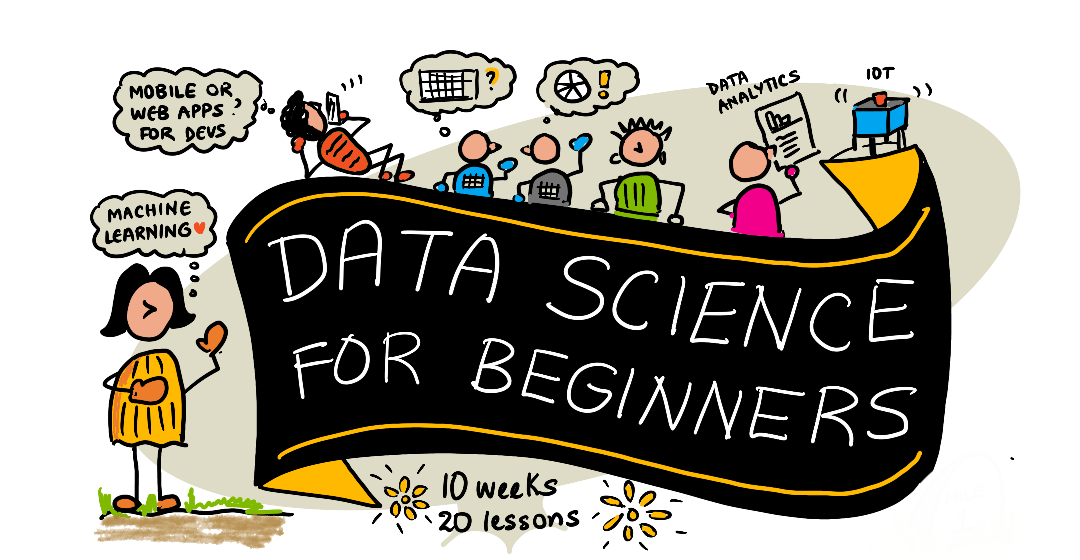
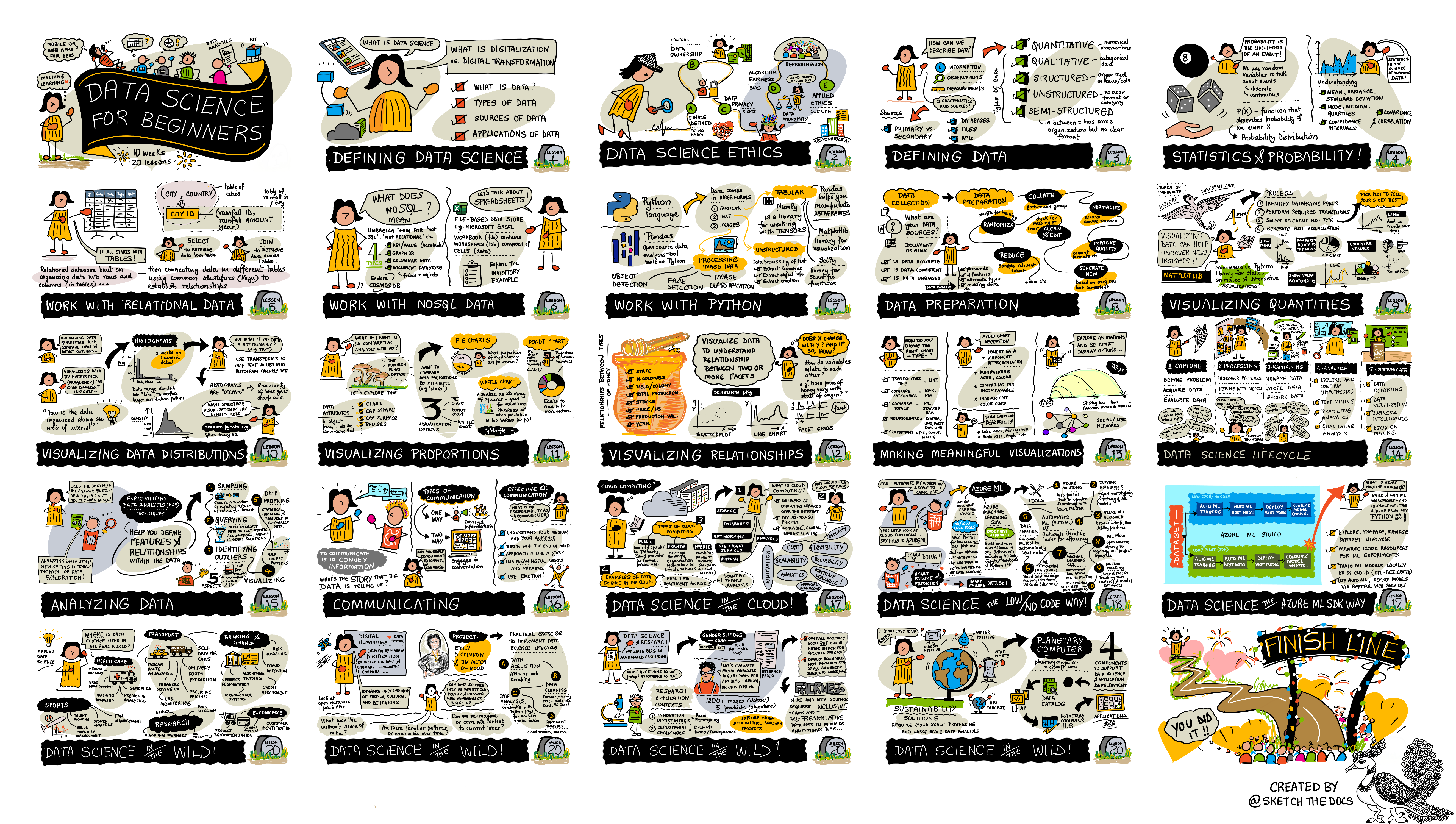
10 Weeks, 20 Lessons, Data Science for All!
36.1k
Stars
7.3k
Forks
5
Open issues
30
Contributors




AI Analysis
A 10-week, 20-lesson structured curriculum for learning data science from Microsoft Cloud Advocates, featuring Jupyter Notebooks with quizzes, written instructions, solutions, and assignments across topics like pandas, Python, data analysis, and visualization. Designed specifically for beginners seeking a project-based learning path with built-in pedagogy; best suited for self-directed learners and educational institutions, not for experienced practitioners seeking advanced reference material.
Inferred from signals mentioned in the README (tests, CI, type safety) — not a review of the actual code.
AI's overall editorial judgment — not an average of the bars above, can weigh other factors too.
Microsoft's structured 10-week data science curriculum for absolute beginners, now with 35K+ stars
Data Science for Beginners is a free, open-source educational curriculum built by Microsoft's Azure Cloud Advocates. It delivers 20 structured lessons covering data science fundamentals—ethics, statistics, visualization, and analysis—via Jupyter Notebooks. Its primary audience is self-learners, bootcamp students, and educators who want a well-scoped, project-based introduction to data science. It matters because it lowers the entry barrier with structured pedagogy, assignments, quizzes, and multilingual support across 30+ languages, backed by an institution with credibility in developer education.
Launched in March 2021 as part of Microsoft's broader 'For Beginners' curriculum series, alongside ML-For-Beginners and AI-For-Beginners. It was produced by Azure Cloud Advocates and Microsoft Student Ambassadors as a contribution to open developer education.
Initial growth was driven by Microsoft's brand recognition, social media promotion by its developer advocates, and the surge in self-directed learning during 2021-2022. It has grown more slowly than sibling repositories like Web-Dev-For-Beginners (95K stars) or ML-For-Beginners (87K), likely because data science has more competing resources. Star gains of ~92 per week as of mid-2026 suggest a mature, steady state rather than viral growth—consistent with a curriculum asset used continuously but no longer novel.
Adoption not verified in the sense of institutional deployments, but the 7,274 forks are a strong proxy for active use: many learners fork curriculum repos to work through lessons. The 30+ language translations and Microsoft Student Ambassador contributor network imply real international classroom and self-study use. No third-party citations of enterprise or university adoption are visible from the metadata alone.
Appears to follow a lesson-per-folder structure with Jupyter Notebooks as primary learning artifacts. Each lesson likely includes a README with instructions, pre/post quizzes, solution notebooks, and assignments. Translation files are stored under a /translations directory and maintained via an automated GitHub Action (co-op-translator). This is a content repository, not a software library, so architectural complexity is low.
Not documented in README. As a curriculum repository, automated testing likely covers link validation or notebook execution checks rather than unit tests, but no specifics are mentioned.
Last push was 2026-06-10, roughly 10 days before the evaluation date—indicating active maintenance. The addition of automated multilingual translation via GitHub Actions and Discord/Foundry community links in the README suggests ongoing investment. The project is not stagnant; it is in a slow, steady maintenance phase appropriate for a mature curriculum.
ADOPT IF: you are a self-learner wanting a free, structured, 10-week introduction to data science with assignments and quizzes, or an educator needing a forkable, MIT-licensed curriculum. AVOID IF: you need depth beyond fundamentals, production-level tooling guidance, or coverage of modern ML/AI stacks—this curriculum does not extend to those areas. MONITOR IF: you are evaluating it for institutional use and want to see whether Microsoft continues to update lesson content (as opposed to just translation tooling) to reflect 2025+ data science practices.
Independent dimensions
Mainstream potential
4/10
Technical importance
3/10
Adoption evidence
5/10
- Curriculum content may become dated as data science tooling evolves; lesson updates appear less frequent than infrastructure updates (translation automation).
- The 'For Beginners' series format means content depth is intentionally limited, which may leave learners without a clear next step within the same ecosystem.
- Dependence on Microsoft's ongoing sponsorship of Azure Cloud Advocates for maintenance—organizational restructuring at Microsoft could reduce upkeep.
- The repository serves a crowded space with well-funded commercial alternatives; learners may increasingly prefer interactive platforms over static Jupyter Notebook curricula.
- No verified evidence of structured academic adoption, so classroom suitability beyond self-study is uncertain.
Likely to remain a stable, widely-referenced free resource for entry-level learners, but unlikely to see significant growth beyond its current plateau given market saturation in beginner data science education.
Newsletter
Get analyses like this every Monday
Free weekly digest of the most interesting open-source discoveries.
Languages
Information
- Language
- Jupyter Notebook
- License
- MIT
- Last updated
- 4d ago
- Created
- 65mo ago
- Analyzed with
- anthropic/claude-haiku-4-5
Stars over time
Contributors over time
Top 100 contributors only — repos with more will plateau at 100.
Open issues
No open issues — clean slate.
Top contributors
Recent releases
No releases published yet.
Similar repos
microsoft/AI-For-Beginners
A structured 12-week, 24-lesson open curriculum by Microsoft covering AI...
microsoft/ML-For-Beginners
ML-For-Beginners is a structured 12-week, 26-lesson curriculum by Microsoft...
microsoft/IoT-For-Beginners
A comprehensive 12-week, 24-lesson curriculum for learning IoT fundamentals...

tkarim45/Beginner-Data-Science-Projects
A curated collection of beginner-friendly data science projects organized by...
| Repository | Stars | Week Δ | Language | Score | Updated |
|---|---|---|---|---|---|
|
microsoft/Data-Science-For-Beginners
this
|
36.1k | +166 | Jupyter Notebook | 8/10 | 4d ago |
|
microsoft/AI-For-Beginners
|
52k | — | Jupyter Notebook | 8/10 | 2d ago |
|
microsoft/ML-For-Beginners
|
87.9k | — | Jupyter Notebook | 9/10 | 1w ago |
|
microsoft/IoT-For-Beginners
|
17k | — | Jupyter Notebook | 8/10 | 1mo ago |
|
tkarim45/Beginner-Data-Science-Projects
|
2.6k | — | Jupyter Notebook | 7/10 | 2w ago |
|
microsoft/Web-Dev-For-Beginners
|
96k | — | JavaScript | 8/10 | 2d ago |
Sister repository with 87K stars—more than double the audience. ML-For-Beginners covers machine learning specifically and appears to have stronger organic traction, possibly because ML has higher search demand than general data science.
Kaggle's free micro-courses are highly adopted for data science entry-level learning, with interactive in-browser notebooks and credential badges. They offer a more interactive experience but are not open-source curricula that educators can fork and remix.
Targets a more advanced audience and focuses specifically on deep learning. Not a direct competitor for absolute beginners, but learners often migrate there after completing entry-level curricula like this one.
Commercial platform with a much larger course catalog and interactive IDE. The key differentiator here is that Microsoft's curriculum is fully free, MIT-licensed, and forkable by educators—DataCamp cannot be remixed or self-hosted.
Community-driven, peer-reviewed open curricula used by universities and research institutions. More academically rigorous and workshop-oriented, while this Microsoft curriculum is more self-paced and solo-learner focused.