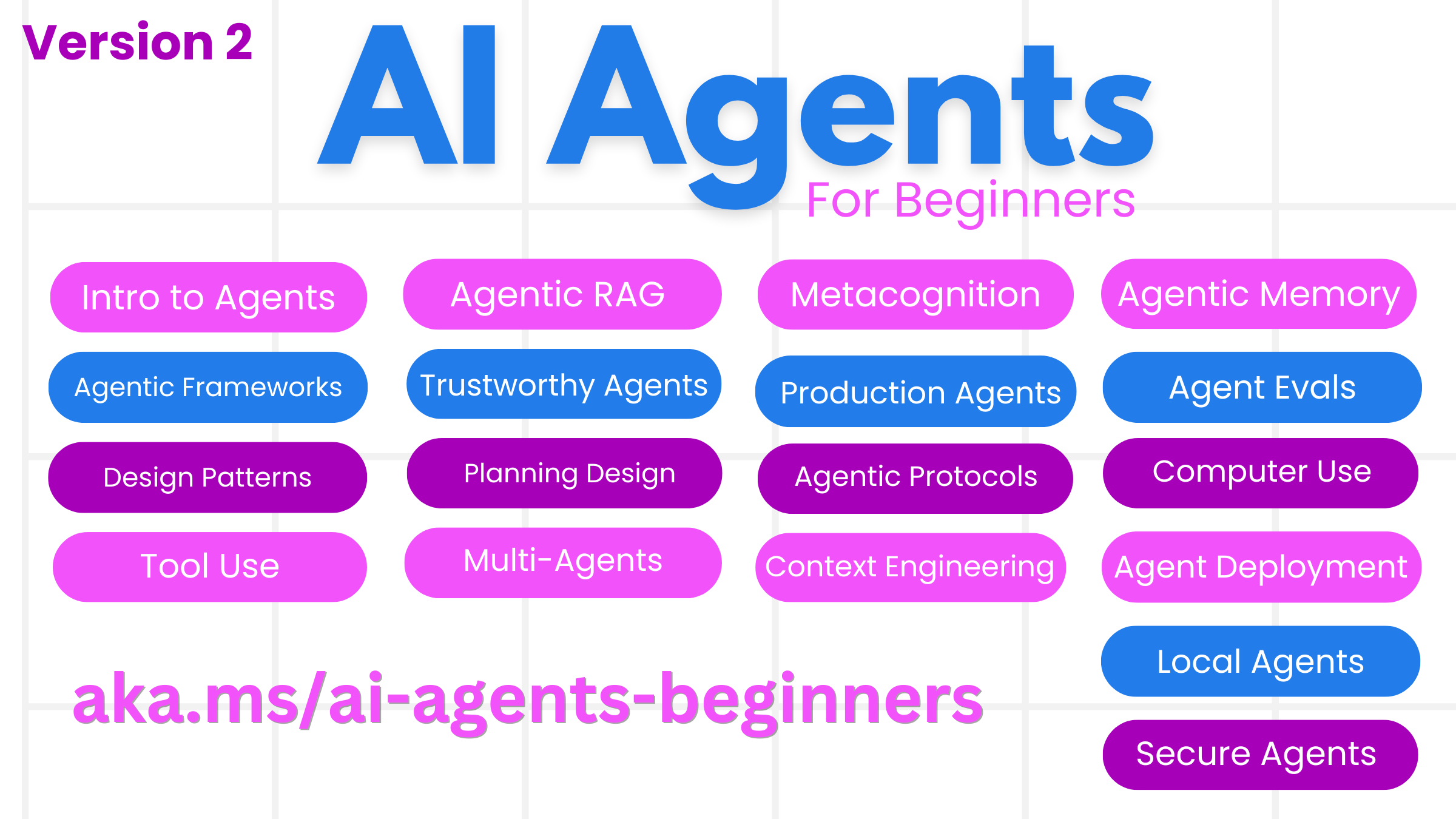
12 Lessons to Get Started Building AI Agents
69k
Stars
22.9k
Forks
18
Open issues
91
Contributors


AI Analysis
A structured 12-lesson course by Microsoft teaching beginners how to build AI agents using frameworks like AutoGen and Semantic Kernel, delivered via Jupyter Notebooks. It serves developers and students who are new to agentic AI and want a guided, hands-on introduction — covering concepts like agentic RAG, multi-agent frameworks, and tool use. It is NOT intended for experienced practitioners building production-grade agent systems, nor for those seeking deep technical reference documentation.
Inferred from signals mentioned in the README (tests, CI, type safety) — not a review of the actual code.
AI's overall editorial judgment — not an average of the bars above, can weigh other factors too.
Microsoft's 12-lesson AI agents course attracts 67K stars in 19 months
AI Agents for Beginners is a structured, 12-lesson educational curriculum built by Microsoft targeting developers, students, and professionals new to building AI agent systems. It covers agent fundamentals through practical Jupyter Notebook exercises, with 50+ language translations expanding global reach. It is not a framework or library — it is a learning resource. Its primary value is lowering the barrier to entry for AI agent development. The course sits within Microsoft's broader 'for beginners' educational portfolio alongside generative-ai-for-beginners and AI-For-Beginners.
Created in November 2024, the course launched as AI agent tooling (AutoGen, LangGraph, CrewAI) was maturing. It extends Microsoft's established pattern of open educational repositories, following the success of generative-ai-for-beginners which reached 112K stars.
The repository gained ~67K stars in roughly 19 months — approximately 3,500 per month on average. Growth was likely driven by Microsoft's brand credibility, the surging interest in AI agents through 2025, aggressive multi-language localization (55+ languages), and cross-promotion with sibling repositories. The 460 stars in the last 7 days as of June 2026 indicates sustained but gradually decelerating organic interest.
Adoption not verified in the traditional sense — this is an educational resource, not a deployable tool. However, 67K stars and 22K forks are strong signals of learner engagement. Forks at this scale suggest many individuals actively working through the material. No independent third-party case studies or organizational deployment metrics are available from the README alone.
Appears to be a content-first repository structured as a sequence of numbered lessons, each self-contained in Jupyter Notebook format. Likely includes code examples, explanations, and exercises per lesson. The multi-language support is managed via automated GitHub Actions using the co-op-translator tool. No framework or installable library architecture is present — this is educational material.
Not documented in README. As an educational repository, automated test coverage of lesson code is unlikely to be a primary concern, though notebooks may contain validation cells.
Last push was June 18, 2026 — two days before evaluation date — indicating active, recent maintenance. The 22K forks and open PR/issue badges suggest ongoing community engagement. Multi-language updates via GitHub Action imply continuous automated maintenance. Project appears actively maintained, not merely preserved.
ADOPT IF: you are new to AI agents and want a structured, Microsoft-backed curriculum with hands-on notebooks and broad language support to onboard yourself or a team. AVOID IF: you are an experienced AI practitioner seeking architectural patterns, production guidance, or a deployable framework — this course will not serve those needs. MONITOR IF: you are an educator or developer relations professional tracking which learning resources are gaining mindshare in the AI agent space, as the curriculum's evolution may reflect Microsoft's strategic priorities in the agent tooling ecosystem.
Independent dimensions
Mainstream potential
5/10
Technical importance
4/10
Adoption evidence
5/10
- Educational content on AI agents risks becoming outdated quickly as the underlying frameworks (AutoGen, Azure AI Foundry APIs, etc.) evolve — lesson code may break or become stale between updates.
- The automated multi-language translation via GitHub Actions may introduce inaccuracies in technical terminology across 55+ languages that are difficult to audit at scale.
- High star count may create an expectation of depth or breadth that 12 lessons cannot fully satisfy, potentially leading to learner disappointment for those seeking advanced material.
- The course's dependence on Microsoft-specific tooling (Azure OpenAI, Azure AI Foundry) may limit accessibility for learners without Azure access or budget.
- As a curriculum rather than a library, it has no versioned releases or semantic stability guarantees — learners who return months later may find exercises changed without notice.
Likely to sustain slow, steady star growth through 2026-2027 as AI agent interest persists, though growth rate will probably plateau as the topic matures and competing tutorials proliferate. May expand to 15-20 lessons over time.
Newsletter
Get analyses like this every Monday
Free weekly digest of the most interesting open-source discoveries.
Languages
Information
- Language
- Jupyter Notebook
- License
- MIT
- Last updated
- 15h ago
- Created
- 20mo ago
- Analyzed with
- anthropic/claude-sonnet-4-6
Stars over time
Contributors over time
Top 100 contributors only — repos with more will plateau at 100.
Open issues
No open issues — clean slate.
Top contributors
Recent releases
No releases published yet.
Similar repos
microsoft/generative-ai-for-beginners
A structured 21-lesson curriculum from Microsoft designed to teach beginners...
microsoft/AI-For-Beginners
A structured 12-week, 24-lesson open curriculum by Microsoft covering AI...
microsoft/Generative-AI-for-beginners-dotnet
A hands-on educational course teaching .NET developers how to build Generative...
| Repository | Stars | Week Δ | Language | Score | Updated |
|---|---|---|---|---|---|
|
microsoft/ai-agents-for-beginners
this
|
69k | +471 | Jupyter Notebook | 8/10 | 15h ago |
|
microsoft/generative-ai-for-beginners
|
112.8k | — | Jupyter Notebook | 8/10 | 1d ago |
|
microsoft/AI-For-Beginners
|
52k | — | Jupyter Notebook | 8/10 | 2d ago |
|
microsoft/Generative-AI-for-beginners-dotnet
|
2.9k | — | C# | 8/10 | 1mo ago |
 NirDiamant/GenAI_Agents NirDiamant/GenAI_Agents
|
23.1k | — | Jupyter Notebook | 7/10 | 6d ago |
 MARKTECHPOST-AI-MEDIA-INC/AI-Agents-Projects-Tutorials MARKTECHPOST-AI-MEDIA-INC/AI-Agents-Projects-Tutorials
|
2.8k | — | Jupyter Notebook | 6/10 | 18h ago |
The sibling course with 112K stars and 21 lessons covers broader GenAI topics. AI Agents for Beginners is the narrower, agent-specific follow-on. The two courses are complementary, not competitive — the README explicitly cross-links them.
A community-driven agent tutorial collection with 22K stars. Less structured than the 12-lesson format, more pattern-catalog style. Targets a similar audience but lacks Microsoft's institutional backing and translation infrastructure.
AutoGen (59K stars) is an actual multi-agent framework — a different category entirely. AI Agents for Beginners teaches concepts and likely uses frameworks like AutoGen as instructional tools, not replacing them.
Older, broader AI curriculum (48K stars) covering classical ML through deep learning. AI Agents for Beginners is more current in topic focus and has grown faster in a shorter timeframe, likely reflecting the agent-specific demand spike.
A .NET-specific variant with 2.8K stars. Much narrower audience. AI Agents for Beginners uses Python/Jupyter and targets a wider developer base, explaining the large adoption gap.