A privacy-focused iOS app that raises awareness about what native apps can see
1.4k
Stars
51
Forks
6
Open issues
2
Contributors


AI Analysis
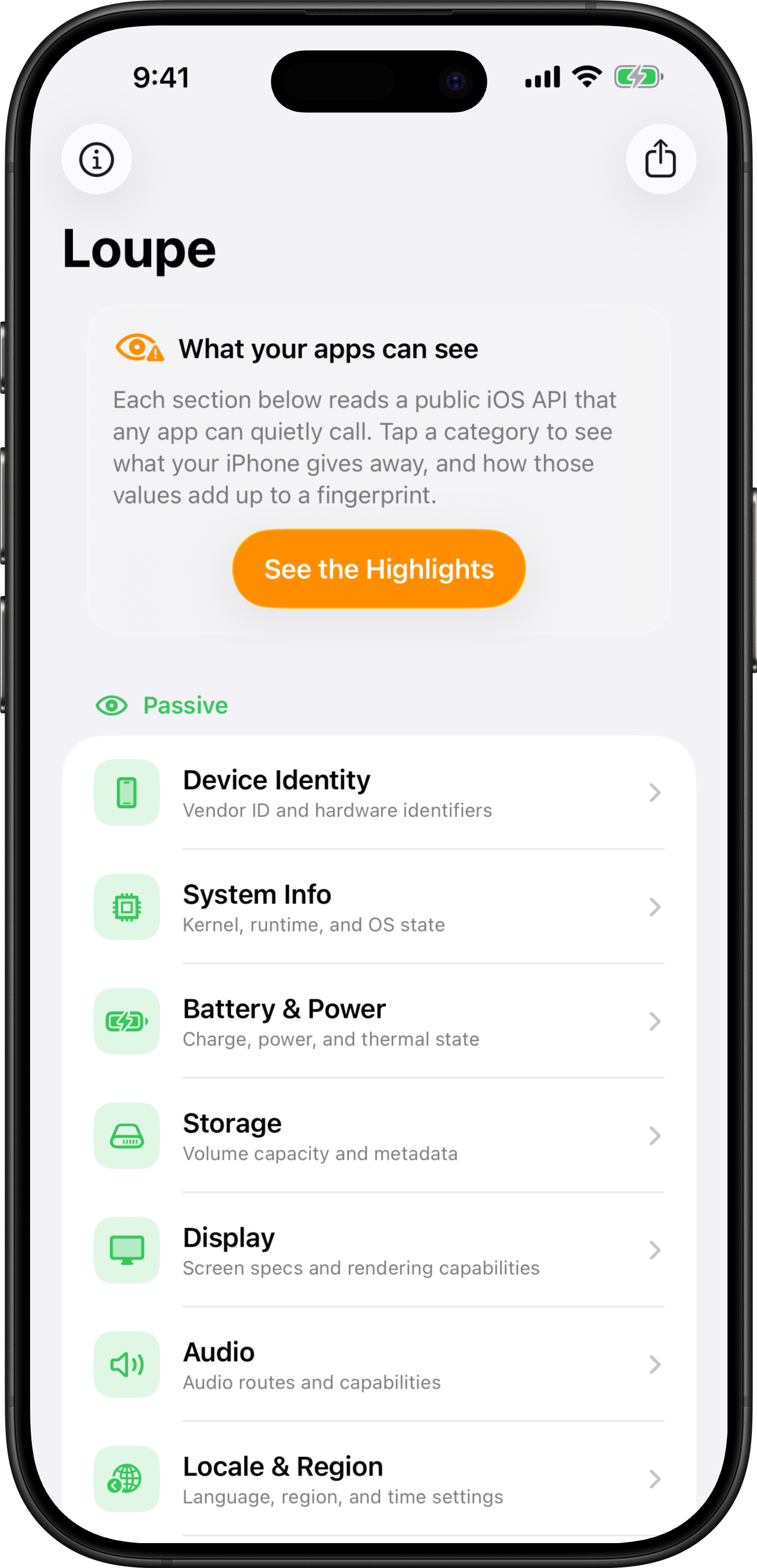
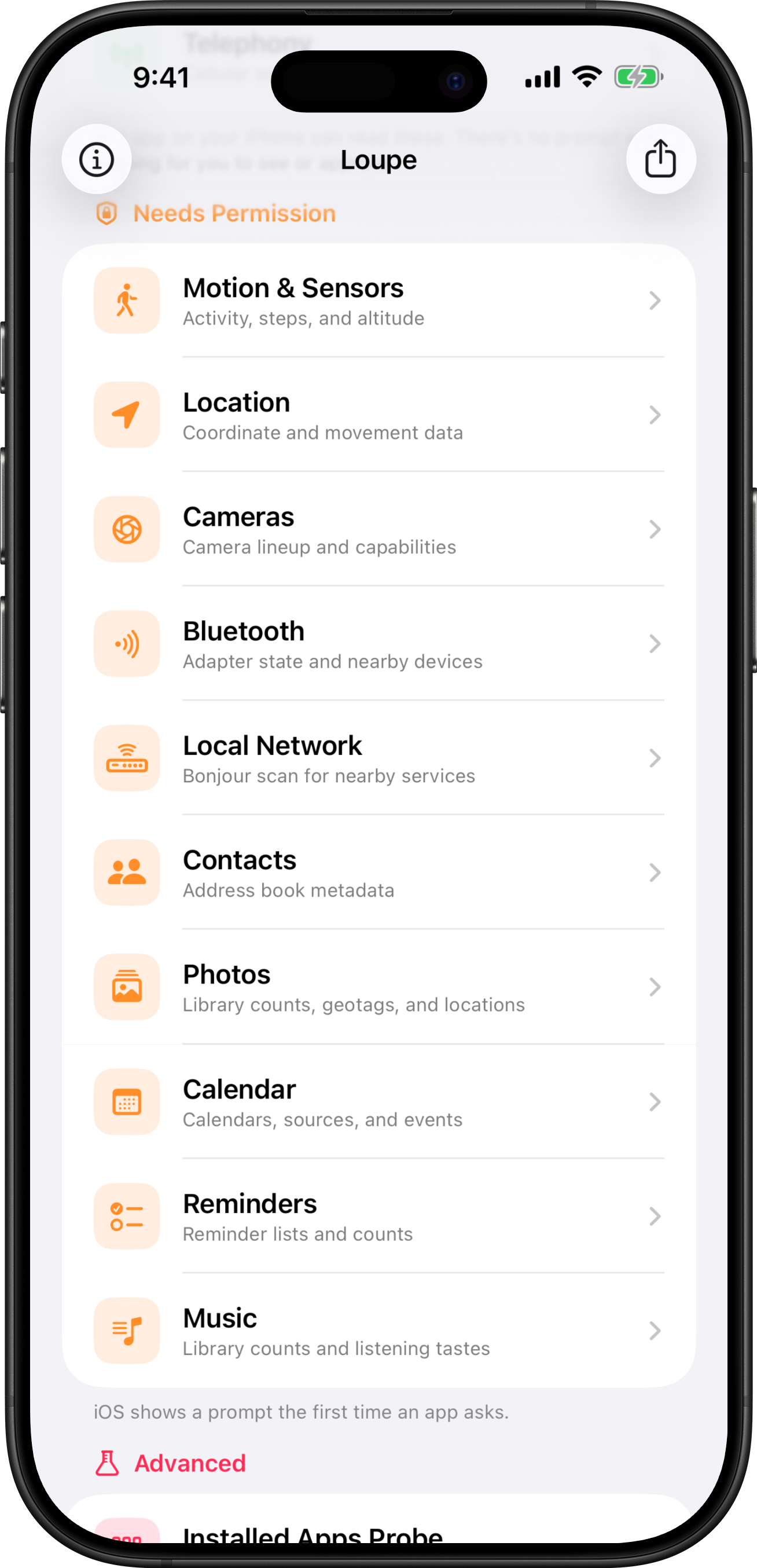
Loupe is an iOS/iPadOS app that demonstrates device fingerprinting by displaying raw values from public APIs that third-party apps can access without user knowledge. It serves privacy-conscious users and researchers who want to understand what information their device passively exposes, organized into three tiers: passive signals, permission-gated signals, and advanced side-channel techniques. This is a specialized educational and privacy-awareness tool, not a general-purpose utility.
Inferred from signals mentioned in the README (tests, CI, type safety) — not a review of the actual code.
AI's overall editorial judgment — not an average of the bars above, can weigh other factors too.
Privacy awareness app that visualizes iOS device fingerprinting surface accessible to native apps
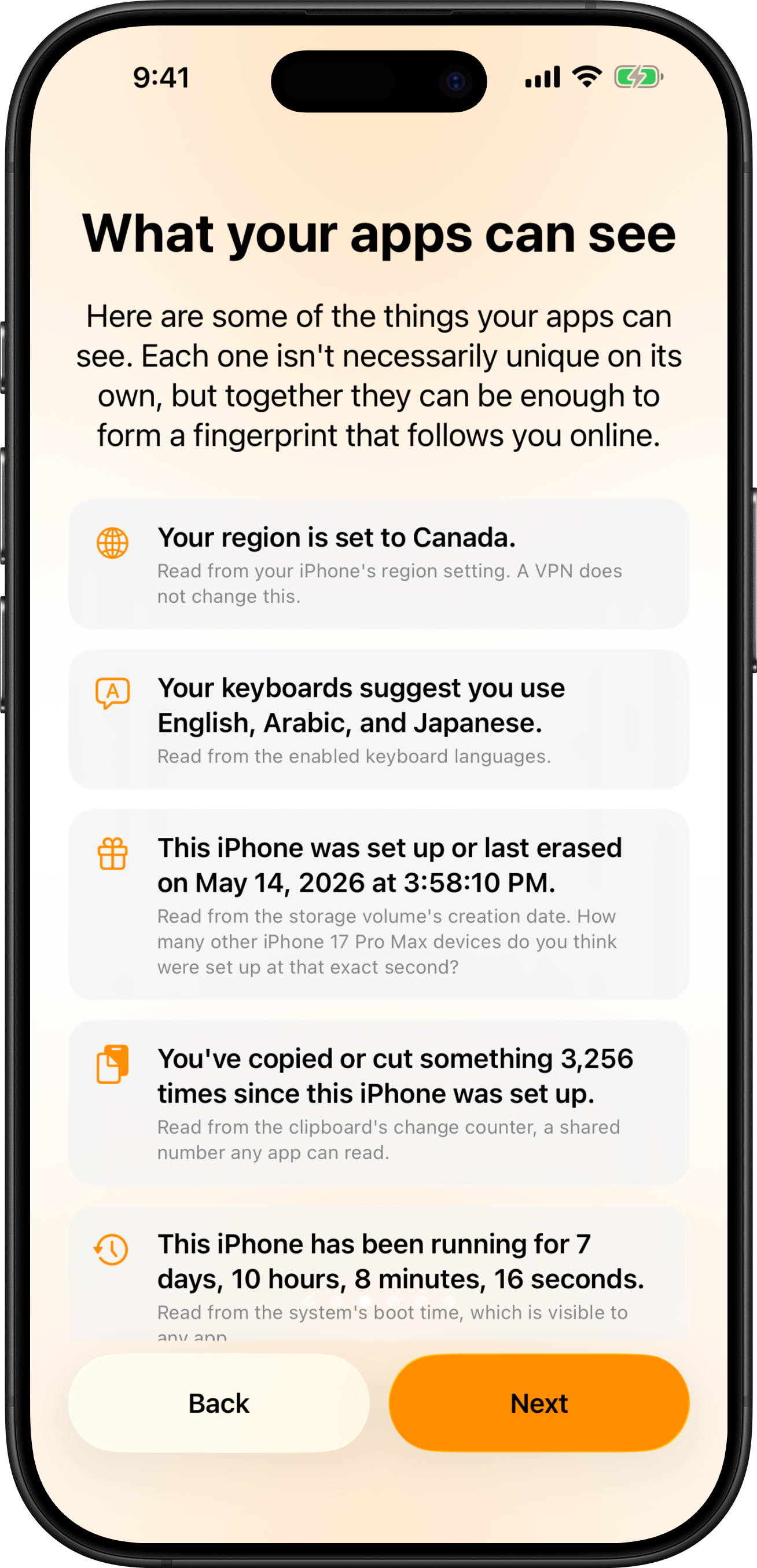
Loupe is a free, open-source iOS/macOS app that demonstrates which device signals (locale, timezone, battery, contacts, location, etc.) third-party apps can access without explicit user knowledge. Built by Mysk, a privacy-focused research organization, it targets privacy-conscious users and developers seeking to understand fingerprinting mechanics. The app reads real iOS API values and displays them locally with no network transmission. Created June 2026 and launched on App Store; extremely early in its lifecycle with adoption not yet verified beyond App Store availability.
Loupe launched June 4, 2026, making it roughly 24 days old as of the analysis date. Mysk is known for privacy research and the Psylo browser product. The project appears to emerge from research into device fingerprinting and iOS privacy surface area. README explicitly notes the codebase was written almost entirely by AI coding tools.
Gained 143 stars in first 7 days post-launch, reaching 1,292 stars by June 28. Growth pattern suggests initial privacy/tech community interest following App Store release and likely social media amplification within privacy-focused circles. Recent push activity (June 12) indicates active post-launch refinement. Growth rate is steep for a brand-new app but insufficient to predict sustained trajectory; early adopter surge is typical for privacy tools with media attention.
App Store presence confirmed (bundle ID 6766152470). 1,292 GitHub stars and 143 new stars in 7 days suggest visibility within privacy/security developer communities. Concrete download counts, user feedback, or production issue reports not mentioned in README. Adoption not verified beyond App Store listing and early GitHub interest.
Appears to be a native iOS/macOS Swift application using standard Apple frameworks to query device APIs. README does not document architectural patterns, dependency structure, or modular design. Likely reads from public iOS APIs across three signal tiers (passive, permission-gated, advanced). macOS version noted as incomplete.
Not documented in README. No mention of unit tests, integration tests, or test infrastructure.
Last push June 12, 2026 (16 days prior to analysis date). Repository is 24 days old. Actively maintained in immediate post-launch phase. Cannot yet assess whether maintenance will sustain beyond initial release cycle. Build requirement stated as Xcode 26 or newer. No documented CI/CD pipeline visible in README.
ADOPT IF: you are a privacy researcher, security auditor, or privacy-conscious developer needing to demonstrate iOS fingerprinting surface to non-technical stakeholders, and you accept that the codebase is brand-new (24 days old), generated partly by AI, and has unverified production stability. AVOID IF: you require a tool with multi-year production history, extensive test coverage, proven reliability at scale, or need macOS feature parity (README notes macOS version is incomplete). MONITOR IF: you work in privacy policy, threat modeling, or consumer privacy advocacy and want to track whether Loupe's user base grows beyond early adopters and whether Mysk sustains maintenance beyond initial launch cycle.
Independent dimensions
Mainstream potential
3/10
Technical importance
6/10
Adoption evidence
2/10
- Extreme recency: created June 4, 2026, only 24 days old; insufficient time to assess stability, maintainability, or long-term viability.
- Maintenance uncertainty: no documented commitment to ongoing support; Mysk's primary product is Psylo browser; Loupe may be secondary or research-oriented project that receives sporadic attention.
- AI-generated codebase: README discloses code written by AI tools; code quality, edge-case handling, and security implications of AI authorship not independently verified in this analysis.
- Test infrastructure absent: no documented automated tests or CI/CD visible in README; risk of regressions across iOS API changes or in new signal categories.
- macOS incompleteness: README acknowledges macOS version needs work; cross-platform polish lag suggests resource constraints or divided focus.
Loupe will likely remain a niche, specialized tool for privacy researchers and privacy-conscious developers rather than a mainstream iOS utility. If Mysk sustains maintenance, adoption may stabilize in the 5,000–15,000 active user range within privacy/security communities. If maintenance lapses or iOS API breaking changes occur without updates, usage may decline as app becomes incompatible with newer iOS versions. App Store presence and organic privacy community discovery favor modest sustained adoption over abandonment.
Newsletter
Get analyses like this every Monday
Free weekly digest of the most interesting open-source discoveries.
Languages
Information
- Language
- Swift
- License
- NOASSERTION
- Last updated
- 4w ago
- Created
- 1mo ago
- Analyzed with
- anthropic/claude-haiku-4-5
Stars over time
Contributors over time
Top 100 contributors only — repos with more will plateau at 100.
Open issues
Top contributors
Recent releases
No releases published yet.
Similar repos
| Repository | Stars | Week Δ | Language | Score | Updated |
|---|---|---|---|---|---|
|
mysk-research/loupe
this
|
1.4k | +51 | Swift | 7/10 | 4w ago |
 signerlabs/Klee signerlabs/Klee
|
1.7k | — | Swift | 7/10 | 4mo ago |
 mazzzystar/Queryable mazzzystar/Queryable
|
3k | — | Swift | 7/10 | 3mo ago |
 pmusolino/Wormholy pmusolino/Wormholy
|
2.6k | — | Swift | 7/10 | 2mo ago |
 openclaw/Peekaboo openclaw/Peekaboo
|
4.8k | — | Swift | 8/10 | 6h ago |
 sveinbjornt/Sloth sveinbjornt/Sloth
|
8.9k | — | Objective-C | 8/10 | 1mo ago |
Peekaboo also appears to be a network inspection/visibility tool for iOS. Larger audience and longer history. Differs in scope: Peekaboo focused on network layer; Loupe focused on device fingerprinting surface.
Swift-based iOS debugging/inspection tool. Broader scope than Loupe. Different use case: Wormholy targets developers for deep app inspection; Loupe targets privacy-aware end users and privacy researchers.
Similar star count to Loupe. Exact positioning unclear from metadata alone. Likely serves different iOS development niche.
Higher adoption than Loupe. Again, exact scope and audience not determinable from metadata. Loupe is narrower in focus: specifically device fingerprinting awareness, not general app inspection.