Gaming Input Peripherals Device Firewall for Windows.
1.5k
Stars
96
Forks
12
Open issues
13
Contributors


AI Analysis
HidHide is a Windows device firewall that hides human interface devices (joysticks, game pads, controllers) from specific applications. It serves gaming and input-remapping enthusiasts who use feeder utilities like vJoy or Joystick Gremlin, allowing them to hide physical devices from games to prevent duplicate input notifications when virtual controllers are in use. This specialized tool benefits advanced gamers and control-mapping power users, but is not for general Windows users or applicat...
Inferred from signals mentioned in the README (tests, CI, type safety) — not a review of the actual code.
AI's overall editorial judgment — not an average of the bars above, can weigh other factors too.
Windows kernel driver that hides gaming input devices from specific applications
HidHide is a Windows kernel-mode filter driver that allows users to hide Human Interface Devices (joysticks, gamepads, steering wheels) from specific applications while keeping them visible to whitelisted programs. Built for gaming peripheral enthusiasts who use feeder/remapping utilities, it solves the dual-notification problem when virtual device emulators are stacked with physical hardware. Adoption appears concentrated in the input remapping and HOTAS/racing sim communities rather than mainstream gaming.
Created March 2021 by nefarius, HidHide emerged as a specialized solution to a specific friction point in the gaming input peripheral ecosystem. It filled a gap between virtual device emulators (vJoy, Joystick Gremlin) and game applications that couldn't distinguish between physical and virtual device input during control binding.
The project has accumulated 1,438 stars over ~5 years with steady but modest growth. No significant star activity in the last 7 days. The project appears to have reached a stable equilibrium serving its target niche rather than pursuing exponential expansion. Maintenance activity (last push May 2026) indicates continued support, though the growth pattern suggests the addressable market has plateaued or the project has achieved product-market fit within a bounded community.
Adoption not formally verified through public case studies or usage statistics. Indirect evidence: Chocolatey package distribution (download count badge shown but value not provided in excerpt). GitHub release download stats badge present. User base likely includes: (1) HOTAS flight simulator enthusiasts, (2) racing sim wheel users, (3) input remapping utility developers (vJoy, Joystick Gremlin communities). README explicitly warns against scam sites, suggesting enough visibility to attract fraud attempts—a mild indicator of real adoption. No enterprise adoption signals visible.
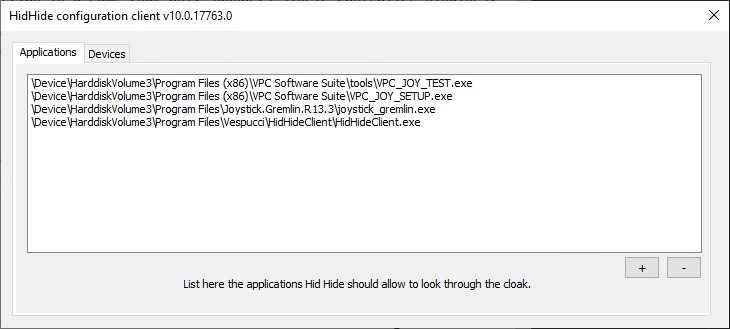
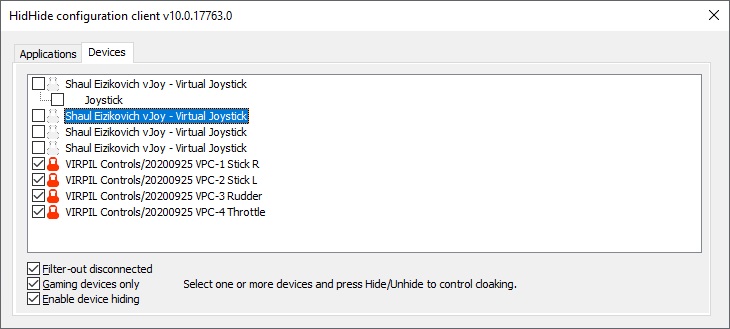
Likely a two-component architecture: kernel-mode filter driver (C++, KMDF 1.13+) running at system level, paired with a user-mode configuration utility (appears to be GUI-based from README screenshots). The driver intercepts device access at the kernel level to enforce hiding rules. README indicates Windows 10+ requirement but does not document internal filtering logic, driver state management, or communication between kernel and user components.
Not documented in README. No mention of unit tests, integration tests, CI/CD pipeline beyond AppVeyor badge link.
Last push 2026-05-22 (approximately 40 days before analysis date), indicating recent activity. AppVeyor CI badge present, suggesting automated build checks. However, no recent release dates are visible in README. Issue counts shown via badges but absolute numbers not documented. Maintenance appears active but minimal-effort—likely responding to bug reports and OS compatibility rather than feature-driven development.
ADOPT IF: you use feeder utilities (vJoy, Joystick Gremlin) with gaming peripherals and experience dual-input notifications during control binding, or you need per-application input device hiding on Windows 10+. AVOID IF: you expect cross-platform support, require modern GUI frameworks, or need native support outside Windows gaming peripheral niche. MONITOR IF: Windows kernel API changes force major rewrites, or if the KMDF dependency becomes problematic in future OS versions.
Independent dimensions
Mainstream potential
2/10
Technical importance
6/10
Adoption evidence
4/10
- Windows kernel driver maintenance burden: future OS updates (Windows 11 variants, Windows 12+) could break driver compatibility, requiring developer response.
- Small maintenance team: no evidence of multiple active contributors; project depends on single maintainer (nefarius) for critical kernel-level code.
- Limited marketing/documentation: README is technical but lacks troubleshooting guides, FAQ, or community forum links visible in excerpt; adoption may be constrained by discoverability.
- Kernel privilege attack surface: any driver running at system level is a potential security target; depends on code review rigor (not evident from README).
- Narrow addressable market: use case specific to gaming input remapping enthusiasts; unlikely to expand beyond current niche.
HidHide will likely remain a stable, niche tool maintained in reactive mode—responding to OS changes and critical bugs—rather than pursuing new features. Mainstream gaming will not adopt it because the problem it solves (dual-input during feeder setup) affects only power users. Adoption among input peripheral enthusiasts will remain modest but durable.
Newsletter
Get analyses like this every Monday
Free weekly digest of the most interesting open-source discoveries.
Languages
Information
- Language
- C++
- License
- MIT
- Last updated
- 5d ago
- Created
- 64mo ago
- Analyzed with
- anthropic/claude-haiku-4-5
Stars over time
Contributors over time
Top 100 contributors only — repos with more will plateau at 100.
Open issues
Latest signed release (v1.5.230.0, May 2024) is 14+ months behind source (v1.7.346.0+) — session blacklist and other merged fixes are unreachable via the official installer
Config UI/CLI crashes on every launch with ERROR_INVALID_PARAMETER in GetWhitelist (FilterDriverProxy.cpp:91) — reproducible across driver versions 1.2.98.0 through 1.5.230.0 on Windows 11 25H2
HidHide loses all cloaks after attempting to add new cloak
HidHide Client stopped working after update KB5064401 for Windows 11 24H2
HidHide breaks after mounting and dismounting a volume
Open pull requests
No open pull requests.
Top contributors
Similar repos

hiddify/Hiddify-Manager
Hiddify Manager is a multi-user anti-filtering panel that enables circumvention...
| Repository | Stars | Week Δ | Language | Score | Updated |
|---|---|---|---|---|---|
|
nefarius/HidHide
this
|
1.5k | +1 | C++ | 7/10 | 5d ago |
 jfedor2/hid-remapper jfedor2/hid-remapper
|
1.6k | — | JavaScript | 8/10 | 4w ago |
|
hiddify/Hiddify-Manager
|
9.1k | — | Python | 7/10 | 1mo ago |
 Idov31/Nidhogg Idov31/Nidhogg
|
2.4k | — | C++ | 7/10 | 2w ago |
 sezanzeb/input-remapper sezanzeb/input-remapper
|
5.8k | — | Python | 8/10 | 4d ago |
 pgkt04/defender-control pgkt04/defender-control
|
1.9k | — | C++ | 7/10 | 2w ago |
Complementary rather than competing. vJoy/Gremlin create virtual devices; HidHide hides physical ones. Used together in the same workflows. HidHide is orthogonal layer solving a specific pain point.
Windows offers basic device disable/enable but not application-level hiding. HidHide provides granular per-application filtering, which OS lacks.
Solves input mapping problem on Linux; HidHide is Windows-specific device hiding. Different OS ecosystems, non-overlapping audiences.
Focuses on windowing/display behavior for games. Orthogonal concern; no direct competition on input device filtering.
Network/VPN obscuring tool. Completely different problem domain despite superficially similar name. No technical overlap.
 HidHide