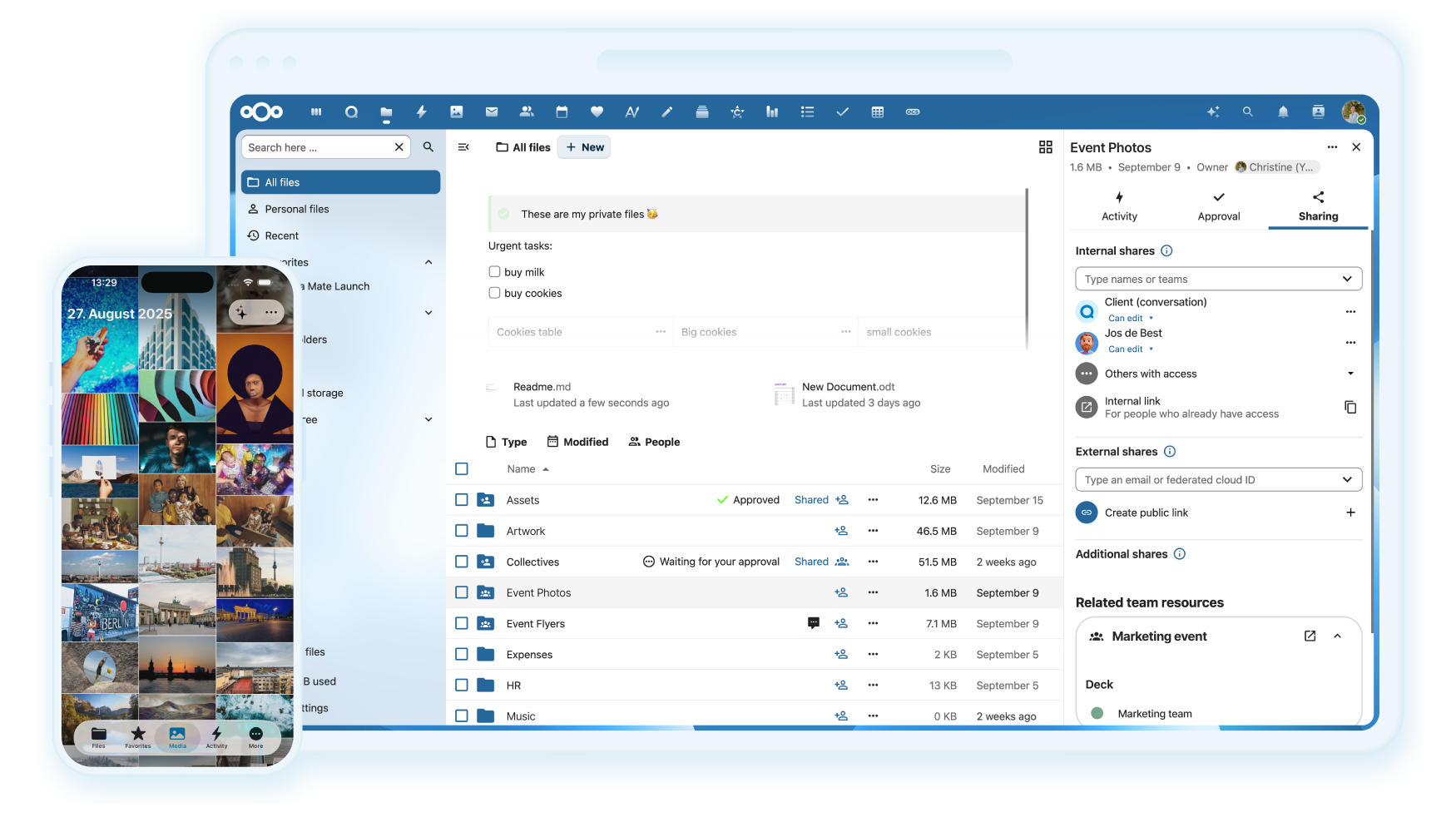
☁️ Nextcloud server, a safe home for all your data
36.1k
Stars
5.1k
Forks
3.4k
Open issues
30
Contributors





AI Analysis
Nextcloud Server is a self-hosted cloud platform that provides file storage, synchronization, sharing, and collaboration features comparable to proprietary solutions like Google Drive or Dropbox. It serves organizations, privacy-conscious individuals, and enterprises seeking data sovereignty and federated collaboration capabilities. It is not suitable for users who require a managed SaaS experience without server administration responsibilities.
Inferred from signals mentioned in the README (tests, CI, type safety) — not a review of the actual code.
AI's overall editorial judgment — not an average of the bars above, can weigh other factors too.
Nextcloud Server: mature self-hosted cloud platform with enterprise backing and broad app ecosystem
Nextcloud Server is a self-hosted file sync, share, and collaboration platform covering files, calendars, contacts, mail, and video chat. It targets privacy-conscious individuals, SMEs, educational institutions, public sector organizations, and enterprises that need on-premises or sovereign-cloud deployments. With commercial support via Nextcloud GmbH, a HackerOne bug bounty program, CII Best Practices certification, and hundreds of third-party apps, it represents one of the most complete open-source alternatives to Google Workspace or SharePoint for organizations unwilling to rely on third-party cloud providers.
Forked from ownCloud in June 2016 by Frank Karlitschek and other core contributors following a governance dispute. It inherited a substantial codebase and community, then diverged significantly with tighter security practices, a richer app ecosystem, and commercial enterprise offerings.
Growth accelerated around data sovereignty concerns, GDPR compliance pressure in Europe, and public-sector digitization mandates. Adoption spiked notably during 2020-2021 as remote work drove demand for self-hosted collaboration tools. The project now grows steadily (~107 stars/week currently) rather than explosively, indicating a maturing, stable install base rather than a hype cycle.
Nextcloud GmbH publicly reports millions of users and thousands of enterprise deployments. Several European governments (Germany, France, Netherlands) and universities have publicly documented Nextcloud deployments. Hosted providers listed on nextcloud.com/providers and a device/appliance market further confirm broad real-world production use at scale.
Appears to be a PHP-based monorepo with a plugin/app architecture. Likely uses a MVC-style backend with REST and WebDAV APIs, JavaScript/TypeScript frontends per app, and git submodules for third-party dependencies. The app store model suggests a loosely coupled extension system.
Multiple test frameworks are explicitly documented: PHPUnit for PHP unit tests, Behat for PHP integration tests, Vitest for JS/TS unit tests, and Playwright for end-to-end tests. Codecov badge is present, indicating automated coverage tracking, though exact coverage percentage is not stated in the README excerpt.
Extremely active: last push was 2026-06-24 02:41:46, same day as the evaluation date. With 35,905 stars, 5,017 forks, and a structured contribution workflow including labeled issues and bot automation, the project shows all signals of sustained, professional-grade maintenance. No indicators of stagnation.
ADOPT IF: you need a self-hosted, privacy-first collaboration platform with broad functionality, active security patching, and optional commercial support — especially in regulated industries or public sector. AVOID IF: you lack the infrastructure or IT capacity to maintain a self-hosted PHP application, or if seamless real-time co-editing (e.g., Google Docs quality) is your primary requirement. MONITOR IF: you are evaluating sovereign cloud strategies or watching how Nextcloud's AI/assistant integrations (Nextcloud Hub releases) evolve to close UX gaps with commercial SaaS competitors.
Independent dimensions
Mainstream potential
7/10
Technical importance
8/10
Adoption evidence
9/10
- PHP-based architecture may present performance ceilings and security surface concerns at very large scale compared to modern compiled-language alternatives.
- Breadth of the app ecosystem means quality and maintenance consistency across third-party apps varies considerably; enterprise use may require careful app vetting.
- AGPL-3.0 license creates compliance complexity for organizations embedding or modifying Nextcloud in commercial products or managed services.
- Self-hosting operational burden (upgrades, backups, security patching) is non-trivial and may be underestimated by smaller organizations without dedicated IT staff.
- Real-time collaborative document editing (via ONLYOFFICE or Collabora integrations) adds external dependencies and complexity that can be a friction point in deployments.
Nextcloud is likely to continue steady growth, particularly in European public sector and privacy-first enterprise segments. AI assistant and federated identity features will likely define the next major differentiation wave over the next 2-3 years.
Newsletter
Get analyses like this every Monday
Free weekly digest of the most interesting open-source discoveries.
Languages
Information
- Website
- https://nextcloud.com
- Language
- PHP
- License
- AGPL-3.0
- Last updated
- 13h ago
- Created
- 123mo ago
- Analyzed with
- anthropic/claude-haiku-4-5
Stars over time
Contributors over time
Top 100 contributors only — repos with more will plateau at 100.
Open issues
Top contributors
Similar repos

nextcloud-snap/nextcloud-snap
Nextcloud packaged as a snap (universal Linux package), providing a complete...
| Repository | Stars | Week Δ | Language | Score | Updated |
|---|---|---|---|---|---|
|
nextcloud/server
this
|
36.1k | +86 | PHP | 8/10 | 13h ago |
|
nextcloud-snap/nextcloud-snap
|
1.8k | — | Shell | 7/10 | 3d ago |
|
nextcloud/vm
|
1.5k | — | Shell | 7/10 | 9h ago |
|
nextcloud/docker
|
7.3k | — | Shell | 7/10 | 1w ago |
 Sync-in/server Sync-in/server
|
1.5k | — | TypeScript | 7/10 | 5d ago |
|
nextcloud/calendar
|
1.2k | — | JavaScript | 7/10 | 22h ago |
Nextcloud's direct ancestor. ownCloud (8,795 stars) has fewer community contributors and a narrower app ecosystem. Nextcloud has diverged significantly in features, security posture, and community size. ownCloud retains some enterprise customers but appears to have lost developer mindshare to Nextcloud since 2016.
Seafile focuses primarily on file sync with strong performance on large file sets. It lacks Nextcloud's breadth (no native calendar, contacts, video chat). A better fit for pure file storage use cases where simplicity and speed outweigh ecosystem depth.
The primary commercial alternative Nextcloud positions against. Workspace offers superior collaboration UX and zero infrastructure overhead but requires trusting Google with data. Nextcloud wins on data sovereignty, compliance, and total cost at scale for organizations with in-house IT capacity.
A TypeScript-based newer entrant (1,467 stars) with adoption not yet verified at scale. May appeal to organizations preferring a Node.js stack but lacks Nextcloud's maturity, app ecosystem, and enterprise support infrastructure.
Microsoft's enterprise collaboration suite dominates in Windows-centric organizations. Nextcloud is a viable alternative for organizations seeking vendor independence or running Linux/mixed environments, though SharePoint's deep Office integration is difficult to match.