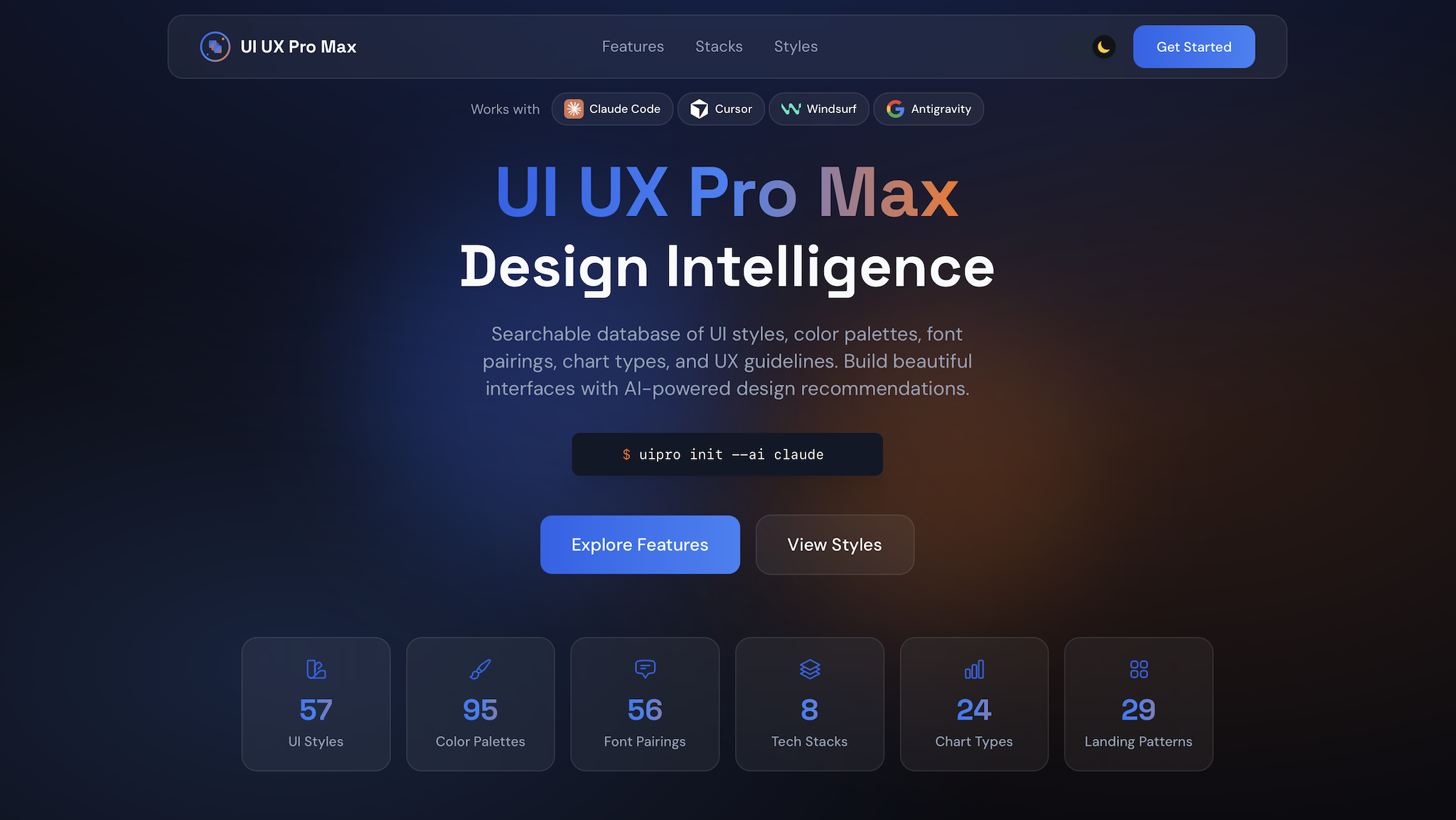
An AI SKILL that provide design intelligence for building professional UI/UX multiple platforms
103.8k
Stars
11k
Forks
127
Open issues
58
Contributors


AI Analysis
UI UX Pro Max is an AI skill/prompt layer that provides design intelligence for generating professional UI/UX across multiple platforms and frameworks, including React, TailwindCSS, HTML5, and mobile. It targets developers and AI coding assistants (Claude, Copilot, Cursor, Windsurf, etc.) who want guided, rule-based UI generation with 161 reasoning rules and 67 UI styles. It is NOT a general-purpose design tool or a standalone application — it is a specialized prompt engineering artifact for ...
Inferred from signals mentioned in the README (tests, CI, type safety) — not a review of the actual code.
AI's overall editorial judgment — not an average of the bars above, can weigh other factors too.
AI skill for UI/UX design guidance gains rapid traction with 94K stars in under six months
UI UX Pro Max is an AI 'skill' — a structured reasoning ruleset or prompt layer — designed to guide AI coding assistants (likely Claude or similar) in generating professional UI/UX decisions: layout patterns, color systems, typography, accessibility compliance, and anti-patterns. It targets developers and designers who want opinionated, context-aware design system generation without manual design expertise. The 161 reasoning rules and 67 UI style definitions suggest a curated knowledge base rather than a traditional code library. Primary audience appears to be solo developers, freelancers, and small teams building client-facing products across web and mobile frameworks.
Created in November 2025, likely coinciding with the rise of AI agent skill ecosystems (Claude Projects, Cursor rules, etc.). v2.0 introduced a Design System Generator as its flagship feature, indicating rapid iteration from a simpler rule prompt to a structured generation system.
The 94K stars acquired in roughly seven months, with 2,872 stars in the last seven days as of June 2026, strongly suggests viral distribution through AI/developer communities on Twitter/X, Reddit, or Hacker News. Growth likely driven by the broader trend of 'AI skills' and 'cursor rules' repositories gaining large audiences in 2025-2026, where developers collect and share curated AI behavior rulesets. The pattern resembles social/viral star accumulation rather than organic adoption-driven growth.
Adoption not verified at scale. An npm package (uipro-cli) with a download badge exists, suggesting some real CLI usage, but specific download figures are not cited in the available README. No case studies, integration testimonials, or enterprise references are documented. Star counts are high but do not confirm active production usage.
Likely a collection of structured prompt rules, configuration files, and reasoning templates rather than executable application code. The Python language tag may reflect CLI tooling (an npm package 'uipro-cli' is referenced), suggesting a thin Python or Node wrapper around a ruleset. The 161 reasoning rules and 67 UI styles appear to be declarative configuration. Architecture is likely file-based and flat rather than a complex multi-module system.
Not documented in README.
Last push was April 3, 2026, approximately 2.5 months before current date. For a project this young and viral, the pause in activity is mildly concerning but not alarming — could reflect a stable ruleset rather than abandonment. No CI/CD badges visible in the README excerpt. The PayPal donation link and multiple side-project links suggest a solo or very small maintainer team, which elevates bus-factor risk.
ADOPT IF: you use an AI coding assistant and want structured, opinionated UI/UX design guidance baked into your workflow without hiring a designer or manually crafting design rules. AVOID IF: you need production-grade, tested, framework-specific component logic rather than design heuristics and style recommendations — this is guidance, not code. MONITOR IF: the April 2026 activity gap extends beyond mid-2026, which would signal potential maintainer disengagement on a project with meaningful community investment.
Independent dimensions
Mainstream potential
3/10
Technical importance
4/10
Adoption evidence
2/10
- Viral star inflation: the star count may not reflect proportional real-world usage, making it difficult to assess true adoption signal versus social sharing momentum.
- Solo or micro-team maintainer risk: multiple PayPal donation links and personal side-project links suggest limited organizational backing, creating bus-factor vulnerability.
- Ruleset staleness: AI assistant platforms (Claude, Cursor, etc.) evolve rapidly; a static ruleset may degrade in effectiveness as underlying model behavior changes.
- Shallow per-platform depth: claiming multi-platform coverage with 67 styles and 161 rules may mean broad but thin guidance that fails edge cases in specific frameworks.
- No visible test or validation framework: design rule quality cannot be independently verified from available metadata, making quality assessment dependent on user trust.
Likely to plateau or slowly decline in star velocity as the AI-skills trend matures and more specialized tools emerge, unless the maintainer ships a v3.0 with deeper integrations or framework-specific rulesets before end of 2026.
Newsletter
Get analyses like this every Monday
Free weekly digest of the most interesting open-source discoveries.
Languages
Information
- Website
- https://www.uupm.cc/
- Language
- Python
- License
- MIT
- Last updated
- 4d ago
- Created
- 7mo ago
- Analyzed with
- anthropic/claude-sonnet-4-6
Stars over time
Contributors over time
Top 100 contributors only — repos with more will plateau at 100.
Open issues
Proposal: Add RTL (Right-to-Left) Support for Multi-Platform UI-UX
Request: Support for Trae CN (ByteDance TRAE China Edition)
Fix grammatical errors in README/about description
SKILL.md must start with YAML frontmatter (---)
Top contributors
Similar repos

Owl-Listener/designer-skills
Designer Skills Pack is a curated collection of 239 AI-native skills and 88...
| Repository | Stars | Week Δ | Language | Score | Updated |
|---|---|---|---|---|---|
|
nextlevelbuilder/ui-ux-pro-max-skill
this
|
103.8k | +3.5k | Python | 6/10 | 4d ago |
 bergside/typeui bergside/typeui
|
1.5k | — | TypeScript | 7/10 | 6d ago |
 MiniMax-AI/skills MiniMax-AI/skills
|
13k | — | C# | 7/10 | 3mo ago |
 ibelick/ui-skills ibelick/ui-skills
|
3.6k | — | TypeScript | 6/10 | 1d ago |
|
Owl-Listener/designer-skills
|
1.8k | — | Markdown | 8/10 | 4w ago |
 JimLiu/baoyu-design JimLiu/baoyu-design
|
2.5k | — | JavaScript | 8/10 | 1d ago |
Broader agent-skill collection from a high-credibility maintainer (Chrome team lead). More general-purpose but lacks the domain-specific UI/UX focus and opinionated design system generation that UUPM provides.
Another AI skill repository with significant traction, appears generalist. UUPM differentiates on the design domain specifically, which may appeal to a more targeted audience.
Organizational/commercial backing gives credibility, but UUPM's star count suggests stronger community reach in its niche.
Closest in intent — design-focused AI skills — but UUPM has dramatically more traction, suggesting it has captured the design-focused AI skill niche more effectively for now.
Platform-specific (SwiftUI) versus UUPM's multi-platform claim. UUPM is broader in scope but may be shallower per platform.