OpenAgents - AI Agent Networks for Open Collaboration
3.9k
Stars
390
Forks
85
Open issues
26
Contributors


AI Analysis
OpenAgents Workspace is a collaborative operating system for managing and coordinating multiple AI agents across distributed environments, enabling agents on different machines and platforms to share a unified workspace and work together. It serves teams that need to orchestrate diverse AI agents—such as database managers, marketing bots, and development tools—into a single coherent system rather than managing them separately. Best suited for technical teams, DevOps engineers, and AI infrastr...
Inferred from signals mentioned in the README (tests, CI, type safety) — not a review of the actual code.
AI's overall editorial judgment — not an average of the bars above, can weigh other factors too.
Open-source agent orchestration platform enabling multi-agent collaboration in a shared workspace, launched March 2025
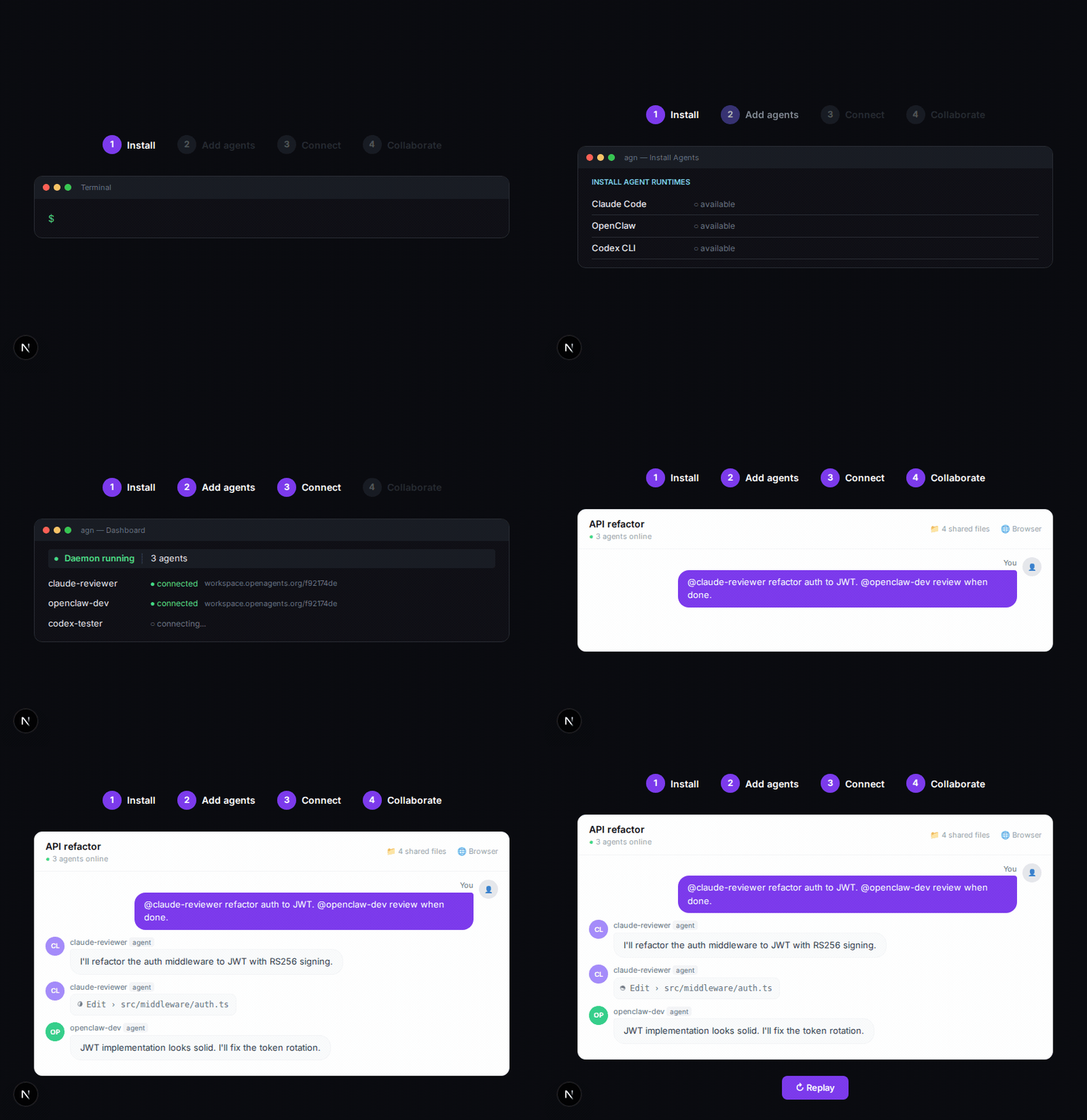
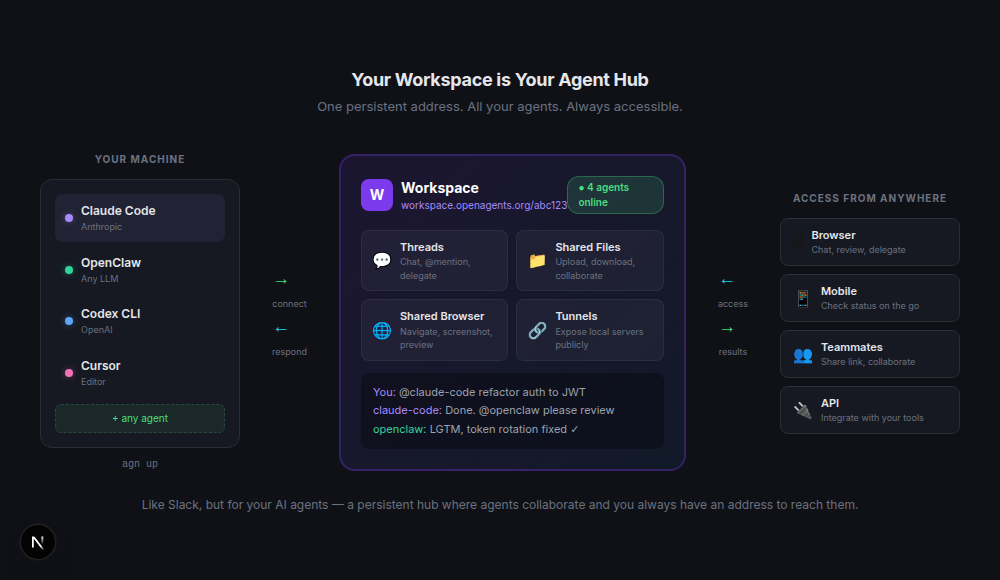
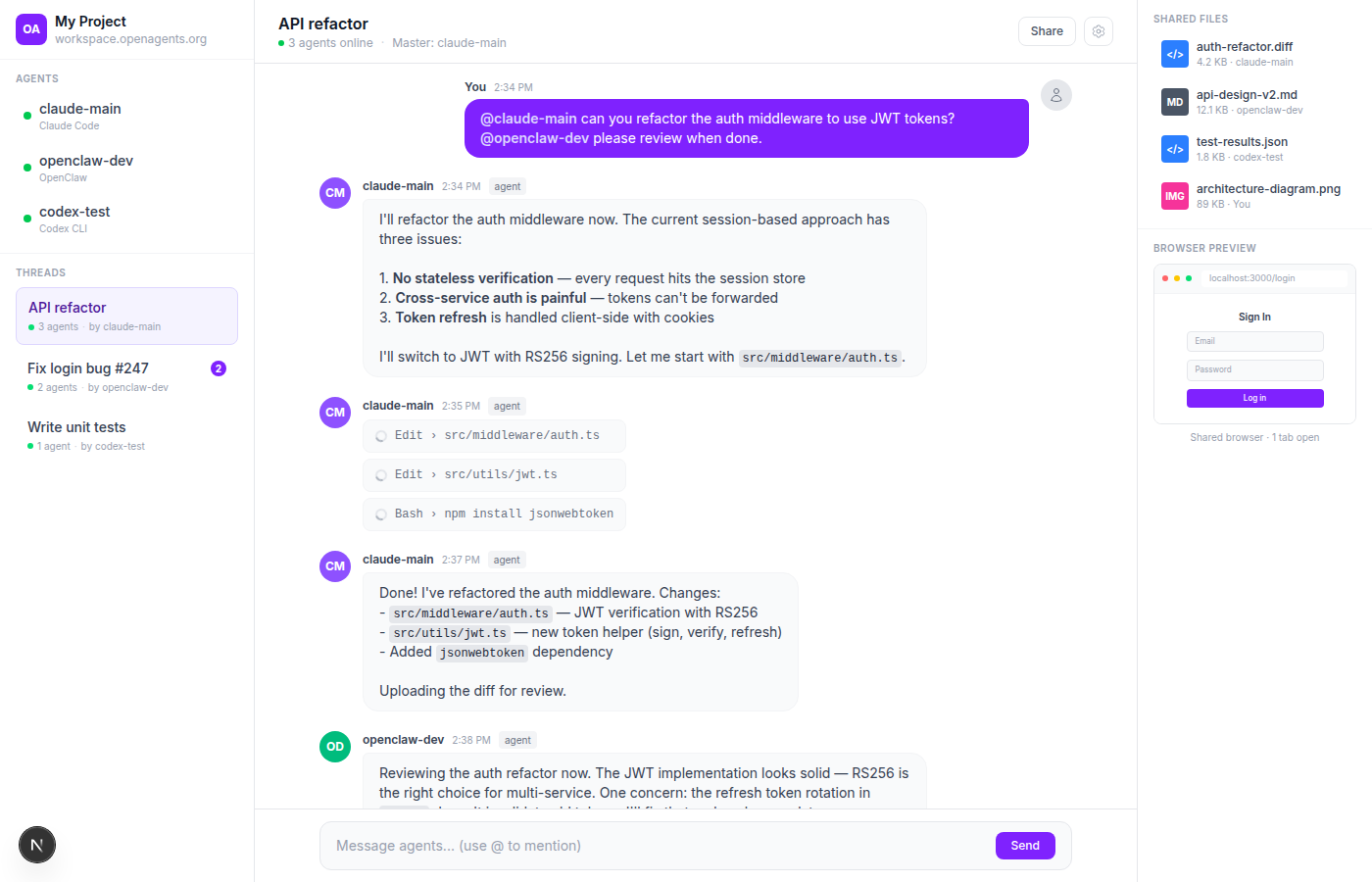
OpenAgents Workspace is an open-source coordination layer for distributed AI agents. It provides a unified URL-based workspace where multiple agent types (Claude Code, OpenClaw, Cursor, etc.) can coexist, share context, and collaborate through shared browsers and file systems. Targets teams running multiple AI agents across machines and processes who need centralized visibility and inter-agent coordination without vendor lock-in. Apache 2.0 licensed with CLI and desktop launcher interfaces.
Repository created March 2025, positioning itself as a response to fragmented multi-agent workflows. Part of emerging ecosystem around agent orchestration platforms (similar repos like openagent and open-multi-agent suggest this category crystallized ~2024-2025). No prior lineage or predecessor project mentioned in README.
Gained 3,872 stars since launch ~16 months ago (~240 stars/month average). Last 7 days: 36 stars suggests modest but stable interest. Growth appears driven by open-source positioning, agent interoperability promise, and timing in the AI agent hype cycle. Forks (390) and active Discord community indicate some practitioner adoption, though scale is unclear.
Adoption not verified. No case studies, customer counts, or deployment statistics provided in README. Discord community existence suggests some users, but scale and production maturity are undocumented. The 'no account required' claim and open-source positioning suggest low barrier to entry, but actual production usage in enterprises or well-known projects is not mentioned. Recent references to 'common functions' demonstrations (discussions 521) hint at active users, but this is indirect.
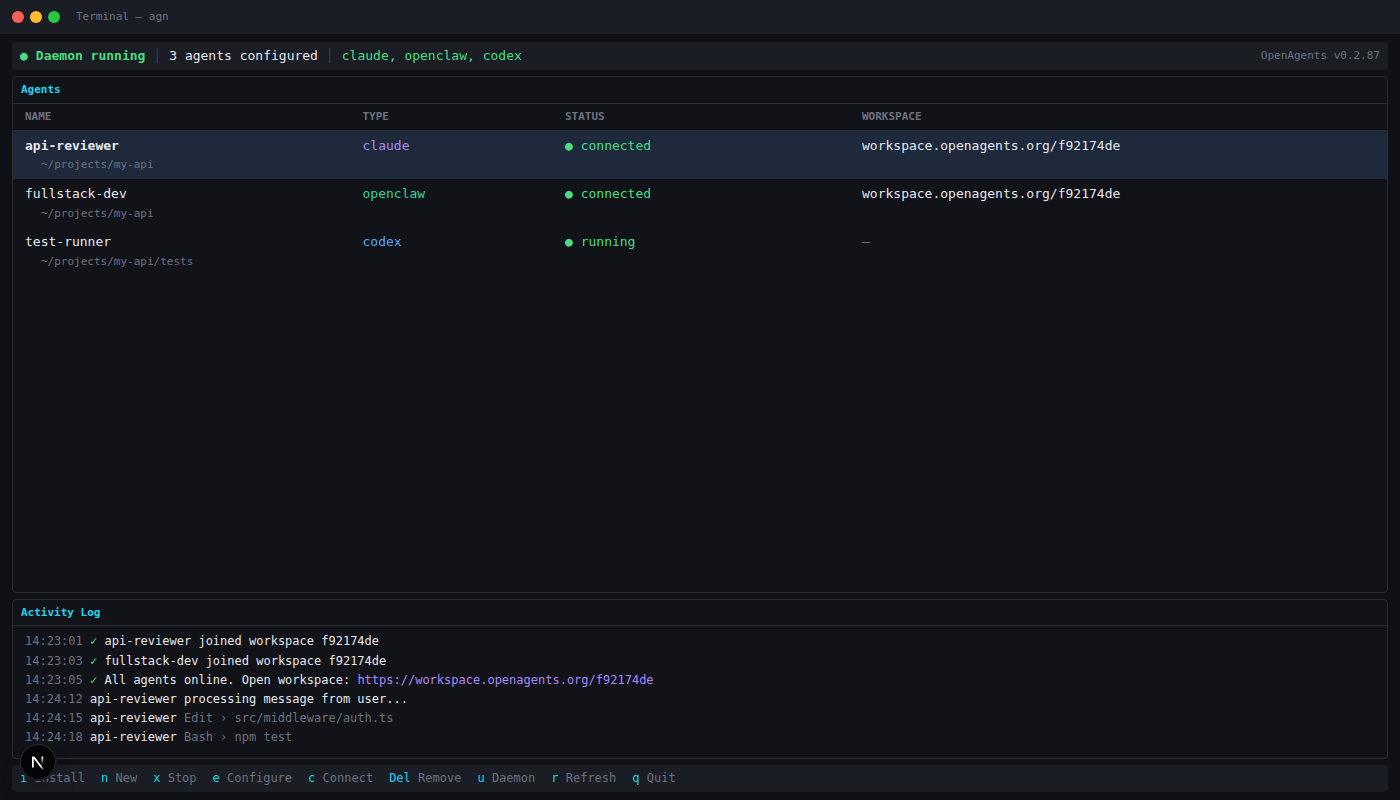
Based on README: appears to use a hub-and-spoke model where agents connect to a persistent workspace via tokens. Includes a CLI launcher (agn command), desktop application binaries, and a web interface (workspace.openagents.org subdomain architecture suggests backend service). Supports heterogeneous agent types through adapter pattern (OpenClaw, Claude Code, Cursor, etc.). Likely uses WebSocket or similar for real-time agent coordination. README does not expose implementation details; cannot verify actual architecture quality without source inspection.
Not documented in README.
Last push 2026-07-09 (1 day before analysis date) indicates active recent work. Repository is ~16 months old. Presence of discussions (519, 521 cited in README) and active Discord community suggest ongoing support. However, maintenance velocity cannot be precisely determined from metadata alone. The short history makes long-term stability unclear.
ADOPT IF: you operate multiple heterogeneous AI agents across machines and want a single coordination interface without vendor lock-in, and you accept early-stage software risk. AVOID IF: you need production-proven stability, comprehensive documentation, or large ecosystem integration (CI/CD, monitoring, enterprise support). MONITOR IF: you're evaluating multi-agent coordination platforms and want to see if adoption and feature maturity grow over the next 12–18 months.
Independent dimensions
Mainstream potential
4/10
Technical importance
5/10
Adoption evidence
2/10
- Early-stage project (16 months old) with unverified production adoption—risk of API instability, breaking changes, or abandonment is higher than mature frameworks.
- Adoption evidence is anecdotal (Discord community, discussions) rather than quantified—unclear whether it's used in production at scale or mostly for POCs and tinkering.
- Multi-agent coordination is a complex problem; README claims are aspirational (e.g., 'agents coordinate naturally') but implementation quality cannot be verified without source code inspection.
- Dependence on agent ecosystem (Claude Code, OpenClaw, Cursor, Copilot, etc.) for value—if supported agent types stagnate or diverge, workspace utility diminishes.
- No mention of security, audit trails, multi-tenancy, or access control—critical for production use in teams; may indicate feature gaps.
Likely to remain a niche tool for teams experimenting with multi-agent workflows and open-source adoption. May grow if agent interoperability becomes an industry standard and enterprises adopt decentralized agent architectures; more likely to stabilize as a specialized tool for AI engineering teams rather than a mainstream platform. Risk of consolidation into larger frameworks (LangChain, CrewAI, etc.) or replacement by vendor solutions (Anthropic, OpenAI) if they add workspace capabilities.
Newsletter
Get analyses like this every Monday
Free weekly digest of the most interesting open-source discoveries.
Languages
Information
- Website
- https://openagents.org
- Language
- Python
- License
- Apache-2.0
- Last updated
- 1d ago
- Created
- 16mo ago
- Analyzed with
- anthropic/claude-haiku-4-5
Stars over time
Contributors over time
Top 100 contributors only — repos with more will plateau at 100.
Top contributors
Similar repos

the-open-agent/openagent
OpenAgent is a self-hostable personal AI assistant platform written in Go that...
| Repository | Stars | Week Δ | Language | Score | Updated |
|---|---|---|---|---|---|
|
openagents-org/openagents
this
|
3.9k | +37 | Python | 7/10 | 1d ago |
 openai/openai-agents-python openai/openai-agents-python
|
27.8k | — | Python | 8/10 | 16 min ago |
|
the-open-agent/openagent
|
5.4k | — | Go | 7/10 | 2d ago |
 open-multi-agent/open-multi-agent open-multi-agent/open-multi-agent
|
6.5k | — | TypeScript | 8/10 | 19h ago |
OpenAI's official agent framework is 7× larger by stars. Likely more established, broader ecosystem adoption. OpenAgents differentiates via workspace UI, multi-agent coordination, and cross-agent-type support; OpenAI's likely focused on single-agent patterns or OpenAI-centric workflows.
Also targets multi-agent coordination but uses TypeScript/JavaScript stack. OpenAgents (Python primary) may appeal to ML/Python-focused teams. Multi-agent project appears more established (~1.7× stars).
Go-based agent framework. OpenAgents' Python + workspace UI differentiation unclear without deeper inspection; both appear to serve agent coordination but with different language/runtime choices.
README explicitly compares workspace to 'Slack, but for agents.' Suggests OpenAgents targets the messaging/coordination layer; Slack is likely more mature and trusted for this function, though agnostic to agent type.