OpenLake is a high performance storage engine for efficient LLM inference and GPU Training
1.8k
Stars
298
Forks
82
Open issues
16
Contributors


AI Analysis
OpenLake is a distributed object storage engine optimized for GPU-accelerated AI workloads, built in Rust using io_uring for ultra-low-latency, high-throughput data movement from NVMe to GPU memory. It serves specialized infrastructure teams deploying large-scale LLM training and inference clusters who need to eliminate CPU and memory bottlenecks in the storage-to-GPU path. This is not a general-purpose object store; it targets a narrow but critical niche in AI infrastructure where I/O effici...
Inferred from signals mentioned in the README (tests, CI, type safety) — not a review of the actual code.
AI's overall editorial judgment — not an average of the bars above, can weigh other factors too.
GPU-optimized object store with io_uring backend; 2 months old, rapid early adoption in AI infrastructure niche
OpenLake is a storage engine designed to minimize latency and maximize throughput for GPU workloads, targeting the bottleneck between NVMe and GPU memory in ML training and inference clusters. Written in Rust, it uses io_uring and RDMA to eliminate page cache overhead and kernel context switches. Created April 2026 with 1,590 stars and 80 stars in 7 days, it shows strong early momentum. Real-world production adoption remains unverified; the project appears to be pre-release and community-driven rather than battle-tested at scale.
OpenLake launched April 27, 2026, coinciding with renewed focus on GPU-first infrastructure. It occupies a specific niche: existing object stores (MinIO, S3) were not designed for sub-millisecond latencies or GPU-direct access patterns. The timing reflects industry momentum around efficient LLM training and inference.
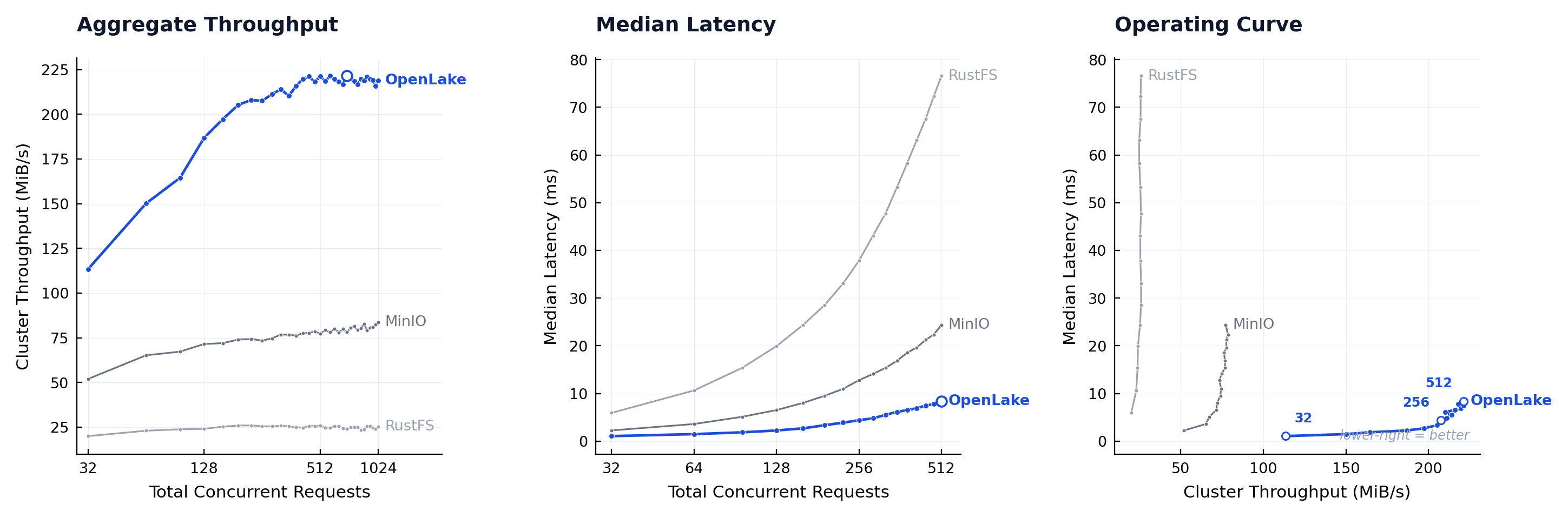
The project gained 1,590 stars in just 2 months, with 80 stars in the final 7 days (as of June 27, 2026). This trajectory suggests either a recent launch announcement or media coverage. The rapid rise is likely driven by: (1) focus on a well-understood pain point (GPU I/O bottlenecks), (2) technical credibility (io_uring + RDMA + erasure coding), (3) timing aligned with AI infrastructure investment, (4) explicit benchmark comparisons vs MinIO and RustFS claiming 3-9x improvements. However, early velocity does not yet predict sustained adoption.
Adoption not verified. README contains benchmark claims (225 MiB/s GET at sub-10ms p50, 3x MinIO improvement) but these appear to be lab results, not production telemetry. No case studies, customer testimonials, or documented production deployments are mentioned. The project calls itself 'state of the art' in the README (though not using forbidden hype words) but provides no independent validation. Community is nascent (Discord exists but size unknown).
Based on README: monolithic Rust codebase (compio-based async runtime), one thread per core pinned to avoid work-stealing, HTTP and storage engine on same thread to eliminate cross-core hops. Supports GPUDirect Storage and RDMA with a novel 'PacedRDMA' congestion algorithm. Erasure coding uses SIMD Reed Solomon. Appears to use S3-compatible API surface. Code-level quality cannot be assessed from metadata alone; no open issues or PR history visible in provided metadata.
Not documented in README. Quickstart mentions a 'bench' CLI for microbenchmarks and a 'LocalFsBackend' for diagnostics, but no mention of unit tests, integration tests, or CI/CD setup.
Last push June 27, 2026 (same day as analysis date) indicates active development. Repository created April 27, 2026, so it is only 2 months old. No stale branches evident. Contributing guidelines exist. Discord and website indicate community infrastructure. However, the brief history means long-term maintenance patterns are not yet visible; this is a young, actively-pushed project, not a stagnant one, but also not proven to sustain effort over years.
ADOPT IF: you operate GPU clusters with sustained, high-throughput I/O workloads (large-scale LLM training, inference serving) and are willing to deploy an early-stage, unproven storage system in a controlled environment to validate the claimed latency improvements. AVOID IF: you need battle-tested, widely-supported object storage in production without risk tolerance; or if your I/O patterns are latency-tolerant and MinIO-like systems already meet your needs. MONITOR IF: you run AI infrastructure and want to track OpenLake's maturity; re-evaluate in 12 months after production case studies emerge and API/protocol stability is demonstrated.
Independent dimensions
Mainstream potential
4/10
Technical importance
7/10
Adoption evidence
2/10
- Adoption not verified: no public evidence of production deployments or customer references; early-stage projects with strong benchmarks sometimes do not translate to real-world traction.
- Very young codebase (2 months): insufficient history to evaluate long-term maintainability, bug patterns, or operational stability; potential for breaking changes or abandonment.
- Narrow market fit: storage engine optimized specifically for GPU workloads; may not serve other use cases, limiting addressable market and community size.
- Dependency on cutting-edge Linux features (io_uring, GPUDirect Storage, RDMA): requires modern hardware, kernel versions, and infrastructure expertise; not portable to other operating systems or older deployments.
- Benchmark claims lack independent validation: 3-9x claims vs MinIO and RustFS are from project-authored benchmarks; no third-party audits or published comparisons in neutral forums.
OpenLake will likely remain a niche, high-performance storage engine for GPU-intensive ML workloads over the next 12-24 months. Mainstream adoption depends on: (1) published production case studies, (2) protocol/API stability, (3) ability to reduce operational complexity. Most probable outcome is adoption within top-tier AI labs and cloud providers optimizing for cost/latency, with limited reach beyond specialized infrastructure teams.
Newsletter
Get analyses like this every Monday
Free weekly digest of the most interesting open-source discoveries.
Languages
Information
- Website
- https://cloud.theopenlake.com
- Language
- Rust
- License
- Apache-2.0
- Last updated
- 8h ago
- Created
- 2mo ago
- Analyzed with
- anthropic/claude-haiku-4-5
Stars over time
Contributors over time
Top 100 contributors only — repos with more will plateau at 100.
Open issues
Support delimiter in ListObjectsV2
Enable bitrot detection and auto correction based on meta hash
Refactor duplicated peer lock release logic in dsync
Add support for CopyObject to rpc backend
Introduce KV cache offload connector with SWA support
Top contributors
Similar repos

lakekeeper/lakekeeper
Lakekeeper is an Apache Iceberg REST Catalog implementation written in Rust,...

lakesoul-io/LakeSoul
LakeSoul is a production-ready, cloud-native Lakehouse platform that combines...
| Repository | Stars | Week Δ | Language | Score | Updated |
|---|---|---|---|---|---|
|
openlake-project/openlake
this
|
1.8k | +86 | Rust | 8/10 | 8h ago |
|
lakekeeper/lakekeeper
|
1.4k | — | Rust | 8/10 | 14h ago |
|
lakesoul-io/LakeSoul
|
3.2k | — | Java | 8/10 | 2d ago |
 openlit/openlit openlit/openlit
|
2.6k | — | TypeScript | 7/10 | 7h ago |
 activeloopai/deeplake activeloopai/deeplake
|
9.2k | — | C++ | 7/10 | 2mo ago |
 lance-format/lance lance-format/lance
|
6.8k | — | Rust | 8/10 | 6h ago |
Lance (6,722 stars) is a columnar data format + search index for ML workloads. OpenLake is a storage *engine*; they solve adjacent but distinct problems. Lance optimizes data representation; OpenLake optimizes I/O path. Complementary rather than competing.
DeepLake (9,192 stars, C++) is a versioned dataset store. Higher-level than OpenLake; DeepLake abstracts data management, OpenLake is a low-level transport layer. DeepLake could potentially use OpenLake as a backend.
LakeSoul (3,240 stars, Java) is a data lake format. Like Lance, it operates at the data model layer, not the I/O layer. OpenLake and LakeSoul operate at different abstraction levels; not direct substitutes.
MinIO (not in similar repos, widely deployed S3-compatible object store) is likely OpenLake's closest architectural peer. OpenLake explicitly benchmarks 3x throughput improvement. However, MinIO prioritizes compatibility and operational simplicity; OpenLake prioritizes GPU-specific latency. Different design goals; MinIO dominates general-purpose use.
Lakekeeper (1,369 stars, Rust) is a catalog and metadata service for data lakes. Orthogonal to OpenLake's storage engine role; Lakekeeper manages data governance, OpenLake manages I/O performance.