TinyVue is an enterprise-class UI component library of OpenTiny community, support both Vue.js 2 and Vue.js 3, as well as PC and mobile.
2.3k
Stars
346
Forks
260
Open issues
30
Contributors


AI Analysis
TinyVue is an enterprise-class UI component library from OpenTiny that provides 104 reusable Vue components supporting both Vue.js 2 and Vue.js 3, with unified code paths for both PC and mobile environments. It serves teams building multi-framework, cross-platform applications who need a comprehensive, configurable component system with internationalization and theming support. Best suited for enterprise developers and low-code platform builders; not designed for single-framework Vue-only pro...
Inferred from signals mentioned in the README (tests, CI, type safety) — not a review of the actual code.
AI's overall editorial judgment — not an average of the bars above, can weigh other factors too.
Vue 2/3 dual-stack component library targeting enterprise and mobile with AI-assisted development tooling
TinyVue is an open-source UI component library offering 104 components that support both Vue.js 2 and Vue.js 3 in a single codebase, plus PC and mobile rendering. Built by OpenTiny (appears to be a Huawei-affiliated community), it targets enterprise developers who need to maintain legacy Vue 2 projects while building new Vue 3 applications. The library includes low-code platform support and AI coding assistant integration. Adoption appears concentrated in Chinese enterprises and developer communities, with modest GitHub presence relative to similar libraries.
Project created November 2022 as part of the OpenTiny open-source initiative. Positioned as an enterprise-grade alternative to existing Vue component libraries, emphasizing dual Vue version support and cross-platform (PC/mobile) reach — features less common in mainstream libraries at the time of inception.
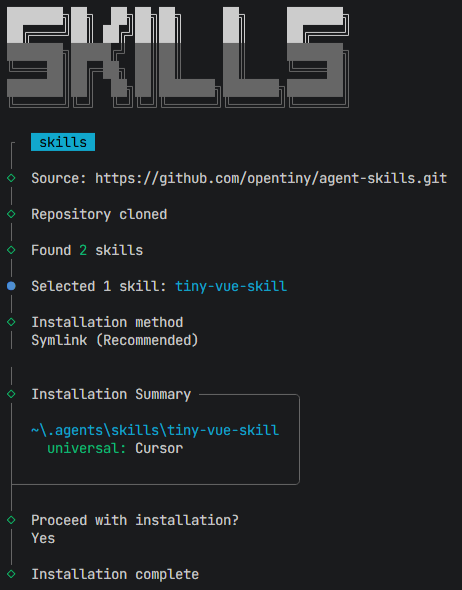
Growth appears steady but modest: 2,250 stars over ~3.5 years, 346 forks. No measurable acceleration in recent weeks (0 stars gained in last 7 days as of evaluation date). Active maintenance shown by recent push (June 24, 2026), but growth trajectory does not indicate rapid market adoption. Presence of AI coding assistant integration (tiny-vue-skill) suggests strategic positioning toward emerging AI-driven development workflows, but this addition is unlikely to significantly alter adoption trajectory without foundational user base expansion.
Adoption not verified in provided metadata. README references WeChat technical exchange groups and mailing list but provides no documented case studies, user testimonials, or production deployment statistics. Presence in enterprise-targeted positioning and low-code platform support suggests intended use in production, but real-world adoption evidence is absent from README and repository metadata.
Based on README: appears to use a modular architecture supporting configuration-driven component development for low-code platforms. Likely built with cross-end and cross-framework portability as a core design constraint. Codebase written primarily in Less (stylesheet language), suggesting heavy CSS customization emphasis. Single codebase supporting both Vue 2 and Vue 3 implies conditional/adapter pattern implementation, though specific approach not documented in README.
Not documented in README. No evidence of testing strategy, coverage metrics, or CI/CD pipeline visibility provided.
Recent activity: push date June 24, 2026 (9 days before evaluation date) indicates active maintenance. Contributor list shows multiple individuals with merged PRs, suggesting ongoing collaboration. Absence of issue activity and response time metrics in provided metadata limits assessment of issue triage velocity. Slow star growth despite active development suggests maintenance is focused on stability and feature completeness rather than rapid adoption expansion.
ADOPT IF: you maintain legacy Vue 2 applications while building new Vue 3 projects and need unified component strategy; you require PC and mobile from single codebase; you operate in Chinese enterprise ecosystem where this library has clearer adoption patterns. AVOID IF: you need high-confidence production ecosystem with abundant third-party integrations and public case studies; you are Vue 3-only project where Naive UI, Element Plus, or similar larger communities better serve your needs; your team lacks experience with Less-based customization. MONITOR IF: you are evaluating for low-code platform integration; you are considering long-term strategic alignment and want to observe whether AI coding assistant positioning drives adoption; you need to assess regional community size and support channels before committing.
Independent dimensions
Mainstream potential
3/10
Technical importance
6/10
Adoption evidence
2/10
- Adoption appears geographically and linguistically concentrated (Chinese community), limiting English-language documentation and support surface area for international teams.
- No publicly documented production deployments or case studies; real-world reliability at scale is unverified.
- Dual Vue 2/3 support increases maintenance complexity; single codebase strategy may constrain optimization for each version.
- AI coding assistant integration (tiny-vue-skill) is recent and immature; unclear if adoption will materially improve without expanded ecosystem.
- GitHub activity suggests stable maintenance but not rapid feature velocity; feature parity with competitors may gradually erode if development velocity does not increase.
TinyVue will likely remain a stable, niche solution serving enterprises with legacy Vue 2 requirements and Chinese market presence. Unlikely to achieve mainstream adoption outside Asia-Pacific region without significant English-language documentation and international case study publication. AI assistant tooling may provide incremental adoption boost but is insufficient to drive category leadership. Project will probably persist long-term as a maintained but slow-growth library.
Explore similar
Newsletter
Get analyses like this every Monday
Free weekly digest of the most interesting open-source discoveries.
Languages
Information
- Website
- https://opentiny.design/tiny-vue
- Language
- Less
- License
- MIT
- Last updated
- 2w ago
- Created
- 44mo ago
- Analyzed with
- anthropic/claude-haiku-4-5
Stars over time
Contributors over time
Top 100 contributors only — repos with more will plateau at 100.
Open issues
Top contributors
Similar repos
| Repository | Stars | Week Δ | Language | Score | Updated |
|---|---|---|---|---|---|
|
opentiny/tiny-vue
this
|
2.3k | — | Less | 7/10 | 2w ago |
 youzan/vant youzan/vant
|
24.3k | — | TypeScript | 9/10 | 3d ago |
 Tencent/tdesign-vue-next Tencent/tdesign-vue-next
|
2.1k | — | TypeScript | 7/10 | 21h ago |
|
Tencent/tdesign-vue
|
1k | — | TypeScript | 7/10 | 3d ago |
 tusen-ai/naive-ui tusen-ai/naive-ui
|
18.4k | — | TypeScript | 8/10 | 5d ago |
10x larger community. Vant is mobile-first (YouZan retail focus). TinyVue supports both PC and mobile with single codebase. Vant is Vue 3-only in recent versions; TinyVue explicitly supports Vue 2 legacy projects — a meaningful differentiation for enterprises with dual-version requirements.
Similar star count but split across Vue 2/3. TinyVue consolidates this with one codebase supporting both. TDesign is Tencent-backed; TinyVue is OpenTiny/Huawei-affiliated. Regional adoption patterns likely differ.
Vue 3-only, PC-focused. Much larger adoption. TinyVue's dual Vue version support and mobile capabilities are orthogonal feature sets, not direct replacements.
Not in provided similar list but implied context. Similar dual-version strategy historically. TinyVue emphasizes single-codebase maintenance vs. separate library versions — potentially lower maintenance burden.
Enterprise-focused like TinyVue. Vue 3 primary. TinyVue's mobile support and Vue 2 compatibility are distinguishing factors in some niches.