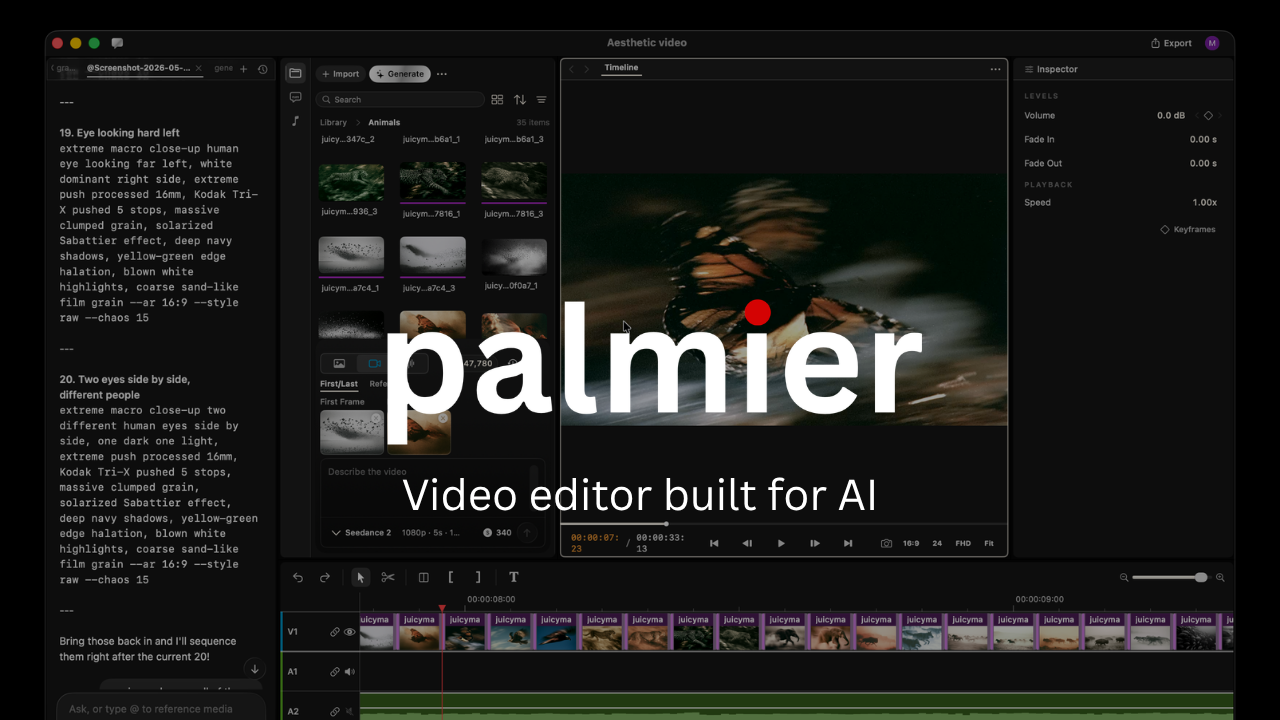
macOS video editor built for AI
10.2k
Stars
766
Forks
71
Open issues
18
Contributors


AI Analysis
Palmier Pro is a Swift-native video editor for macOS that integrates generative AI directly into the timeline, allowing users and AI agents to collaboratively generate and edit videos using models like Seedance and Kling. It is best suited for content creators and AI developers who want to experiment with AI-assisted video production on macOS; it is not a general-purpose editor for traditional video workflows and requires macOS 26 (Tahoe) on Apple Silicon. The project also exposes an MCP serv...
Inferred from signals mentioned in the README (tests, CI, type safety) — not a review of the actual code.
AI's overall editorial judgment — not an average of the bars above, can weigh other factors too.
Open-source macOS video editor brings MCP agent integration and generative AI into the timeline
Palmier Pro is a Swift-native, open-source video editor for macOS that lets users and AI agents collaboratively edit video timelines. It exposes a local MCP server so tools like Claude, Codex, and Cursor can programmatically control the editor. Generative video/image models (Seedance, Kling, etc.) are embedded directly in the timeline. Built by a YC S24 company, it targets AI-forward creators and developers who want agent-driven or AI-assisted video workflows, not traditional professional editors.
Created in April 2026 by Palmier, a YC S24 startup. Appears purpose-built around the MCP protocol and the Apple Intelligence / macOS 26 (Tahoe) era, suggesting it was designed from the outset to exploit the emerging agent-tool ecosystem rather than retrofitting AI onto an existing editor.
7,418 stars gained in a single week on a repo that is only ~2.5 months old strongly suggests a viral social-media or Hacker News/X launch event around June 2026. The YC affiliation and novel MCP-based positioning likely drove attention from the developer and AI-enthusiast communities. Growth appears spike-driven rather than organic accumulation, which is common for newly launched open-source tools with strong novelty framing.
Adoption not verified in a formal sense. Star count and fork count (553) suggest meaningful developer interest, but stars alone do not confirm production usage. No case studies, user testimonials, or download metrics are cited in the README. The app requires macOS 26 (Tahoe) on Apple Silicon, a platform that was very newly released as of this analysis, which further constrains the addressable user base at this moment. Community Discord existence suggests some active users but scale is unknown.
Appears to be a fully native Swift application targeting Apple Silicon macOS 26 (Tahoe). Likely uses AVFoundation or a similar Apple media framework for timeline editing. The MCP server is exposed as a local HTTP endpoint (127.0.0.1:19789), suggesting an embedded lightweight HTTP server. Generative AI processing is described as closed-source, implying the open-source portion is the editor shell and MCP/agent interface, while model inference calls likely go to Palmier's cloud.
Not documented in README.
Last push was 2026-06-23, one day before the evaluation date, indicating very active, ongoing development. The repo is only ~2.5 months old and is being pushed to near-daily, which is a strong positive maintenance signal for a project at this stage. Discord and GitHub Issues are listed as support channels, suggesting active community engagement.
ADOPT IF: you are a developer or AI-forward creator on Apple Silicon macOS 26 who wants to experiment with agent-controlled video editing via Claude, Cursor, or Codex, and can accept an early-stage tool. AVOID IF: you need a stable production editor, work on Windows/Linux or older macOS, or require the full feature depth of a mature NLE — the macOS 26-only constraint alone eliminates most current users. MONITOR IF: you are watching the MCP ecosystem and want to see whether agent-driven media editing gains traction as macOS 26 adoption grows over 2026-2027.
Independent dimensions
Mainstream potential
5/10
Technical importance
7/10
Adoption evidence
2/10
- Hard platform dependency on macOS 26 (Tahoe) and Apple Silicon severely limits addressable audience, at least until macOS 26 penetration grows significantly through 2026-2027.
- Viral star growth may not translate to sustained active users; spike-driven GitHub attention often precedes a sharp engagement decline if the product experience does not retain users.
- The generative AI features (the primary differentiator beyond free editing) are closed-source and require a paid subscription, introducing a business-model dependency that could change pricing, availability, or quality independently of the open-source core.
- As a ~2.5-month-old project, the editor likely lacks features, stability, and polish expected by users accustomed to mature NLEs; early-stage churn risk is high.
- MCP as a protocol for controlling desktop media applications is very new; if the MCP ecosystem fragments or agent tooling conventions shift, the core integration story may require significant rework.
Likely to remain a developer-and-early-adopter tool through late 2026 as macOS 26 adoption ramps. If the MCP agent-editing paradigm resonates, it could carve a durable niche; broader mainstream uptake depends on platform expansion and feature maturity.
Newsletter
Get analyses like this every Monday
Free weekly digest of the most interesting open-source discoveries.
Languages
Information
- Website
- https://palmier.io
- Language
- Swift
- License
- GPL-3.0
- Last updated
- 7h ago
- Created
- 3mo ago
- Analyzed with
- anthropic/claude-haiku-4-5
Stars over time
Contributors over time
Top 100 contributors only — repos with more will plateau at 100.
Open issues
New Feature Request: XML Imports and Exports
Custom STT
Ability to restructure parts
Agent crash: an out-of-range integer frame arg (near Int.max) traps Int arithmetic and kills the app
Windows help
Top contributors
Recent releases
Similar repos

digitalsamba/claude-code-video-toolkit
An AI-native video production toolkit that integrates with Claude Code to...

jau123/MeiGen-AI-Design-MCP
MeiGen AI Design MCP is an open-source MCP server that integrates AI image and...
| Repository | Stars | Week Δ | Language | Score | Updated |
|---|---|---|---|---|---|
|
palmier-io/palmier-pro
this
|
10.2k | +377 | Swift | 7/10 | 7h ago |
|
digitalsamba/claude-code-video-toolkit
|
1.7k | — | Python | 8/10 | 4d ago |
 Emily2040/seedance-2.0 Emily2040/seedance-2.0
|
3.7k | — | Python | 7/10 | 3d ago |
|
jau123/MeiGen-AI-Design-MCP
|
1.5k | — | TypeScript | 8/10 | 2w ago |
 ArcReel/ArcReel ArcReel/ArcReel
|
3.2k | — | Python | 7/10 | 6h ago |
 SamurAIGPT/Generative-Media-Skills SamurAIGPT/Generative-Media-Skills
|
3.8k | — | Shell | 8/10 | 3w ago |
The stated north-star reference. Premiere is a full professional NLE with decades of feature depth, broad platform support, and established AI features (Firefly integration). Palmier Pro is narrower in scope and macOS/Apple Silicon-only, but differentiates on native MCP agent control, which Premiere does not offer.
Mentioned by Palmier itself as a comparable free editor. CapCut has massive consumer adoption and strong AI features but no MCP/agent programmability. Palmier targets a more technical, developer-adjacent audience.
Free, professional-grade, cross-platform NLE with scripting APIs. Has broader hardware support and a mature scripting/automation layer, but no MCP server or generative AI model integration in the timeline. More suitable for traditional professional workflows.
AI-native editor focused on transcript-driven editing. Targets content creators wanting AI assistance but through a different paradigm (text-based). No MCP integration; closed-source SaaS. Palmier's MCP approach gives developers more programmatic control.
Strong generative video AI platform with editing capabilities. Cloud-based and cross-platform but not an open-source NLE. Palmier's open-source core and local MCP server offer a different trust and extensibility profile.