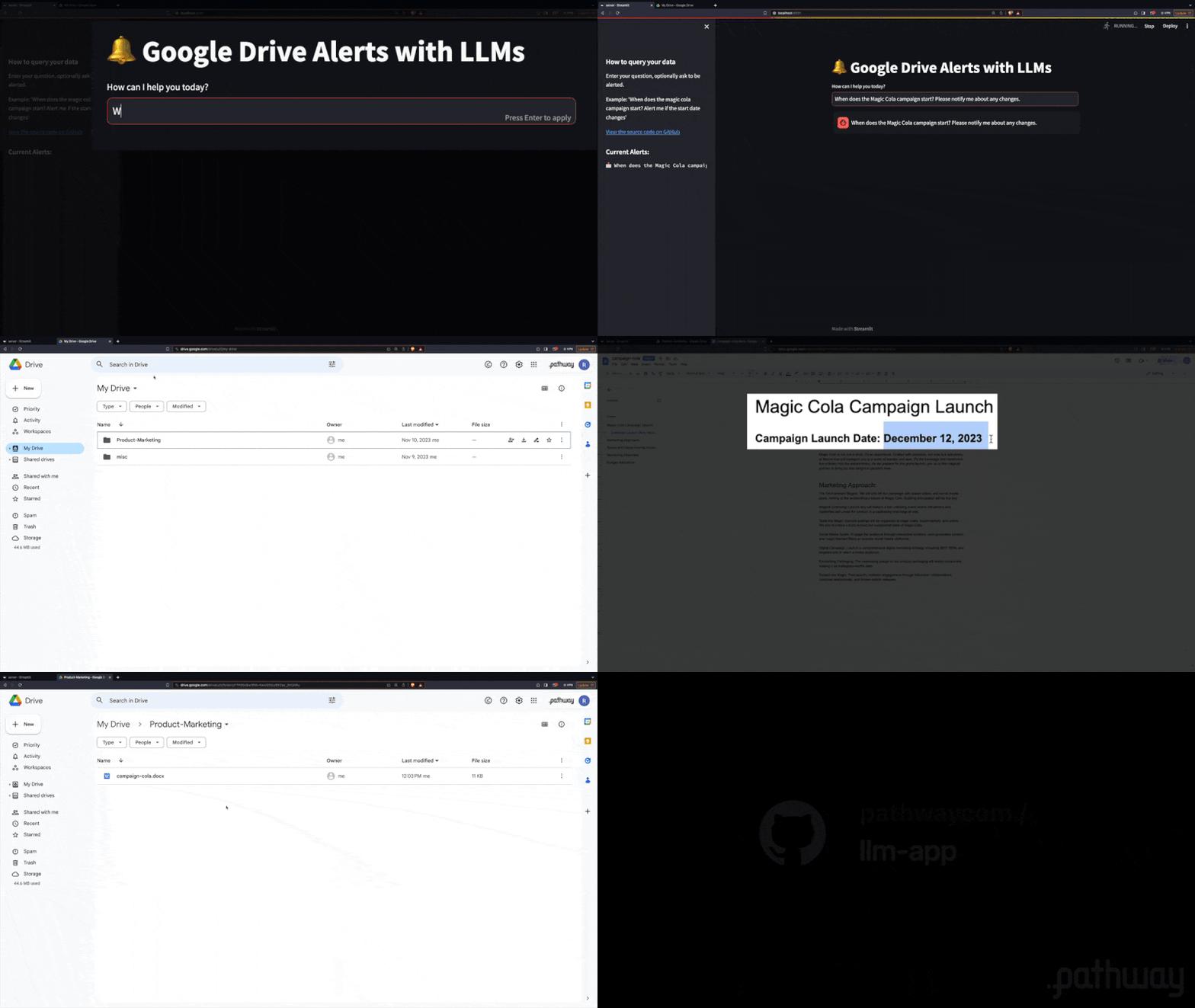
Ready-to-run cloud templates for RAG, AI pipelines, and enterprise search with live data. 🐳Docker-friendly.⚡Always in sync with Sharepoint, Google Drive, S3, Kafka, PostgreSQL, real-time data APIs, and more.
59.1k
Stars
1.4k
Forks
10
Open issues
24
Contributors


AI Analysis
Pathway LLM App provides ready-to-deploy cloud templates for building RAG pipelines, AI enterprise search, and LLM-powered chatbots that stay continuously synchronized with live data sources such as Google Drive, SharePoint, S3, Kafka, and PostgreSQL. It is best suited for teams that need real-time, always-fresh document retrieval and question-answering without managing separate vector database infrastructure. This is primarily a tool for ML engineers and backend developers building productio...
Inferred from signals mentioned in the README (tests, CI, type safety) — not a review of the actual code.
AI's overall editorial judgment — not an average of the bars above, can weigh other factors too.
Live-data RAG templates for enterprise search that stay in sync with real-time sources
llm-app is a collection of ready-to-deploy RAG and enterprise search pipeline templates built on the Pathway Live Data Framework. Its distinguishing angle is continuous, low-latency synchronization with live data sources — SharePoint, Google Drive, S3, Kafka, PostgreSQL, and REST APIs — without requiring a separate ETL layer. Targeted at developers and data engineers who need production-grade RAG that reflects document changes in near real-time, rather than periodic batch re-indexing. Useful for enterprises with frequently-updated document corpora where answer staleness is a real problem.
Created in July 2023 as the applied templates layer on top of Pathway, a Python/Rust streaming data engine. Grew rapidly in late 2023 alongside the broader RAG ecosystem boom, positioning itself as the 'live data' alternative to static vector-store pipelines.
Accumulated nearly 60k stars quickly, driven by its early positioning in the RAG wave of 2023-2024 and presence on trending lists (Trendshift badge visible in README). Growth has plateaued — 0 stars in the last 7 days as of June 2026 — suggesting the viral phase is over. The underlying Pathway framework may sustain the project's relevance even if template-repo star growth stalls.
No third-party case studies or named production deployments are cited in the README. Demo REST endpoints are provided by Pathway itself. The 1,432 forks suggest meaningful developer experimentation, but independent production deployments are not directly verifiable from available metadata. Adoption not verified at enterprise scale beyond Pathway's own demos.
Appears to follow a template-per-use-case structure: each subdirectory is a self-contained pipeline (Docker-composable, HTTP API + optional Streamlit UI). The Pathway engine likely handles incremental dataflow and in-process vector indexing (in-memory, with cache per README). Likely no external vector database required by default. REST API exposure and Docker packaging suggest microservice-style deployment.
Not documented in README
Last push was June 10, 2026 — 11 days before evaluation date — indicating active maintenance. The project has been continuously updated for nearly 3 years. Pathway's commercial backing (pathwaycom org) provides staffing continuity. Discord community and X presence suggest ongoing developer engagement.
ADOPT IF: you need RAG pipelines where data freshness is critical (frequently updated SharePoint/Drive/Kafka sources) and want pre-built, Docker-deployable templates to avoid building sync infrastructure from scratch. AVOID IF: you need a battle-tested, vendor-supported production system with documented SLAs, or if your data is mostly static and any major vector-store framework already fits your needs. MONITOR IF: you are evaluating Pathway as a streaming data engine for AI workloads — the templates are the best entry point to assess whether the underlying framework suits your architecture.
Independent dimensions
Mainstream potential
4/10
Technical importance
7/10
Adoption evidence
3/10
- Deep coupling to the Pathway framework means adoption requires buying into a less mainstream engine; switching costs are non-trivial if Pathway's development direction diverges from your needs.
- Star growth has flatlined as of mid-2026, and there is no verified evidence of widespread independent production deployments — the project may remain primarily a showcase for Pathway's commercial product.
- In-memory vector indexing (per README) likely imposes RAM limits at very large scale; the claim of 'millions of pages' lacks third-party benchmarks to validate in the README.
- The Jupyter Notebook primary language classification suggests the repo is partly educational/demo material, which may limit direct production applicability without meaningful customization.
- Dependency on a single commercial backer (Pathway) for the core engine introduces business continuity risk if funding or priorities shift.
Likely to remain a well-maintained reference implementation and lead-generation tool for Pathway's commercial offering rather than becoming a standalone dominant framework. Niche utility for live-data RAG will persist.
Newsletter
Get analyses like this every Monday
Free weekly digest of the most interesting open-source discoveries.
Languages
Information
- Language
- Jupyter Notebook
- License
- MIT
- Last updated
- 5d ago
- Created
- 36mo ago
- Analyzed with
- anthropic/claude-sonnet-4-6
Stars over time
Contributors over time
Top 100 contributors only — repos with more will plateau at 100.
Open issues
Compliance audit trails for enterprise RAG pipelines
Getting Started instructions are fragmented across templates, making initial setup unclear
[Question]: Could it be An APP in cellphone ?
Pathway's connector issue in Jsonlines
[FEATURE] OpenAI Chat Completion response streaming support
Top contributors
Recent releases
No releases published yet.
Similar repos

Shubhamsaboo/awesome-llm-apps
Awesome LLM Apps is a curated collection of 100+ ready-to-run Python templates...

Mintplex-Labs/anything-llm
AnythingLLM is a self-hosted, all-in-one AI platform that lets users chat with...
| Repository | Stars | Week Δ | Language | Score | Updated |
|---|---|---|---|---|---|
|
pathwaycom/llm-app
this
|
59.1k | — | Jupyter Notebook | 8/10 | 5d ago |
|
Shubhamsaboo/awesome-llm-apps
|
117.3k | — | Python | 8/10 | 12h ago |
 llmware-ai/llmware llmware-ai/llmware
|
14.8k | — | Python | 8/10 | 2mo ago |
 EmbeddedLLM/JamAIBase EmbeddedLLM/JamAIBase
|
1.1k | — | Python | 7/10 | 1mo ago |
|
Mintplex-Labs/anything-llm
|
63k | — | JavaScript | 8/10 | 15h ago |
 DataTalksClub/llm-zoomcamp DataTalksClub/llm-zoomcamp
|
6.7k | — | Jupyter Notebook | 8/10 | 6d ago |
LangChain is far more widely adopted and flexible, but requires users to wire together their own ingestion, embedding, and sync logic. llm-app provides the sync layer out of the box at the cost of framework lock-in to Pathway.
AnythingLLM (61k stars) is a full-stack chat UI over documents, targeting non-technical users. llm-app targets developers building backend pipelines and is not a UI product. Different use cases despite similar star counts.
llmware focuses on small-model fine-tuning and enterprise document parsing. llm-app focuses on real-time sync and retrieval rather than model management. Complementary more than competing.
Haystack is a mature, production-proven pipeline framework with broader connector ecosystem. llm-app's advantage is live streaming sync via Pathway; Haystack requires custom integration for real-time updates.
Managed cloud search services handle sync natively but are vendor-locked and costly at scale. llm-app offers a self-hosted, open-source path with comparable live-data claims, though without the same enterprise SLA guarantees.