postalsys/emailengine
JavaScript No license Dev Tools Single maintainer risk License not recognized by GitHubHeadless email client
2.2k
Stars
222
Forks
0
Open issues
18
Contributors


AI Analysis
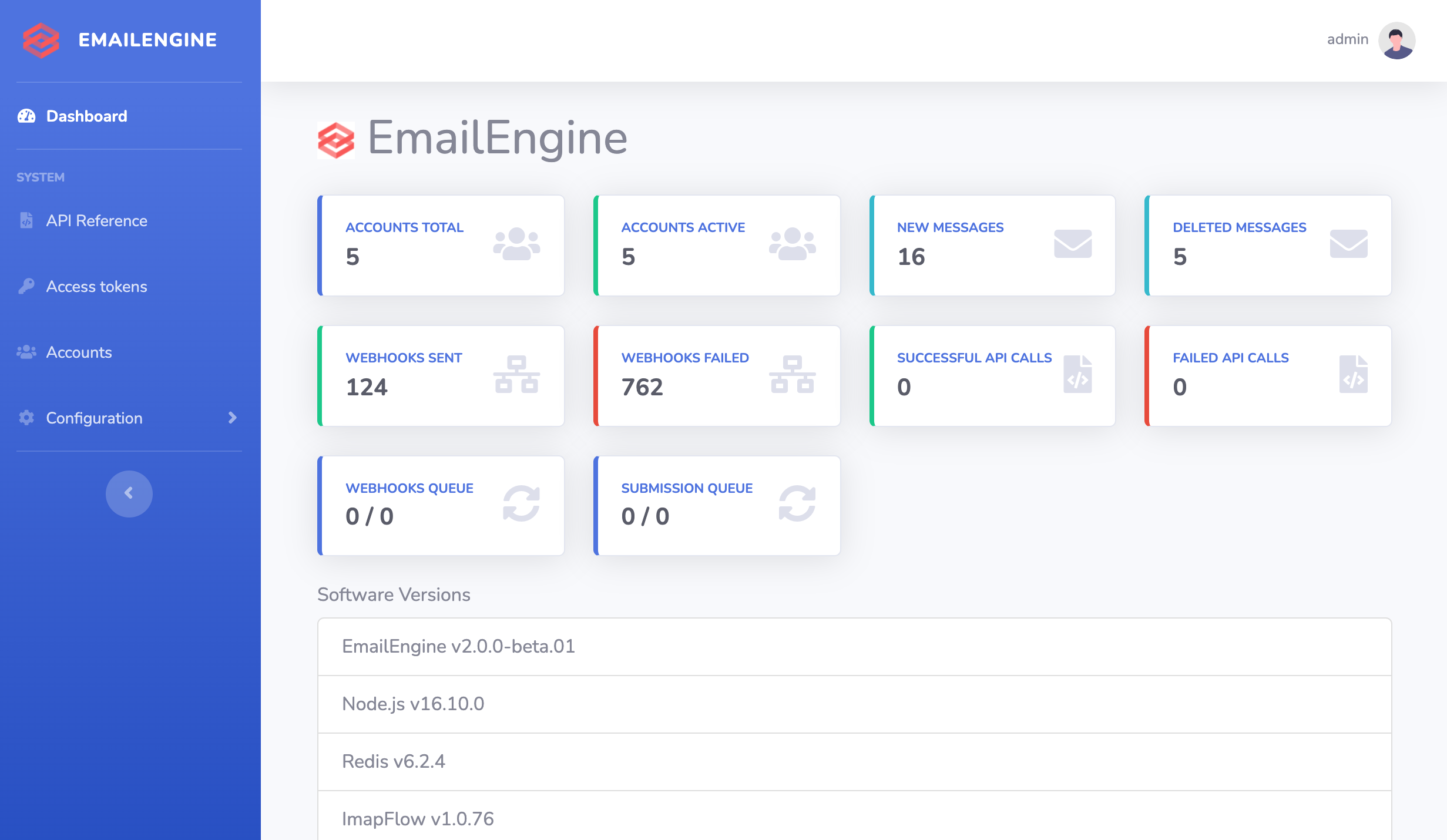
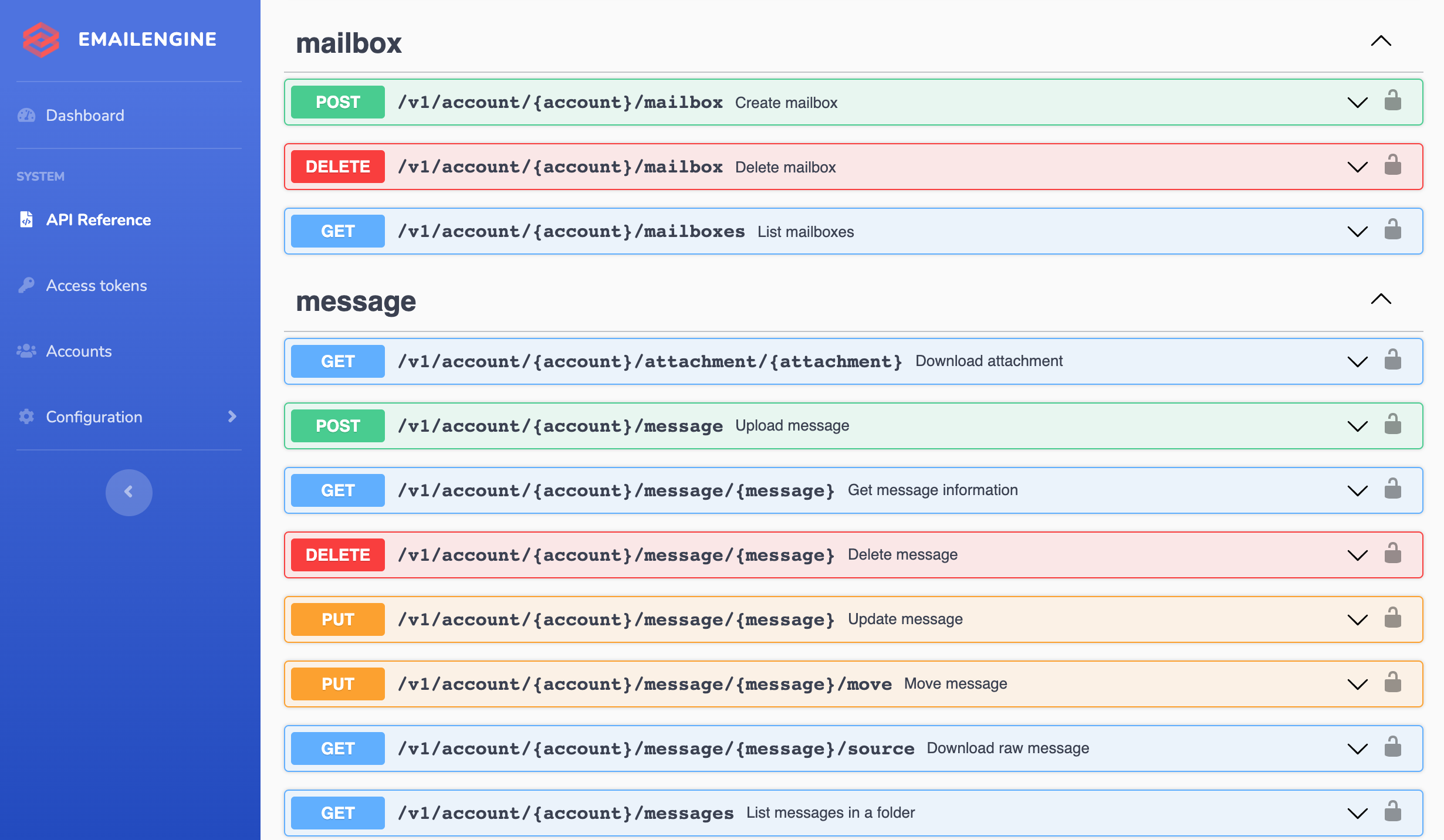
EmailEngine is a self-hosted headless email client providing unified REST API access to IMAP, SMTP, Gmail API, and MS Graph API. It is purpose-built for developers and SaaS companies needing to integrate email functionality (sync, send, monitor) into applications without direct MIME/IMAP handling; it is not suited for users seeking a traditional email client or open-source-only solutions, as it requires a paid subscription after the 14-day trial.
Inferred from signals mentioned in the README (tests, CI, type safety) — not a review of the actual code.
AI's overall editorial judgment — not an average of the bars above, can weigh other factors too.
Headless email API with unified IMAP/SMTP/Gmail/Graph access; commercial source-available model with modest adoption.
EmailEngine is a Node.js application that abstracts IMAP, SMTP, Gmail API, and Microsoft Graph API behind a single REST API, targeting developers who need programmatic email access without direct protocol handling. It requires Redis, charges for production use beyond a 14-day trial, and serves use cases like webmail/mobile apps, email sync integrations, and inbox monitoring. Adoption appears concentrated among SMB developers and niche integrators; no public case studies or enterprise references evident.
Created February 2020, EmailEngine has evolved from a hobbyist headless client into a maintained commercial product. The shift to source-available licensing occurred after initial development, reflecting a business model change rather than organic growth into a category leader.
Repository gained 2,189 stars over 6+ years with modest recent velocity (7 stars in 7 days as of early July 2026). Growth appears steady rather than accelerating, suggesting a stable niche audience rather than expanding market penetration. Most similar projects (Mailspring at 17k stars, mailpit at 9.7k stars) are substantially larger, indicating EmailEngine has not become the category default.
Adoption not verified. No public case studies, customer references, or deployment counts mentioned. README lists use cases (webmail, support email sync, spam testing) but does not cite real implementations. Docker image availability and Prometheus metrics suggest production readiness, but concrete usage evidence is absent. GitHub stars (2,189) are modest relative to competing tools in the headless email category.
Based on README, appears to be a Node.js/Express server using Redis as primary data store. Supports multiple OAuth flows (Gmail, Microsoft Graph) and direct IMAP/SMTP. Includes Bull queue management, Prometheus metrics, and Bull Arena UI for observability. Likely uses a message-oriented architecture with queue-based job processing for email sync.
Not documented in README. No mention of test suites, CI/CD pipelines, or test coverage percentages.
Last push July 5, 2026 (same day as analysis date), indicating active maintenance. Deployment documentation (Ubuntu/Debian install script, Docker, SystemD) is comprehensive and current. No evidence of abandoned issues or slow response times, but issue/PR statistics not provided in metadata. Appears actively maintained rather than stagnant, though growth is slow.
ADOPT IF: you need to centralize multi-protocol email access (IMAP/SMTP/Gmail/Graph) behind a single REST API, can operate within a commercial licensing model, and have operational capacity to run and monitor Redis. Teams building webmail, email sync platforms, or inbox monitoring services may find value. AVOID IF: you require pure open-source licensing, need a mature ecosystem with extensive third-party integrations, or prefer established tools with larger reference bases. You will need to operate infrastructure (Redis, server) and commit to subscription costs. MONITOR IF: you are evaluating headless email tooling and want to track EmailEngine's adoption trajectory—current evidence suggests it remains niche, but maintenance is active and the problem it solves is real.
Independent dimensions
Mainstream potential
3/10
Technical importance
6/10
Adoption evidence
2/10
- Commercial source-available model creates licensing friction; adoption may be constrained by willingness to pay beyond trial period.
- Redis dependency introduces operational complexity and potential failure mode (README warns of RAM saturation causing application failure); not suitable for low-ops environments.
- Adoption not verified in public record; no large case studies or reference customers visible, making it difficult to assess production stability at scale.
- Modest GitHub activity and slow star growth relative to category peers suggest limited community momentum; risk of slow feature velocity or prioritization misalignment.
- Multiple concurrent API standards (IMAP, SMTP, Gmail OAuth, Microsoft Graph) increase maintenance surface area; bugs in one protocol may impact reliability.
EmailEngine will likely remain a stable, actively maintained tool for specialized backend email integrations. Commercial licensing may prevent explosive growth, but slow, sustainable adoption in niche use cases (webmail builders, email sync startups) is probable. No evidence suggests it will displace category leaders or become mainstream.
Newsletter
Get analyses like this every Monday
Free weekly digest of the most interesting open-source discoveries.
Languages
Information
- Website
- https://emailengine.app/
- Language
- JavaScript
- License
- NOASSERTION
- Last updated
- 4d ago
- Created
- 77mo ago
- Analyzed with
- anthropic/claude-haiku-4-5
Stars over time
Contributors over time
Top 100 contributors only — repos with more will plateau at 100.
Open issues
No open issues — clean slate.
Open pull requests
Top contributors
Similar repos

Foundry376/Mailspring
Mailspring is an open-source email client for macOS, Windows, and Linux that...

Mailtrain-org/mailtrain
Mailtrain is a self-hosted newsletter and email marketing automation platform...
| Repository | Stars | Week Δ | Language | Score | Updated |
|---|---|---|---|---|---|
|
postalsys/emailengine
this
|
2.2k | +7 | JavaScript | 7/10 | 4d ago |
|
Foundry376/Mailspring
|
17.7k | — | JavaScript | 7/10 | 23h ago |
 axllent/mailpit axllent/mailpit
|
9.8k | — | Go | 8/10 | 1d ago |
|
Mailtrain-org/mailtrain
|
5.7k | — | JavaScript | 7/10 | 9mo ago |
 anypost/emailmd anypost/emailmd
|
1.3k | — | TypeScript | 8/10 | 5d ago |
 maildev/maildev maildev/maildev
|
5.9k | — | TypeScript | 7/10 | 2d ago |
Desktop email client (17.7k stars) vs. EmailEngine's headless API. Mailspring is user-facing; EmailEngine serves backend integrations. Different markets, though both JavaScript-based.
Go-based SMTP testing and email inspection tool (9.8k stars) with simpler scope. mailpit focuses on local testing; EmailEngine targets multi-account sync and REST abstraction. mailpit has wider adoption.
Email campaign platform (5.7k stars) with self-hosting support. Mailtrain is marketing-focused; EmailEngine is integration-focused. Different use cases; Mailtrain has larger community.
Email forwarding and relay service (1.6k stars). Narrower scope; EmailEngine is more general-purpose API. Similar adoption scale but different problem domain.
Mature npm libraries for SMTP/email; EmailEngine wraps multiple protocols. nodemailer is more specialized and widely used; EmailEngine adds IMAP sync and unified API but is less established.