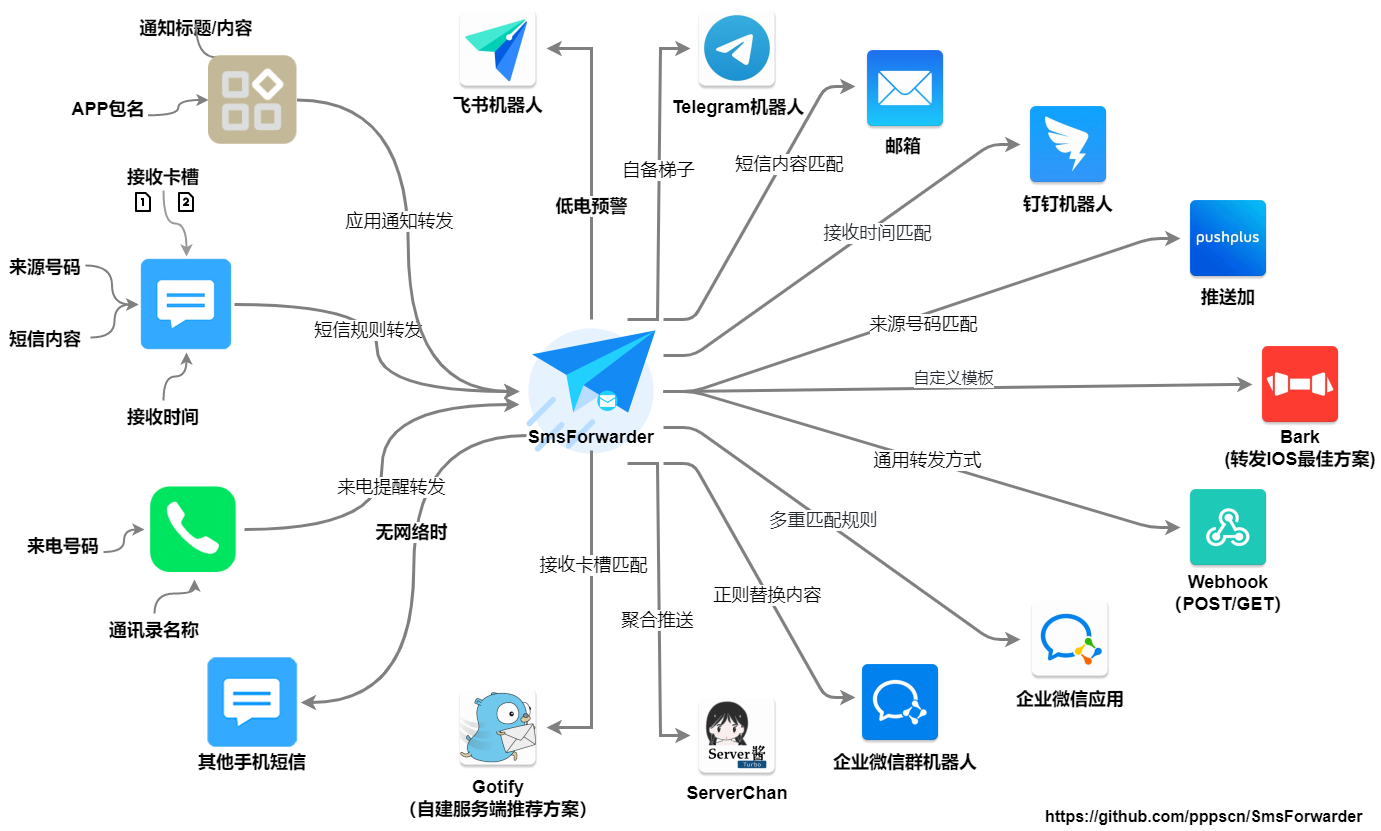
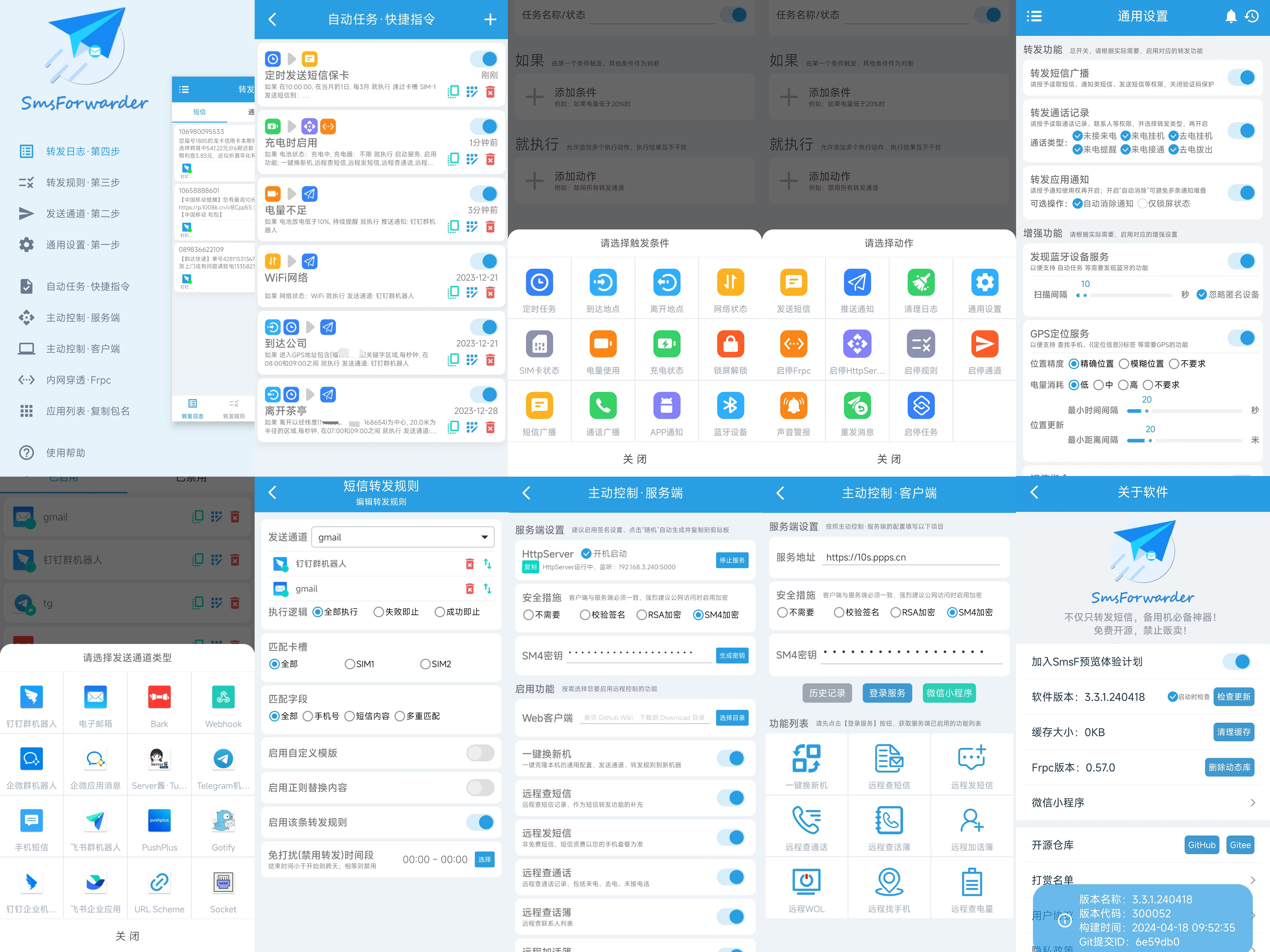
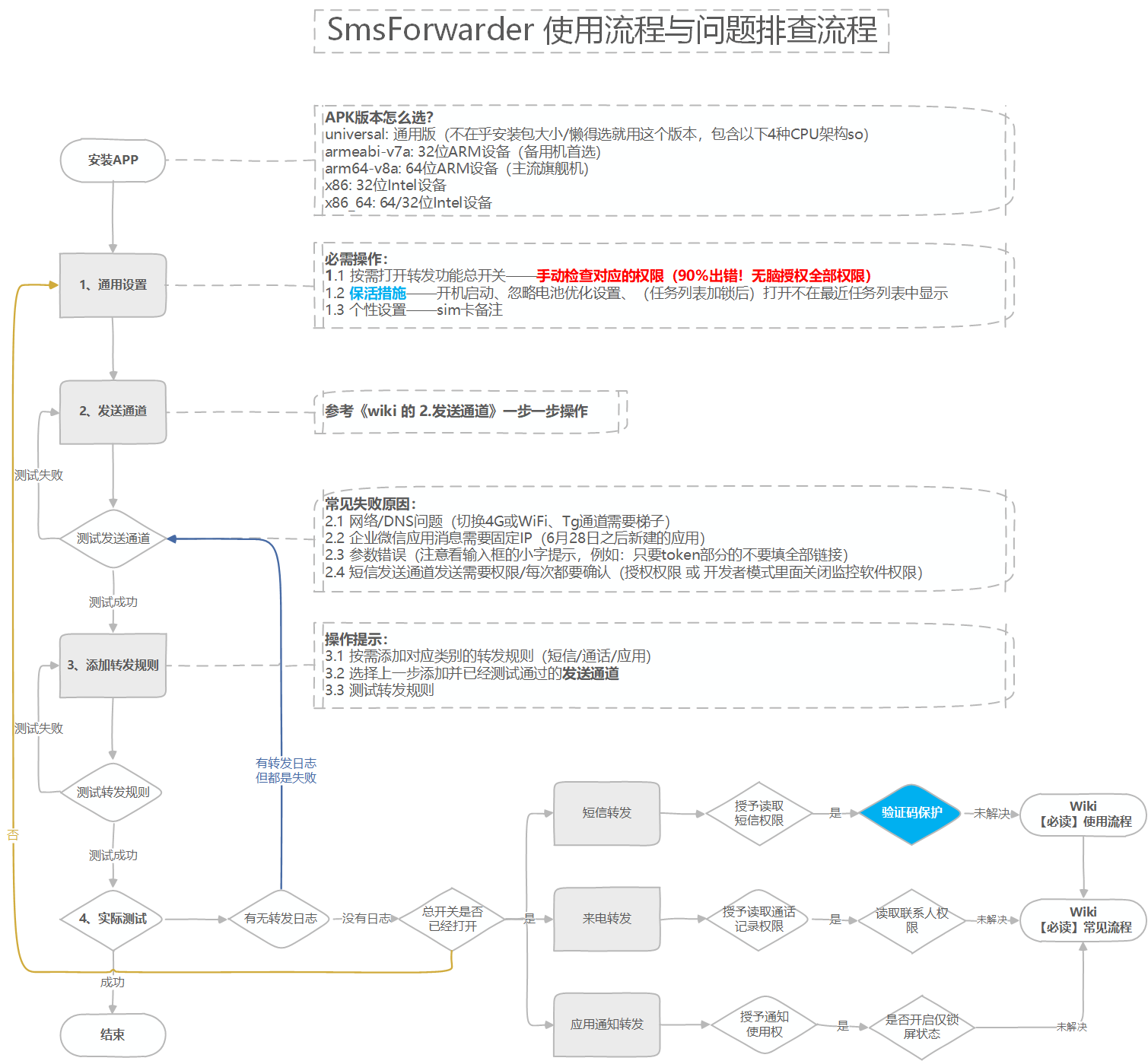
短信转发器——监控Android手机短信、来电、APP通知,并根据指定规则转发到其他手机:钉钉群自定义机器人、钉钉企业内机器人、企业微信群机器人、飞书机器人、企业微信应用消息、邮箱、bark、webhook、Telegram机器人、Server酱、PushPlus、手机短信等。包括主动控制服务端与客户端,让你轻松远程发短信、查短信、查通话、查话簿、查电量等。(V3.0 新增)PS.这个APK主要是学习与自用,如有BUG请提ISSUE,同时欢迎大家提PR指正
27k
Stars
3.3k
Forks
26
Open issues
25
Contributors


AI Analysis
SmsForwarder is an Android application that monitors SMS, calls, and app notifications, forwarding them to multiple services (DingTalk, WeChat Work, Feishu, Telegram, email, webhooks, and others) based on configurable rules. It serves Android device users who need centralized notification management and remote SMS/call control, particularly those using multiple devices or managing business communications.
Inferred from signals mentioned in the README (tests, CI, type safety) — not a review of the actual code.
AI's overall editorial judgment — not an average of the bars above, can weigh other factors too.
Android SMS forwarder routes texts, calls, and app notifications to 15+ platforms including Telegram, DingTalk, WeChat Work, and email
SmsForwarder is an Android app that monitors incoming SMS, phone calls, and app notifications on a secondary or idle device, then forwards them to a wide range of messaging platforms via configurable rules. It also supports remote control — allowing users to send SMS, query call logs, and check battery from a remote client. Built primarily for personal and small-team use cases where a spare Android phone serves as a communication relay. The project targets Chinese users first (supporting DingTalk, Feishu, WeChat Work, and domestic push services) but includes Telegram and webhook support for international users. With 26,000+ stars and active weekly builds, it has clear and broad adoption in its niche.
Created in February 2021 as a personal learning project. The original Java version was archived in June 2022 at v2.x; the project was fully rewritten in Kotlin for v3.x, supporting Android 4.4 through 13.0 and adding remote control capabilities in v3.0.
Growth appears driven by the very common need to monitor SMS verification codes and banking alerts on a secondary device without physically accessing it. The support for Chinese enterprise platforms (DingTalk, WeChat Work, Feishu) tapped a large domestic user base. Steady word-of-mouth in Chinese developer communities, a Gitee mirror for domestic access, and continuous feature additions (automation, scheduling in v3.3) have sustained interest. The 505 stars gained in the last 7 days as of evaluation date suggests the project remains actively discovered and shared.
26,657 GitHub stars and 3,291 forks are strong signals for a highly personal/utility tool. A Gitee mirror exists for Chinese users who may not access GitHub. The README includes a donation list and an active Telegram community group, suggesting real, engaged users beyond passive stargazers. The README explicitly describes itself as 'learning and personal use', but the scale of stars, forks, and community infrastructure implies substantially broader adoption. Adoption not formally verified through documented production deployments at enterprise scale.
Likely a single Android application with a foreground service for SMS/call/notification monitoring, a rule engine to match and dispatch events to configurable sender channels, and an embedded HTTP server (AndServer) for remote control. Appears to use frpc for intranet tunneling and a client-server model introduced in v3.0. Architecture is modular at the channel level based on the breadth of supported senders listed in the README.
not documented in README
Last push was June 11, 2026 — 13 days before evaluation date. Weekly build workflows are active (referenced in README). The project migrated from Java to Kotlin, has versioned releases, and maintains both GitHub and Gitee mirrors. All signals indicate active, ongoing maintenance, not just passive upkeep.
ADOPT IF: you need a spare Android device to forward SMS verification codes, banking alerts, or app notifications to Telegram, WeChat Work, DingTalk, email, or webhook endpoints — especially in Chinese-platform environments. AVOID IF: you need enterprise-grade reliability guarantees, auditable data handling for sensitive messages, or operation on non-Android platforms. MONITOR IF: you're evaluating it for small business or team use where the remote SMS sending feature is critical — the project is actively developed but self-described as personal use, so support expectations should be set accordingly.
Independent dimensions
Mainstream potential
4/10
Technical importance
6/10
Adoption evidence
7/10
- Android background process killing by OEMs (Xiaomi, Huawei, OPPO, etc.) is a persistent and well-known challenge for any always-on SMS monitoring app; keepalive mechanisms may not be reliable on all devices.
- The app requires broad permissions (SMS read/send, call log access, notification listener) that may be restricted or revoked by Android OS updates or enterprise MDM policies.
- Legal and privacy risk: intercepting and forwarding SMS containing OTPs or personal messages to third-party platforms raises compliance questions in GDPR and other jurisdictions — the README explicitly disclaims legal responsibility.
- Primary maintainer is a single developer (pppscn); long-term sustainability depends on continued personal interest, though the community contribution model via PRs provides some resilience.
- The README states the project is 'primarily for learning and personal use', which means there are no formal SLAs, enterprise support, or guaranteed backward compatibility across versions.
Likely to maintain steady growth and active maintenance for the foreseeable future given sustained weekly builds and a large existing user base. Will probably remain a dominant tool in its specific niche — Android SMS relay for personal and prosumer use in East Asian tech communities — without expanding into enterprise markets.
Newsletter
Get analyses like this every Monday
Free weekly digest of the most interesting open-source discoveries.
Languages
Information
- Language
- Kotlin
- License
- BSD-2-Clause
- Last updated
- 4w ago
- Created
- 66mo ago
- Analyzed with
- anthropic/claude-haiku-4-5
Stars over time
Contributors over time
Top 100 contributors only — repos with more will plateau at 100.
Open issues
Open pull requests
No open pull requests.
Similar repos

capcom6/android-sms-gateway
SMS Gateway for Android turns a smartphone into an SMS gateway API server,...

signalapp/Signal-Android
Signal Android is a secure end-to-end encrypted messaging application for...
| Repository | Stars | Week Δ | Language | Score | Updated |
|---|---|---|---|---|---|
|
pppscn/SmsForwarder
this
|
27k | +151 | Kotlin | 7/10 | 4w ago |
|
capcom6/android-sms-gateway
|
5.1k | — | Kotlin | 7/10 | 12h ago |
 ZhongFuCheng3y/austin ZhongFuCheng3y/austin
|
6.1k | — | Java | 7/10 | 1mo ago |
 xlrpa/FlowBot xlrpa/FlowBot
|
1.3k | — | Java | 6/10 | 1d ago |
|
signalapp/Signal-Android
|
29k | — | Kotlin | 9/10 | 2d ago |
|
signalapp/Signal-Server
|
10.6k | — | Java | 8/10 | 23h ago |
android-sms-gateway focuses on providing a REST API to send/receive SMS from Android, targeting developers who want programmatic control. SmsForwarder is more end-user oriented with a GUI rule engine and notification forwarding — complementary rather than directly competing, but overlapping in SMS relay use cases.
Signal is a full encrypted messaging platform, not a relay tool. The comparison is superficial — Signal replaces SMS; SmsForwarder forwards it. Different problem, different user, no meaningful overlap.
Austin is a backend unified message-pushing platform for engineers. SmsForwarder operates at the Android device level for individuals. Austin requires server infrastructure; SmsForwarder only needs an Android phone. Different deployment model and audience.
FlowBot appears to target Android automation more broadly. SmsForwarder is narrower — it focuses specifically on SMS, calls, and notification forwarding with remote control. Less overlap in actual feature set.
General Android automation apps like Tasker can replicate some forwarding behavior but require complex setup with no SMS-specific UI. SmsForwarder offers a purpose-built, lower-barrier experience for this specific use case.