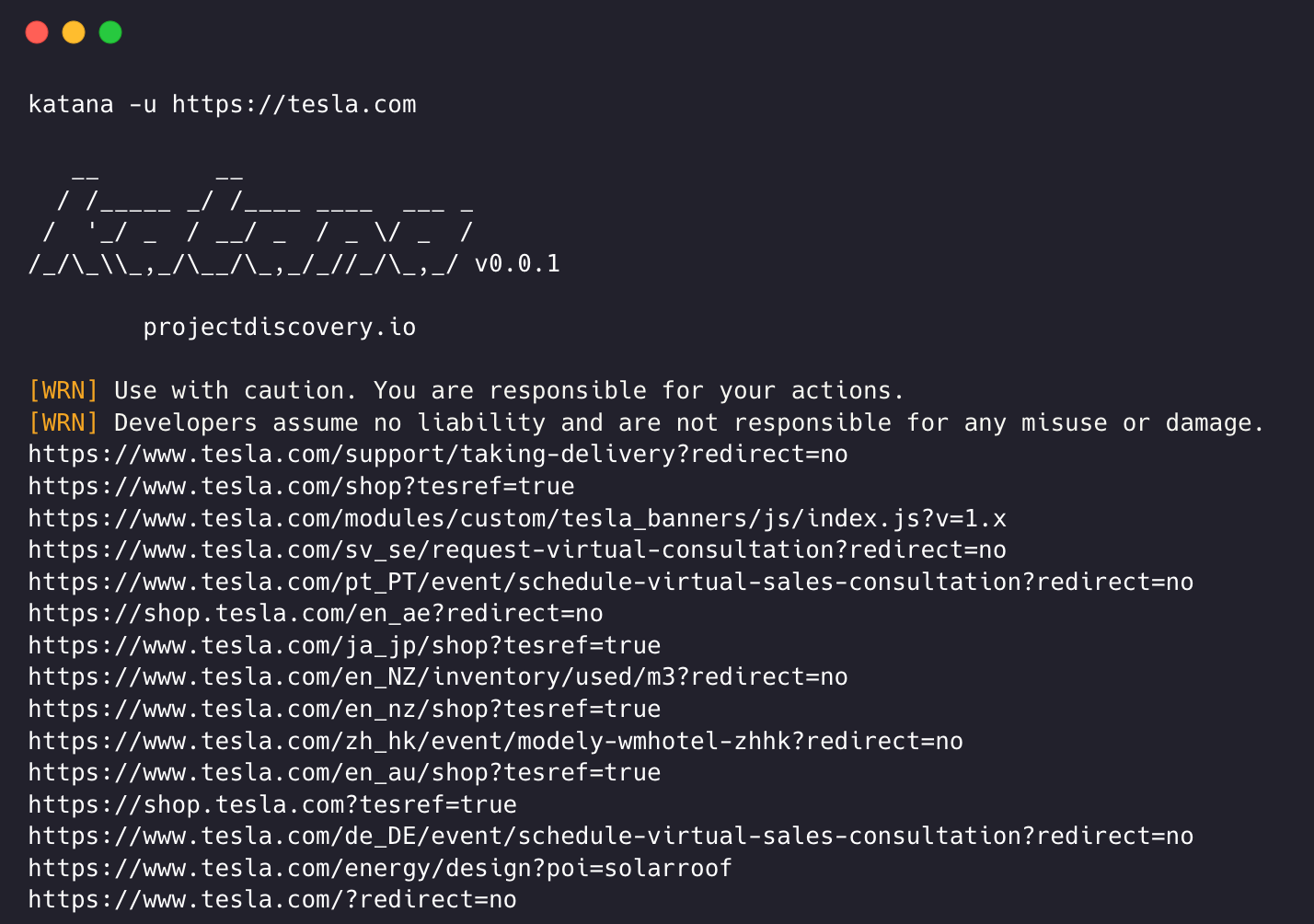
A next-generation crawling and spidering framework.
17.1k
Stars
1.2k
Forks
16
Open issues
30
Contributors


AI Analysis
Katana is a next-generation web crawling and spidering framework written in Go, designed for reconnaissance and information gathering in security research. It specializes in fast, configurable web crawling with both standard and headless browser modes, JavaScript execution, and automatic form filling—serving security professionals, penetration testers, and reconnaissance teams who need detailed site mapping and link discovery rather than general-purpose web scraping.
Inferred from signals mentioned in the README (tests, CI, type safety) — not a review of the actual code.
AI's overall editorial judgment — not an average of the bars above, can weigh other factors too.
ProjectDiscovery's Katana: A fast, headless-capable web crawler built for security automation pipelines
Katana is a Go-based web crawling framework built primarily for security professionals — penetration testers, bug bounty hunters, and automated recon pipelines. It supports both standard HTTP and headless browser modes, JavaScript parsing, automatic form filling, and scope-controlled crawling. Unlike general-purpose scrapers, it is optimized for fast, deep enumeration of web application endpoints for attack surface discovery. It integrates naturally with the broader ProjectDiscovery toolchain (nuclei, httpx, subfinder) and is a first-class citizen in OSINT and offensive security workflows.
Created in January 2022 by ProjectDiscovery, a company known for open-source security tooling. It emerged as the team needed a crawler designed for security automation rather than data extraction or indexing, filling a gap in their existing toolkit.
Growth was driven primarily by the large and active bug bounty and penetration testing communities that already adopted ProjectDiscovery tools. Integration with nuclei and httpx pipelines gave it an immediate user base. The 17K+ stars reflect organic adoption within the infosec community, though growth has plateaued somewhat — 42 stars in the last 7 days suggests a mature, steady-state project rather than a rapidly accelerating one.
Widely referenced in bug bounty writeups, security automation blog posts, and CTF tooling lists. Integrated into ProjectDiscovery's own cloud platform (pdcp). Used in public recon automation pipelines by security researchers. Adoption within the infosec community is well-documented, though production use in non-security contexts (e.g., commercial data pipelines) is not verified.
Likely built as a CLI tool with a library core, supporting two crawling modes: a standard HTTP-based crawler and a headless browser mode (requiring Chrome/Chromium). Appears to support pluggable output formats (STDOUT, JSON, file), configurable scope control via regex, and optional ML-based page classification. The CGO_ENABLED=1 requirement suggests native dependencies, likely for the headless or ML components.
Not documented in README
Last push was 2026-06-25, three days before the evaluation date — actively maintained. The project has been consistently updated over its multi-year lifespan. Requires Go 1.26+, indicating it tracks modern Go releases. Active Discord and GitHub issues suggest ongoing community engagement.
ADOPT IF: you are building security recon pipelines, doing bug bounty hunting, or need a scriptable crawler with headless and JavaScript support designed for endpoint discovery. AVOID IF: you need a general-purpose scraping framework with rich data extraction, item pipelines, middleware ecosystems, or non-security use cases — Scrapy or Playwright-based tools are better fits. MONITOR IF: you are a security platform vendor evaluating crawler components — Katana's library API may serve embedded use cases, but CGO dependencies add integration friction.
Independent dimensions
Mainstream potential
4/10
Technical importance
8/10
Adoption evidence
7/10
- CGO_ENABLED=1 requirement complicates cross-compilation, containerization, and embedding as a library in pure-Go projects.
- Headless mode requires a Chrome/Chromium installation, adding a significant runtime dependency that may be problematic in minimal environments.
- Primary adoption is concentrated in the security/bug bounty community — limited uptake outside this niche may affect long-term contributor diversity and sustainability.
- ML model auto-download at runtime introduces a network dependency and potential reproducibility concern in air-gapped or strict environments.
- As a ProjectDiscovery product, roadmap and maintenance pace depend on a single company's priorities; there is no independent governance structure.
Katana is likely to remain the de facto standard crawler in security automation pipelines for the foreseeable future. Growth will likely be steady but not dramatic, tracking the expansion of the bug bounty and AppSec automation markets.
Newsletter
Get analyses like this every Monday
Free weekly digest of the most interesting open-source discoveries.
Languages
Information
- Language
- Go
- License
- MIT
- Last updated
- 4d ago
- Created
- 67mo ago
- Analyzed with
- anthropic/claude-haiku-4-5
Stars over time
Contributors over time
Top 100 contributors only — repos with more will plateau at 100.
Open issues
Top contributors
Recent releases
Similar repos
projectdiscovery/naabu
Naabu is a fast, lightweight port scanner written in Go designed for security...
projectdiscovery/subfinder
Subfinder is a fast passive subdomain enumeration tool built in Go for...
projectdiscovery/httpx
httpx is a fast, multi-purpose HTTP toolkit designed for security professionals...
projectdiscovery/uncover
Uncover is a CLI tool for security researchers and bug bounty hunters that...
| Repository | Stars | Week Δ | Language | Score | Updated |
|---|---|---|---|---|---|
|
projectdiscovery/katana
this
|
17.1k | +19 | Go | 8/10 | 4d ago |
|
projectdiscovery/naabu
|
6k | — | Go | 8/10 | 4d ago |
|
projectdiscovery/subfinder
|
14k | — | Go | 8/10 | 2d ago |
|
projectdiscovery/httpx
|
10.1k | — | Go | 8/10 | 20h ago |
|
projectdiscovery/uncover
|
3k | — | Go | 8/10 | 7d ago |
 crawlab-team/crawlab crawlab-team/crawlab
|
12.2k | — | Go | 7/10 | 5mo ago |
Scrapy is a mature, general-purpose Python scraping framework with a vastly larger ecosystem and community (62K stars). Katana is narrower in scope — it prioritizes security recon features (JS crawling, headless mode, scope control) over data extraction pipelines, plugins, and item processing. Scrapy is a better choice for structured data harvesting; Katana for attack surface mapping.
httpx is a complementary tool — it probes HTTP endpoints rather than discovering them. In typical workflows, Katana feeds discovered URLs into httpx for analysis. They are not competitors but pipeline stages.
Crawlab is a distributed crawler management platform with a UI, job scheduling, and multi-spider orchestration. Katana is a single-purpose CLI tool. Different target users: Crawlab suits data engineering teams; Katana suits security researchers running automated scans.
Hakrawler is an older, simpler Go crawler popular in bug bounty communities. Katana supersedes it in most dimensions: headless support, JS parsing, scope controls, and active maintenance. Katana is now the community default for this use case.
GoSpider is another Go-based security crawler with a similar target audience. Katana offers more features (headless, ML classification, jsluice integration) and has significantly more adoption, but GoSpider remains in use where a lighter dependency footprint is preferred.