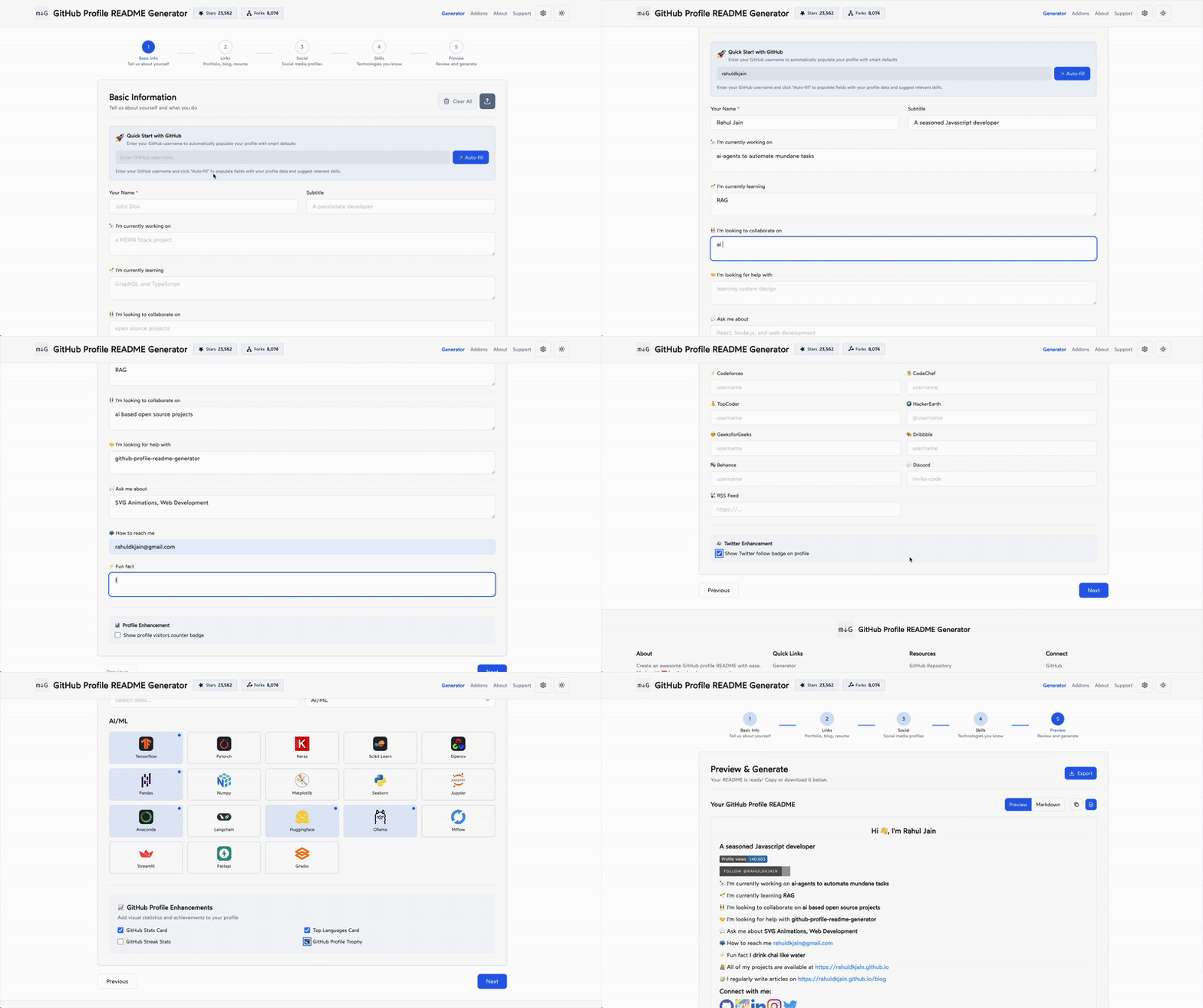
🚀 Generate GitHub profile README easily with the latest add-ons like visitors count, GitHub stats, etc using minimal UI.
24.3k
Stars
8.4k
Forks
408
Open issues
30
Contributors


AI Analysis
A web-based generator tool that creates GitHub profile README files with minimal UI effort, featuring add-ons like visitor counters and GitHub statistics. It serves GitHub users who want to quickly generate and customize their profile documentation without manual markdown editing. Best suited for individual developers and open-source contributors seeking to enhance their GitHub presence.
Inferred from signals mentioned in the README (tests, CI, type safety) — not a review of the actual code.
AI's overall editorial judgment — not an average of the bars above, can weigh other factors too.
Form-based GitHub profile README generator with 24K stars and a broad feature set
GitHub Profile README Generator is a web-based tool (hosted on GitHub Pages) that lets developers build a GitHub profile README by filling out a form rather than writing Markdown by hand. It targets developers — especially those new to GitHub profiles — who want to include stats cards, visitor counters, social icons, streak stats, and blog feeds without manual configuration. With 24K stars and 8.3K forks, it has clear evidence of broad hobbyist and student adoption. It is not an enterprise or production infrastructure tool; its value is purely in developer experience and personal branding.
Created in July 2020, immediately after GitHub launched profile READMEs. It rode that announcement wave and accumulated most of its stars in 2020–2021, positioning itself as one of the first polished generators for the feature.
Growth was largely driven by the novelty of GitHub profile READMEs in mid-2020, YouTube tutorials, and viral social sharing. Star velocity has significantly slowed — only 17 stars in the past 7 days as of mid-2026 — indicating the project has reached saturation in its niche rather than continued organic expansion. The high fork count (8.3K) suggests many users self-hosted or customized it, which also signals real engagement beyond passive starring.
Direct production-usage metrics are not available. However, 8,363 forks is a strong proxy signal for real usage — this is unusually high relative to the star count and suggests many developers actually used and adapted the tool. The existence of a Discord community and multiple donation channels implies a sustained user base. The project is referenced in the 'awesome-github-profile-readme' list (30K stars), increasing discoverability. Adoption appears broad but concentrated among individual developers and students rather than organizations.
Appears to be a Next.js 15 application using the App Router, written in TypeScript, styled with Tailwind CSS, with Framer Motion for UI animation and React Hook Form for input handling. It is a client-side form that generates static Markdown output. No backend is required for core functionality; third-party services (github-readme-stats, streak stats, visitor counter) are embedded as image URLs in the generated Markdown.
not documented in README
Last push was October 2025, roughly 8 months before the evaluation date of June 2026. The README references Next.js 15 and a modern stack update, suggesting at least one significant refresh occurred in the recent past. Maintenance appears slow but not abandoned — the gap since last push is notable but not alarming for a tool of this scope. No evidence of active issue triage or PR merges post-October 2025 is available from metadata alone.
ADOPT IF: you want a quick, no-code way to produce a complete GitHub profile README and value a guided form UX over writing Markdown manually or prompting an AI. AVOID IF: you need a custom or highly unconventional profile layout — the tool's opinionated template structure limits flexibility significantly. MONITOR IF: you depend on third-party widgets embedded in generated output (streak stats, visitor counters) since those external services can break or add rate limits independently of this project.
Independent dimensions
Mainstream potential
3/10
Technical importance
3/10
Adoption evidence
7/10
- Star and fork growth has plateaued; the project may receive only minimal maintenance going forward, with the last push already ~8 months ago as of evaluation date.
- The generated output depends heavily on third-party services (github-readme-stats, streak-stats, visitor counter) that are not controlled by this project and may degrade or disappear.
- AI-assisted README generation (via LLMs) is a low-friction alternative that increasingly reduces the marginal value of a form-based generator for technically comfortable users.
- No documented test coverage means regressions from dependency updates (e.g., Next.js major versions) may go undetected until user reports surface them.
- The project is maintained by a solo developer with no evident organizational backing, making long-term sustainability dependent on individual motivation.
Likely to remain a stable, low-maintenance reference tool with slow organic discovery via tutorials and lists. Unlikely to regain significant growth momentum given LLM competition and market saturation.
Newsletter
Get analyses like this every Monday
Free weekly digest of the most interesting open-source discoveries.
Languages
Information
- Language
- TypeScript
- License
- Apache-2.0
- Last updated
- 9mo ago
- Created
- 73mo ago
- Analyzed with
- anthropic/claude-haiku-4-5
Stars over time
Contributors over time
Top 100 contributors only — repos with more will plateau at 100.
Open issues
[Feature]
Suggestion: Mini-Tools.uk Image Hosting for generated profile README images
[Bug] Connect with me, language and etc. items render under each other
[Bug] Flask outdated & Express background not applied
Top contributors
Similar repos

anuraghazra/github-readme-stats
GitHub Readme Stats is a serverless tool that generates dynamically rendered...

ryo-ma/github-profile-trophy
GitHub Profile Trophy generates dynamic trophy badges for GitHub user profiles...

abhisheknaiidu/awesome-github-profile-readme
A curated list of GitHub profile README examples organized by style and...
| Repository | Stars | Week Δ | Language | Score | Updated |
|---|---|---|---|---|---|
|
rahuldkjain/github-profile-readme-generator
this
|
24.3k | +23 | TypeScript | 7/10 | 9mo ago |
|
anuraghazra/github-readme-stats
|
79.8k | — | JavaScript | 6/10 | 1w ago |
|
ryo-ma/github-profile-trophy
|
6.6k | — | TypeScript | 7/10 | 1w ago |
|
abhisheknaiidu/awesome-github-profile-readme
|
30.5k | — | — | 7/10 | 4mo ago |
 tipsy/profile-summary-for-github tipsy/profile-summary-for-github
|
19.9k | — | Vue | 7/10 | 5mo ago |
 jstrieb/github-stats jstrieb/github-stats
|
3.5k | — | Zig | 8/10 | 3w ago |
Not a direct competitor — it provides the stats card widgets that this generator embeds. The two are complementary rather than competing; github-readme-stats is far more technically significant (79K stars) and solves a different problem (rendering stats as SVGs).
A curated list of profile READMEs rather than a generator. It overlaps in audience but serves as inspiration rather than automation. Users may use both together.
Visualizes GitHub activity in a web UI rather than generating README markdown. Different output format and purpose; less relevant as a direct competitor.
Another embeddable widget (trophies) that this generator likely references. Complementary rather than competitive.
The most realistic current competitor. As of 2025–2026, many developers simply ask an LLM to generate their profile README. This generator's form-based UX remains faster for non-technical users who want a consistent, validated output without prompting.