git worktrees + tmux windows for zero-friction parallel dev
1.8k
Stars
165
Forks
22
Open issues
28
Contributors


AI Analysis
workmux is a Rust CLI tool that orchestrates git worktrees with tmux (or kitty/WezTerm/Zellij) windows to create isolated, parallel development environments—particularly useful for running multiple AI agents on different features simultaneously without branch switching or conflict management overhead. It's specialized for terminal-centric developers and AI agent orchestration workflows; not intended for GUI-first or centralized version control workflows.
Inferred from signals mentioned in the README (tests, CI, type safety) — not a review of the actual code.
AI's overall editorial judgment — not an average of the bars above, can weigh other factors too.
Rust tool binding git worktrees to tmux/zellij for parallel agent-driven development
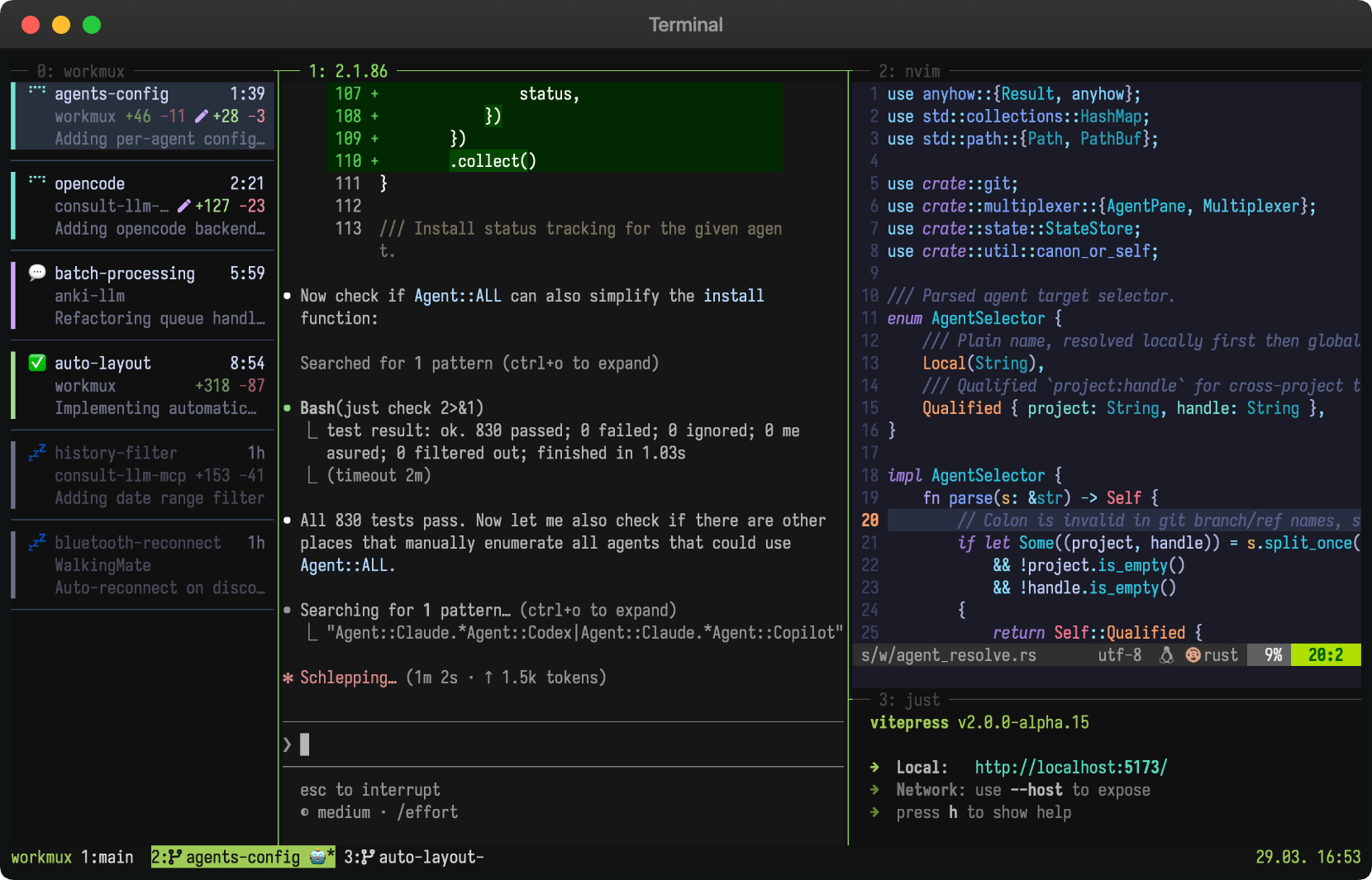
workmux automates the setup and lifecycle management of isolated development environments by combining git worktrees with tmux (or zellij/kitty/WezTerm) windows. Built explicitly for running multiple AI coding agents in parallel, it eliminates branch switching and merge conflicts through one-command worktree creation and cleanup. Adoption appears concentrated among developers using AI agents for coding tasks and those seeking terminal-native parallel workflows, with evidence of active enthusiasm in early adopter communities but limited mainstream verification.
Created November 2025, workmux emerged in the early wave of AI-agent-assisted development tooling. It positions itself as a glue layer between existing tools (git, tmux, agents) rather than replacing them, reflecting a philosophy of composability over monolithic solutions.
Project gained 1,655 stars over ~7 months and 17 stars in the last week (as of 2026-06-29), indicating sustained early-stage interest. Growth appears driven by convergence of three factors: git worktree adoption among developers seeking isolation, increasing use of AI agents for coding, and frustration with GUI-only agent tooling. Positive sentiment in quotes suggests strong product-market fit within its target niche, though absolute adoption numbers remain modest.
Quoted testimonials from named GitHub users describe using workmux as a 'daily driver' and praising it for workflow integration; one Threads post indicates adoption by @dedbrizz. However, these are individual endorsements rather than enterprise or large-team deployment signals. No documentation of production usage at organizational scale, no case studies, no statistics on usage volume. Adoption not formally verified at scale.
Based on README, workmux abstracts over multiple terminal multiplexers (tmux primary, zellij/kitty/WezTerm as alternatives) and git worktree operations. Likely uses a plugin/skill system to integrate with AI agents (e.g., `/worktree` skill for task delegation, automatic branch naming via LLM). Architecture appears designed for extensibility and composability rather than monolithic control.
not documented in README
Last push 2026-06-29 (same date as evaluation), indicating active development. Changelog referenced in README suggests semantic versioning discipline. Recent additions (e.g., sidebar feature, container/VM sandboxing, automatic branch naming) indicate ongoing feature development. No explicit CI/CD or test infrastructure mentioned, limiting visibility into code quality practices.
ADOPT IF: you are an AI agent user or multi-branch developer already comfortable with tmux, git worktrees, and terminal workflows; you need automated worktree + window lifecycle management and agent coordination; you want to avoid GUI lock-in. AVOID IF: you prefer graphical interfaces, do not use terminal multiplexers, or work in environments where git worktrees are not feasible (monorepos with strict branch policies, etc.). MONITOR IF: you are considering it for team adoption but lack clear documentation of scaling behavior, CI/CD integration, or organizational deployment patterns; if your workflow depends heavily on agent coordination, watch for security/stability maturity as the project grows.
Independent dimensions
Mainstream potential
4/10
Technical importance
6/10
Adoption evidence
3/10
- Adoption appears concentrated in early-adopter AI developer communities; unclear if it will scale to mainstream developer workflows or enterprise teams.
- Requires pre-existing tmux (or zellij/kitty/WezTerm) setup; adds a new tool to an already-complex terminal stack, risking increased cognitive load.
- No documented test coverage or formal security review; sandboxing feature (containers/VMs) may have gaps if project lacks security-focused development practices.
- Dependency on git worktrees, which are powerful but have known limitations (rebasing, gc edge cases); workmux cannot fully abstract these away.
- Limited visibility into production use at scale; risk that tool will work well for single developer but encounter unforeseen issues in team or CI/CD contexts.
Likely to remain a specialized tool for AI-agent-driven development and terminal-native parallel workflows. May see adoption growth if AI coding agents become standard in developer tooling; unlikely to displace established multiplexers or branch management tools. Could mature into a standard component of AI agent platforms if those platforms adopt terminal-first philosophies.
Newsletter
Get analyses like this every Monday
Free weekly digest of the most interesting open-source discoveries.
Languages
Information
- Website
- http://workmux.raine.dev
- Language
- Rust
- License
- MIT
- Last updated
- 3d ago
- Created
- 8mo ago
- Analyzed with
- anthropic/claude-haiku-4-5
Stars over time
Contributors over time
Top 100 contributors only — repos with more will plateau at 100.
Open issues
Update Gemini CLI support for Antigravity CLI (`agy`)
allow use docker compose to run docker sandbox
Support multi-repository workspaces
send-keys commands silently lost during shell initialization
Add qwen-code support
Top contributors
Similar repos

standardagents/dmux
dmux is a multiplexer for managing multiple AI coding agents in parallel using...

coderabbitai/git-worktree-runner
gtr is a Bash-based CLI tool that simplifies Git worktree management for...
| Repository | Stars | Week Δ | Language | Score | Updated |
|---|---|---|---|---|---|
|
raine/workmux
this
|
1.8k | +106 | Rust | 8/10 | 3d ago |
 max-sixty/worktrunk max-sixty/worktrunk
|
5.8k | — | Rust | 8/10 | 6h ago |
 coder/mux coder/mux
|
1.9k | — | TypeScript | 7/10 | 12h ago |
|
standardagents/dmux
|
1.7k | — | HTML | 7/10 | 1d ago |
|
coderabbitai/git-worktree-runner
|
1.7k | — | Shell | 7/10 | 4w ago |
 arxanas/git-branchless arxanas/git-branchless
|
4.1k | — | Rust | 8/10 | 10h ago |
Larger, more established project solving similar git worktree + terminal integration problem. workmux is more explicitly designed for AI agent orchestration; worktrunk's positioning is less documented. Direct comparison impossible without inspecting worktrunk source.
Modern terminal multiplexer (alternative to tmux). workmux supports zellij as a backend but does not replace it; zellij is the raw multiplexing layer, workmux the worktree + agent coordination layer.
Similar goal (worktree automation) but shell-based, simpler scope. Unclear how much it addresses agent coordination or multi-worktree dashboard features that workmux emphasizes.
Multiplexing and workspace abstraction layer. Different language and positioning; direct feature comparison unclear from README alone.
Web-based dashboard for managing tmux sessions. workmux includes a terminal dashboard and sidebar; different UI philosophy (CLI-first vs web-first).