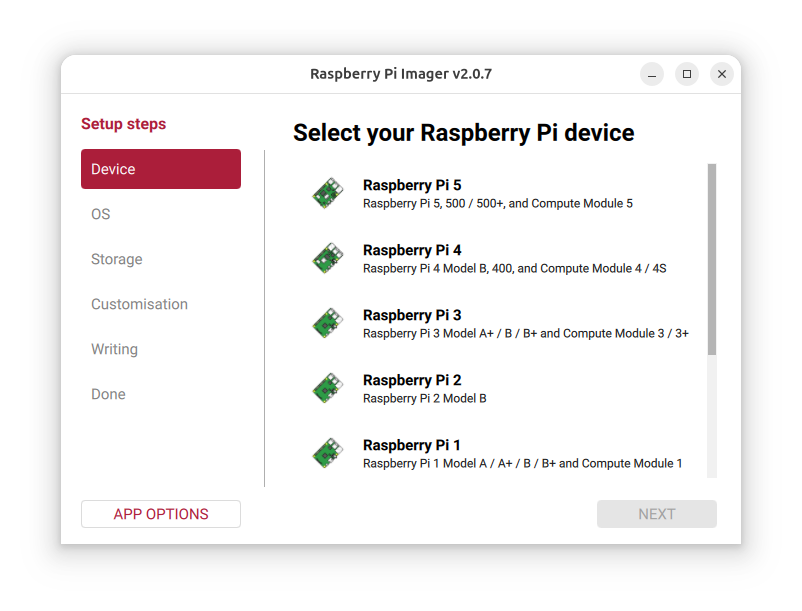
The home of Raspberry Pi Imager, a user-friendly tool for creating bootable media for Raspberry Pi devices.
2.5k
Stars
426
Forks
105
Open issues
30
Contributors


AI Analysis
Raspberry Pi Imager is an official, user-friendly application for creating bootable media for Raspberry Pi devices across Windows, macOS, Ubuntu, and Raspberry Pi OS. It is purpose-built for users installing or provisioning Raspberry Pi boards and does not serve general-purpose disk imaging needs; it specifically optimizes the workflow for Raspberry Pi device setup and includes built-in support for Raspberry Pi OS variants and curated third-party images.
Inferred from signals mentioned in the README (tests, CI, type safety) — not a review of the actual code.
AI's overall editorial judgment — not an average of the bars above, can weigh other factors too.
Official Raspberry Pi image writer for multi-platform bootable media creation
Raspberry Pi Imager is the official tool for writing Raspberry Pi OS and other operating systems to SD cards and USB storage across Windows, macOS, and Linux. Built and maintained by the Raspberry Pi Foundation, it serves as the primary distribution mechanism for Raspberry Pi software, replacing earlier ad-hoc flashing methods. Adoption is effectively universal among Raspberry Pi users who install an OS—it is bundled in official documentation and distributed through official channels.
Created in 2019 as an official replacement for older, fragmented flashing workflows. Evolved from simpler tools into a comprehensive GUI and CLI utility with support for multiple operating systems, custom repositories, and built-in OS discovery. Now the de facto standard entry point for Raspberry Pi setup.
Growth was front-loaded at launch (2019–2021) as the Raspberry Pi Foundation promoted it as the official solution. Since then, growth has plateaued, with modest star accumulation (3 stars in last 7 days as of 2026-07-10) reflecting maturity and market saturation rather than active feature expansion. The tool has reached its natural audience: anyone setting up a Raspberry Pi through official channels.
Adoption is effectively verified through official status: distributed via apt package manager in Raspberry Pi OS, featured on official Raspberry Pi downloads page, and referenced in official documentation. Embedded in the Network Installer. While explicit download metrics are not disclosed publicly beyond aggregate anonymous statistics (visible at rpi-imager-stats.raspberrypi.com), the fact that it is the *only* officially recommended tool means adoption among active Raspberry Pi users approaches near-universality. Real-world adoption is very high.
Written in C++ with Qt framework for GUI. Appears to be a cross-platform desktop application with CLI support. README indicates support for custom image repositories via command-line parameters. Implementation details not visible from README; likely uses platform-specific APIs for disk enumeration and writing.
Not documented in README. No mention of testing framework, coverage metrics, or CI/CD pipeline.
Actively maintained: last push 2026-07-08, only 2 days before current date (2026-07-10). Repository shows consistent, recent activity. However, the low weekly star gain and slow issue/PR velocity relative to the project's size suggests maintenance is primarily reactive (bug fixes, security updates) rather than feature-driven. This is appropriate for a mature tool in stable equilibrium.
ADOPT IF: you are setting up a Raspberry Pi using official OS images or want the simplest, most officially-supported path. AVOID IF: you need advanced image manipulation, post-creation shrinking, or are working with non-Raspberry Pi systems (use Balena Etcher instead). MONITOR IF: you are evaluating it as a dependency for downstream tooling; it is stable but unlikely to receive major feature additions.
Independent dimensions
Mainstream potential
6/10
Technical importance
7/10
Adoption evidence
9/10
- Telemetry collection enabled by default may concern privacy-conscious users, though it is documented and can be disabled via UI.
- Anonymous metrics infrastructure depends on external Heroku service; downtime would not affect flashing but would lose statistics collection.
- Narrow scope (Raspberry Pi only) means it will not generalize to other ARM SBCs or broader use cases; not a risk for intended users.
- Low ongoing star velocity and modest PR activity suggests limited developer bandwidth for non-critical bug fixes or minor features.
- Custom repository feature is underdocumented; may create friction for users building private OS distributions.
Will remain the official Raspberry Pi imaging tool indefinitely, maintained in stable mode with security and compatibility updates. Unlikely to see major feature expansion. May eventually be superseded by an updated major version if Raspberry Pi Foundation restructures the Raspberry Pi ecosystem (e.g., unified Linux distribution strategy), but no evidence of that is visible.
Newsletter
Get analyses like this every Monday
Free weekly digest of the most interesting open-source discoveries.
Languages
Information
- Language
- C++
- License
- NOASSERTION
- Last updated
- 2d ago
- Created
- 82mo ago
- Analyzed with
- anthropic/claude-haiku-4-5
Stars over time
Contributors over time
Top 100 contributors only — repos with more will plateau at 100.
Open issues
[BUG]: Imager 2.0.10 unusable on Windows 11
[BUG]: Mac OS v2.0.7+ Can't initialize filter; unable to run program "zstd -d -qq"
[BUG]: Internal eMMC appearing as "Internal SD card reader"
[FEATURE]: Support for external cloud-init files
[BUG]: Imager uses older Bootloader image for Pi 5
Top contributors
Similar repos

homebridge/homebridge-raspbian-image
This project provides an official Raspberry Pi image pre-configured with...
raspberrypi/firmware
This repository provides pre-compiled binaries of Raspberry Pi kernel, modules,...
| Repository | Stars | Week Δ | Language | Score | Updated |
|---|---|---|---|---|---|
|
raspberrypi/rpi-imager
this
|
2.5k | +4 | C++ | 8/10 | 2d ago |
 RPi-Distro/pi-gen RPi-Distro/pi-gen
|
3.2k | — | Shell | 7/10 | 3w ago |
|
raspberrypi/rpi-eeprom
|
1.5k | — | Shell | 7/10 | 2w ago |
 Drewsif/PiShrink Drewsif/PiShrink
|
4.1k | — | Shell | 7/10 | 2mo ago |
|
homebridge/homebridge-raspbian-image
|
1.1k | — | Shell | 7/10 | 2w ago |
|
raspberrypi/firmware
|
5.5k | — | — | 7/10 | 1w ago |
Cross-platform general-purpose image writer with broader OS support. Simpler UI, larger ecosystem adoption outside Raspberry Pi. Raspberry Pi Imager is tightly integrated with Raspberry Pi OS discovery and custom repositories, making it more convenient for the specific use case; Etcher is more generic.
Image shrinking and compression utility (different purpose: post-creation optimization rather than initial flashing). Complementary rather than competitive; Imager is upstream in the workflow.
Windows-only, lower-level tool with minimal UI. Imager replaced this for most users by offering cross-platform support, OS discovery, and official backing.
Command-line only, high barrier to entry for casual users. Imager provides GUI convenience and platform abstractions; still supports CLI via command-line parameters for advanced users.