embedded-graphics backend for Ratatui
1.3k
Stars
40
Forks
22
Open issues
16
Contributors





AI Analysis
Mousefood is a no-std embedded-graphics backend for Ratatui that enables rendering terminal UIs on embedded displays and microcontrollers. It solves the specific problem of bringing rich, terminal-style UI capabilities to resource-constrained devices that support embedded-graphics drivers. This project is built for embedded systems developers and firmware engineers who need to build interactive UIs on displays like ILI9341, ST7735, and SSD1306—not for general terminal UI development on standa...
Inferred from signals mentioned in the README (tests, CI, type safety) — not a review of the actual code.
AI's overall editorial judgment — not an average of the bars above, can weigh other factors too.
Ratatui terminal UI toolkit gains embedded-graphics backend for microcontroller displays
Mousefood is an embedded-graphics backend for Ratatui, enabling Rust TUI rendering on resource-constrained microcontroller displays (e.g., SSD1306, ILI9341). It bridges Ratatui's high-level widget API with low-level display drivers, solving the problem of how to reuse TUI code across embedded and desktop platforms. Adoption appears concentrated within the Ratatui ecosystem and embedded Rust communities; evidence of production use is not documented in README.
Created March 2025 as part of the Ratatui ecosystem expansion. Joins sibling projects (ratzilla, tachyonfx) in extending Ratatui beyond traditional terminal rendering. Represents a deliberate design choice to support alternative output targets rather than terminal-only architecture.
Project gained ~1,288 stars in ~15 months (as of June 2026), with 20 stars in the last 7 days. Growth appears steady but modest relative to main Ratatui (21k stars). Trajectory suggests niche adoption aligned with embedded Rust interest, rather than rapid mainstream expansion. Recent activity (last push June 23, 2026) indicates active maintenance.
Adoption not verified. README includes exemplary code and demo images but does not cite production deployments, users, or case studies. Project is embedded in Ratatui organization, suggesting internal validation, but real-world embedded display projects using Mousefood are not documented.
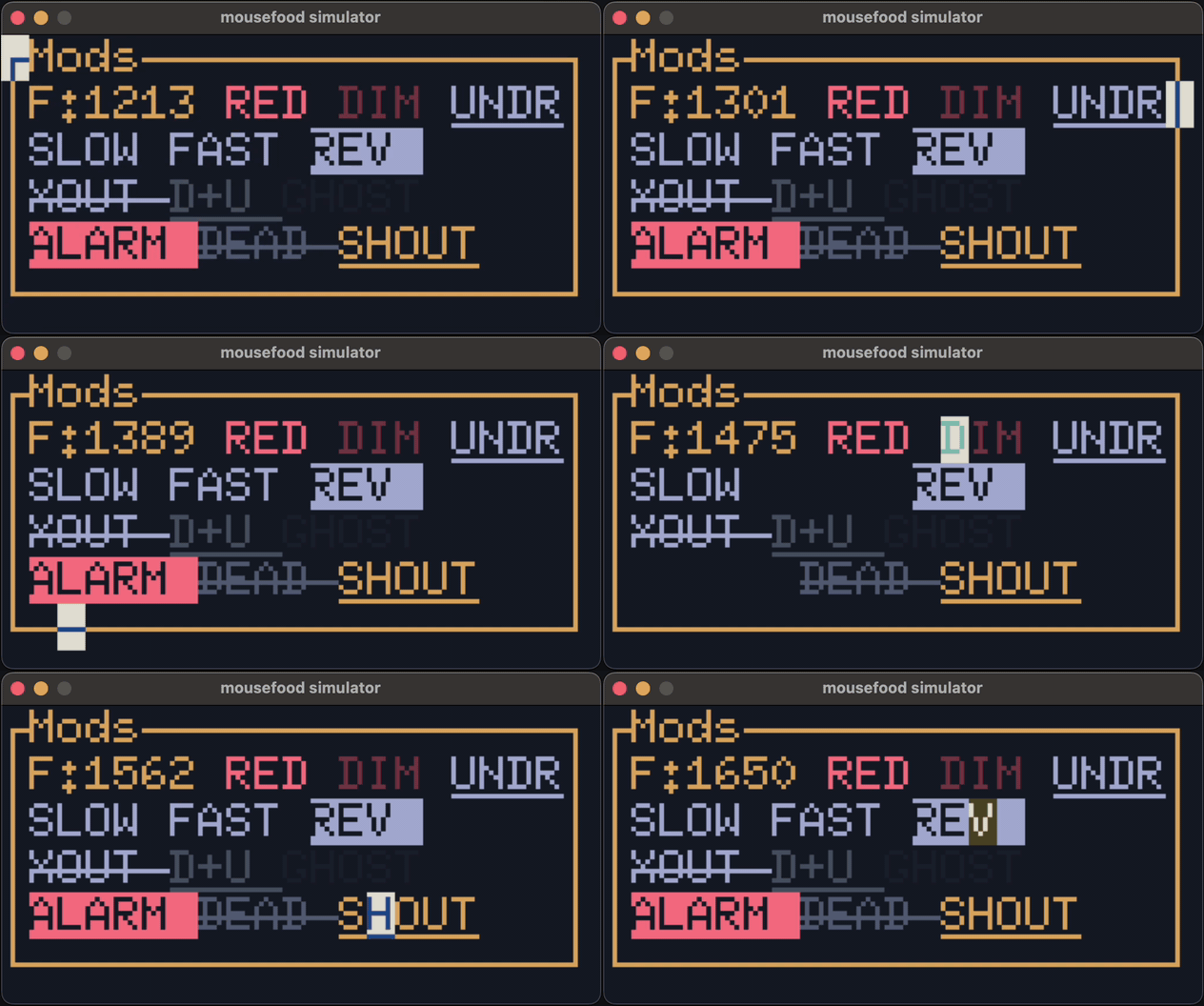
Based on README: Mousefood exposes an `EmbeddedBackend` implementing Ratatui's backend trait, wrapping embedded-graphics display drivers. It handles character-to-bitmap rendering, font management (with unicode support via embedded-graphics-unicodefonts), color remapping via theme abstraction, cursor styles (Inverse/Underline/Outline/Japanese), and optional text blink. Appears to support no-std environments. Configuration is builder-pattern via `EmbeddedBackendConfig`.
Not documented in README. CI workflow is referenced (badge present) but test specifics not disclosed.
Last push June 23, 2026 (6 days before analysis date) indicates active maintenance. Repository is young (15 months old) but regularly updated. CI/CD pipeline is configured. Dependency status tracked via deps.rs badge. No evidence of stalled development; appears to be actively used by maintainers.
ADOPT IF: you are building an embedded Rust project that needs TUI-like rendering on a microcontroller display, want to leverage Ratatui widgets, and are comfortable with a young (15-month-old) project. AVOID IF: you need production-grade stability guarantees, extensive documentation of real-world use cases, or support for exotic display hardware beyond common embedded-graphics drivers. MONITOR IF: you are considering it for a new embedded project; assess community activity and feature stability before committing, but the active maintenance signal (recent commits) is positive.
Independent dimensions
Mainstream potential
3/10
Technical importance
6/10
Adoption evidence
2/10
- Young project (15 months old); API surface may shift as Ratatui or embedded-graphics evolve, requiring maintenance burden on end-users.
- Adoption not verified; lack of documented production deployments or user testimonials makes it difficult to assess real-world robustness.
- Performance and hardware support claims in README are acknowledged as trade-offs but not quantified; embedded systems are resource-sensitive and rendering performance is critical.
- Font support relies on embedded-graphics-unicodefonts, which may limit character set coverage compared to desktop Ratatui; breaking change if that dependency is abandoned.
- Limited to backends supported by embedded-graphics ecosystem; esoteric or very new display drivers may not be compatible.
Mousefood will likely remain a specialized tool within the embedded Rust and Ratatui communities over the next 2–3 years. Adoption will grow modestly as IoT and embedded Rust projects mature, but mainstream penetration (outside embedded systems) is improbable. Project sustainability depends on Ratatui and embedded-graphics ecosystem health; if either shifts, Mousefood may require significant rewrites.
Explore similar
Newsletter
Get analyses like this every Monday
Free weekly digest of the most interesting open-source discoveries.
Languages
Information
- Language
- Rust
- License
- Apache-2.0
- Last updated
- 3d ago
- Created
- 16mo ago
- Analyzed with
- anthropic/claude-haiku-4-5
Stars over time
Contributors over time
Top 100 contributors only — repos with more will plateau at 100.
Open issues
Top contributors
Similar repos
| Repository | Stars | Week Δ | Language | Score | Updated |
|---|---|---|---|---|---|
|
ratatui/mousefood
this
|
1.3k | +3 | Rust | 7/10 | 3d ago |
|
ratatui/ratatui
|
21.6k | — | Rust | 9/10 | 3d ago |
|
orhun/ratty
|
3.1k | — | Rust | 7/10 | 5d ago |
|
ratatui/ratzilla
|
1.4k | — | Rust | 7/10 | 6d ago |
|
ratatui/tachyonfx
|
1.3k | — | Rust | 8/10 | 5d ago |
Parent project; Mousefood is a backend extension, not a replacement. Ratatui handles terminal rendering; Mousefood adds embedded-graphics support.
Lower-level graphics library; Mousefood provides TUI widget abstraction on top, enabling code reuse across platforms.
Alternative Ratatui ecosystem project (3k stars) focused on different problem domain; not directly competitive.
No widely-adopted embedded TUI rendering libraries identified in README or sibling projects; Mousefood appears to occupy a relatively underserved niche.