Implementation for MatMul-free LM.
3.1k
Stars
202
Forks
25
Open issues
7
Contributors




AI Analysis
MatMul-Free LM is a language model architecture that eliminates matrix multiplication operations, offering an alternative approach to transformer-based models with potential efficiency gains. This specialized research project serves researchers and practitioners exploring non-standard LM architectures, particularly those interested in efficient alternatives to standard transformers—not suitable for those seeking conventional LLM implementations.
Inferred from signals mentioned in the README (tests, CI, type safety) — not a review of the actual code.
AI's overall editorial judgment — not an average of the bars above, can weigh other factors too.
MatMul-Free LM eliminates matrix multiplication in language models via ternary weights and linear attention
MatMul-Free LM is a research-driven language model architecture that replaces traditional matrix multiplication operations with ternary weight quantization and linear attention mechanisms. Built for researchers exploring compute-efficient LM alternatives, it provides Hugging Face–compatible models (370M–2.7B parameters) with published scaling laws suggesting better efficiency per operation. Adoption remains limited to academic interest; production deployment evidence is absent.
Project emerged April 2024 as implementation of arXiv preprint 2406.02528 ("Scalable MatMul-free Language Modeling"). Adapted from flash-linear-attention repository. Represents experimental architecture research rather than practical refactoring of established systems.
Steady but modest growth from April 2024 to December 2025 (3,073 stars, ~200 forks). Peaked early with initial paper release; recent activity (3 stars in 7 days, last push December 2025) indicates slow-burn academic interest rather than explosive adoption. Growth pattern typical of niche research implementation.
Adoption not verified. README references Hugging Face model hub (3 pre-trained checkpoints: 370M, 1.3B, 2.7B) but provides no evidence of production deployment, inference benchmarks at scale, or enterprise use. No deployment guides, performance comparisons against standard transformers, or latency/throughput data.
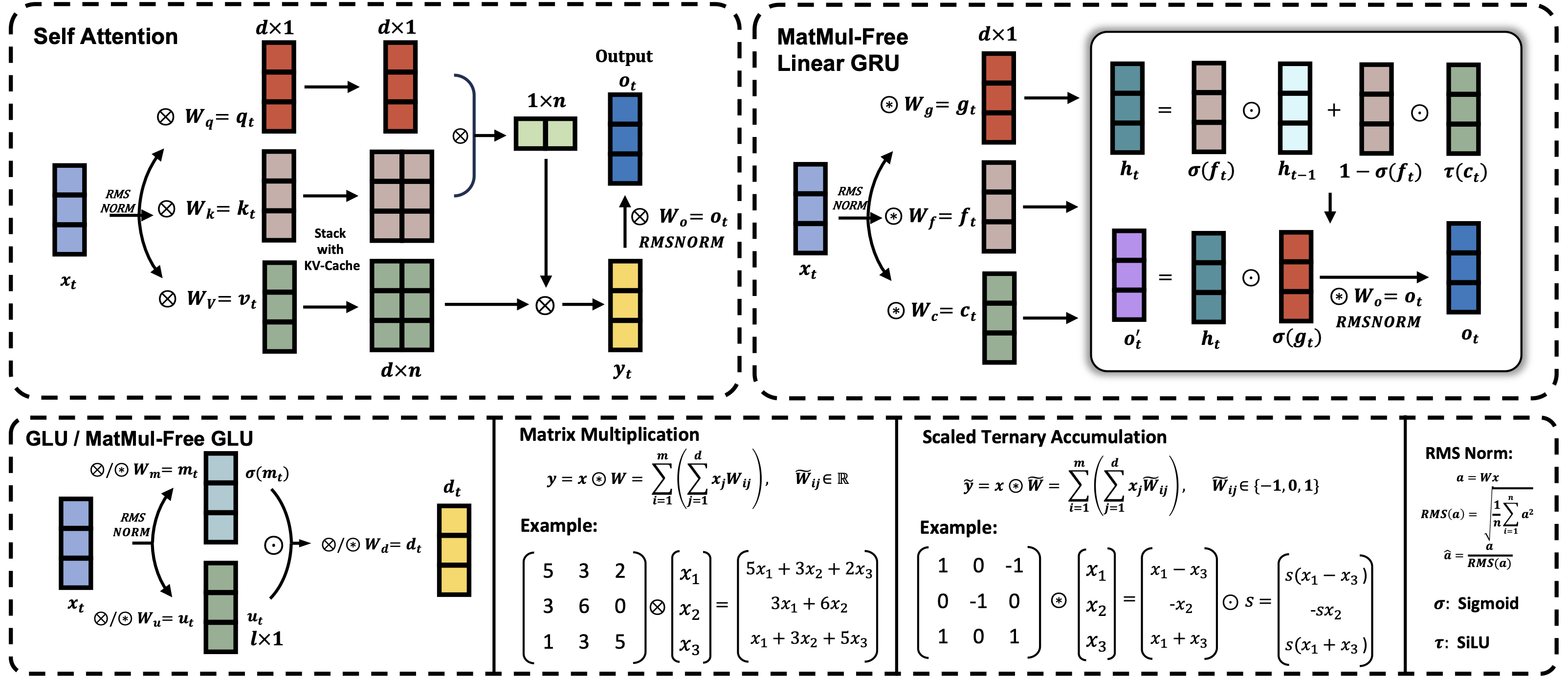
Appears to implement MatMul-free layers using ternary weight quantization (FusedBitLinear) and linear attention (HGRNBitAttention). Replaces standard transformer blocks with custom modules; fully integrated into Transformers library via AutoModel. Requires PyTorch ≥2.0, Triton ≥2.2, einops. README does not detail kernel optimization specifics beyond Triton dependency.
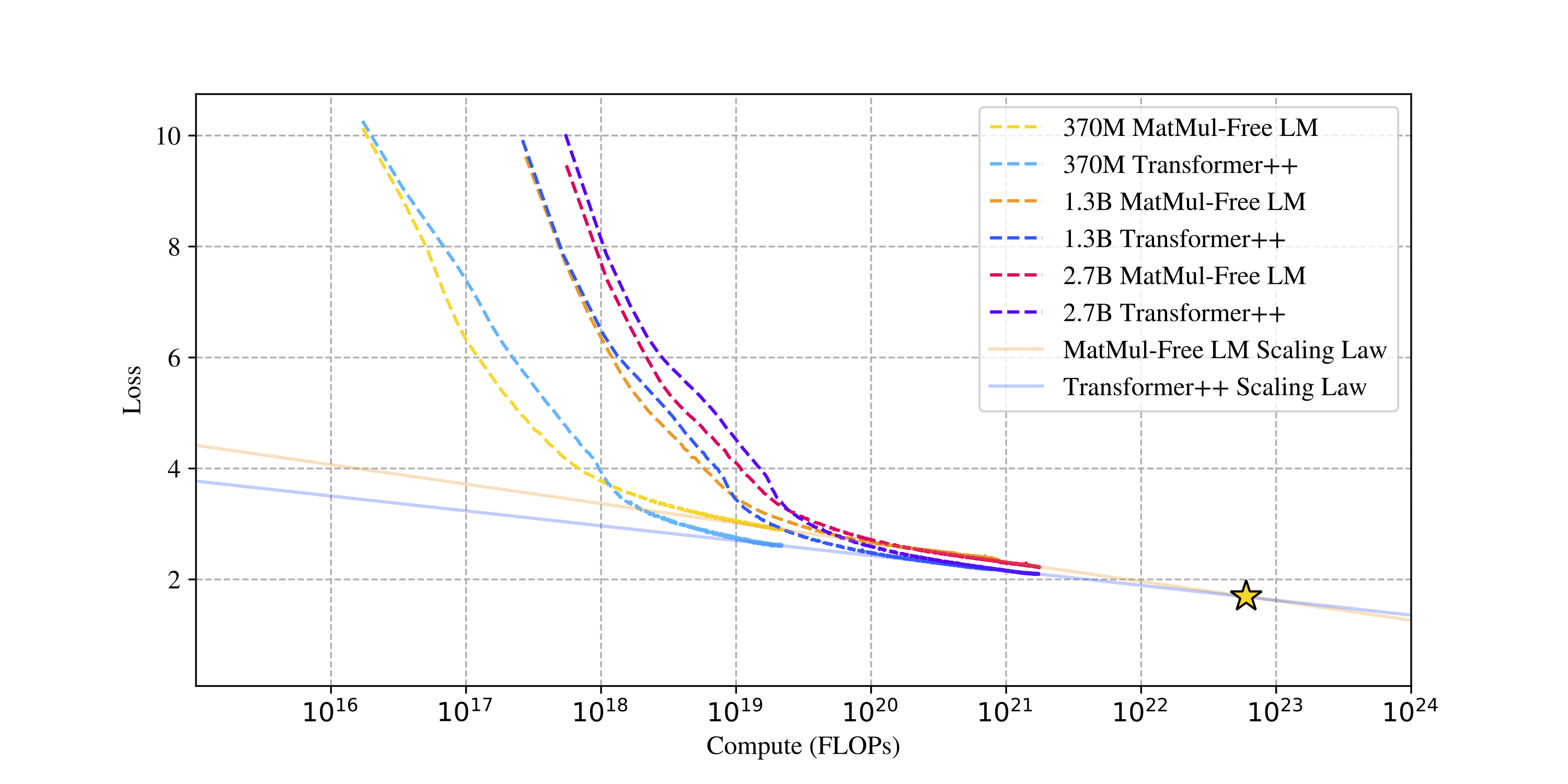
Not documented in README. No mention of benchmarks, unit tests, or validation suites. Scaling law graphs provided but reproducibility details absent.
Last push December 2025 (6 months before analysis date) indicates active but infrequent maintenance. No evidence of rapid issue resolution or community engagement patterns. Repository appears author-driven rather than collaboratively maintained.
ADOPT IF: you are researching compute-efficient LM architectures or need Hugging Face-compatible reference implementation of ternary-quantized, linear-attention models. Integration with standard tools reduces friction. AVOID IF: you require production-grade inference performance, operational stability guarantees, or evidence of real-world validation. No latency benchmarks, deployment documentation, or performance comparisons provided. MONITOR IF: you track emerging quantization techniques in LLM research; architecture shows theoretical promise (steeper scaling law descent claimed) but lacks empirical production validation.
Independent dimensions
Mainstream potential
3/10
Technical importance
6/10
Adoption evidence
2/10
- No published performance benchmarks vs. standard transformers or established quantization methods (bfloat16, int8); theoretical efficiency gains unvalidated in practice.
- Ternary weight constraints may impose non-obvious accuracy penalties at scale; README provides no accuracy/perplexity tables or downstream task evaluation.
- Adoption not verified; unknown whether real users encounter compatibility issues, numerical stability problems, or deployment friction beyond toy examples.
- Long-term maintenance unclear; author-driven project with no visible community contribution pattern or roadmap for supporting new architectures/model sizes.
- Licensing (Apache-2.0) permissive but project size/scope may limit liability or support expectations vs. well-backed frameworks.
Likely to remain in academic/research niche. May influence future quantization research but unlikely to displace standard training pipelines due to lack of production validation and operational evidence. If inference performance data eventually shows compelling advantage, could see adoption in edge/resource-constrained settings.
Newsletter
Get analyses like this every Monday
Free weekly digest of the most interesting open-source discoveries.
Languages
Information
- Language
- Python
- License
- Apache-2.0
- Last updated
- 7mo ago
- Created
- 27mo ago
- Analyzed with
- anthropic/claude-haiku-4-5
Stars over time
Contributors over time
Top 100 contributors only — repos with more will plateau at 100.
Open issues
📋 Documentation Enhancement Suggestion
关于 MatMul-free LM 在端侧神经形态硬件 (BrainChip/SynSense) 上的落地验证
CPU support
Inference Code and trained Model
How can we say matmul-free enables parallel computation?
Open pull requests
Top contributors
Recent releases
No releases published yet.
Similar repos

ml-explore/mlx-lm
MLX LM is a Python package for running and fine-tuning large language models on...

vllm-project/llm-compressor
LLM Compressor is a Python library for applying quantization and pruning...
| Repository | Stars | Week Δ | Language | Score | Updated |
|---|---|---|---|---|---|
|
ridgerchu/matmulfreellm
this
|
3.1k | +1 | Python | 7/10 | 7mo ago |
 mlc-ai/mlc-llm mlc-ai/mlc-llm
|
22.9k | — | Python | 8/10 | 3d ago |
 ModelTC/LightLLM ModelTC/LightLLM
|
4.2k | — | Python | 8/10 | 11h ago |
|
ml-explore/mlx-lm
|
6.2k | — | Python | 8/10 | 2d ago |
|
vllm-project/llm-compressor
|
3.5k | — | Python | 8/10 | 19h ago |
 InternLM/lmdeploy InternLM/lmdeploy
|
7.9k | — | Python | 8/10 | 9h ago |
General-purpose LM compilation/optimization framework (22k stars). Broader scope, more adoption; MatMul-Free targets specific architectural alternative.
Inference optimization (quantization, pruning) at similar star count (3.5k). Orthogonal goal: compression vs. architecture replacement. VLLMCompressor likely more mature operationally.
LM deployment pipeline with quantization support (7.9k stars). Established in production; MatMul-Free is experimental architecture.
Rust-based inference engine (7.4k stars). Different language, different focus (serving). MatMul-Free is training/research focused.
Core dependency/inspiration. MatMul-Free wraps linear attention into full LM pipeline; flash-linear-attention is lower-level kernel library.