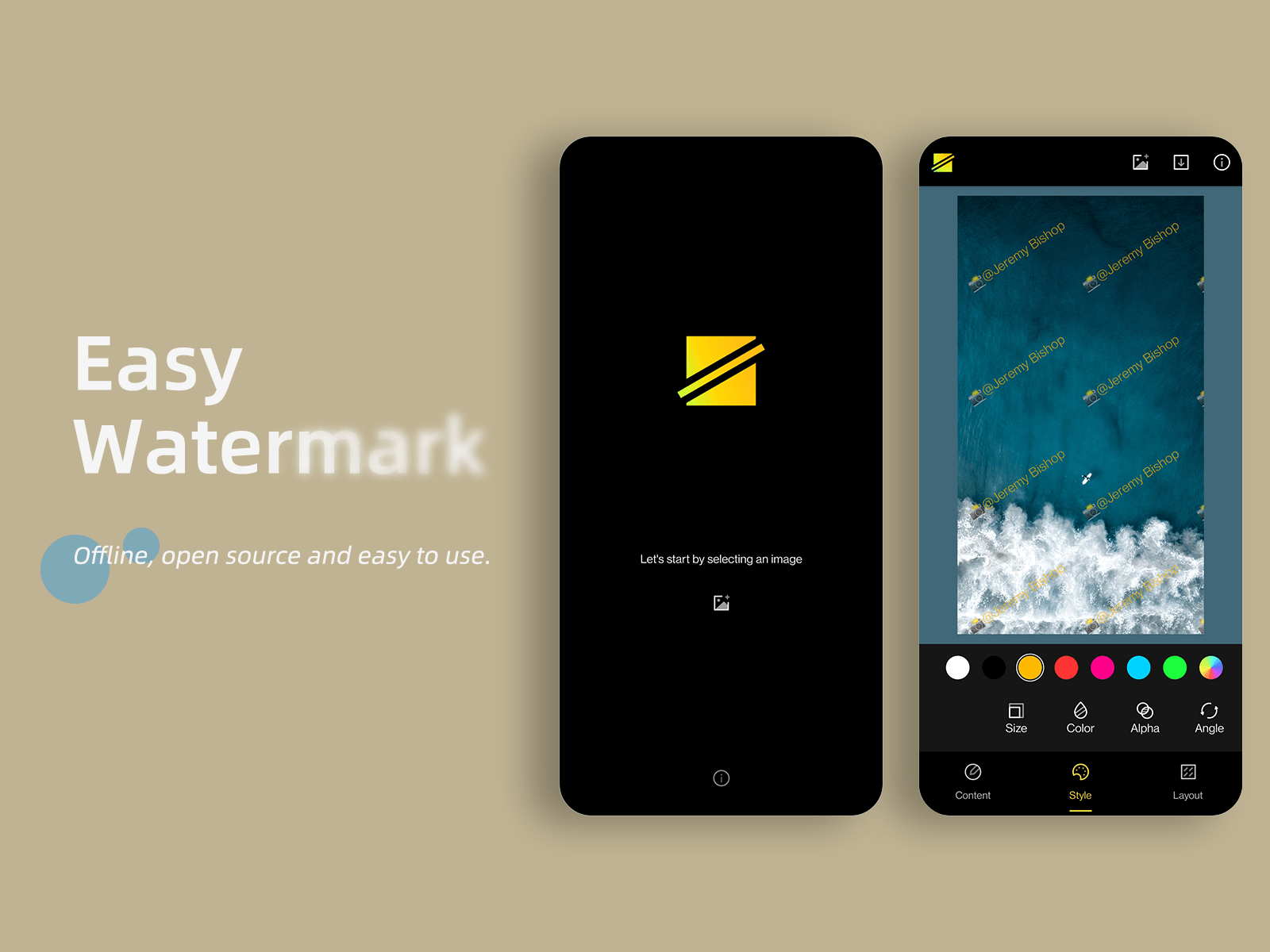
🔒 🖼 Securely, easily add a watermark to your sensitive photos. 安全、简单地为你的敏感照片添加水印,防止被人泄露、利用
1.8k
Stars
150
Forks
34
Open issues
13
Contributors


AI Analysis
Easy Watermark is an Android application that adds text and image watermarks to photos with a focus on user privacy and offline operation. It's purpose-built for protecting sensitive images (IDs, documents, confidential previews) from unauthorized leakage or misuse—best suited for users in jurisdictions requiring photo watermarking for compliance or personal protection, not for general casual photo editing.
Inferred from signals mentioned in the README (tests, CI, type safety) — not a review of the actual code.
AI's overall editorial judgment — not an average of the bars above, can weigh other factors too.
Android app for offline photo watermarking focused on privacy and document protection
EasyWatermark is a Kotlin-based Android application that adds text and image watermarks to photos entirely offline, with emphasis on privacy protection for sensitive documents like ID photos. Built for users in China and broader Asian markets who need to add protective watermarks before uploading photos to online services. The project operates as a consumer end-user application rather than a developer library, distributed through Google Play, F-Droid, Coolapk, and GitHub. It explicitly avoids tracking, analytics, and cloud connectivity, positioning watermarking as a local risk-mitigation tool.
Project created July 2020 during rising concerns about photo misuse and identity theft in Asia. Watermarking has grown as a privacy practice in Chinese and Southeast Asian online culture, where users regularly submit identity documents for verification. EasyWatermark arrived as a standalone solution in this ecosystem, with active development continuing through 2026.
Early adoption appears concentrated in Chinese-speaking and Asian markets (evidenced by Coolapk distribution, Weblate translation platform usage, and Chinese README). Growth was strongest in first 2–3 years post-launch (2020–2022). Recent trajectory shows modest, stable maintenance rather than rapid expansion: 1 star gained in last 7 days as of 2026-07-08, ~1,845 total stars after 6 years. User base appears loyal but geographically and culturally bounded. No evidence of viral growth or mainstream crossover into Western markets.
Distributed on Google Play (including a paid tier), F-Droid, and Coolapk, suggesting real installation and active user base. Explicit mention of API 29+ support and permission handling indicates production-grade Android development. Privacy policy document present. However, concrete download counts, active user metrics, or documented enterprise/organizational usage are not publicly available. Adoption appears significant within target geographic regions but not verified globally.
Appears to be a single-purpose Android application (Kotlin) with UI for watermark configuration (font, color, transparency, rotation, layout spacing), image processing pipeline, and gallery/file access. Likely uses Android native APIs for image manipulation. README mentions integration with ColorPickerView, Material Design components, and image compression libraries. No monolithic architecture documented; appears to be a straightforward client-side image processing tool with no server backend.
Not documented in README. No mention of unit tests, integration tests, or test automation.
Last push 2026-06-30 (8 days before evaluation date), indicating active maintenance. 150 forks and ongoing GitHub Release channel suggest developer is responsive. Localization activity on Weblate platform indicates international community engagement. No evidence of burnout or abandonment, but update frequency cannot be inferred from metadata alone. Described as maintained rather than rapidly evolving.
ADOPT IF: you are an Android user in Asia (especially China/SE Asia) who regularly needs to add visible watermarks to sensitive photos before uploading to services, value offline-first operation, and trust open-source code. The app solves a real, geographically specific problem with privacy-first design. AVOID IF: you need cross-platform watermarking (desktop, iOS, web), expect frequent feature additions, or require documented support/SLAs. The project is stable but narrow in scope. MONITOR IF: you are evaluating watermarking solutions for a product that may serve Asian markets; the privacy positioning and offline model show thoughtful design, though mainstream adoption remains limited to its geographic niche.
Independent dimensions
Mainstream potential
3/10
Technical importance
4/10
Adoption evidence
4/10
- Adoption heavily concentrated in Asia; viability outside these regions unclear. Unlikely to become a globally mainstream tool.
- No public evidence of real-world download counts or user base size; reported adoption metrics unavailable.
- Single developer/small team (inferred from Telegram/email contact in README); continuity risk if maintainer becomes unavailable.
- Test coverage not documented; code quality assurance practices opaque. Security-sensitive application (handles photo data) without visible test infrastructure.
- App-only distribution model limits reach; no library version for developers to integrate watermarking into other Android apps.
Likely to remain a stable, maintained niche tool serving privacy-conscious Asian users with modest growth. Unlikely to expand into Western markets or become a category leader. May gradually adopt more advanced watermarking techniques (invisible watermarks, blockchain-backed verification) if maintainer commits, but core use case is finite. Project trajectory suggests long-term sustainability within its geographic and cultural market rather than growth into adjacent spaces.
Newsletter
Get analyses like this every Monday
Free weekly digest of the most interesting open-source discoveries.
Languages
Information
- Language
- Kotlin
- License
- MIT
- Last updated
- 1w ago
- Created
- 73mo ago
- Analyzed with
- anthropic/claude-haiku-4-5
Stars over time
Contributors over time
Top 100 contributors only — repos with more will plateau at 100.
Open issues
Top contributors
Recent releases
Similar repos

guofei9987/blind_watermark
This Python library implements blind watermarking for images using DWT-DCT-SVD...

burhanrashid52/PhotoEditor
PhotoEditor is a Kotlin-based Android library that provides UI components and...

Skykai521/StickerCamera
StickerCamera is an Android photo editing application that combines camera...
| Repository | Stars | Week Δ | Language | Score | Updated |
|---|---|---|---|---|---|
|
rosuH/EasyWatermark
this
|
1.8k | +2 | Kotlin | 7/10 | 1w ago |
|
guofei9987/blind_watermark
|
14.1k | — | Python | 7/10 | 4mo ago |
 you-apps/WallYou you-apps/WallYou
|
1k | — | Kotlin | 7/10 | 3w ago |
|
burhanrashid52/PhotoEditor
|
4.5k | — | Kotlin | 7/10 | 1mo ago |
|
Skykai521/StickerCamera
|
3.2k | — | Java | 6/10 | 3w ago |
 allenk/GeminiWatermarkTool allenk/GeminiWatermarkTool
|
2.7k | — | C++ | 7/10 | 1mo ago |
Blind watermark is a library-first Python tool for embedding imperceptible watermarks in images; EasyWatermark is a visible, user-facing Android app. Different problem space: blind_watermark targets developers and content protection at scale; EasyWatermark targets end-users protecting individual documents.
PhotoEditor is a general-purpose photo editing library for Android; EasyWatermark is a single-function consumer app. PhotoEditor serves developers building editing features; EasyWatermark serves users with specific watermarking needs.
StickerCamera is a photo editing app with sticker overlays; EasyWatermark is narrower (watermark-only) but with stronger privacy positioning and offline-first design.
Watermarking tool in C++ (appears to be desktop-oriented); EasyWatermark is mobile-native. Different platform and use case.
Wallpaper creation app; tangential to EasyWatermark. Both are niche Android utilities but serve different user problems.