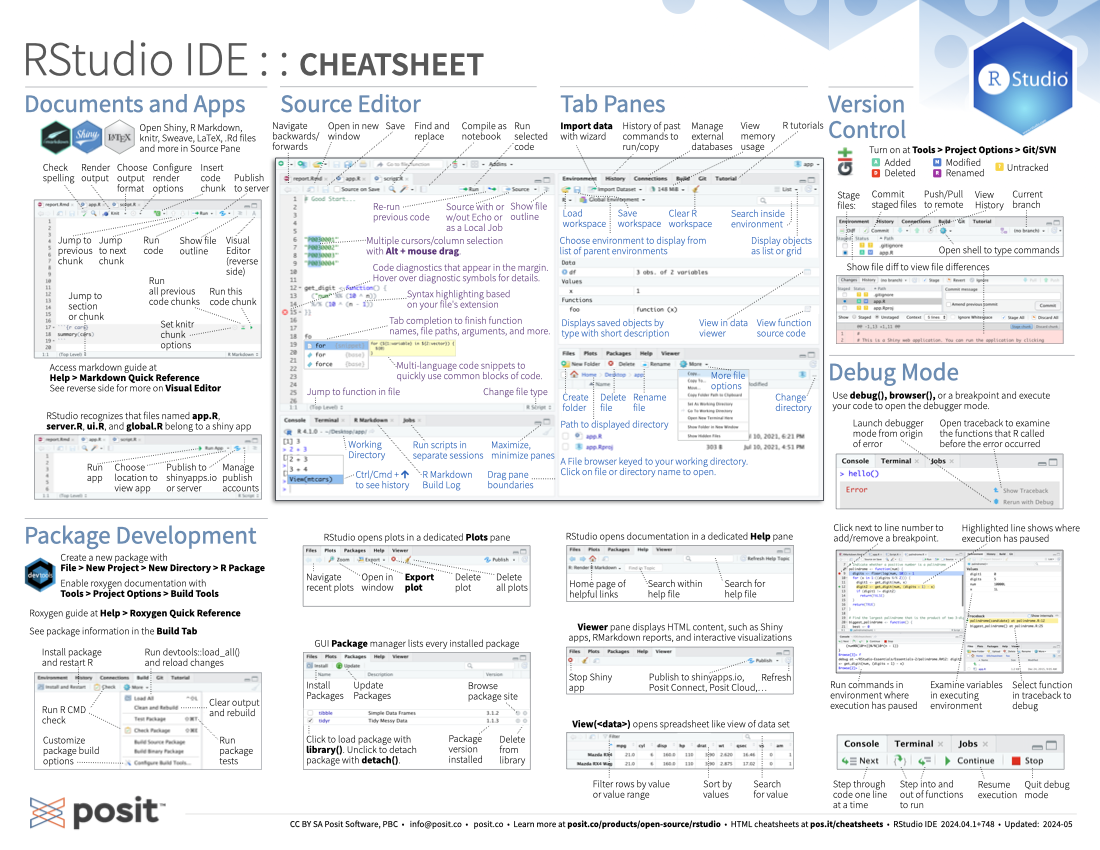
Posit Cheat Sheets - Can also be found at https://posit.co/resources/cheatsheets/.
6.4k
Stars
1.9k
Forks
25
Open issues
30
Contributors


AI Analysis
Posit Cheatsheets is an official collection of reference guides for R, RStudio, and related data science packages, maintained by Posit (formerly RStudio). It provides scannable visual quick-reference materials in PDF and accessible HTML formats, designed to help users quickly locate essential functions rather than serve as comprehensive documentation. The project benefits data scientists, R developers, and RStudio IDE users who need rapid function lookup; it is not intended as a learning reso...
Inferred from signals mentioned in the README (tests, CI, type safety) — not a review of the actual code.
AI's overall editorial judgment — not an average of the bars above, can weigh other factors too.
Posit's official R/data-science cheatsheets: 6k-star reference repo powering millions of learners
This repository hosts the source files for Posit's (formerly RStudio) official quick-reference cheatsheets covering R packages such as ggplot2, dplyr, tidyr, Shiny, and many more. It is built for R users and data science educators who need dense, scannable visual aids rather than full documentation. The cheatsheets are bundled directly into the RStudio IDE and hosted on posit.co, giving them extremely high passive distribution. The repo also serves as a submission point for community-contributed and translated cheatsheets.
Originated in January 2017 under the RStudio GitHub org; predates the Posit rebrand (2022). Cheatsheets were originally created by Garrett Grolemund and became a canonical teaching artifact in the R community.
Stars accumulated steadily as the R/tidyverse ecosystem grew through 2018-2022. Growth has plateaued (0 stars in last 7 days) — expected for a mature reference artefact where discovery is now primarily through the IDE bundle and posit.co rather than GitHub search. The project is effectively a stable utility asset, not a growth-stage project.
Cheatsheets are embedded in the RStudio/Posit IDE under Help > Cheatsheets, placing them in front of millions of active R users. Hosted prominently at posit.co/resources/cheatsheets/. Community translations (pull requests) exist. 1,943 forks suggest broad reuse and adaptation. Direct IDE integration constitutes strong evidence of widespread passive consumption.
Appears to be a document repository, not a software library. Source files are Keynote and PowerPoint templates plus TeX/PDF outputs. Likely no executable code. HTML-accessible versions are being added as Quarto (.qmd) files in an html/ subdirectory, suggesting a dual-format strategy.
not documented in README — not applicable for a document/asset repository
Last push was 2026-06-29, the same date as the analysis — the repository is actively maintained. README is detailed with contribution guidelines, and a CONTRIBUTING.md exists, indicating ongoing stewardship by Posit staff.
ADOPT IF: you teach R, learn R, or need quick-reference material for tidyverse packages — these are the de facto standard reference cards for the R ecosystem. AVOID IF: you are looking for executable code, an R library to install, or narrative documentation — this repo contains printable/visual assets, not software. MONITOR IF: you contribute translations or community cheatsheets, as the shift to HTML/Quarto formats may change contribution workflows.
Independent dimensions
Mainstream potential
3/10
Technical importance
3/10
Adoption evidence
8/10
- PDF-based format may gradually lose relevance as interactive, searchable documentation (pkgdown sites, Quarto books) becomes the preferred reference medium.
- Keynote source files create a contribution barrier for non-macOS users, potentially limiting community authorship.
- Coverage gaps may emerge if the team cannot keep pace with rapidly evolving packages or new Posit product launches.
- The HTML/Quarto migration is in an early stage; parallel maintenance of two formats (PDF and HTML) could strain maintainer bandwidth.
- Project relevance is tied to RStudio/Posit IDE adoption; any significant decline in that IDE's market share would reduce passive distribution.
The repository will remain a stable, well-maintained reference asset for the R ecosystem. Gradual migration toward accessible HTML formats is likely to continue incrementally without urgency.
Newsletter
Get analyses like this every Monday
Free weekly digest of the most interesting open-source discoveries.
Languages
Information
- Language
- TeX
- License
- CC-BY-4.0
- Last updated
- 2w ago
- Created
- 116mo ago
- Analyzed with
- anthropic/claude-haiku-4-5
Stars over time
Contributors over time
Top 100 contributors only — repos with more will plateau at 100.
Open issues
Package Development: Keyboard shortcuts only apply to RStudio
<Dplyr>: <Wrong/confusing examples of joins>
sf: st_point signature wrong (typo)
stringr: markdown table is malformed
<cheatsheet name>: <brief description of issue/question>
Top contributors
Recent releases
No releases published yet.
Similar repos

ralsina/rst-cheatsheet
A two-page PDF cheatsheet for reStructuredText (reST) syntax and usage. This is...

detailyang/awesome-cheatsheet
Awesome Cheatsheet is a curated index of programming and technical cheatsheets...

ralfbiedert/cheats.rs
A single-page Rust language cheat sheet designed for high information density,...
| Repository | Stars | Week Δ | Language | Score | Updated |
|---|---|---|---|---|---|
|
rstudio/cheatsheets
this
|
6.4k | — | TeX | 8/10 | 2w ago |
|
ralsina/rst-cheatsheet
|
1.2k | — | Shell | 6/10 | 2mo ago |
|
detailyang/awesome-cheatsheet
|
8.5k | — | Python | 6/10 | 4mo ago |
|
ralfbiedert/cheats.rs
|
4.5k | — | Rust | 8/10 | 2mo ago |
 cheat/cheat cheat/cheat
|
13.4k | — | Go | 8/10 | 2mo ago |
Official documentation is comprehensive but verbose; cheatsheets are explicitly designed as scannable quick-reference aids rather than replacements, serving a complementary role.
R for Data Science is a narrative learning resource; cheatsheets target users who already know the basics and need function lookup, not conceptual explanation.
Commercial learning platforms produce their own quick references, but Posit's sheets carry official maintainer authority and are bundled in the IDE, giving them a distribution advantage.
Community-generated sheets on Cheatography lack official maintainer backing and IDE integration; quality is inconsistent compared to Posit-curated content.
The Python ecosystem lacks an equivalent centrally-maintained, IDE-integrated cheatsheet repo, making this R resource comparatively more organized within its language ecosystem.