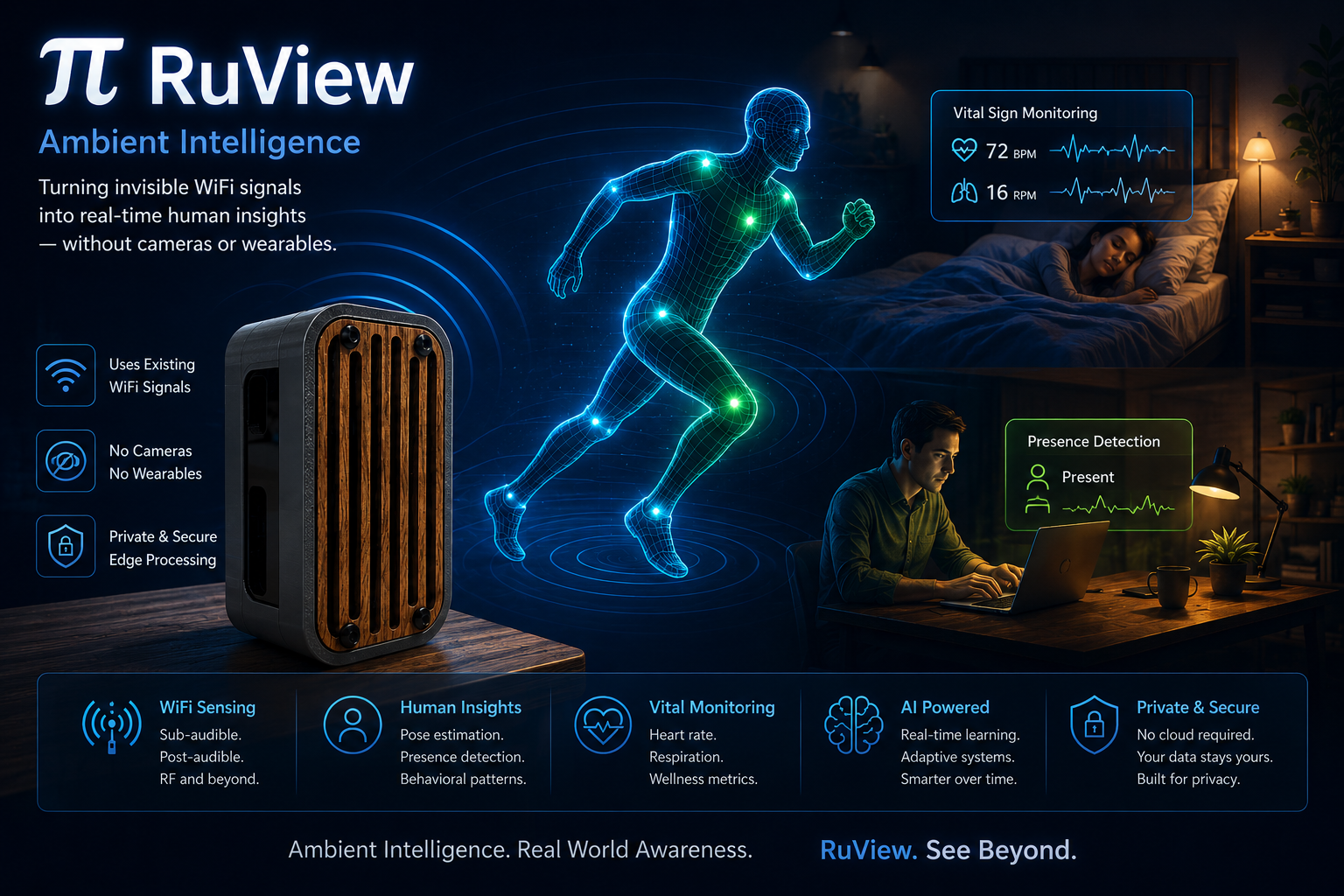
π RuView turns commodity WiFi signals into real-time spatial intelligence, vital sign monitoring, and presence detection — all without a single pixel of video.
79.8k
Stars
10.7k
Forks
358
Open issues
26
Contributors


AI Analysis
RuView is a WiFi-based sensing platform that uses Channel State Information (CSI) from ESP32 hardware sensors to detect human presence, monitor vital signs (breathing, heart rate), recognize activity, and map indoor environments — all without cameras or wearables. Its best-fit use case is privacy-preserving home automation and elder care monitoring, with deep integration into Home Assistant, Apple Home, Google Home, and Alexa via Matter bridging. It is intended for technically oriented smart-...
Inferred from signals mentioned in the README (tests, CI, type safety) — not a review of the actual code.
AI's overall editorial judgment — not an average of the bars above, can weigh other factors too.
RuView uses WiFi radio signals to detect presence, vital signs, and movement without cameras
RuView is a Rust-based WiFi sensing platform that processes Channel State Information (CSI) from ESP32 hardware to perform contactless presence detection, breathing rate monitoring, heart rate estimation, and activity recognition. It targets privacy-conscious home automation users, eldercare scenarios, and security applications where cameras are unacceptable. It integrates with Home Assistant, Apple Home, Google Home, Alexa, and Matter. The system is designed to run entirely on edge hardware with no cloud dependency, using a quantized 8KB neural model. However, adoption evidence is thin and several performance claims in the README appear to have been revised or retracted.
Created on 2025-06-07 by ruvnet, a prolific open-source author also behind ruflo (60K+ stars). The project is under a year old but has grown rapidly, likely propelled by the author's existing audience and viral attention to the privacy-preserving sensing concept.
The repo gained ~75K stars in roughly 13 months, averaging over 1,100 stars per week recently. This pattern closely resembles other ruvnet projects like ruflo, suggesting a shared audience amplification effect — likely driven by social media, Hacker News, and the author's follower base — rather than organic growth from production deployments. The concept (seeing through walls with commodity hardware) is inherently attention-grabbing.
Adoption not verified. The README references a Hugging Face model ('ruvnet/wifi-densepose-pretrained'), a crates.io package, and Docker Hub images, which are verifiable artifacts. A badge claims '10M+ downloads' for edge modules, but this is self-reported and unverifiable from available metadata. No third-party case studies, production deployments, or community testimonials are documented in the README excerpt.
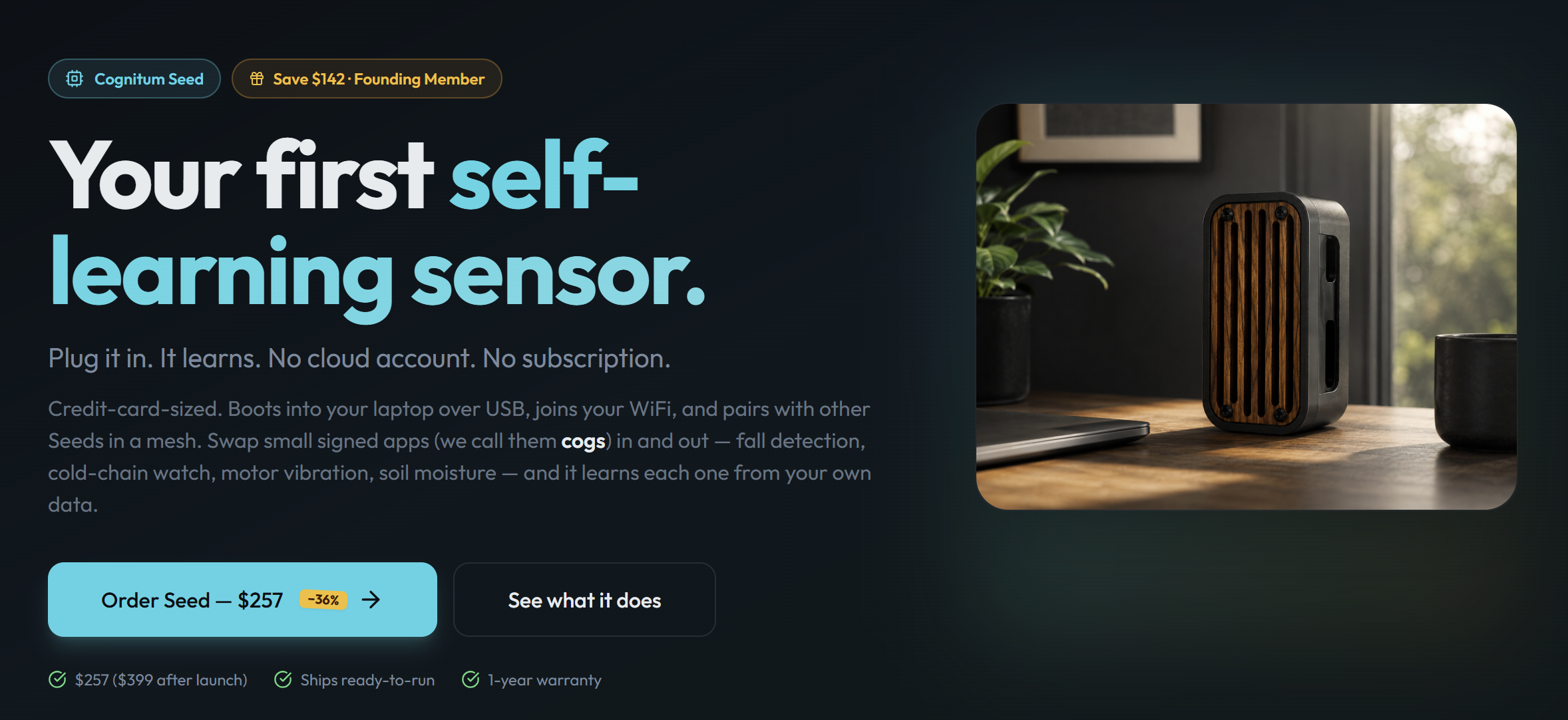
Appears to follow an edge-first architecture: ESP32-S3 nodes stream CSI data over WiFi mesh, a Rust core processes signals using spiking neural networks, and results are published via MQTT or exposed as a HAP/Matter bridge. Likely modular, with edge modules running directly on ESP32 hardware and a host-side aggregation layer. The 'RuVector' and 'Cognitum Seed' dependencies suggest external AI inference and memory components. Multi-arch Docker support (amd64 + arm64) is claimed.
README badges claim 1,463 tests passing. This is a specific and relatively credible signal, but the badge is self-reported and cannot be independently verified from metadata alone. Actual coverage percentage is not documented.
Last push date is 2026-06-20, the same as the evaluation date, indicating active development. Given the project is ~13 months old with continuous recent commits, it appears actively maintained rather than stagnant. However, the README itself notes a retracted accuracy claim ('the older 100% presence figure was measured on a single-class recording and has been retracted'), which is a positive transparency signal but also a red flag about initial claim quality.
ADOPT IF: you need privacy-preserving occupancy or vital sign monitoring in a home/eldercare setting, are comfortable with experimental hardware integration (ESP32-S3), and can tolerate an 82% accuracy ceiling with ongoing model improvement. AVOID IF: you need production-grade, independently validated sensing accuracy for safety-critical applications (fall detection, medical monitoring), or lack the hardware and RF expertise to tune a CSI-based system. MONITOR IF: you are interested in the space but want to wait for independent benchmarks, community deployments, and verified crates.io download figures before committing.
Independent dimensions
Mainstream potential
4/10
Technical importance
7/10
Adoption evidence
2/10
- Performance claims have already been retracted once (100% presence accuracy → 82.3%); other benchmark figures may also be optimistic or context-dependent.
- The '10M+ downloads' badge and similar self-reported metrics are unverifiable and may inflate perceived adoption.
- CSI-based WiFi sensing is highly environment-dependent; real-world accuracy may degrade significantly across different router hardware, room geometries, and interference conditions.
- Dependency on external proprietary or semi-proprietary components ('Cognitum Seed', 'RuVector') introduces supply-chain and continuity risk for a project claiming full offline operation.
- Star count growth pattern mirrors other ruvnet repos and may reflect social media virality rather than genuine developer or deployer interest, making adoption trajectory difficult to assess.
RuView will likely remain a technically interesting reference implementation and exploration platform for WiFi sensing. Mainstream adoption will depend on independent accuracy validation and community-contributed real-world deployments, neither of which is yet documented.
Newsletter
Get analyses like this every Monday
Free weekly digest of the most interesting open-source discoveries.
Languages
Information
- Website
- https://Cognitum.One/RuView
- Language
- Rust
- License
- MIT
- Last updated
- -36 min ago
- Created
- 13mo ago
- Analyzed with
- anthropic/claude-sonnet-4-6
Stars over time
Contributors over time
Top 100 contributors only — repos with more will plateau at 100.
Top contributors
Similar repos

security-union/videocall-rs
videocall.rs is an open-source video conferencing platform and media streaming...
| Repository | Stars | Week Δ | Language | Score | Updated |
|---|---|---|---|---|---|
|
ruvnet/RuView
this
|
79.8k | +3.4k | Rust | 7/10 | -36 min ago |
|
ruvnet/RuVector
|
4.3k | — | Rust | 7/10 | 1d ago |
|
security-union/videocall-rs
|
1.8k | — | Rust | 7/10 | 3d ago |
|
ruvnet/ruflo
|
63.8k | — | TypeScript | 7/10 | -24 min ago |
 roflcoopter/viseron roflcoopter/viseron
|
3.3k | — | Python | 7/10 | 14h ago |
 secluso/core secluso/core
|
1.6k | — | Rust | 8/10 | 4d ago |
Viseron is a camera-based NVR/AI detection platform with ~3K stars and documented production use in Home Assistant communities. RuView targets a different modality (RF vs. video) rather than directly competing, but both serve home automation occupancy detection. Viseron has more verified real-world adoption; RuView claims stronger privacy guarantees.
Reticulum is a cryptographic mesh networking stack, not a sensing platform. The comparison is architecturally adjacent — both involve mesh radio and edge cryptography — but the use cases are entirely different. Reticulum has ~6K stars with documented community adoption; RuView's adoption is less verified.
A Rust WebSocket library with ~2.4K stars and wide production use. Shares only the Rust language with RuView. Included likely as an ecosystem reference. Not a meaningful functional competitor.
A sibling project by the same author with 60K+ stars in TypeScript. The growth pattern of both repos is nearly identical, suggesting the same viral amplification mechanism. ruflo's star count does not translate to verified production adoption evidence for RuView.