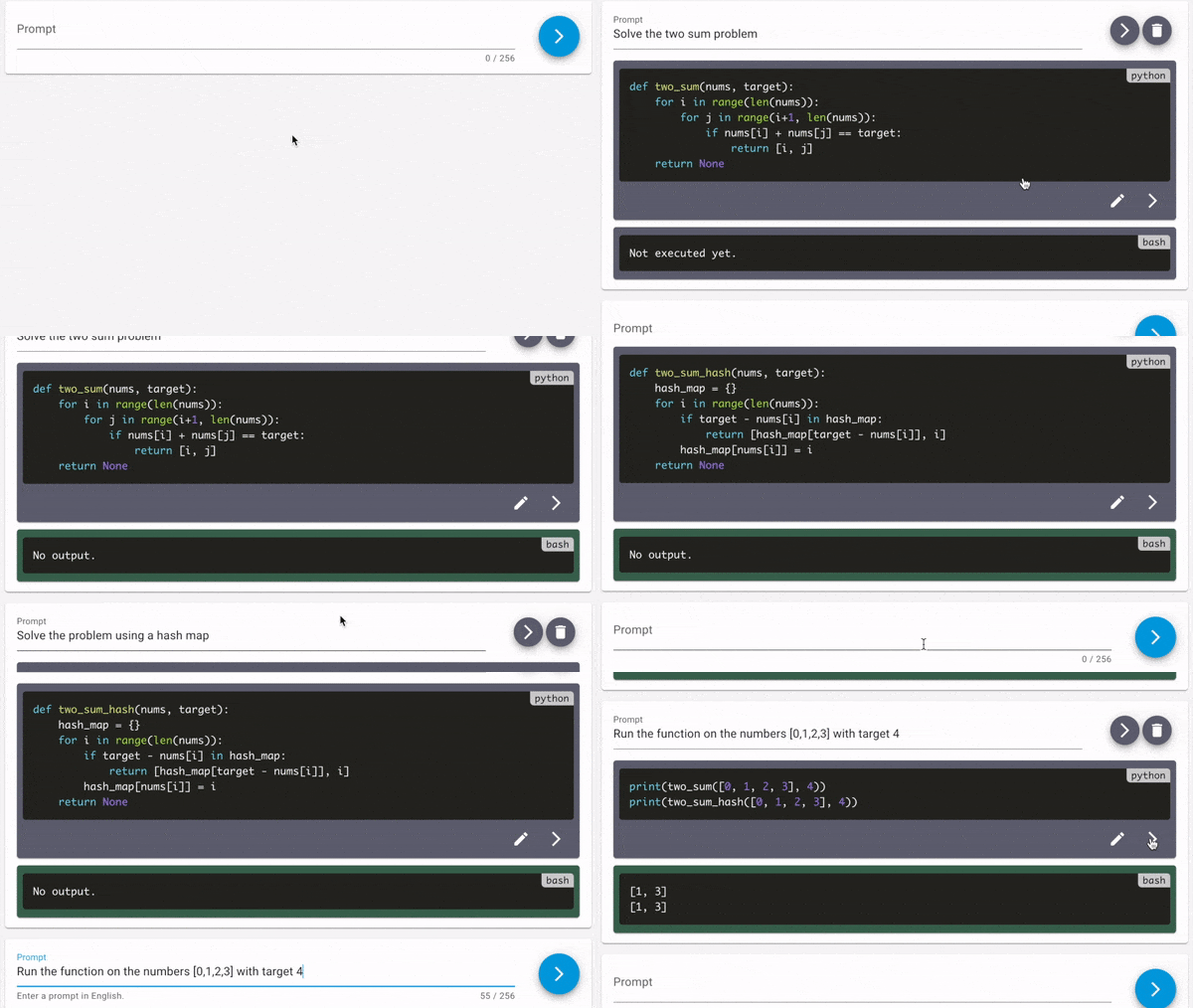
CodeGen is a family of open-source model for program synthesis. Trained on TPU-v4. Competitive with OpenAI Codex.
5.2k
Stars
423
Forks
48
Open issues
11
Contributors





AI Analysis
CodeGen is a family of open-source models (350M to 16B parameters) for program synthesis, released by Salesforce AI Research and trained on TPU-v4. It is designed specifically for code generation tasks and serves researchers, ML practitioners, and developers building code-related applications. This is a research-focused project, not a general-purpose LLM—it targets those working on program synthesis rather than the broader LLM application audience.
Inferred from signals mentioned in the README (tests, CI, type safety) — not a review of the actual code.
AI's overall editorial judgment — not an average of the bars above, can weigh other factors too.
Salesforce's open-source code-generation LLM family, now a historical research artifact in a fast-moving field
CodeGen is a family of open-source large language models (350M to 16B parameters) trained by Salesforce AI Research for program synthesis. It was designed for researchers and developers who needed an open alternative to OpenAI Codex circa 2022-2023. Published at ICLR 2023, it was academically significant at release. Real-world usage today appears concentrated in research citation and Hugging Face model hub downloads rather than new production deployments, given the emergence of faster-evolving alternatives.
Released March 2022 as a Codex-competitive open model, followed by CodeGen2 (May 2023) with infill capability and CodeGen2.5 (July 2023) claiming 7B-parameter performance matching prior 16B models. Both CodeGen1 and CodeGen2 papers appeared at ICLR 2023.
Initial star growth was driven by the novelty of an open, Codex-competitive code LLM in early 2022 when such models were scarce. Growth plateaued as the field rapidly advanced with StarCoder, Code Llama, DeepSeek-Coder, and others offering superior benchmarks. Zero new stars in the last 7 days as of June 2026 indicates the repository has entered a maintenance-only phase with no active community growth.
Adoption not verified through explicit production case studies in the README. Indirect evidence of adoption exists via Hugging Face Hub model availability and academic citations, but the README contains no deployment testimonials, user numbers, or downstream integration examples. Research and academic use is probable given two ICLR publications.
Appears to be a family of autoregressive transformer decoder models (GPT-style) ranging from 350M to 16B parameters. CodeGen2 likely adds fill-in-the-middle (FIM/infill) capability. Training infrastructure references Jaxformer (JAX/TPU-v4). Inference is served via standard Hugging Face transformers API, suggesting standard causal LM architecture with no exotic runtime dependencies.
not documented in README
Last push was June 2, 2026, roughly 3 weeks before the evaluation date, suggesting the repository is not fully abandoned. However, with 0 stars gained in the last 7 days and the most recent substantive content update being July 2023 (CodeGen2.5), active development appears to have concluded. The repo likely receives only minor housekeeping commits at this point.
ADOPT IF: you are reproducing results from the original CodeGen or CodeGen2 papers, need a well-documented historical baseline for academic comparison, or require an Apache-2.0-licensed model with straightforward Hugging Face integration and can accept 2022-2023-era capability levels. AVOID IF: you need competitive code generation performance for production use in 2026 — newer models significantly outperform this family on standard benchmarks. MONITOR IF: Salesforce AI Research resumes active development or releases a CodeGen3 successor that re-enters competitive benchmark ranges.
Independent dimensions
Mainstream potential
2/10
Technical importance
6/10
Adoption evidence
3/10
- Model capability is materially behind the current state of open code LLMs (2024-2026 vintage models), making it a poor default choice for new projects.
- No evidence of active model training or architecture updates since mid-2023; the project appears to be in permanent feature freeze.
- Community activity appears effectively dormant (zero star growth, no visible issue/PR momentum mentioned), which may affect availability of community support and integrations.
- Benchmark comparisons in the README reference OpenAI Codex, which itself is deprecated — making the stated competitive positioning largely obsolete.
- Downstream users relying on Hugging Face Hub model hosting face dependency on Salesforce maintaining those model artifacts, with no documented long-term hosting guarantee.
CodeGen will likely persist as a stable research artifact and citation target for the 2022-2023 code LLM literature but is unlikely to regain active development momentum or community growth without a major new model release from Salesforce AI Research.
Newsletter
Get analyses like this every Monday
Free weekly digest of the most interesting open-source discoveries.
Languages
Information
- Language
- Python
- License
- Apache-2.0
- Last updated
- 1mo ago
- Created
- 52mo ago
- Analyzed with
- anthropic/claude-haiku-4-5
Stars over time
Contributors over time
Top 100 contributors only — repos with more will plateau at 100.
Open issues
Which repetitive Salesforce tasks consume the most time for your team?
📝 Integration Proposal: CAJAL — Scientific Paper Agent for CodeGen
Remove appendix with license text placeholders
[BUG] CodeGen 2.5 Tokenizer cannot be initialized anymore
The output is comments, not code
Similar repos

deepseek-ai/DeepSeek-Coder
DeepSeek Coder is a series of open-source code language models (1B to 33B...

code-yeongyu/oh-my-openagent
oh-my-openagent (OmO) is a TypeScript-based agent harness and orchestration...
| Repository | Stars | Week Δ | Language | Score | Updated |
|---|---|---|---|---|---|
|
salesforce/CodeGen
this
|
5.2k | +2 | Python | 7/10 | 1mo ago |
 openai/codex openai/codex
|
96.9k | — | Rust | 8/10 | 1h ago |
|
deepseek-ai/DeepSeek-Coder
|
23.8k | — | Python | 8/10 | 8mo ago |
|
code-yeongyu/oh-my-openagent
|
65.5k | — | TypeScript | 6/10 | 2h ago |
 colbymchenry/codegraph colbymchenry/codegraph
|
59k | — | TypeScript | 8/10 | -99 min ago |
More recent (2023-2024), higher benchmark scores across multiple sizes, actively developed with a large community (23K+ stars). Likely the stronger choice for most code generation tasks today compared to CodeGen2.5.
Built on Llama 2/3 base, supports more languages and larger context windows. Backed by Meta's ongoing research investment; surpasses CodeGen on most benchmarks as of 2024-2025.
Community-governed, trained on The Stack v2 with strong multi-language coverage and transparency. Generally considered a more current open baseline than CodeGen for research and deployment.
The original target of comparison. Now repositioned as an agent/CLI tool (92K stars). No longer a direct model-weight competitor; the comparison context has fundamentally changed since 2022.
Smaller, highly efficient models that outperform CodeGen on code tasks at comparable or smaller parameter counts, making CodeGen's efficiency story less compelling.