Lightweight Armoury Crate alternative for Asus laptops with nearly the same functionality. Works with ROG Zephyrus, Flow, TUF, Strix, Scar, ProArt, Vivobook, Zenbook, Expertbook, ROG Ally, and many more.
14.1k
Stars
527
Forks
132
Open issues
30
Contributors


AI Analysis
G-Helper is a lightweight system utility that replaces Asus's Armoury Crate software for controlling power profiles, fan curves, RGB lighting, and hardware settings on Asus gaming and productivity laptops (ROG, TUF, Flow, Zenbook, ProArt, and ROG Ally). It serves users who want minimal system overhead while retaining core hardware management features; it is not a general-purpose laptop tool but rather a specialized alternative for the Asus ecosystem.
Inferred from signals mentioned in the README (tests, CI, type safety) — not a review of the actual code.
AI's overall editorial judgment — not an average of the bars above, can weigh other factors too.
G-Helper: A lean, open-source replacement for Asus's bloated Armoury Crate software
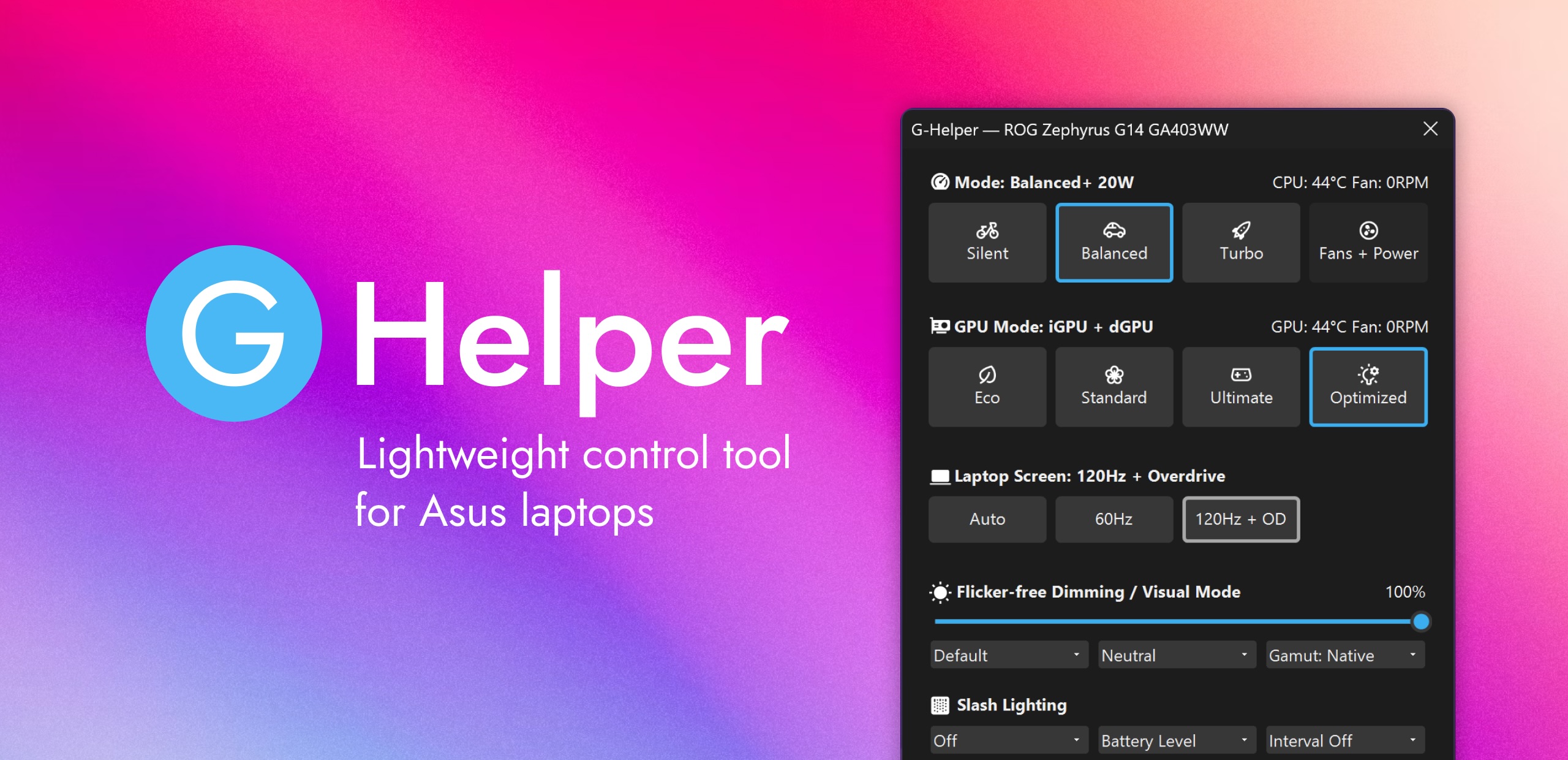
G-Helper is a single-executable Windows application that replicates nearly all functionality of Asus's official Armoury Crate software — performance mode switching, fan curve editing, GPU mode control, RGB lighting, battery health limits, and more — without the installation overhead, background services, or resource consumption of the official app. It targets Asus laptop owners (ROG, TUF, Zephyrus, Zenbook, etc.) who want hardware control without bloatware. With 13,800+ stars, coverage in outlets like Digital Trends and Notebookcheck, and daily-level commit activity, it has clear, demonstrated traction in the Asus enthusiast community.
Created in February 2023, G-Helper emerged as frustration with Armoury Crate's bloat peaked in online communities. It evolved rapidly from a basic fan control tool to a near-complete hardware management suite within its first year.
Growth was driven by viral word-of-mouth in Reddit communities (r/ASUS, r/ZephyrusG14, etc.), YouTube reviews from tech channels, and press coverage from established hardware media. The project's single-exe, no-install approach resonated strongly with enthusiasts. Steady weekly star gains (~130/week observed) suggest ongoing organic discovery rather than a one-time spike.
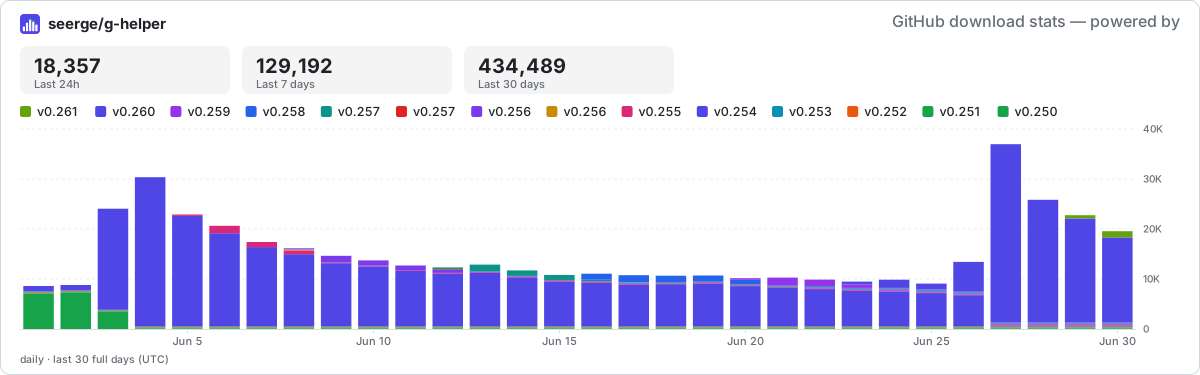
Strong adoption evidence: downloads are tracked via a release monitor badge on the README, YouTube reviews with public view counts exist, and multiple tier-1 tech publications (Digital Trends, Notebookcheck, Les Numériques) have covered it. Community-reported usage across ROG, TUF, and Zenbook lines is well-documented in public forums. Exact install counts are not published but appear to be in the hundreds of thousands based on release monitor chart presence and press visibility.
Likely a native Windows desktop application built in C# targeting .NET, structured as a system-tray utility. Based on README, it appears to communicate directly with ASUS BIOS/WMI interfaces and hardware drivers rather than wrapping Armoury Crate — the single-exe, no-install design suggests minimal dependency footprint. Multi-language README support and modular feature set suggest a reasonably organized codebase.
not documented in README
Last push was 2026-06-22 — effectively the day before the analysis date — indicating active, near-daily maintenance. The project has been continuously updated for over 3 years. A dedicated website (g-helper.com), SLSA3 build attestation, and structured wiki/FAQ suggest mature project hygiene for a solo-maintained open source tool.
ADOPT IF: you own a supported Asus laptop and find Armoury Crate slow, resource-heavy, or intrusive — G-Helper covers the vast majority of use cases with far lower overhead and is actively maintained. AVOID IF: you rely on Armoury Crate's GameVisual profiles, certain RGB per-key effects not yet implemented, or if you need fully official vendor support and warranty-safe tooling. MONITOR IF: you own a very recently released Asus model, as new hardware support may lag by weeks to months after launch.
Independent dimensions
Mainstream potential
5/10
Technical importance
7/10
Adoption evidence
8/10
- Hardware compatibility gaps: Asus releases new laptop models frequently; support for the newest hardware may lag official software, and some features may be incomplete or unstable on less-common models.
- Single-maintainer risk: The project appears to be primarily maintained by one developer (seerge). A change in availability or interest could significantly slow development or maintenance.
- Reverse-engineering fragility: G-Helper likely interfaces with undocumented BIOS/WMI APIs. Asus firmware updates could break functionality without notice, as there is no official API contract.
- Windows-only scope: The tool is inherently limited to Windows; Linux Asus users are not served, and any Asus shift toward proprietary firmware lock-down could restrict access.
- No formal test suite documented: The absence of documented testing means regressions on specific hardware combinations may not be caught before release, requiring users to report issues post-update.
G-Helper is likely to remain the de-facto community standard for Asus laptop management on Windows, growing steadily as the Asus laptop install base expands, barring a major Armoury Crate overhaul or API lockdown by Asus.
Newsletter
Get analyses like this every Monday
Free weekly digest of the most interesting open-source discoveries.
Languages
Information
- Website
- https://g-helper.com
- Language
- C#
- License
- GPL-3.0
- Last updated
- 15h ago
- Created
- 42mo ago
- Analyzed with
- anthropic/claude-haiku-4-5
Stars over time
Contributors over time
Top 100 contributors only — repos with more will plateau at 100.
Open issues
Laptop Crashing when unplugged
Charging limit needs to be manually reapplied after hibernation
Mute button triggers as mute even while on FN locked mode
Option missing to enabble/disable the light logo in the back of the lid/screen on ROG G703GXR
Insane Lag and slowed opening of GUI after 0.260.0 update
Top contributors
Similar repos

CalcProgrammer1/OpenRGB
OpenRGB is a cross-platform (Windows, Linux, macOS) application that provides...

Sapd/HeadsetControl
HeadsetControl is a cross-platform utility for Linux, macOS, and Windows that...

ilya-zlobintsev/LACT
LACT is a Linux desktop application for monitoring and controlling AMD, Nvidia,...
| Repository | Stars | Week Δ | Language | Score | Updated |
|---|---|---|---|---|---|
|
seerge/g-helper
this
|
14.1k | +115 | C# | 8/10 | 15h ago |
|
CalcProgrammer1/OpenRGB
|
4.2k | — | C++ | 7/10 | 8h ago |
 hq450/fancyss hq450/fancyss
|
13.7k | — | Shell | 7/10 | 1mo ago |
|
Sapd/HeadsetControl
|
1.9k | — | C++ | 7/10 | 2w ago |
|
ilya-zlobintsev/LACT
|
5.1k | — | Rust | 8/10 | 4d ago |
 jurkovic-nikola/OpenLinkHub jurkovic-nikola/OpenLinkHub
|
1.1k | — | Go | 7/10 | 2d ago |
The incumbent it replaces. Armoury Crate offers the same hardware features but is widely criticized for high resource usage, slow startup, background services, and privacy concerns. G-Helper matches its core functionality with a fraction of the footprint, but Armoury Crate remains the only officially supported path for firmware updates and some niche features.
Focused purely on hardware monitoring (temperatures, clocks, voltages) without control capabilities. Complements rather than competes with G-Helper; G-Helper actually surfaces similar monitoring data but adds actionable controls.
A general-purpose fan control utility for laptops across brands. Less Asus-specific, lacks GPU mode switching, RGB control, and battery management. G-Helper is more feature-complete for Asus hardware specifically.
Targets desktop cooling hardware (AIO coolers, fans, RGB controllers). Different hardware category entirely — no overlap with laptop-specific BIOS/WMI controls that G-Helper manages.
Monitoring overlays with no hardware control plane. Useful alongside G-Helper but do not substitute for performance mode switching or GPU management on Asus laptops.