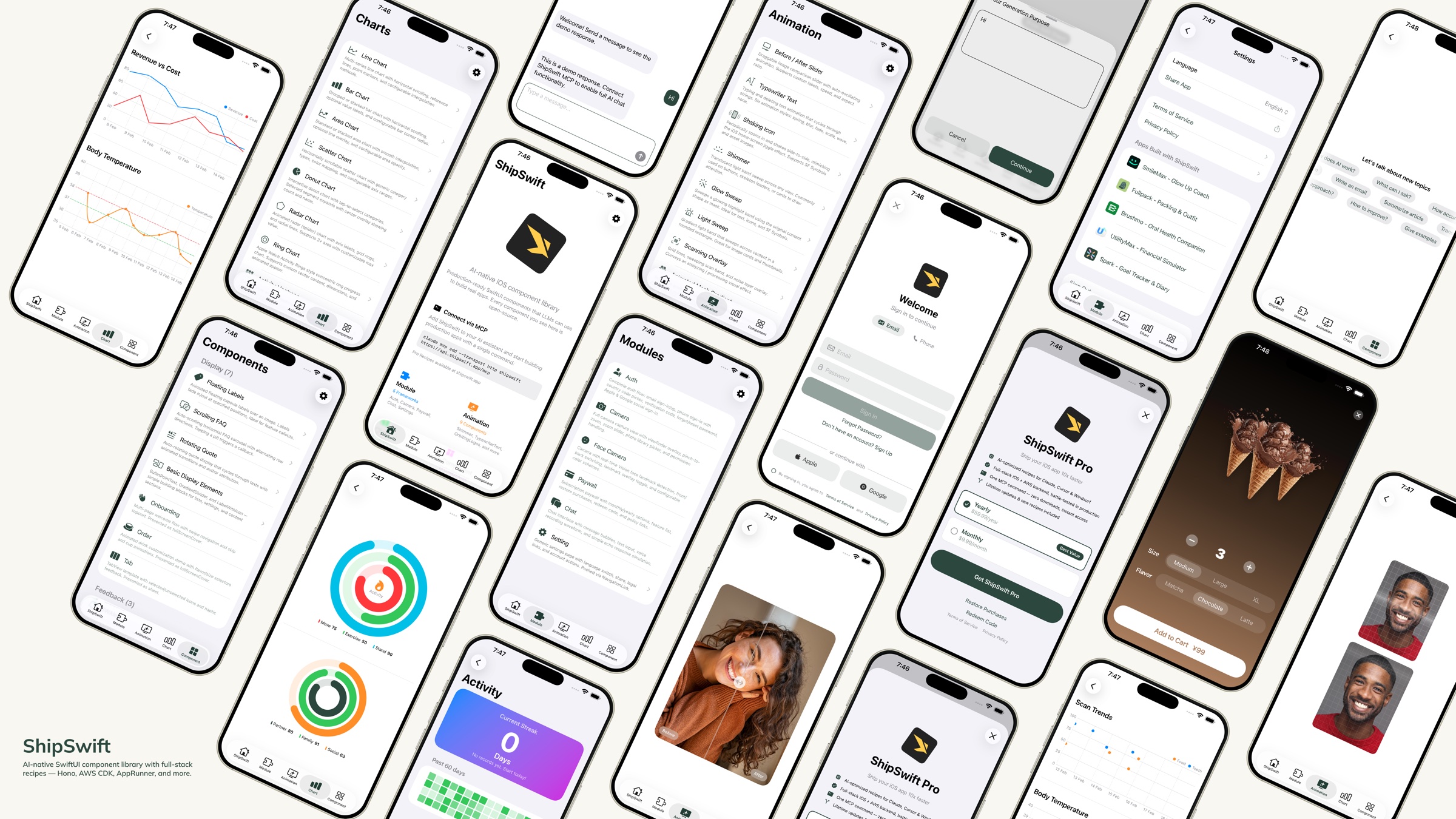
AI-native SwiftUI component library with full-stack recipes — connect via MCP for instant access.
2.7k
Stars
163
Forks
7
Open issues
2
Contributors


AI Analysis
ShipSwift is an AI-native SwiftUI component library designed to enable LLMs to generate production-ready iOS apps by providing pre-built components, full-stack recipes, and MCP server integration. It is optimized specifically for AI-assisted development workflows, serving developers and AI tools (Claude, Gemini, Cursor) who want to rapidly prototype and ship iOS applications — not a general-purpose UI kit for manual development.
Inferred from signals mentioned in the README (tests, CI, type safety) — not a review of the actual code.
AI's overall editorial judgment — not an average of the bars above, can weigh other factors too.
AI-native SwiftUI library with MCP integration for LLM-assisted iOS app development
ShipSwift is a production-ready SwiftUI component library designed explicitly for AI code generation workflows. It provides 30+ animation components, 8 chart types, UI modules (auth, camera, chat, paywall), and full-stack recipes accessible via Model Context Protocol (MCP) servers. Target audience: developers using Claude/Gemini/Cursor to build iOS apps, and teams seeking LLM-accelerated prototyping. Adoption appears concentrated among AI-first developer tooling users rather than mainstream SwiftUI developers.
Project created December 2025 by SignerLabs. Represents a deliberate design decision to optimize component libraries not for traditional SwiftUI developers, but for LLM consumption and generation — components are structured to be legible and copy-paste-friendly for AI models. Emerged alongside the broader wave of MCP-aware SDKs (2025–2026).
2,321 stars in ~6 months with 134 stars gained in the last 7 days suggests accelerating interest. Growth correlates with increased LLM-in-developer-tools adoption (Claude Code, Gemini CLI, Cursor integration). Last push 2026-06-26 (3 days before analysis date) indicates active maintenance. Comparable repos in the Swift ecosystem (SwiftUI-Agent-Skill 3,120 stars, SwiftUI-Animations 3,066 stars) suggest this project is gaining traction but not yet a dominant reference library.
Adoption not verified at scale. Evidence suggests early adoption among AI-assisted development workflows: (1) App Store showcase app indicates publishing intent and likely internal usage; (2) MCP server endpoint is operational; (3) npm skills package (signerlabs/shipswift-skills) available; (4) Commercial services offered ($5K–$10K app builds) imply foundational customer traction, but no public case studies or client list provided; (5) Integration docs for Claude Code, Gemini CLI, Cursor, VS Code Copilot, Windsurf suggest multi-tool adoption path. No public data on enterprise deployments, production app count, or retention rates.
Based on README, appears to follow a modular structure: SWAnimation (30 components including SwiftUI animations, Canvas 3D, Metal shaders), SWChart (8 chart types), SWComponent (UI primitives), SWModule (multi-file frameworks for auth, camera, chat, paywall, settings). Components appear to be self-contained and copyable. Metal shader usage for procedural backgrounds suggests attention to performance-sensitive rendering. MCP integration enables remote recipe serving via https://api.shipswift.app/mcp. README does not document internal code organization, dependency management, or build system details beyond 'copy into Xcode project' or npm skills installation.
not documented in README. Showcase app exists (App Store: ShipSwift MCP Codebase, id 6759209764) and serves as demonstration, but automated test coverage not mentioned.
Last push 2026-06-26 (very recent). Project is 6 months old, suggesting either rapid initial development or launch-phase velocity. Metadata does not provide issue response time, PR merge latency, or contributor diversity. MIT license, active website (shipswift.app), and maintained MCP server endpoint (api.shipswift.app/mcp) are positive signals. Lack of detailed changelog or release notes in README limits ability to assess stability trajectory.
ADOPT IF: you are building iOS apps using LLM code generation (Claude Code, Gemini CLI, Cursor), value pre-built, production-ready components legible to AI models, and want to reduce LLM hallucination around component APIs. AVOID IF: you are building traditional SwiftUI apps without AI assistance (standard libraries and mature third-party packages may be better documented and more widely tested), you require extensive test coverage or formal support guarantees, or you need components for non-Apple platforms. MONITOR IF: you want to track the trajectory of AI-native SDK design in mobile; the MCP integration pattern is emerging across ecosystems and ShipSwift is an early, well-executed example.
Independent dimensions
Mainstream potential
4/10
Technical importance
6/10
Adoption evidence
4/10
- Adoption concentrated in early-adopter LLM-tooling users; mainstream SwiftUI adoption may remain modest even if product quality is high. Niche-by-design risk.
- MCP server dependency (api.shipswift.app) introduces availability risk for remote recipe fetching. Network outage or service discontinuation would degrade experience. Offline fallback (local skills) mitigates partially.
- Project is 6 months old; long-term maintenance unknown. SignerLabs is a small commercial entity; organizational sustainability not documented. Risk of abandonment if business model (custom app builds) does not generate sufficient revenue.
- Test coverage not documented. Quality assurance rigor relative to mature open-source libraries unknown. Components may have edge cases or platform-version compatibility issues not surfaced in README.
- LLM-native optimization may become obsolete if LLM code-generation tools shift to different API styles, tooling standards, or SDK patterns. Design decisions tightly coupled to current MCP/skills ecosystem.
ShipSwift likely remains a specialized tool for AI-assisted iOS development in the near term (2–3 years). Growth will track adoption of LLM-in-IDE workflows (Claude Code, Cursor, Windsurf). If those tools become mainstream, adoption could accelerate; if LLMs prove insufficient for reliable app building, adoption plateaus. Unlikely to displace traditional SwiftUI libraries but may establish a new category. Commercial services offering ($5K apps in 4 weeks) is a hedge against open-source adoption plateau.
Newsletter
Get analyses like this every Monday
Free weekly digest of the most interesting open-source discoveries.
Languages
Information
- Website
- https://shipswift.app
- Language
- Swift
- License
- MIT
- Last updated
- 1d ago
- Created
- 7mo ago
- Analyzed with
- anthropic/claude-haiku-4-5
Stars over time
Contributors over time
Top 100 contributors only — repos with more will plateau at 100.
Open issues
Top contributors
Recent releases
No releases published yet.
Similar repos

AvdLee/SwiftUI-Agent-Skill
A specialized AI agent skill that packages SwiftUI best practices—state...

twostraws/SwiftUI-Agent-Skill
This is an agent skill for AI coding assistants (Claude Code, Codex, Gemini,...

Toni77777/awesome-swiftui-libraries
Awesome SwiftUI Libraries is a curated directory of SwiftUI-focused libraries...
| Repository | Stars | Week Δ | Language | Score | Updated |
|---|---|---|---|---|---|
|
signerlabs/ShipSwift
this
|
2.7k | +334 | Swift | 8/10 | 1d ago |
|
signerlabs/Klee
|
1.7k | — | Swift | 7/10 | 4mo ago |
|
AvdLee/SwiftUI-Agent-Skill
|
3.2k | — | Python | 7/10 | 3w ago |
|
twostraws/SwiftUI-Agent-Skill
|
4.3k | — | — | 7/10 | 3mo ago |
|
Toni77777/awesome-swiftui-libraries
|
1.5k | — | Swift | 6/10 | 2mo ago |
 Shubham0812/SwiftUI-Animations Shubham0812/SwiftUI-Animations
|
3.1k | — | Swift | 8/10 | 5d ago |
ShipSwift does not replace SwiftUI; it is a pre-built component layer on top of it. SwiftUI is mandatory; ShipSwift adds higher-level building blocks and AI-native packaging. Not a direct competitor, but a consumer of SwiftUI.
Similar AI-first positioning but Python-based, likely targeting backend/API generation rather than iOS UI. ShipSwift is Swift/iOS-specific, more directly competitive in the LLM-assisted iOS space. Different ecosystems, partial overlap in intent.
Traditional curated animation collection for SwiftUI developers. Larger star count suggests stronger mainstream adoption, but not MCP-integrated or explicitly optimized for LLM consumption. ShipSwift is narrower but more structurally aligned with AI-driven workflows.
Examples: SwiftUIKit, Combine, third-party design system libraries. These assume human developers; ShipSwift's primary differentiation is explicit LLM legibility and MCP integration. Not a replacement for all existing libraries, but a new category within the SwiftUI ecosystem.
Sibling project by same organization. Klee appears to be a separate effort; ShipSwift may represent a refinement or specialization within the SignerLabs product line. Both growing in star count suggests organizational momentum.