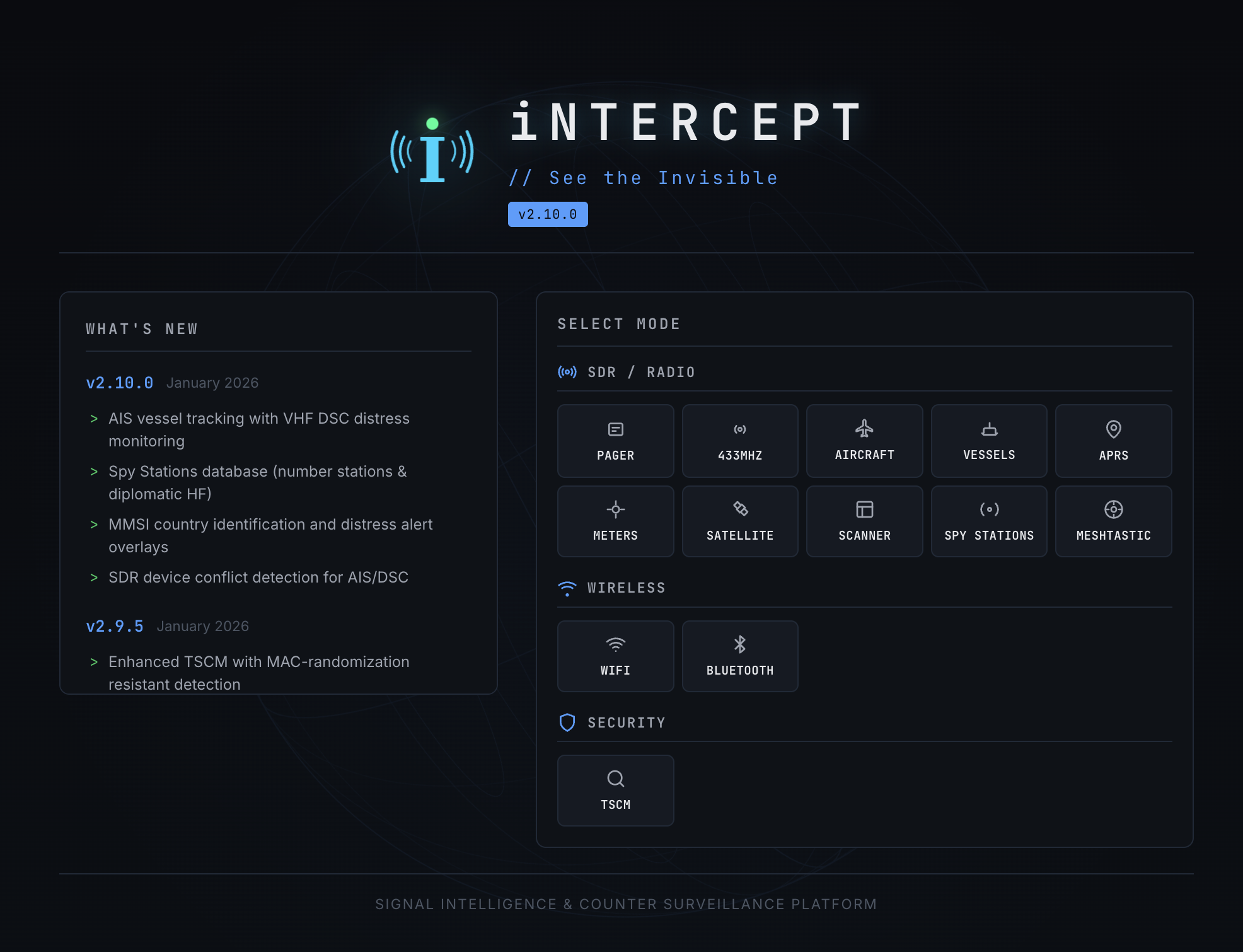
iNTERCEPT, a free and open-source platform that unites the best signal intelligence tools into a single, accessible interface.
2k
Stars
273
Forks
9
Open issues
20
Contributors


AI Analysis
iNTERCEPT is a web-based signal intelligence (SIGINT) platform that integrates RTL-SDR, HackRF, and other radio tools into a unified interface for decoding aircraft, ships, satellites, pagers, and RF signals across multiple bands and protocols. It serves specialized users in amateur radio, TSCM counter-surveillance, and radio reconnaissance — not a general-purpose tool, but a comprehensive platform for practitioners who need multi-modal RF monitoring in a single dashboard.
Inferred from signals mentioned in the README (tests, CI, type safety) — not a review of the actual code.
AI's overall editorial judgment — not an average of the bars above, can weigh other factors too.
Python-based web interface aggregating diverse SDR and RF reconnaissance tools into unified platform
iNTERCEPT is a web-based signal intelligence (SIGINT) aggregator designed for radio hobbyists, researchers, and security professionals. It wraps existing SDR tools (rtl-sdr, dump1090, dumpvdl2, etc.) into a single dashboard, eliminating the need to learn and operate each tool separately. The project emerged in late 2025, gained ~1,900 stars in 6 months, and remains under active development. Adoption appears concentrated in hobbyist and educational communities; production deployment evidence is not documented.
Created December 2025 by smittix as a unified interface layer over established SIGINT tools (rtl-sdr, multimon-ng, dump1090, etc.). Positioned as accessibility-focused rather than novel research—the core innovation is UI/orchestration, not signal processing. No major predecessor with identical scope documented in similar repos list.
Rapid initial traction (1,896 stars in ~6 months) suggests strong appeal to RF enthusiast community. Zero stars gained in last 7 days (as of 2026-06-30) may indicate slowing momentum or natural plateau post-novelty phase. Last push 2026-06-15 shows maintenance activity continues but suggests no recent feature burst. Growth pattern consistent with niche tooling: fast initial adoption by target audience, then stabilization.
Adoption not verified. README emphasizes hobbyist and research use cases ('amateur packet radio', 'radio hobbyists', 'offline/field deployments'). No case studies, enterprise deployments, or institutional adoption documented. 242 forks suggests some experimentation by users but does not establish production usage at scale. Presence of 'Buy Me A Coffee' link and single-maintainer GitHub activity pattern suggests volunteer-driven project without commercial backing.
Appears to be a Python Flask/web backend (based on README mentioning gunicorn + gevent, SSE/WebSocket support) that spawns and manages external CLI tools (rtl_fm, multimon-ng, dump1090, aircrack-ng, etc.) via subprocess orchestration. Likely implements real-time dashboards via WebSocket for live maps, signal feeds, and decode output. README indicates modular 'install profiles' suggesting pluggable tool support.
Not documented in README. No mention of pytest, unit tests, or CI/CD pipelines.
Last push 2026-06-15 (15 days before evaluation date) indicates recent activity. Setup wizard and interactive menu improvements noted in README suggest ongoing UX refinement. No evidence of sustained bug-fix velocity or response time to issues; maintenance status is active but slow-cadence relative to major projects.
ADOPT IF: you operate multiple SDR tools and want a unified web interface for hobby/research use; you lack command-line fluency or prefer dashboard-driven analysis; your hardware uses common SDR devices (RTL-SDR, HackRF) and supported modulation schemes. AVOID IF: you need production-grade reliability, long-term vendor support, or commercial SLAs; you operate specialized RF hardware beyond the supported tool list; you require mature issue triage and security audit trails. MONITOR IF: you work in institutional signal monitoring (military, telecom, spectrum management)—current adoption signals do not yet support enterprise claims, but architecture is sound and tool coverage is expanding.
Independent dimensions
Mainstream potential
3/10
Technical importance
5/10
Adoption evidence
2/10
- Single maintainer with no documented backup; volunteer burnout is a common failure mode for open-source infrastructure projects.
- Heavy dependency on external CLI tools (rtl_fm, multimon-ng, dump1090, etc.) means project stability is coupled to upstream tool maintenance; if a critical dependency breaks or is abandoned, iNTERCEPT inherits the problem.
- No documented security audit, key verification, or supply-chain practices; unclear if suitable for sensitive SIGINT work in regulated environments.
- Python subprocess spawning of system tools (aircrack-ng, etc.) requires elevated privileges (sudo); potential privilege escalation attack surface if web interface is exposed to untrusted networks.
- No documented production deployment guide, monitoring, or failover strategy; appears optimized for single-user or small-team use.
iNTERCEPT likely remains a specialized hobbyist/academic tool for 12–24 months. Star velocity stalling (0 gains in 7 days) may reflect market saturation within its niche rather than decline. Project viability depends on whether smittix sustains maintenance and whether community contributions scale. Mainstream adoption to security operations centers or telecom utilities appears unlikely without institutional backing or significant feature expansion beyond RF hobbyist scope.
Newsletter
Get analyses like this every Monday
Free weekly digest of the most interesting open-source discoveries.
Languages
Information
- Language
- Python
- License
- Apache-2.0
- Last updated
- 2d ago
- Created
- 7mo ago
- Analyzed with
- anthropic/claude-haiku-4-5
Stars over time
Contributors over time
Top 100 contributors only — repos with more will plateau at 100.
Open issues
can add RESTful API for detailed Intelligence Data?
Update to DSD ?
Feature request - CoT Integration (ATAK, WinTAK, TAK Server etc)
Feature request - Multilingual support
Wild life animal tracking
Open pull requests
No open pull requests.
Top contributors
Similar repos

CellularPrivacy/Android-IMSI-Catcher-Detector
AIMSICD is an Android application designed to detect IMSI-catchers (false...
| Repository | Stars | Week Δ | Language | Score | Updated |
|---|---|---|---|---|---|
|
smittix/intercept
this
|
2k | +124 | Python | 7/10 | 2d ago |
 MISP/MISP MISP/MISP
|
6.4k | — | PHP | 8/10 | 21h ago |
 ainfosec/FISSURE ainfosec/FISSURE
|
2k | — | Python | 7/10 | 1w ago |
|
CellularPrivacy/Android-IMSI-Catcher-Detector
|
5.4k | — | Java | 5/10 | 2w ago |
 OISF/suricata OISF/suricata
|
6.4k | — | C | 8/10 | 8h ago |
 calesthio/Crucix calesthio/Crucix
|
10.4k | — | JavaScript | 7/10 | 2mo ago |
6,384 stars; PHP-based threat intelligence platform. Broader scope (malware, vulnerabilities, campaigns) vs. SIGINT-specific. MISP targets security operations; iNTERCEPT targets RF hobbyists/researchers. Different problem domains.
6,422 stars; C-based IDS/NSM. Network-layer detection; iNTERCEPT is RF/SDR-layer. No direct overlap.
5,343 stars; Java-based mobile security tool. Detects false cell towers; iNTERCEPT is general RF analysis. Complementary rather than competitive.
10,383 stars; JavaScript project (likely frontend-heavy). Purpose not clearly determined from name alone; likely unrelated to RF/SIGINT.
5,323 stars; Rust-based. Appears RF-focused but no direct README context provided. If targeting similar domain, iNTERCEPT differentiates via unified UI and Python accessibility over compiled performance.