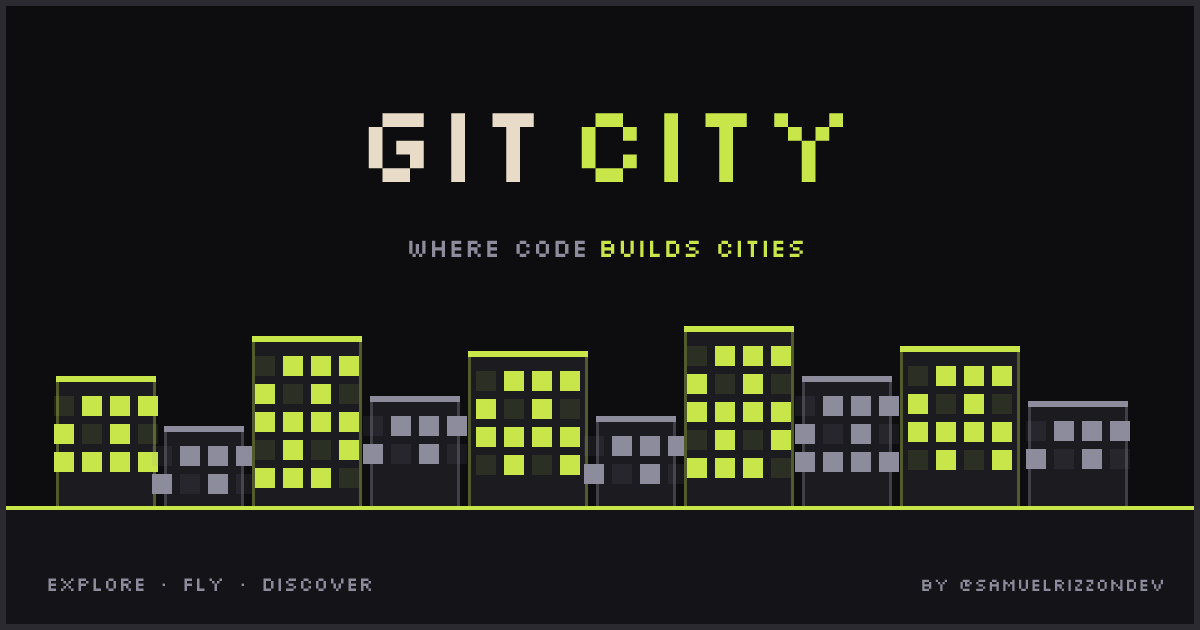
Your GitHub profile as a 3D pixel art building in an interactive city
5.7k
Stars
282
Forks
24
Open issues
20
Contributors


AI Analysis
Git City transforms GitHub profiles into interactive 3D pixel art buildings within a procedurally-generated city visualization. Building height, width, and window illumination encode contribution counts, repository numbers, and star activity respectively. This is a specialized visualization and community exploration tool primarily for developers wanting to gamify their GitHub presence and discover peer activity—not suited for non-developers or those seeking general-purpose 3D modeling.
Inferred from signals mentioned in the README (tests, CI, type safety) — not a review of the actual code.
AI's overall editorial judgment — not an average of the bars above, can weigh other factors too.
Git City turns GitHub profiles into 3D pixel art buildings in a shared interactive city
Git City is a web-based interactive experience that maps GitHub contribution data onto 3D pixel art buildings rendered with Three.js. Contribution count drives height, repo count drives width, and stars affect window brightness. Users can fly through a shared city, compare profiles, unlock achievements, customize buildings via a shop, and share image cards. It targets GitHub developers who enjoy visual, gamified representations of their activity. The project includes social mechanics (kudos, gifting, referrals) and a Stripe-backed monetization layer, suggesting it operates as a live product at thegitcity.com rather than a pure open-source utility.
Created in February 2026, this is a very young project — roughly 4 months old as of the evaluation date. No prior version history or predecessor project is documented in the README.
The project reached 5,689 stars in approximately 4 months, suggesting an early viral spike likely driven by social sharing of the visually striking city concept. Recent momentum has slowed to around 20 stars per week, which is modest but not stagnant for a project of this type. The gamification and shareability features (share cards, referrals) appear designed to sustain organic developer community growth.
A live deployment exists at thegitcity.com and the codebase includes Stripe payment integration, a shop system, and an admin route, all of which imply real users and active service operation. However, independent user counts, traffic data, or third-party adoption reports are not publicly available. Adoption is plausible but not independently verified at scale.
Appears to be a full-stack TypeScript application built on Next.js 16 with App Router and Turbopack. The 3D city is likely rendered client-side using Three.js via react-three-fiber and drei. Backend likely uses Supabase for PostgreSQL storage, GitHub OAuth, and row-level security. Payments appear handled by Stripe. The README references instanced meshes and a LOD system for rendering performance, which suggests deliberate attention to WebGL performance at city scale. Local development is fully supported via Supabase CLI with a dev login bypass — this indicates a reasonably mature developer experience setup.
Not documented in README.
Last push was June 23, 2026 — one day before the evaluation date — indicating very active development. The project is only 4 months old and appears to be under continuous iteration. README quality is thorough with setup instructions, environment variable documentation, and local dev tooling. No signs of abandonment.
ADOPT IF: you want a visually engaging, social way for your developer community or personal brand to showcase GitHub activity, and you're comfortable depending on a third-party hosted service (thegitcity.com) that is still early-stage. AVOID IF: you need a privacy-first, self-hostable solution — the social and payment infrastructure makes true self-hosting non-trivial — or if you require a stable, long-term-proven platform. MONITOR IF: you find the concept compelling but want to see whether the project sustains its user base and service uptime beyond its initial viral period before committing to it for community use.
Independent dimensions
Mainstream potential
4/10
Technical importance
5/10
Adoption evidence
3/10
- Service continuity risk: the live product depends on hosted Supabase and Stripe infrastructure operated by the author; if the project is abandoned, the experience disappears even though the code is open source.
- AGPL-3.0 license requires derivative works and network-deployed modifications to be open-sourced, which may limit commercial adoption or forking by organizations with proprietary codebases.
- The shop and achievement system creates dependency on the hosted platform — self-hosting a full-featured instance requires replicating the payment, database, and social layers, which is non-trivial.
- Growth has slowed significantly from the initial spike to ~20 stars/week; retaining users beyond the novelty of the initial visit is an open question given the entertainment-first nature of the product.
- Very new project (4 months old) with no documented test coverage — production stability and edge-case handling under real load cannot be assessed from available information.
Git City is likely to stabilize as a niche but genuine developer community attraction. It may grow steadily if social features drive return visits, but mainstream dominance is unlikely given its entertainment rather than utility focus.
Newsletter
Get analyses like this every Monday
Free weekly digest of the most interesting open-source discoveries.
Languages
Information
- Website
- https://thegitcity.com
- Language
- TypeScript
- License
- AGPL-3.0
- Last updated
- 1w ago
- Created
- 5mo ago
- Analyzed with
- anthropic/claude-haiku-4-5
Stars over time
Contributors over time
Top 100 contributors only — repos with more will plateau at 100.
Open issues
Top contributors
Recent releases
No releases published yet.
Similar repos

jasonlong/isometric-contributions
A browser extension that renders your GitHub contribution graph as isometric...

yoshi389111/github-profile-3d-contrib
This GitHub Action generates a 3D isometric visualization of your GitHub...

jstrieb/github-stats
Generates GitHub profile statistics visualizations using GitHub Actions,...

tipsy/profile-summary-for-github
Profile Summary is a web application that visualizes GitHub user profiles and...
| Repository | Stars | Week Δ | Language | Score | Updated |
|---|---|---|---|---|---|
|
srizzon/git-city
this
|
5.7k | +14 | TypeScript | 8/10 | 1w ago |
|
jasonlong/isometric-contributions
|
3.7k | — | JavaScript | 7/10 | 4d ago |
|
yoshi389111/github-profile-3d-contrib
|
1.7k | — | TypeScript | 8/10 | 3w ago |
|
jstrieb/github-stats
|
3.5k | — | Zig | 8/10 | 3w ago |
|
tipsy/profile-summary-for-github
|
19.9k | — | Vue | 7/10 | 5mo ago |
 yihong0618/GitHubPoster yihong0618/GitHubPoster
|
1.9k | — | Python | 7/10 | 1d ago |
Generates static Markdown for GitHub profile READMEs. Far higher adoption, but purely 2D and static — no interactive or 3D element. Targets profile customization rather than exploration or gamification.
Generates a static summary page of GitHub stats. More utilitarian and data-focused, lacks any visual/game layer. Significantly more adopted but solves a narrower informational problem.
Badge-style achievement trophies for GitHub READMEs. Similar gamification angle but entirely static and embeddable. Git City's achievement system is richer but requires visiting a separate platform.
SVG stat cards for GitHub profiles. Lightweight, embeddable, no 3D or interactivity. Different use case — utility over experience.
Generates artistic posters from GitHub activity data. Creative visualization focus similar to Git City but produces static images rather than an interactive shared world.