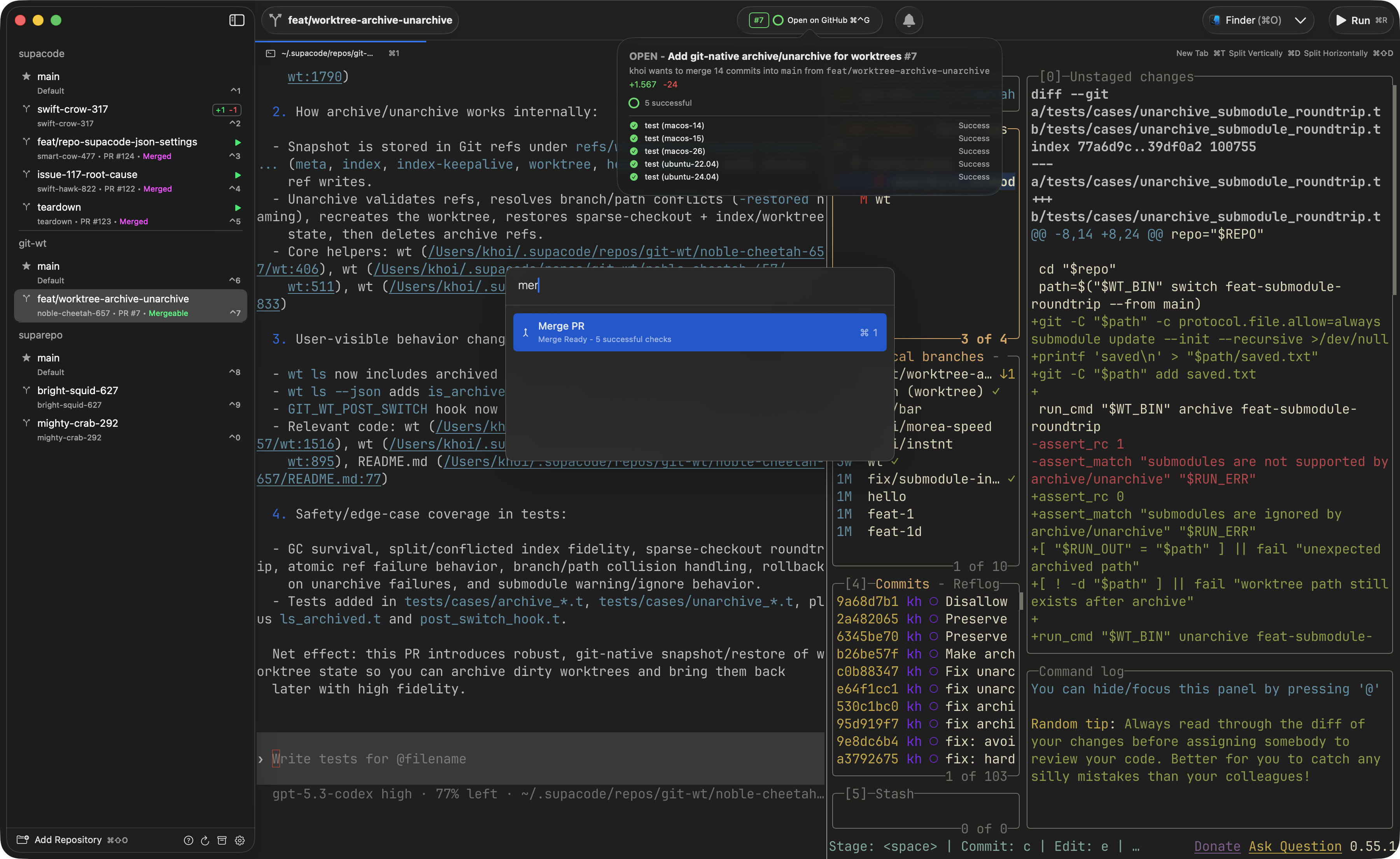
worktree coding agents command center.
2.1k
Stars
262
Forks
53
Open issues
30
Contributors



AI Analysis
Supacode is a native macOS application that serves as a command center for running multiple coding agents in parallel, each with its own git worktree and terminal session. It is purpose-built for AI-assisted development workflows where multiple agents need to work independently on the same repository without interference. This tool is specialized for macOS developers and AI agent orchestration; it is not a general-purpose code editor or terminal and offers little value to users outside this n...
Inferred from signals mentioned in the README (tests, CI, type safety) — not a review of the actual code.
AI's overall editorial judgment — not an average of the bars above, can weigh other factors too.
Supacode: A native macOS terminal UI for managing multiple AI coding agents via git worktrees
Supacode is a native macOS application that acts as a command center for running multiple AI coding agents in parallel, using git worktrees to isolate each agent's workspace. It embeds libghostty (the terminal engine from the Ghostty project) and is built with The Composable Architecture, giving it a structured, testable foundation. The target audience is macOS developers who run CLI-based agents (like Claude Code, Aider, or similar) and want a dedicated GUI to launch, monitor, and manage multiple parallel sessions without context-switching overhead. It requires macOS 26.0 (Tahoe), which limits its audience to beta/developer preview users as of the evaluation date.
Created in January 2026, Supacode emerged alongside the surge in agentic coding tools. It appears purpose-built to address the workflow friction of juggling multiple terminal-based AI coding agents simultaneously, a pain point that crystallized as these agents became popular in late 2025 and early 2026.
The project reached 1,272 stars in roughly five months, with ~60 stars in the last 7 days, indicating steady but not explosive organic growth. Momentum appears driven by developer interest in AI agent tooling and the relatively unique angle of native macOS integration with worktree-based parallelism. The macOS 26.0 requirement currently caps the addressable audience to developers on preview builds, which may be suppressing faster star growth.
Adoption not verified via public case studies or production reports. The star count and fork count (161 forks) suggest real developer interest and likely some personal-use adoption, but no documented organizational or team deployments are visible from available metadata.
Likely follows a unidirectional data-flow pattern via The Composable Architecture (TCA), which enforces strict state management and side-effect isolation. Appears to embed libghostty as an XCFramework built from Zig source, acting as the terminal rendering backend. The use of Tuist for project generation and mise for dependency management suggests a moderately complex multi-module structure. Build steps are clearly separated (ghostty framework, then app), implying intentional layering.
A 'make test' target is documented in the README, and the use of TCA (which has a built-in testability model) suggests tests likely exist. However, actual coverage level is not documented in the README.
Last push was 2026-06-18, one day before the evaluation date — the project is actively maintained. The author explicitly states they personally review every line and will close low-quality PRs, which suggests deliberate quality control over raw contribution velocity. This is a positive signal for long-term code quality, though it may slow community PRs.
ADOPT IF: You are a macOS developer (on macOS 26 beta or Tahoe release) running multiple CLI-based coding agents in parallel and find terminal multiplexing insufficient for tracking agent states across worktrees. AVOID IF: You are on macOS 15 or earlier, use Windows/Linux, or primarily use IDE-integrated agents — the macOS 26.0 requirement is a hard blocker today. MONITOR IF: You are interested in native macOS agent tooling but are waiting for macOS 26 general availability or want to see how the worktree workflow matures before committing.
Independent dimensions
Mainstream potential
4/10
Technical importance
7/10
Adoption evidence
2/10
- macOS 26.0 requirement severely restricts current audience and will remain a blocker until Tahoe ships publicly, likely late 2026.
- Tight dependency on libghostty (a third-party terminal library still maturing) introduces upstream risk if the Ghostty project changes APIs or licensing.
- Single-maintainer quality gate may slow community contributions and create a bus-factor risk for long-term sustainability.
- The niche (worktree-based multi-agent orchestration) may shrink if AI IDEs absorb this workflow natively.
- License listed as NOASSERTION, which may create ambiguity for enterprise adoption or downstream packaging.
Likely to grow steadily as macOS 26 ships publicly and multi-agent workflows become more common. Remains a focused niche tool rather than a mainstream product unless broader OS support is added.
Newsletter
Get analyses like this every Monday
Free weekly digest of the most interesting open-source discoveries.
Languages
Information
- Website
- https://supacode.sh
- Language
- Swift
- License
- NOASSERTION
- Last updated
- 13h ago
- Created
- 6mo ago
- Analyzed with
- anthropic/claude-haiku-4-5
Stars over time
Contributors over time
Top 100 contributors only — repos with more will plateau at 100.
Open issues
Support opening worktrees in Trae and Trae CN
Hide app icon in dock
Event-based Git polling and ability to disable it
"Repository Unavailable" (but it's present!)
Too-frequent GitHub status polling eats rate limits
Top contributors
Similar repos

CommandCodeAI/command-code
Command Code is an AI-powered coding agent that generates full-stack software...
| Repository | Stars | Week Δ | Language | Score | Updated |
|---|---|---|---|---|---|
|
supabitapp/supacode
this
|
2.1k | +90 | Swift | 7/10 | 13h ago |
 wxtsky/CodeIsland wxtsky/CodeIsland
|
2.1k | — | Swift | 8/10 | 9h ago |
 superset-sh/superset superset-sh/superset
|
12.4k | — | TypeScript | 7/10 | 7h ago |
 xintaofei/codeg xintaofei/codeg
|
2k | — | TypeScript | 7/10 | 13h ago |
|
CommandCodeAI/command-code
|
3.5k | — | — | 7/10 | 2w ago |
 can1357/oh-my-pi can1357/oh-my-pi
|
17.1k | — | TypeScript | 8/10 | -44 min ago |
The traditional approach for managing multiple terminal sessions. Supacode offers a purpose-built GUI with agent-awareness and worktree integration, trading flexibility for focused UX — but tmux works on any OS and macOS version.
These integrate agents inside an editor rather than managing parallel terminal agents. Supacode targets CLI agent users who prefer their own editor and want orchestration tooling, not a replacement IDE.
Supacode is a layer on top of CLI agents like Claude Code, not a competitor. It adds multi-agent parallelism management that the CLI itself lacks.
Warp has AI features built into a terminal. Supacode's angle is worktree-based agent isolation rather than AI-enhanced terminal commands — different problem framing.