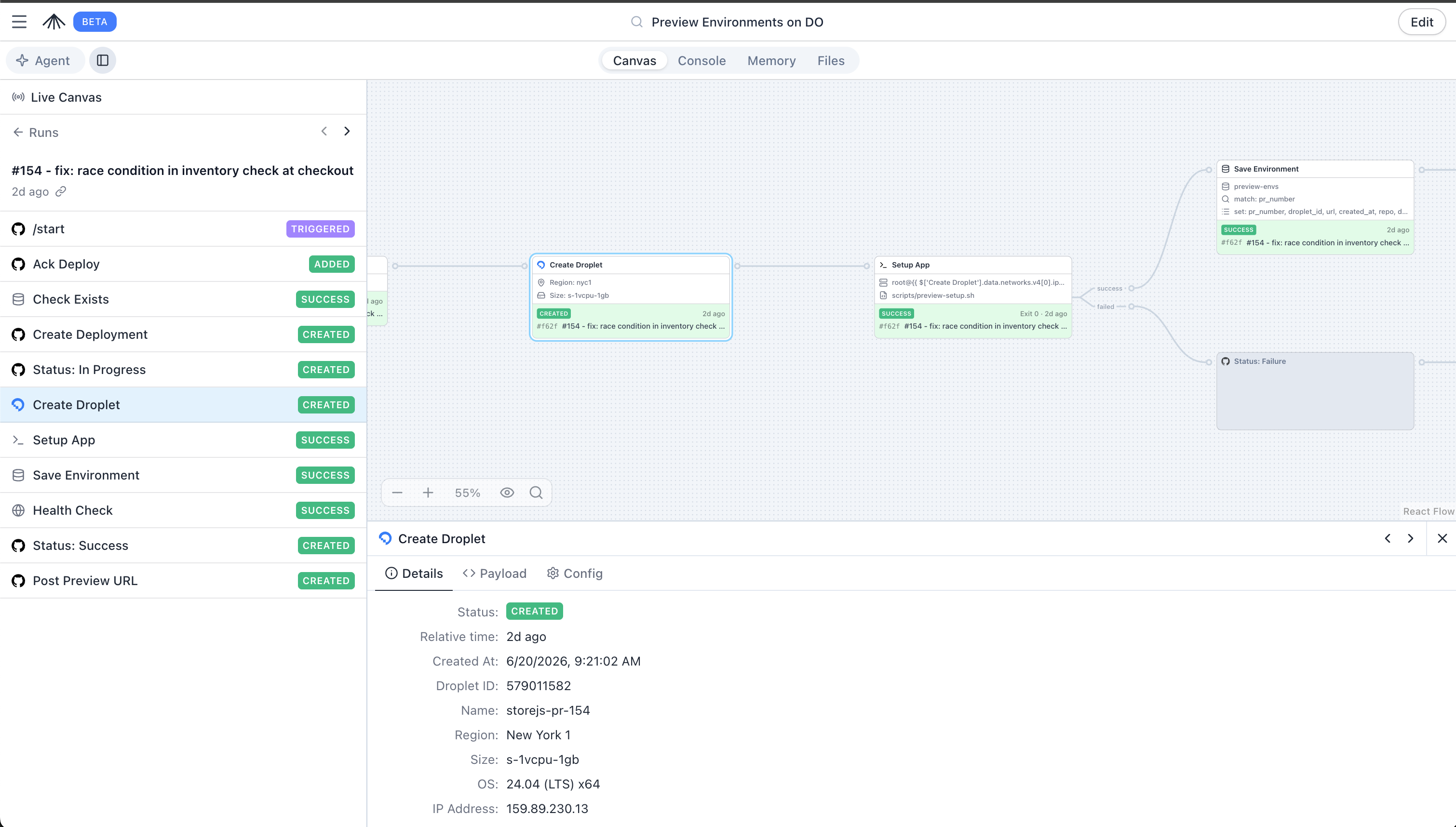
The open source control plane for agentic engineering.
3.8k
Stars
351
Forks
246
Open issues
30
Contributors


AI Analysis
SuperPlane is an open-source automation engine for orchestrating AI-driven engineering workflows across Git, CI/CD, LLMs, observability, and infrastructure tools with durable execution and human-in-the-loop controls. It is purpose-built for platform and DevOps teams who need deterministic, approval-gated, event-driven automation—not a general-purpose workflow tool; it targets engineering teams operating sophisticated toolchains who require durability guarantees and AI-safe guardrails.
Inferred from signals mentioned in the README (tests, CI, type safety) — not a review of the actual code.
AI's overall editorial judgment — not an average of the bars above, can weigh other factors too.
Go-based workflow engine for AI-driven engineering orchestration, 13 months old with strong early momentum
SuperPlane is a self-hosted or cloud-managed orchestration engine written in Go that coordinates multi-step engineering workflows across Git, CI/CD, LLMs, observability, and incident tools. It targets teams automating complex, human-in-the-loop processes too intricate for single CI jobs — particularly those bridging AI agents and operational guardrails. At 13 months old with 3,279 stars and 221 new stars in the last week, it shows early-stage adoption momentum; concrete production usage is not yet publicly documented.
Launched May 2025 as a fresh project entering a nascent category: orchestration engines purpose-built for agentic engineering. Positioned as complementary to both traditional CI/CD (GitHub Actions, Semaphore) and broader IaC tools, rather than replacing them. Backed by an active team with regular releases and expanding integration coverage.
Rapid early growth post-launch (221 stars in 7 days as of June 2026 indicates sustained momentum, not decay). Recent last push on 2026-06-28 confirms ongoing development. The timing coincides with rising enterprise interest in agent-accessible control planes and safely bounded automation. Growth curve appears characteristic of a well-positioned infrastructure project in an emerging category, not a flash-in-the-pan trend.
Adoption not verified. README describes example use cases (PR preview, canary deploys, incident triage) but does not cite customer deployments, case studies, or quantified installations. Cloud offering (SuperPlane Cloud) mentioned but no public metrics on paying customers or SaaS adoption. Discord community referenced (membership not quantified). Absence of public success stories or production deployments in announcement channels is notable for a 13-month-old project seeking enterprise traction.
Based on README, appears to use a graph-based workflow model (canvases → components → events → runs) with durable execution primitives (state tracking across restarts), app-scoped memory, and event-driven triggers. Likely implemented as a stateful service with SDK/CLI agents. Specific architectural choices (messaging, persistence layer, scheduling engine) not detailed in README.
Not documented in README. CI badge present (Semaphore) suggests automated testing is in place, but granularity and coverage metrics are not public.
Last commit 2026-06-28 (same day as analysis date) indicates active ongoing development. GitHub commit activity badge referenced; team appears to be shipping regularly. Project is 13 months old and in beta (breaking changes acknowledged as possible). Pace consistent with a well-staffed, funded project rather than volunteer-driven maintenance.
ADOPT IF: your team is automating multi-step engineering workflows involving AI agents, approvals, and cross-tool orchestration, and you can tolerate beta-stage breaking changes; you prefer self-hosted or cloud-managed solutions over scripting CI jobs; and you want operational dashboards and RBAC built-in. AVOID IF: you need stable, production-hardened guarantees (project is explicitly in beta); your workflows are simple enough for GitHub Actions; you require battle-tested track records or public reference customers; or you lack engineering capacity to potentially fork/contribute if the project stalls. MONITOR IF: you're evaluating control planes for agent workflows but want to see more public production deployments, ecosystem maturity, and post-beta stability before committing; or if your tech stack is heavily locked into competing platforms (AWS Step Functions, GCP Workflows) and switching cost is high.
Independent dimensions
Mainstream potential
4/10
Technical importance
6/10
Adoption evidence
2/10
- Beta status and acknowledged possibility of breaking changes — deployments may require rework as APIs stabilize.
- Adoption not yet publicly verified at scale — no published case studies or customer counts create uncertainty about real-world fit beyond README examples.
- Narrow target audience (agentic engineering + orchestration) may limit community contributions and third-party integrations despite Apache 2.0 licensing.
- Maintenance continuity risk — project is young (13 months) and appears team-driven; no signal yet about long-term stewardship or sustainability model (open-source vs. commercial offering unclear).
- Integration ecosystem still developing (README notes missing providers and asks for issues) — may lack connectors your stack requires.
Likely to mature toward 1.0 stability within 12–24 months and attract early-adopter SaaS/dev-tools companies and large enterprises with agentic AI workflows. Adoption may remain concentrated in that niche rather than becoming a general-purpose orchestration platform. Community and third-party integration coverage will be key indicator; slow growth in either signals maturity plateau.
Newsletter
Get analyses like this every Monday
Free weekly digest of the most interesting open-source discoveries.
Languages
Information
- Website
- https://superplane.com
- Language
- Go
- License
- Apache-2.0
- Last updated
- 9h ago
- Created
- 14mo ago
- Analyzed with
- anthropic/claude-haiku-4-5
Stars over time
Contributors over time
Top 100 contributors only — repos with more will plateau at 100.
Open issues
New core components: Send to SuperPlane (action) + onSuperPlaneAppEvent (trigger)
Error: Failed to read file
Console: Timestamps in table
Error: Objects are not valid as a React child (found: object with keys {id, name}). If you meant to render a collection of children, use an array instead.
Console: when run as datasource, allow pick the origin
Top contributors
Similar repos
| Repository | Stars | Week Δ | Language | Score | Updated |
|---|---|---|---|---|---|
|
superplanehq/superplane
this
|
3.8k | +422 | Go | 7/10 | 9h ago |
 crossplane/crossplane crossplane/crossplane
|
11.9k | — | Go | 8/10 | 4h ago |
 makeplane/plane makeplane/plane
|
54.2k | — | TypeScript | 8/10 | 3h ago |
 katanemo/plano katanemo/plano
|
6.7k | — | Rust | 8/10 | 14h ago |
 envoyproxy/go-control-plane envoyproxy/go-control-plane
|
1.7k | — | Go | 8/10 | 12h ago |
 skypilot-org/skypilot skypilot-org/skypilot
|
10.3k | — | Python | 8/10 | 8h ago |
Mature Kubernetes-native control plane for infrastructure composition. Broader ecosystem and longer track record; SuperPlane is explicitly workflow/agentic-focused rather than infra-code-focused. Non-overlapping primary use cases.
Issue tracking and project planning tool. Distinct category; no direct competition despite 'plane' nomenclature overlap.
Handles resource orchestration and provisioning; SuperPlane assumes compute/tools already exist and orchestrates workflow logic across them. Complementary rather than competitive.
Actions covers simple CI/CD; Temporal and Airflow handle durability and complex orchestration but require platform engineering effort. SuperPlane attempts to simplify agent-bridged workflows with lower operational overhead for the agentic use case specifically.
Consumer/SMB-focused; SuperPlane targets developer/SRE teams deploying on-prem or dedicated cloud infra. Positioning is complementary (enterprise control, durable execution, agent integration).