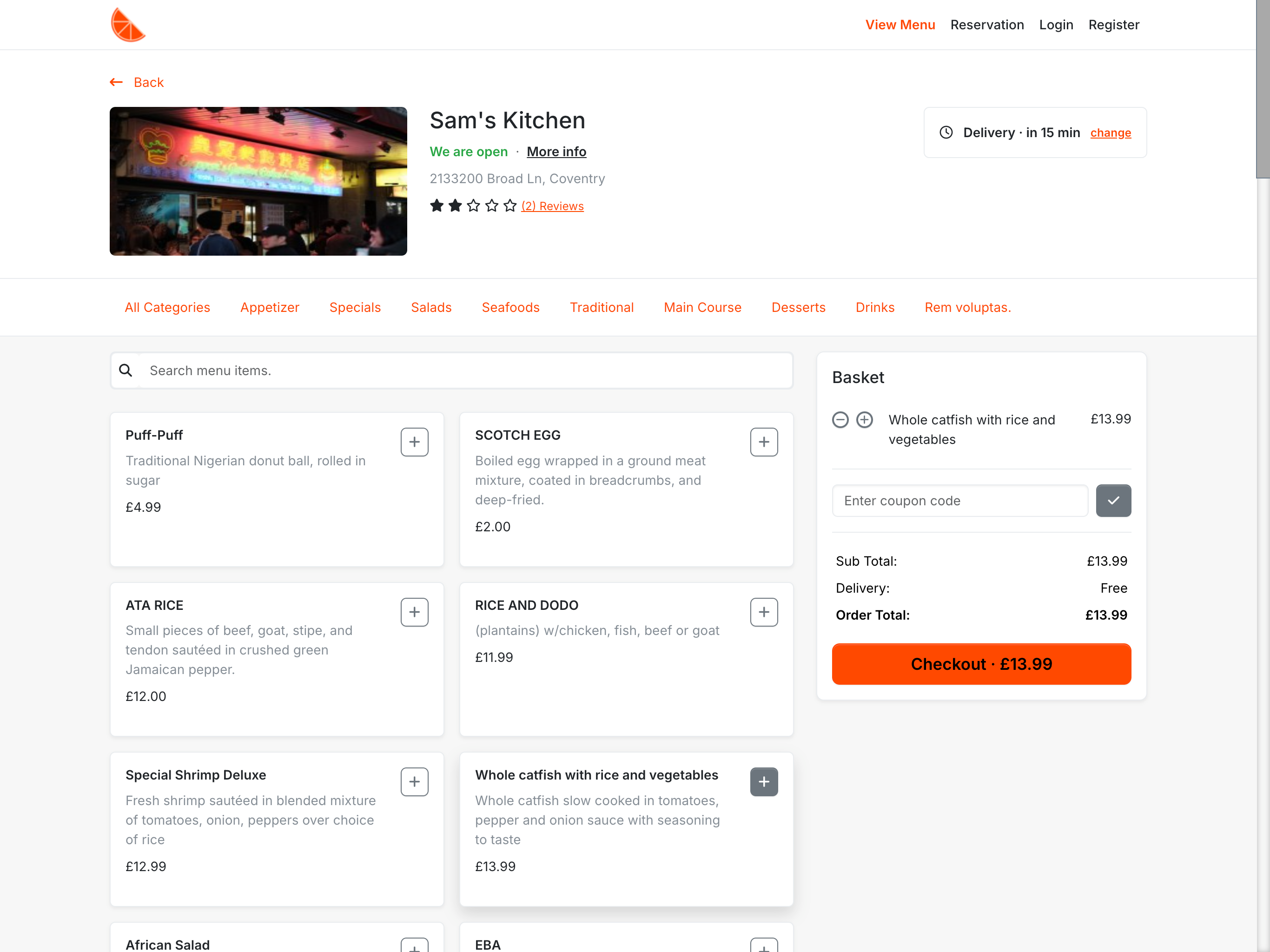
:fire: Powerful, yet easy to use, open-source online ordering, table reservation and management system for restaurants
3.6k
Stars
1.2k
Forks
2
Open issues
30
Contributors




AI Analysis
TastyIgniter is a self-hosted, open-source platform for restaurants to offer online food ordering, table reservations, and management in a single system. It serves restaurant owners and chains looking for an alternative to third-party delivery platforms, supporting multi-location and multi-restaurant deployments. It is not suitable for developers seeking a general-purpose web framework—it is a complete, ready-to-use business application.
Inferred from signals mentioned in the README (tests, CI, type safety) — not a review of the actual code.
AI's overall editorial judgment — not an average of the bars above, can weigh other factors too.
Open-source restaurant ordering and reservation system built on Laravel, serving small-to-mid market establishments
TastyIgniter is an MIT-licensed PHP platform designed for restaurants to manage online food ordering, table reservations, and business operations. Built on Laravel and Bootstrap 5, it targets independent and small-chain restaurants seeking a self-hosted alternative to SaaS platforms. The project has maintained steady activity over 12 years with a core contributor base and growing translation support, though real-world production adoption remains largely undocumented in public channels.
Created in February 2014 by Samuel Adepoyigi, TastyIgniter emerged as a Laravel-based ordering system during the early SaaS restaurant-tech wave. The project has evolved through multiple major versions (current PHP 8.3–8.4 support indicates ongoing modernization) while remaining primarily community-driven with sponsorship support.
Star growth is modest and linear (~8 stars in 7 days, 3,636 total) compared to broader competitor activity, suggesting niche market positioning rather than viral adoption. Last push on 2026-07-04 indicates active maintenance. The project appears to attract long-tail adoption from self-hosted restaurant operators and developers rather than explosive growth, consistent with a specialized B2B tool serving independent establishments.
Adoption not verified in README or public channels. No case studies, deployment counts, restaurant references, or user testimonials provided. The existence of a community forum, Discord, and sponsorship program suggests active user base, but scale and geographic distribution unknown. OpenCollective backers and Patreon sponsorship indicate some revenue-generating community, but volumes not public.
Based on README, built on Laravel full-stack framework with Bootstrap 5 frontend. Appears to follow a monolithic architecture typical of restaurant management systems. No mention of API-first design, microservices, or modern headless patterns in README. PHP 8.3–8.4 support indicates current language version compatibility.
Not documented in README. No CI/CD pipeline, test suite, or coverage metrics mentioned.
Last push 2026-07-04 (1 day before evaluation date) shows active maintenance. Created 2014-02-02, 12-year lifespan indicates long-term project viability. Moderate fork count (1,150) and community contributor graph visible suggest ongoing development. However, 8 stars in 7 days is slow relative to evaluation date, indicating either stable maturity or limited organic growth momentum.
ADOPT IF: you operate an independent restaurant or small chain wanting a self-hosted ordering/reservation system, have PHP hosting available, require low upfront licensing costs, and can tolerate community-based support timelines. AVOID IF: you need enterprise SaaS guarantees, 24/7 support, multi-location complexity at scale, modern API-first architecture, or zero technical setup burden. MONITOR IF: you require production-grade stability and want to see documented case studies or deployment metrics before committing; current public evidence is limited.
Independent dimensions
Mainstream potential
3/10
Technical importance
5/10
Adoption evidence
2/10
- Adoption not verified: no public deployment counts, case studies, or production user base documentation. Risk of underestimating abandonment or overestimating stability.
- Dependency on single core maintainer: Samuel Adepoyigi is primary author. Bus factor unclear; community contribution rate not quantified in README.
- Test coverage opaque: no mention of automated testing, CI/CD, or quality gates. Production reliability difficult to assess.
- Legacy PHP monolith: Laravel 9+ era system. Modern restaurant tech trends toward headless, API-first, and SaaS. TastyIgniter's architecture may require significant refactoring to compete with cloud-native alternatives.
- Market saturation by well-funded competitors: Toast, Square, Uber Eats, and DoorDash control most SMB ordering market. TastyIgniter may struggle to onboard non-technical restaurants despite lower cost.
TastyIgniter will likely remain a stable, niche offering serving self-hosted restaurant operators with technical capacity or hosting partners. Growth will remain slow and organic. Mainstream adoption is improbable given SaaS market consolidation, but project is unlikely to disappear if core contributors remain engaged. 3–5 year outlook: slow steady-state or gradual decline as SaaS incumbents improve pricing and ease-of-use.
Newsletter
Get analyses like this every Monday
Free weekly digest of the most interesting open-source discoveries.
Languages
Information
- Website
- https://tastyigniter.com
- Language
- PHP
- License
- MIT
- Last updated
- 4d ago
- Created
- 151mo ago
- Analyzed with
- anthropic/claude-haiku-4-5
Stars over time
Contributors over time
Top 100 contributors only — repos with more will plateau at 100.
Open issues
Open pull requests
No open pull requests.
Top contributors
Recent releases
Similar repos

opensourcepos/opensourcepos
Open Source Point of Sale is a web-based POS system written in PHP with...

kirilkirkov/Ecommerce-CodeIgniter-Bootstrap
A PHP-based e-commerce platform built on CodeIgniter 3 and Bootstrap 3,...

Blair2004/NexoPOS
NexoPOS is a Laravel-based, self-hosted Point of Sale system designed for small...
| Repository | Stars | Week Δ | Language | Score | Updated |
|---|---|---|---|---|---|
|
tastyigniter/TastyIgniter
this
|
3.6k | +14 | PHP | 8/10 | 4d ago |
|
opensourcepos/opensourcepos
|
4.3k | — | PHP | 7/10 | 1d ago |
|
kirilkirkov/Ecommerce-CodeIgniter-Bootstrap
|
1.4k | — | PHP | 6/10 | 2mo ago |
 RamonSilva20/mapos RamonSilva20/mapos
|
1.1k | — | PHP | 7/10 | 2w ago |
|
Blair2004/NexoPOS
|
1.2k | — | PHP | 7/10 | 1w ago |
 TandoorRecipes/recipes TandoorRecipes/recipes
|
8.4k | — | HTML | 8/10 | 6d ago |
Broader POS system scope (sales, inventory, accounting). TastyIgniter focuses narrower on ordering and reservations. OpenSourcePOS has higher star count but similar PHP foundation.
Lightweight POS alternative. TastyIgniter is more feature-complete for restaurant ordering workflows but smaller adoption signal.
TastyIgniter targets cost-sensitive, self-hosted segment. SaaS dominance means TastyIgniter serves restaurants unwilling to pay recurring fees or accepting vendor lock-in.
Different domain (recipe management vs. restaurant ordering). Higher adoption but not direct competitor.
Enterprise-grade alternative. Odoo's marketing and funding far exceed TastyIgniter, but TastyIgniter is simpler and self-contained for small restaurants.