Build smaller, faster, and more secure desktop and mobile applications with a web frontend.
108.9k
Stars
3.8k
Forks
1.4k
Open issues
100+
Contributors


AI Analysis
Tauri is a framework for building cross-platform desktop and mobile applications using a web frontend (HTML/JS/CSS) with a Rust-powered backend, leveraging the operating system's native webview rather than bundling a browser engine. It is best suited for developers who want to ship small, performant native binaries and are comfortable using or learning Rust alongside a JavaScript frontend framework. It is not for developers who need a purely JavaScript/Node.js stack end-to-end or who want Ele...
Inferred from signals mentioned in the README (tests, CI, type safety) — not a review of the actual code.
AI's overall editorial judgment — not an average of the bars above, can weigh other factors too.
Tauri brings Rust-powered desktop and mobile apps with web frontends — a lean, secure Electron alternative
Tauri is a framework for building cross-platform desktop and mobile applications using web technologies for the UI and Rust for the backend. It uses the OS's native webview rather than bundling Chromium, resulting in dramatically smaller binaries and lower memory usage compared to Electron. Its audience is web developers who want to ship native apps without learning a fully native stack, and Rust developers who want to leverage existing web UI tooling. With 108K stars and active development through June 2026, it has become the primary serious contender to Electron in the open source space.
Started in July 2019, Tauri reached v1 stable in 2022 and v2 in 2024, adding iOS and Android support. It operates under The Commons Conservancy for long-term sustainability and has corporate sponsorship through CrabNebula.
Growth was propelled by frustration with Electron's large binary sizes and memory footprint. Tauri offered a compelling answer — use the system webview instead of bundling Chromium — and attracted a wave of Rust enthusiasts and frontend developers simultaneously. V2's mobile support expanded the addressable audience significantly.
Tauri is used in production by a number of known tools: 1Password (reportedly evaluated), Clash Verge, and numerous community apps tracked in the awesome-tauri list. The Pake project (53K stars) is a popular Tauri-based tool. CrabNebula provides commercial support, implying enterprise-level usage. Broad real-world adoption is plausible and partially documented, though systematic production-scale data is not available from this repository alone.
Appears to use a layered architecture: tao for window management, WRY as a cross-platform webview abstraction layer, and a Rust core that exposes an API to the web frontend via IPC. Likely uses a message-passing model between the JS frontend and Rust backend. Each platform maps to its native webview (WKWebView on macOS/iOS, WebView2 on Windows, WebKitGTK on Linux, Android System WebView on Android). The bundler is built-in and handles multiple package formats natively.
A CI badge for 'test core' is visible in the README and links to GitHub Actions workflows, indicating automated testing exists. Specific coverage percentages are not documented in the README.
Last push was June 19, 2026 — one day before the evaluation date — indicating very active maintenance. The project has a Discord server, a VS Code extension, a GitHub Action for CI, and a dedicated documentation site, all suggesting sustained organizational investment rather than hobby-level upkeep.
ADOPT IF: you are building a desktop or mobile app with a web frontend and care about binary size, memory usage, or security, and your team can work with Rust for backend logic (or use Tauri's command API at a low-complexity level). AVOID IF: you need deep Node.js ecosystem integration for the backend, require consistent rendering across platforms regardless of OS webview differences, or your team has no capacity to manage Rust toolchain complexity. MONITOR IF: you are currently using Electron and watching for ecosystem maturity signals — Tauri's plugin ecosystem and mobile story are still maturing as of mid-2026.
Independent dimensions
Mainstream potential
8/10
Technical importance
9/10
Adoption evidence
7/10
- System webview fragmentation: behavior differences between WKWebView, WebView2, WebKitGTK, and Android System WebView can cause subtle cross-platform bugs that are hard to debug and reproduce.
- Rust barrier to entry: backend logic requires Rust knowledge, which has a steep learning curve. Teams without Rust experience may struggle with complex native integrations.
- Mobile support maturity: iOS and Android support was added in v2 (2024) and may have rough edges, missing APIs, or ecosystem gaps compared to more established mobile frameworks.
- Plugin ecosystem still growing: compared to Electron's npm-backed plugin ecosystem, Tauri's official and community plugin coverage is less comprehensive, which may block certain use cases.
- Dependency on OS webview versions: minimum OS webview requirements (e.g., webkit2gtk 4.1 for Linux v2) can limit deployment targets on older enterprise or embedded Linux systems.
Tauri is likely to consolidate its position as the leading lightweight desktop framework and gradually mature its mobile story. It is unlikely to fully displace Electron in the near term due to ecosystem inertia, but may capture the majority of new projects where binary size and security are priorities.
Newsletter
Get analyses like this every Monday
Free weekly digest of the most interesting open-source discoveries.
Languages
Information
- Website
- https://tauri.app
- Language
- Rust
- License
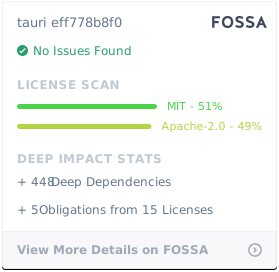
- Apache-2.0
- Last updated
- 10h ago
- Created
- 85mo ago
- Analyzed with
- anthropic/claude-sonnet-4-6
Stars over time
Contributors over time
Top 100 contributors only — repos with more will plateau at 100.
Open issues
Top contributors
Similar repos
tauri-apps/tauri-action
This GitHub Action automates building Tauri applications as native binaries for...
tauri-apps/create-tauri-app
create-tauri-app is a project scaffolding tool that rapidly generates new Tauri...
| Repository | Stars | Week Δ | Language | Score | Updated |
|---|---|---|---|---|---|
|
tauri-apps/tauri
this
|
108.9k | +252 | Rust | 9/10 | 10h ago |
|
tauri-apps/tauri-action
|
1.6k | — | TypeScript | 8/10 | 6d ago |
|
tauri-apps/create-tauri-app
|
1.6k | — | Rust | 8/10 | 17h ago |
|
tauri-apps/tao
|
2.1k | — | Rust | 8/10 | 1w ago |
|
tauri-apps/wry
|
4.9k | — | Rust | 8/10 | 12h ago |
|
tauri-apps/cargo-mobile2
|
1.8k | — | Rust | 7/10 | 2w ago |
Electron bundles Chromium and Node.js, resulting in binaries often 100MB+ with high RAM usage. Tauri uses the system webview and Rust, producing far smaller binaries (often under 10MB) with lower memory overhead. Electron has a far larger ecosystem, more mature plugin support, and a longer track record in production.
Flutter uses its own rendering engine (Skia/Impeller) rather than a webview, giving pixel-perfect consistency across platforms but requiring Dart. Tauri lets developers reuse existing web frameworks. Flutter has stronger official mobile support historically; Tauri's mobile story is newer (v2, 2024).
Neutralinojs also uses the system webview for lightweight desktop apps but is far less mature, has a much smaller community, and lacks Tauri's Rust-powered backend capabilities and mobile support.
Wails is a close conceptual cousin using Go instead of Rust for the backend, also leveraging system webviews. Tauri's ecosystem is significantly larger and more actively maintained. The choice often reduces to language preference (Rust vs Go).
NW.js, like Electron, bundles Chromium and is an older approach with similar binary size drawbacks. It sees declining relative interest compared to both Electron and Tauri.