
A self-hosted, privacy-first location timeline platform: an open-source alternative to Google Timeline with automatic trip detection, Immich integration, and rich analytics.
1.3k
Stars
48
Forks
14
Open issues
12
Contributors


AI Analysis
GeoPulse is a self-hosted, privacy-first location tracking platform that transforms raw GPS data from OwnTracks, Traccar, Home Assistant, and other sources into searchable timelines of stays, trips, and movement patterns—integrating with Immich for photo overlays on map history. It serves individuals and organizations seeking a privacy-preserving alternative to Google Timeline, and is best suited for users who want full data ownership and self-hosted control; it is not a general-purpose mappi...
Inferred from signals mentioned in the README (tests, CI, type safety) — not a review of the actual code.
AI's overall editorial judgment — not an average of the bars above, can weigh other factors too.
Java-based self-hosted location timeline platform launching as privacy-first Google Timeline alternative
GeoPulse is a self-hosted, open-source location timeline platform written in Java that ingests GPS data from multiple sources (OwnTracks, Overland, Traccar, Home Assistant, etc.) and surfaces stays, trips, and movement analytics. It integrates with Immich for photo-on-map visualization and targets privacy-conscious individuals and small organizations unwilling to trust location history to cloud providers. Created July 2025, it has gained approximately 1,177 stars and remains actively maintained as of July 2026. Adoption outside the initial contributor circle is not verified.
GeoPulse emerged July 2025 in a crowded ecosystem of location tracking alternatives (Dawarich, TREK, OwnTracks) where privacy concerns around Google Timeline and smartphone tracking have sustained niche demand. Its positioning emphasizes self-sovereignty and Immich integration—a gap in existing offerings that appeals to the Immich user base and privacy-first homelabbers.
The project gained 1,177 stars over approximately 12 months, with 26 stars in the final 7 days before evaluation. Growth appears steady rather than explosive. The April-July 2026 window (last 3 months of observation) would show whether momentum is accelerating post-launch; without granular monthly data, the trajectory suggests either organic adoption among target users or interest from privacy-focused communities, but not viral adoption. Recent active push (2026-07-03) indicates ongoing development.
Adoption not verified. README demonstrates feature completeness and deployment patterns consistent with production-readiness, but provides no case studies, testimonials, or quantified user base. No evidence of enterprises, significant organizations, or even named individuals running it at scale. The Immich integration is a concrete technical claim but adoption of that pairing is not documented.
Appears to be a full-stack application (Java backend, likely web frontend based on Docker Compose deployment) with PostgreSQL persistence (inferred from typical self-hosted stack patterns). README mentions Kubernetes/Helm support and multiple deployment options, suggesting a containerized microservice-ready design. Likely includes API layer for ingesting GPS data from multiple sources. Cannot verify code structure, modularity, or design patterns without source inspection.
Not documented in README. No mention of testing strategy, CI/CD, or code quality gates.
Last push 2026-07-03 (1 day before evaluation date) indicates active development. Repository created 2025-07-01, so it is approximately 12 months old. Presence of multiple deployment guides (Docker, Kubernetes, Proxmox, manual) and documented configuration suggests sustained investment. However, 45 forks is low relative to 1,177 stars, suggesting limited community contribution or fork-based extension activity.
ADOPT IF: you run Immich, prioritize location data sovereignty, want a lightweight self-hosted timeline with automatic trip detection, and can tolerate a nascent project. AVOID IF: you need proven production stability, require an established community, or expect extensive third-party integrations beyond the listed sources. MONITOR IF: the team sustains active development, adoption evidence emerges (e.g., linked projects, case studies), and Kubernetes support matures—these would signal trajectory toward viability.
Independent dimensions
Mainstream potential
3/10
Technical importance
6/10
Adoption evidence
2/10
- Adoption not verified; may face adoption barriers if users gravitate to more established alternatives (Dawarich, TREK) with larger communities.
- Single-author or very small team (inferred from 45 forks and high concentration of commits); sustained maintenance not guaranteed as personal projects often stall.
- Java/Docker dependency may raise operational complexity vs. lighter self-hosted alternatives; resource claims ('under 100MB RAM') are not independently verified.
- Immich integration is a niche feature; general location timeline users may not value it, limiting addressable market.
- No apparent funding, sponsorship, or organizational backing evident; sustainability depends on volunteer effort or undisclosed commercial interest.
GeoPulse will likely remain a specialized tool favored by Immich users and privacy-focused homelabbers, with slow but steady adoption over 2–3 years if development continues. It may eventually stabilize as a viable alternative for that niche but is unlikely to approach Dawarich or TREK adoption unless backed by organizational resources or a breakout integration.
Explore similar
Newsletter
Get analyses like this every Monday
Free weekly digest of the most interesting open-source discoveries.
Languages
Information
- Language
- Java
- License
- NOASSERTION
- Last updated
- 1d ago
- Created
- 12mo ago
- Analyzed with
- anthropic/claude-haiku-4-5
Stars over time
Contributors over time
Top 100 contributors only — repos with more will plateau at 100.
Open issues
Additional reverse geocoding providers
Allow to set default measure unit for all new users
Transition and data gap overlap (v1.33.0)
Selecting date range in the timeline
[Bug] Overland iOS stationary points not detected as stays; trip remains active
Open pull requests
Top contributors
Similar repos
| Repository | Stars | Week Δ | Language | Score | Updated |
|---|---|---|---|---|---|
|
tess1o/geopulse
this
|
1.3k | +101 | Java | 8/10 | 1d ago |
 Freika/dawarich Freika/dawarich
|
9.7k | — | Ruby | 8/10 | 14h ago |
 mauriceboe/TREK mauriceboe/TREK
|
9.8k | — | TypeScript | 8/10 | 15h ago |
 owntracks/android owntracks/android
|
1.7k | — | Kotlin | 7/10 | 14h ago |
 tidwall/tile38 tidwall/tile38
|
9.7k | — | Go | 8/10 | 7d ago |
 traccar/traccar traccar/traccar
|
7.5k | — | Java | 7/10 | 7h ago |
Functionally similar, older, more established. Dawarich has 8x the stars and visible user community. GeoPulse differentiates via Immich integration and lighter runtime footprint; both are self-hosted privacy-first platforms targeting the same user segment.
Comparable feature set for location timeline visualization. TREK has significantly higher adoption signal. GeoPulse emphasizes stay/trip detection and analytics; TREK appears more map-centric.
OwnTracks is a GPS *client*, not a timeline platform; GeoPulse is a server/collector that *consumes* OwnTracks data. Complementary rather than competitive. GeoPulse acts as a dashboard for OwnTracks users.
Traccar is vehicle/fleet-focused. GeoPulse targets personal timeline and analytics. Orthogonal audiences, though both ingest GPS.
Home Assistant has built-in location tracking. GeoPulse is a specialized, standalone platform offering deeper analytics and multi-source consolidation. Not a direct replacement, but an enhancement for HA users wanting dedicated timeline visualization.





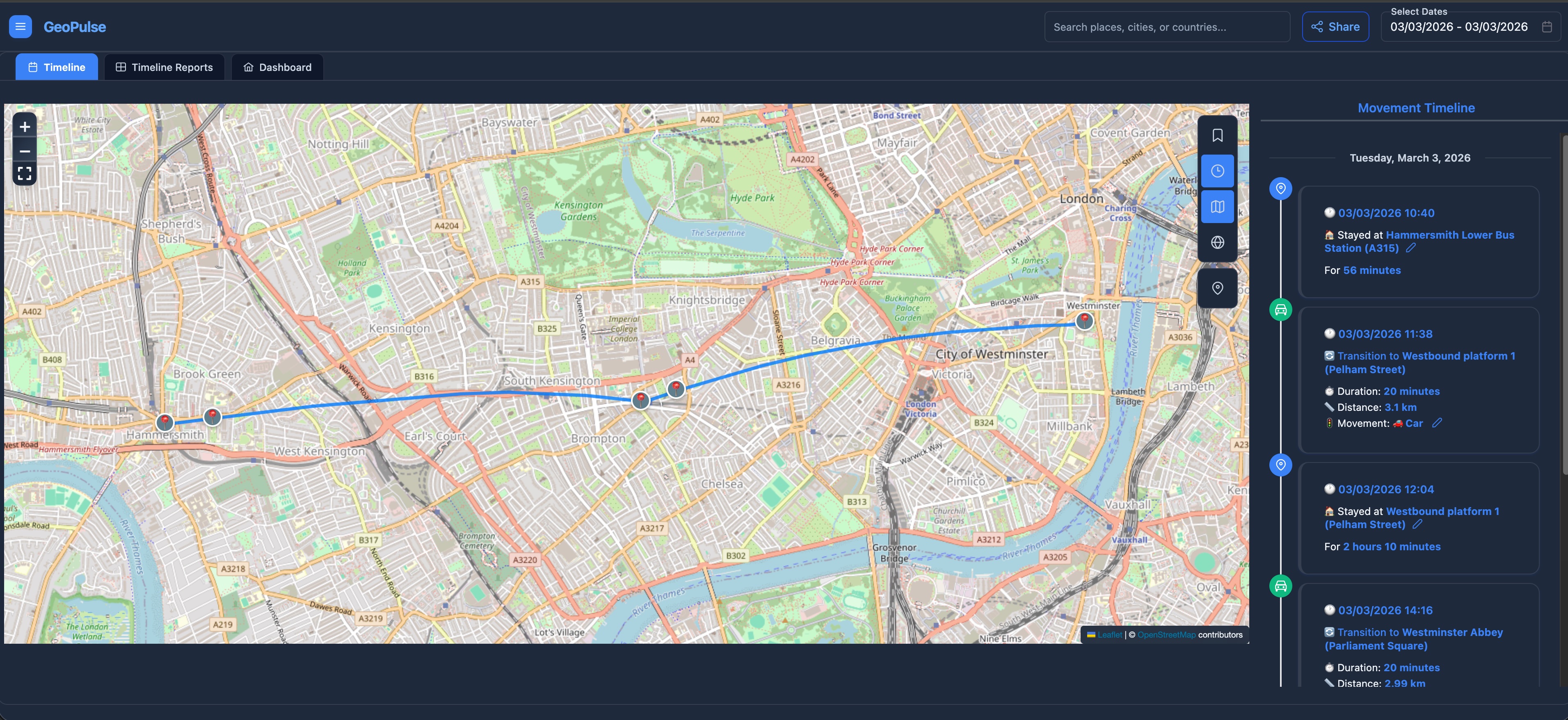
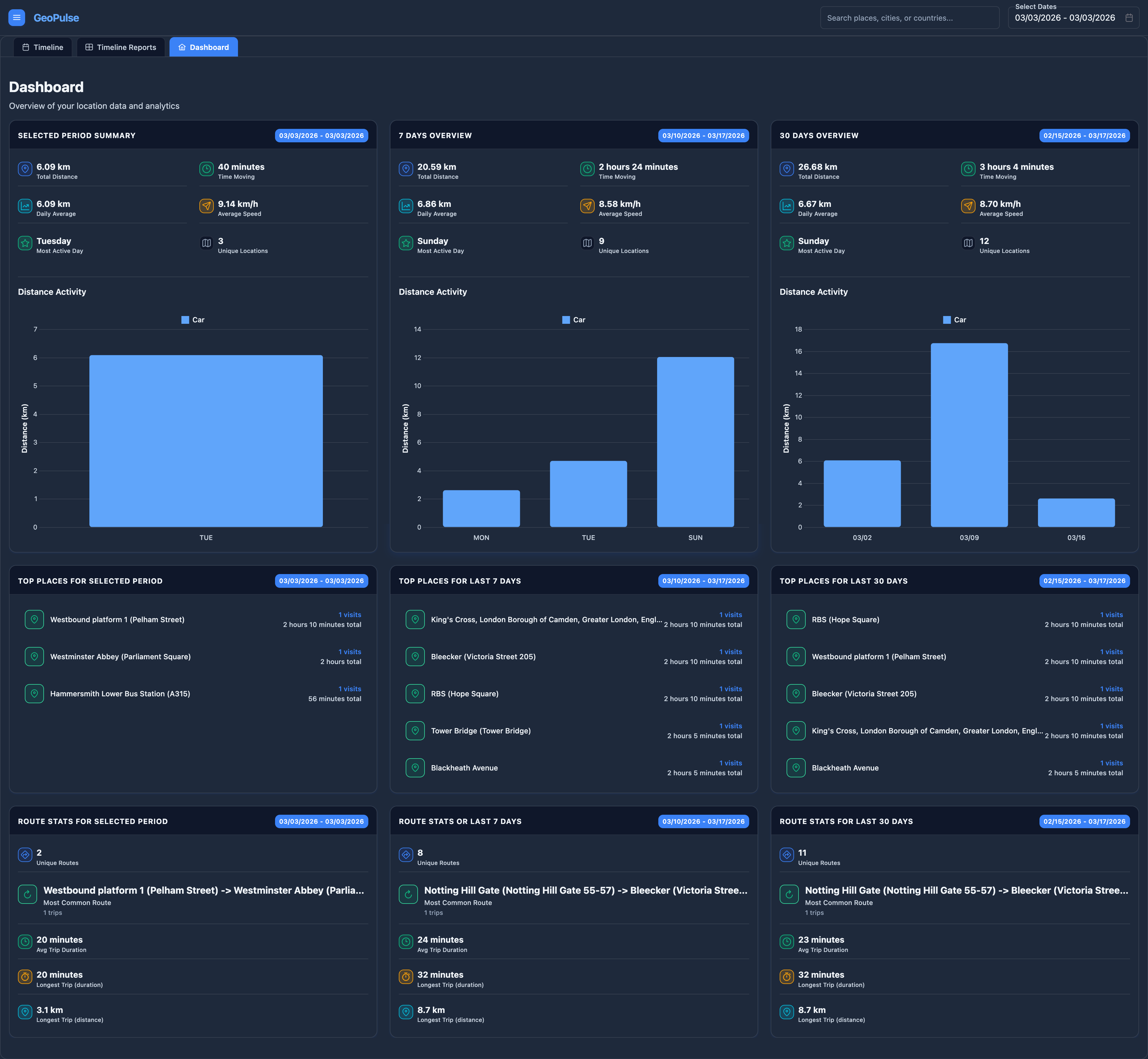 High-level overview of your activity.
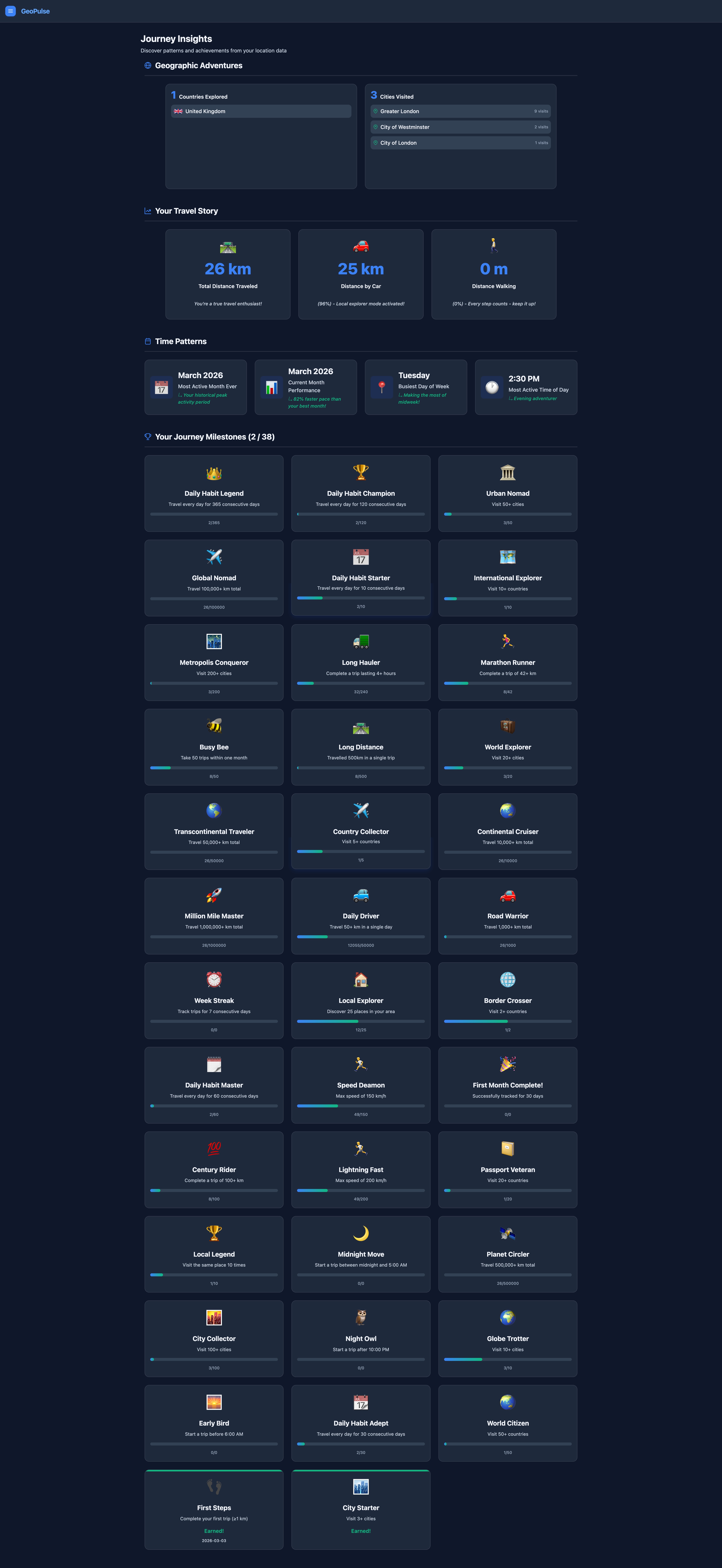 Global travel statistics, milestones, and badges.
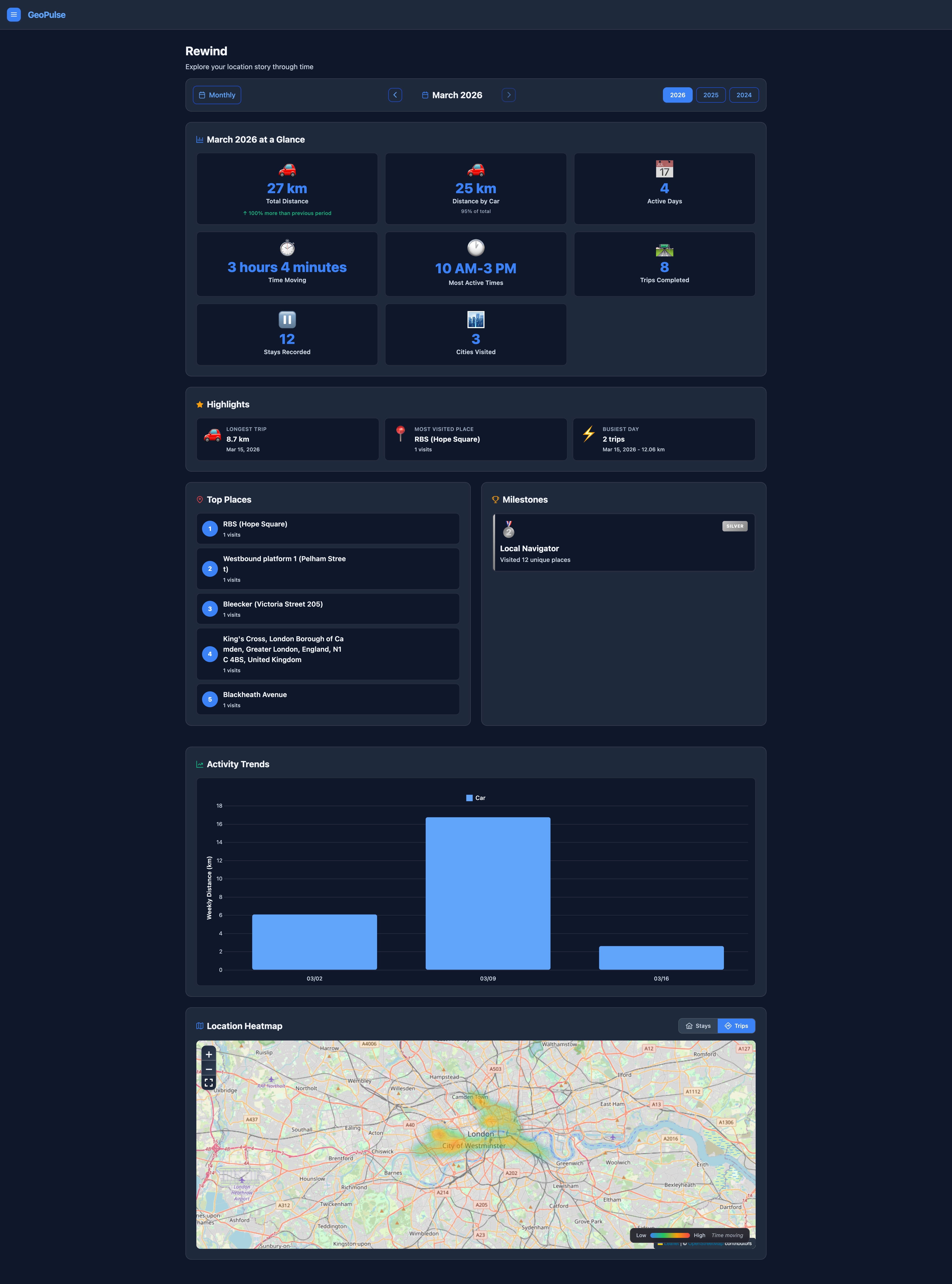 Monthly summaries and movement heatmap.
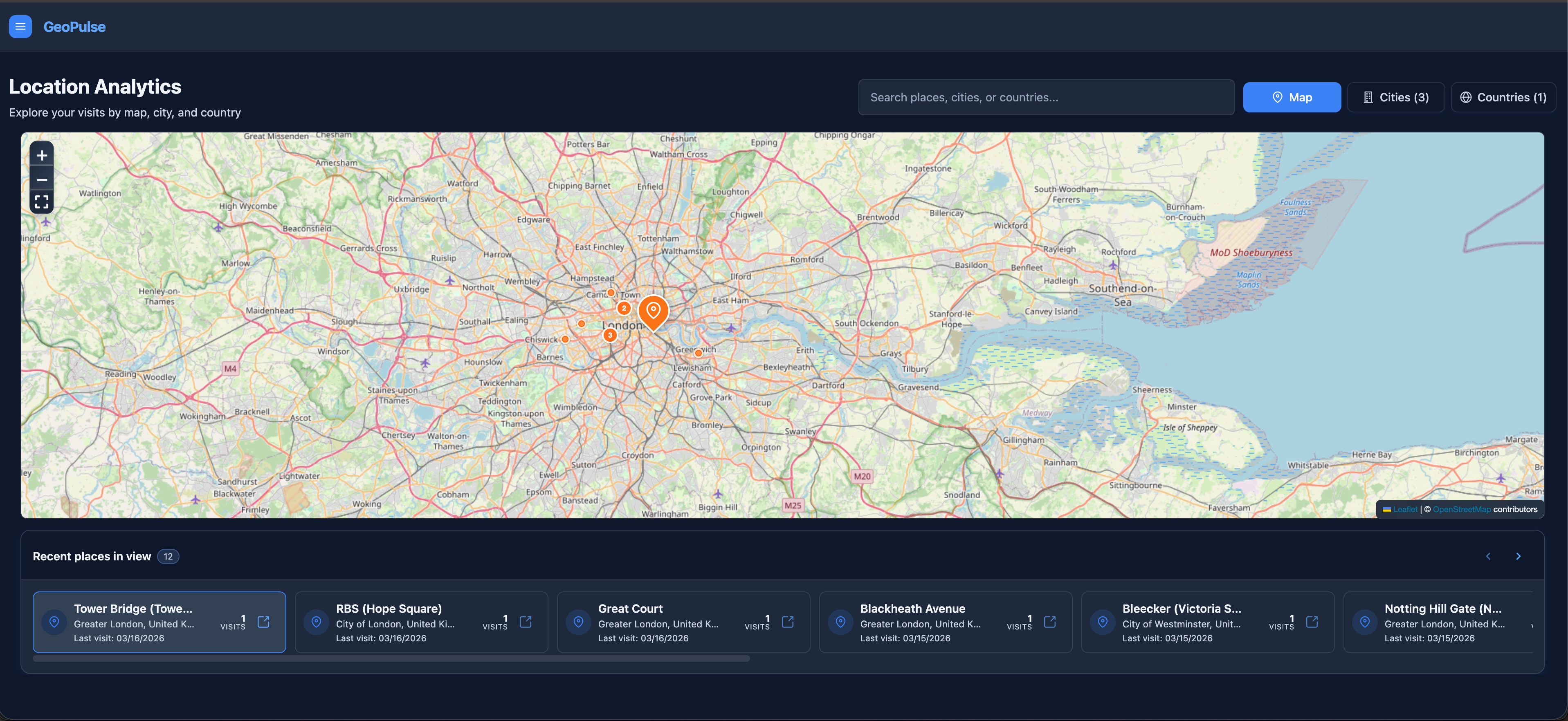 Map-first analytics similar to Timeline views.
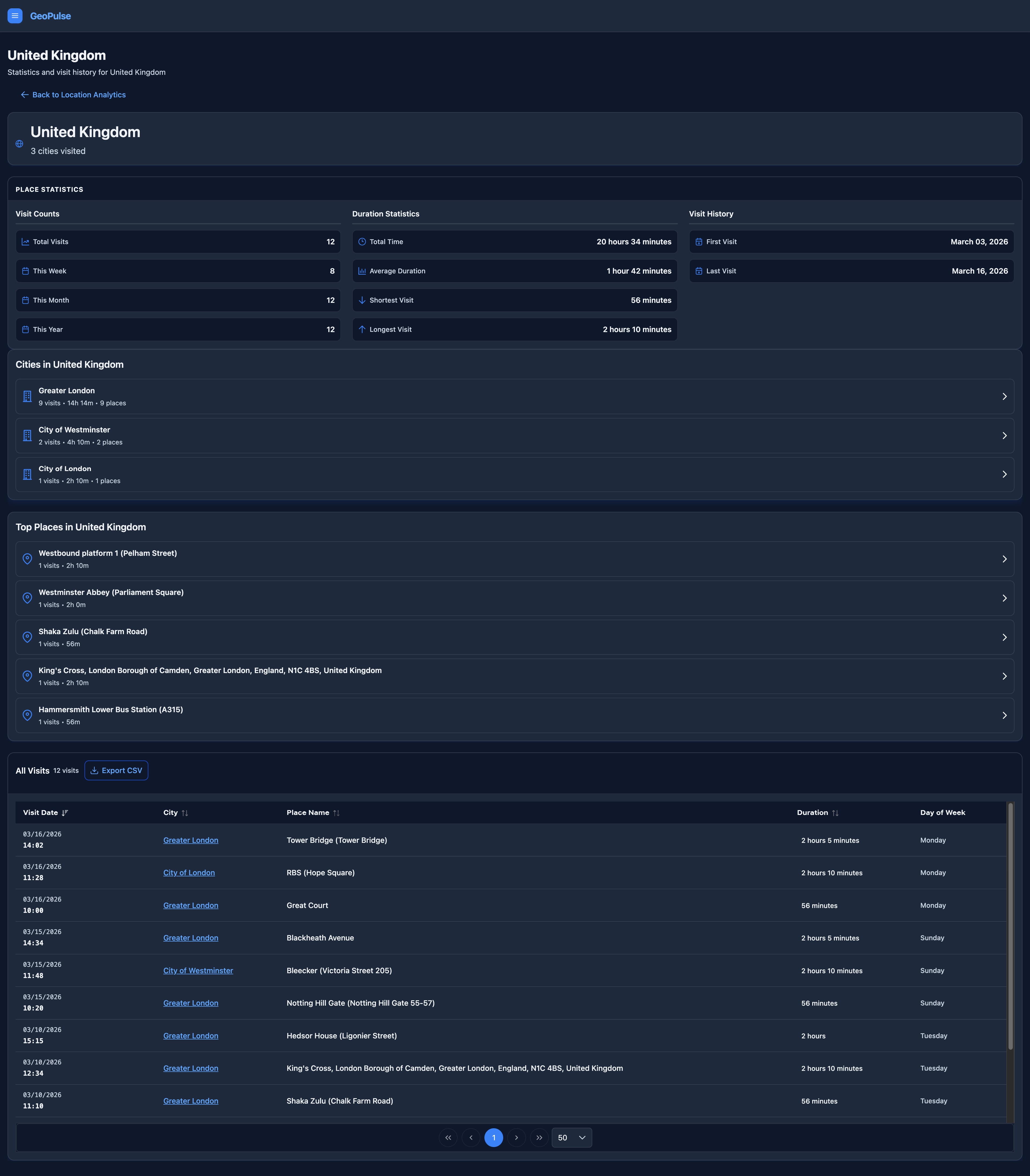 Track travels by country and city.
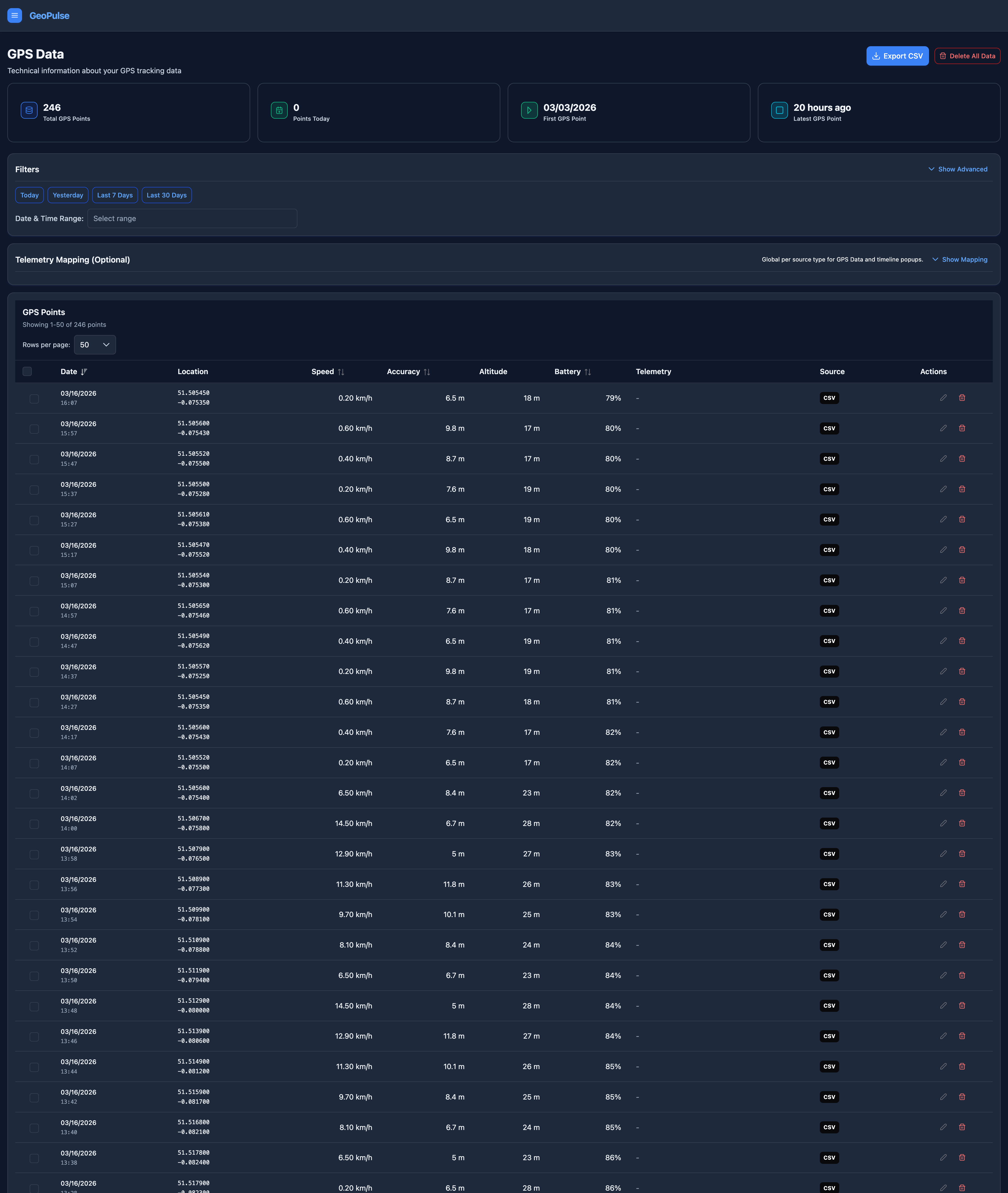 Inspect and manage raw location points.
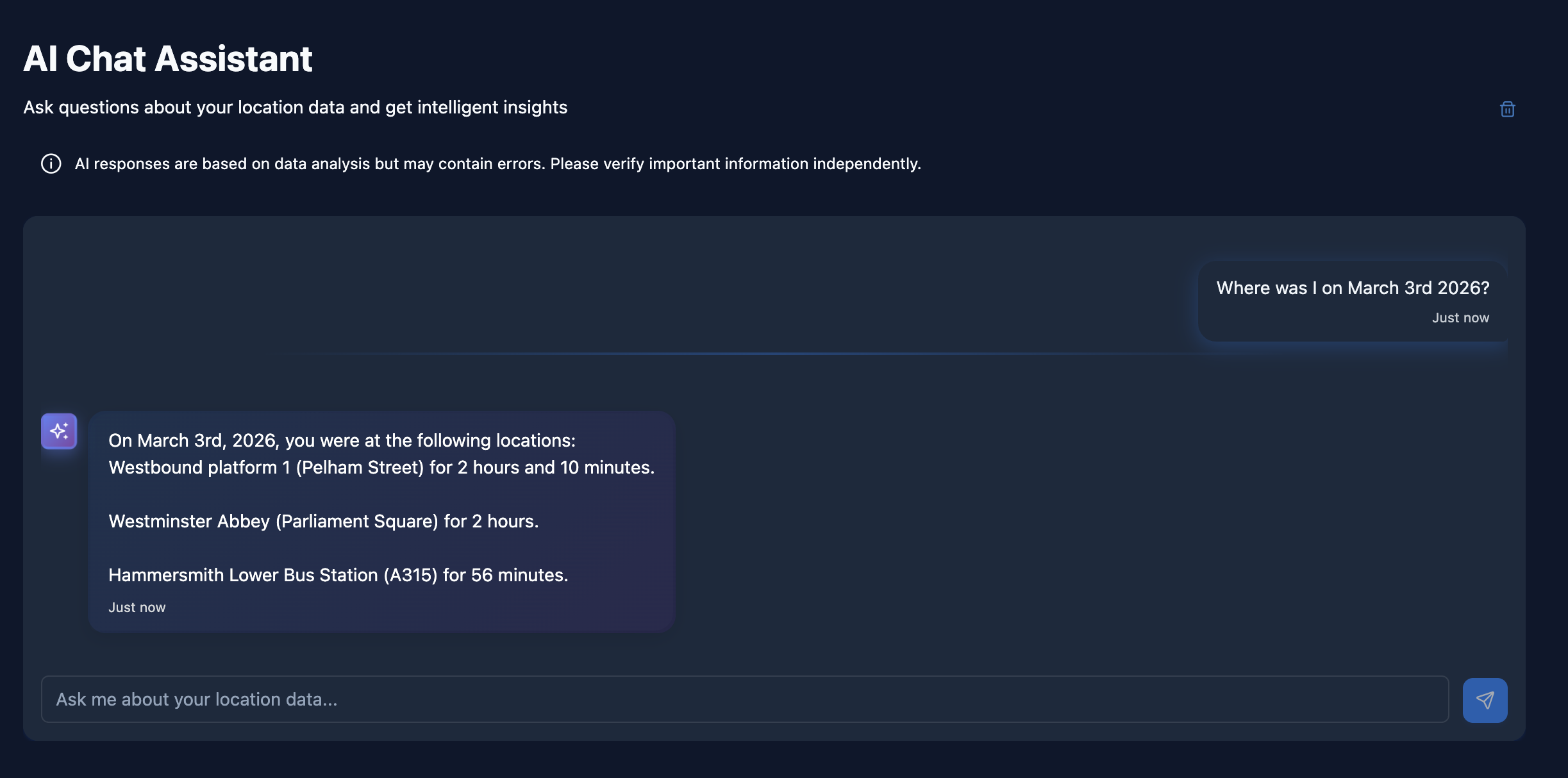 Natural-language queries for your data.