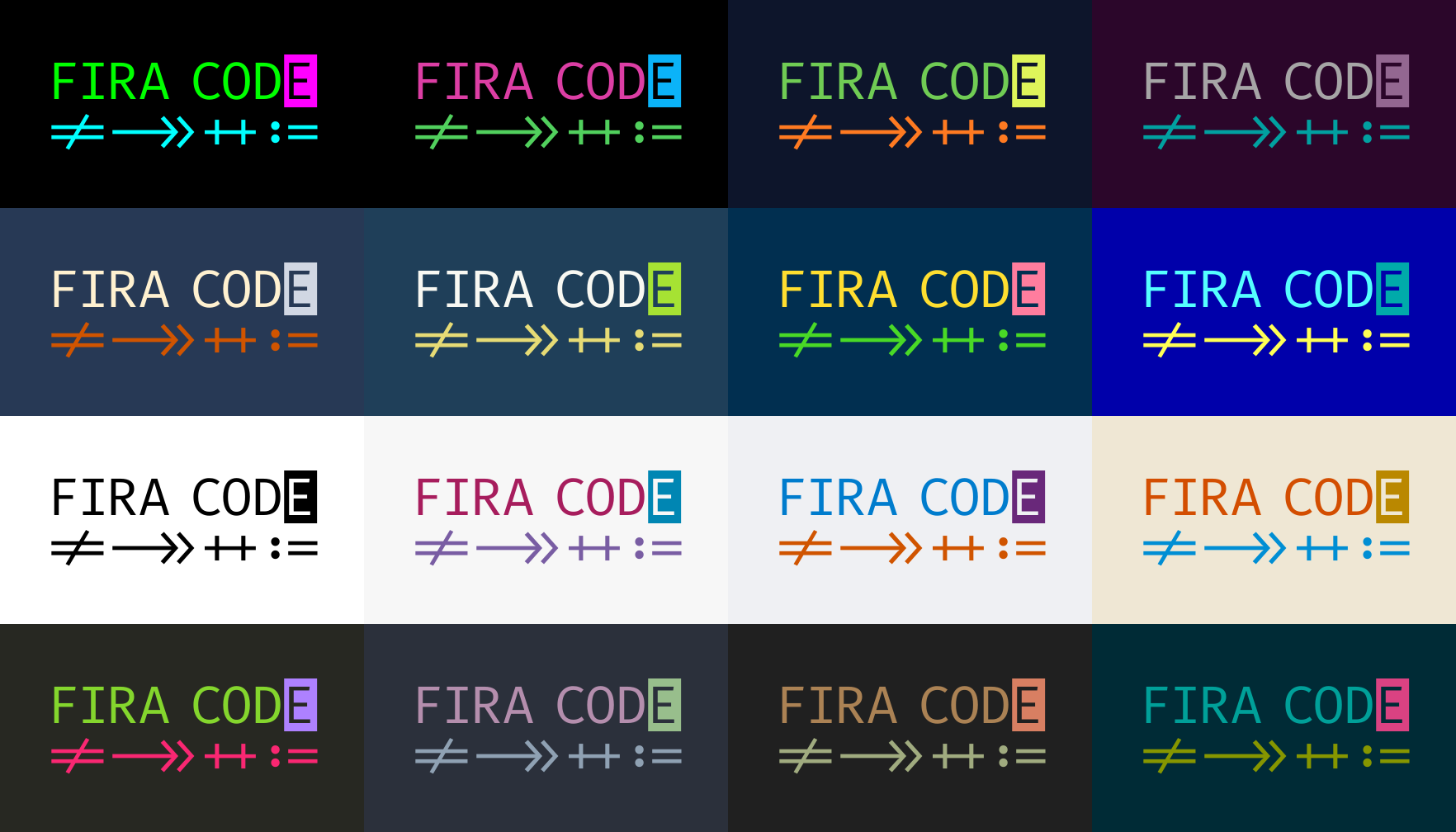
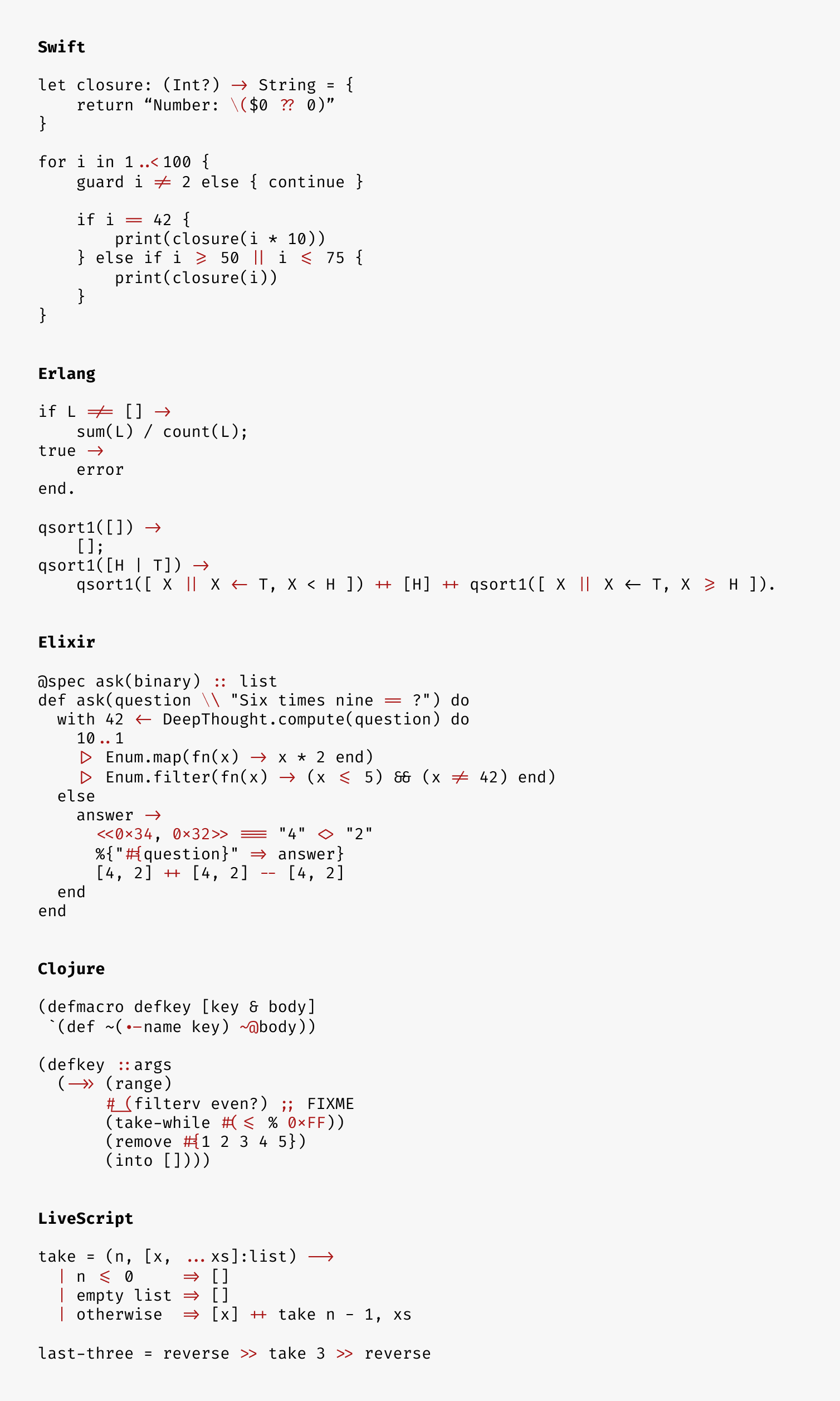
Free monospaced font with programming ligatures
81.8k
Stars
3.2k
Forks
430
Open issues
30
Contributors


AI Analysis
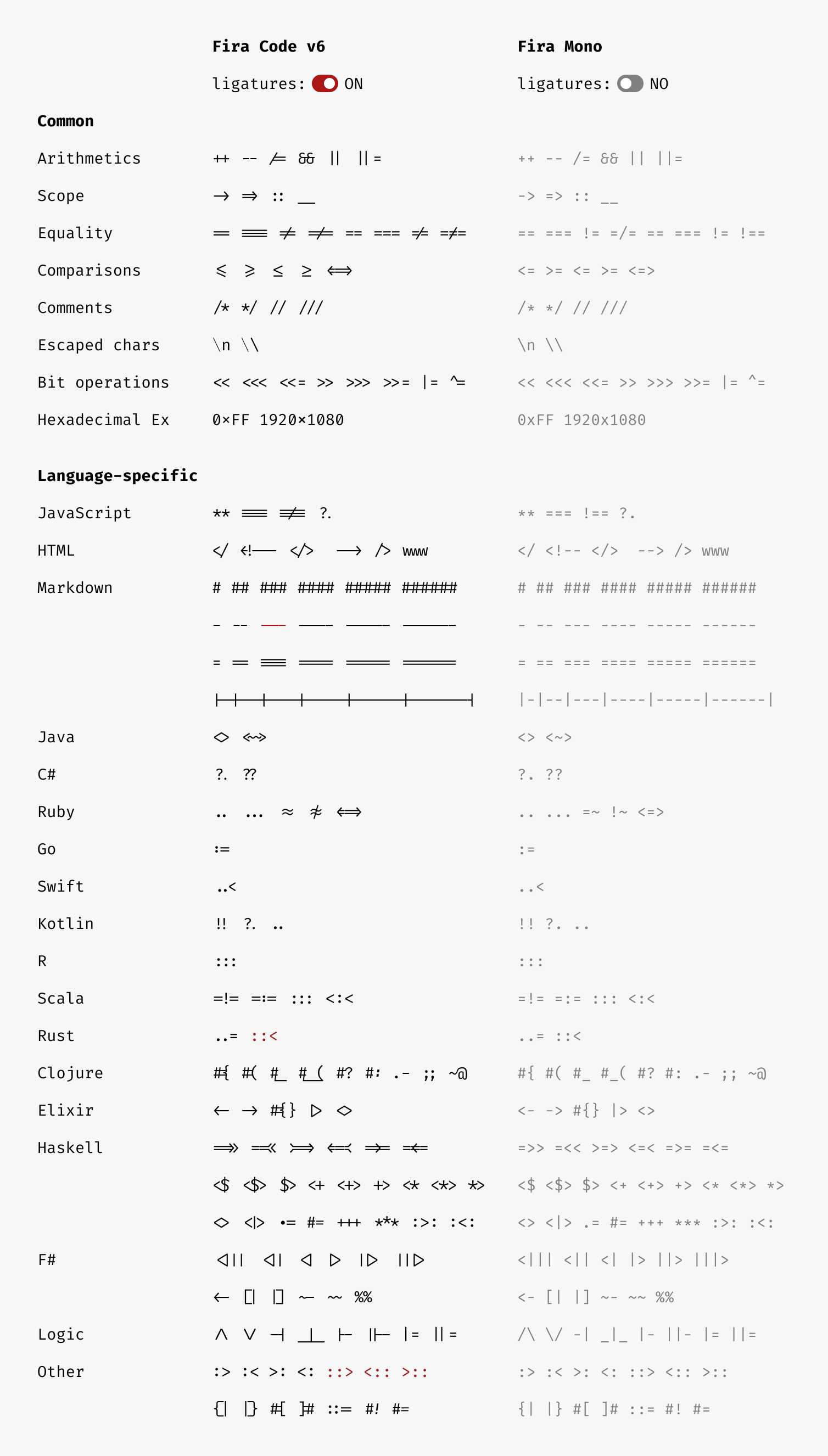
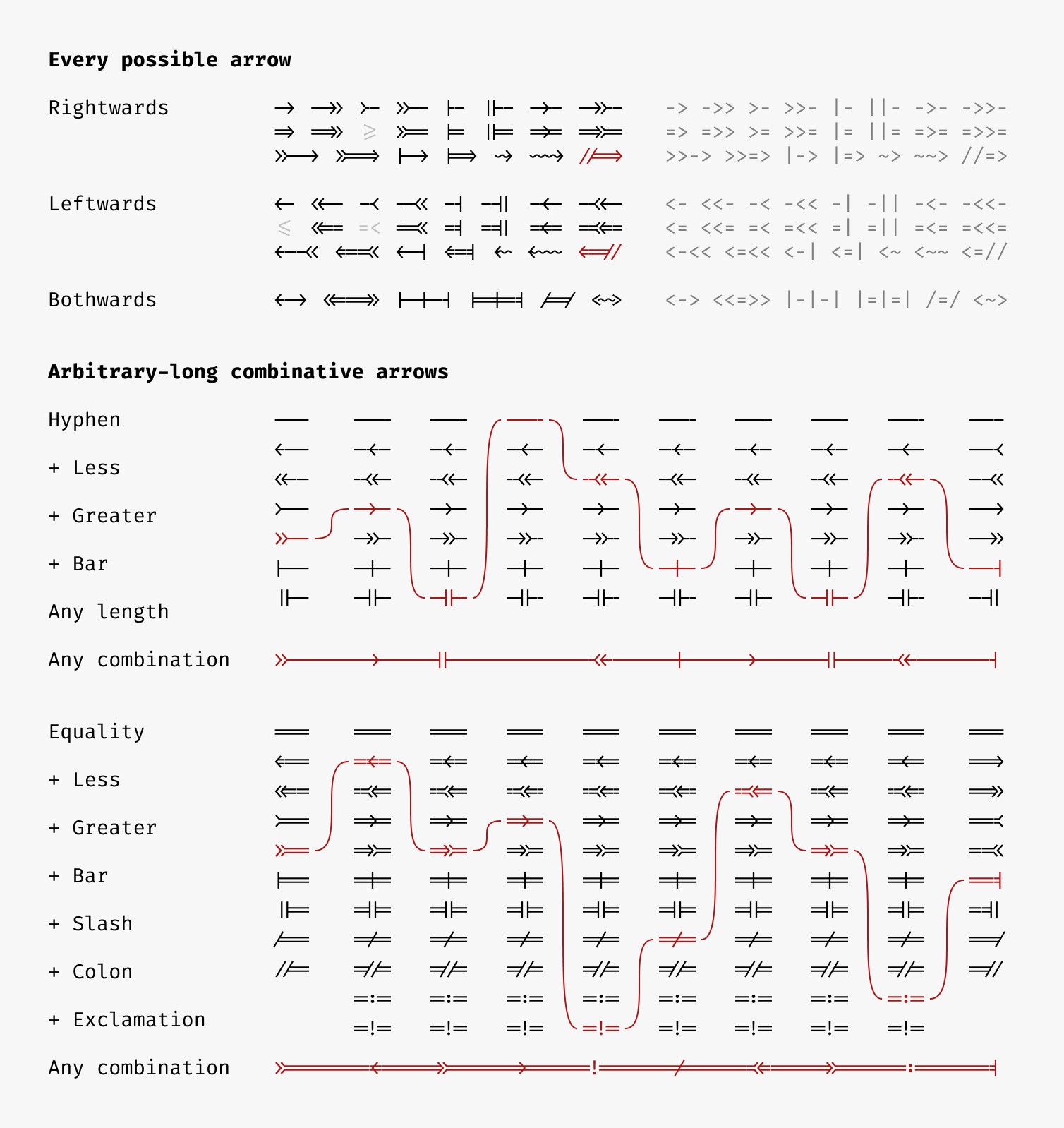
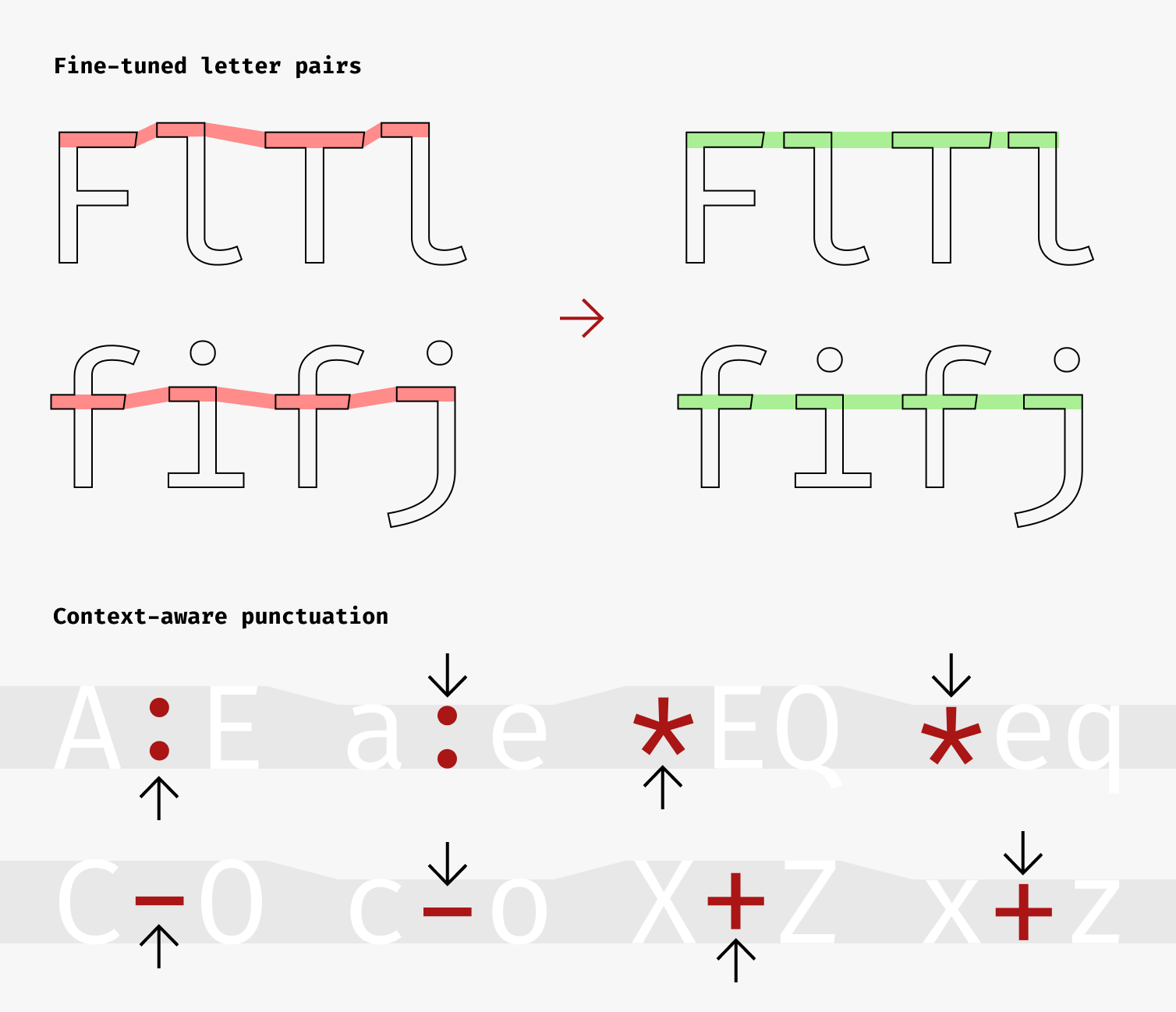
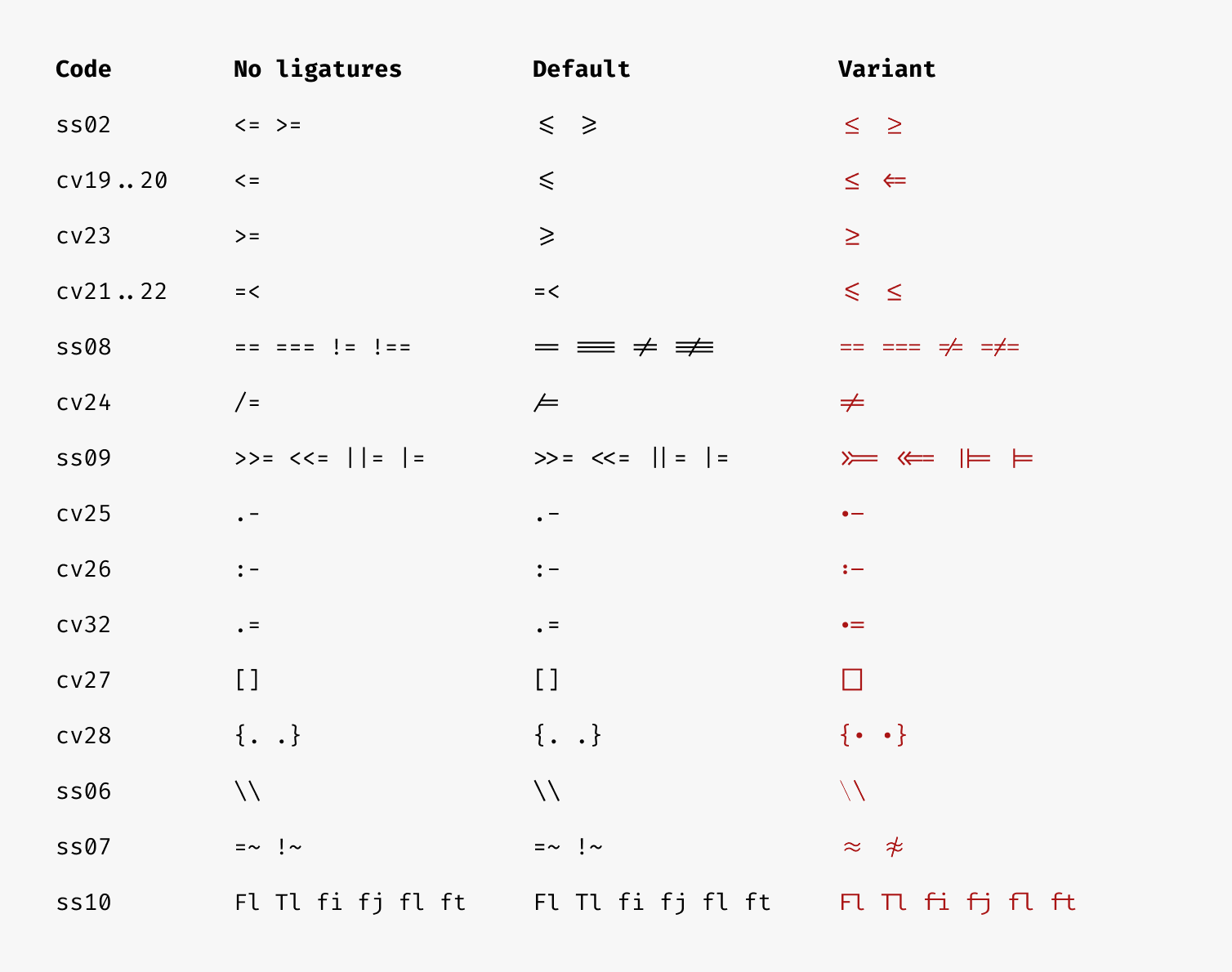
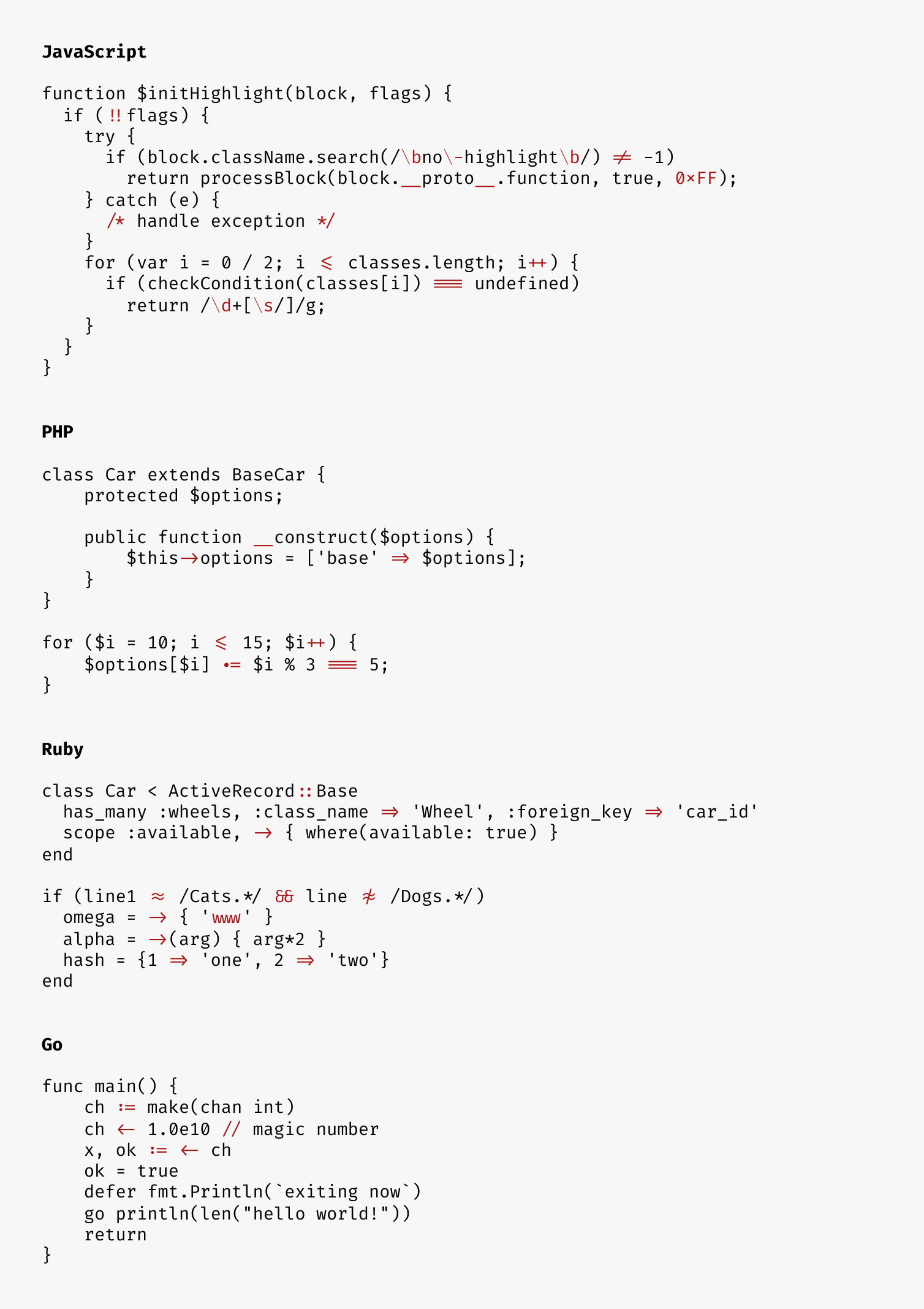
Fira Code is a free monospaced font designed specifically for programmers, featuring ligatures that render common multi-character operator sequences (like ->, <=, :=) as single unified glyphs while keeping the underlying ASCII text intact. It is best suited for developers who spend long hours reading code in editors, terminals, and IDEs and want improved visual parsing of operators and symbols. It is not for general typography, document design, or non-programming text contexts.
Inferred from signals mentioned in the README (tests, CI, type safety) — not a review of the actual code.
AI's overall editorial judgment — not an average of the bars above, can weigh other factors too.
Fira Code: the most-starred programming font, now a fixture in developer toolkits worldwide
Fira Code is a free monospaced font that renders multi-character programming sequences (like ->, <=, :=) as single visual ligatures while keeping the underlying ASCII text unchanged. It targets software developers who spend long hours reading code and want reduced visual parsing friction. With 81,769 GitHub stars, it is almost certainly the most-starred font project on GitHub. Broad compatibility is documented across dozens of major editors and IDEs including VS Code, IntelliJ products, Vim, and Neovim variants.
Created in November 2014 by Nikita Tonsky as a derivative of Mozilla's Fira Mono, it popularized the concept of programming ligatures at a time when most developer fonts offered none. Version 6.2 shipped in December 2021.
Early viral spread came from developer communities on Hacker News and Reddit around 2015-2016, when programming ligatures were a novel idea. Growth has since plateaued into steady slow accumulation (~42 stars per week as of June 2026), consistent with a mature, widely-known project rather than an actively expanding one. The concept itself drove adoption; no marketing budget or corporate backing was needed.
81,769 GitHub stars combined with documented compatibility across 40+ major editors, mentions in developer surveys and blog posts, and default or recommended font status in numerous coding tutorials and dotfile repositories constitute strong indirect evidence of widespread real-world use. Direct download counts are not publicly surfaced but the GitHub release zip has been available for years. Adoption is verifiably large by any reasonable inference, though precise install counts are unavailable.
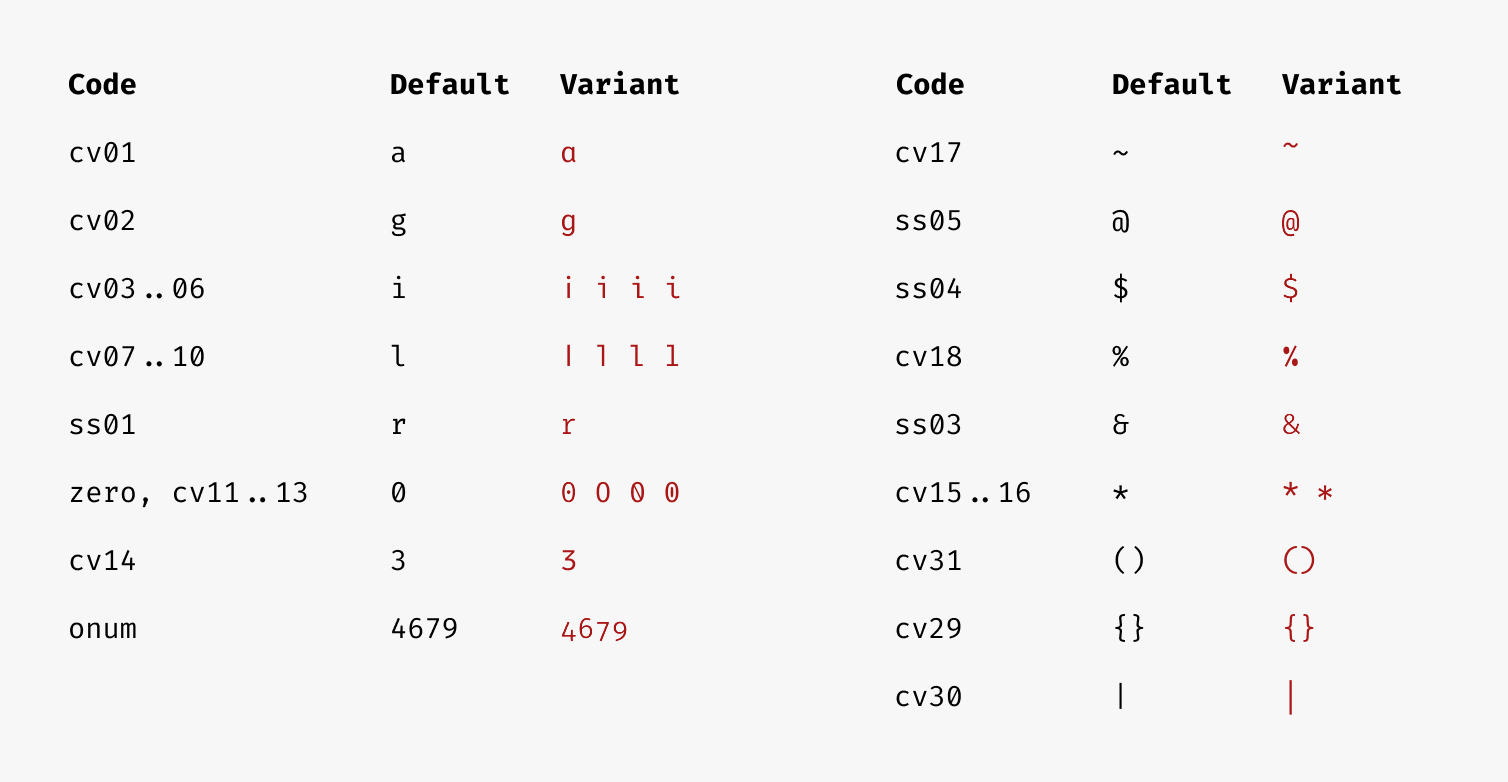
Likely built using font toolchains (the repo language is listed as Clojure, suggesting build scripts or tooling in Clojure, with font sources in a standard format such as UFO or Glyphs). The font ships as static OpenType/variable font files with OpenType CALT (contextual alternates) and LIGA features implementing ligature substitution. Character variants and stylistic sets suggest a structured glyph organization. All inferences are based on README descriptions only.
not documented in README
Last push was May 18, 2026, approximately one month before the evaluation date, indicating the project is actively maintained. However, the most recent release (v6.2) dates to December 2021 — over four years ago — suggesting the font design itself is stable and infrequent releases are intentional rather than a sign of neglect. The wiki and compatibility list appear maintained.
ADOPT IF: you want a stable, widely-supported, well-documented programming font with ligatures and broad editor compatibility, and you are comfortable with the subjective preference for ligature rendering. AVOID IF: you work in environments with poor OpenType CALT support (certain terminal emulators, older IDEs listed in the incompatibility table), or if you philosophically object to visual substitution of ASCII sequences. MONITOR IF: you are waiting for a potential v7 release or new glyph additions, as the font design has been stable since late 2021 with only maintenance-level updates since.
Independent dimensions
Mainstream potential
7/10
Technical importance
6/10
Adoption evidence
9/10
- No major font release since December 2021 (v6.2); users needing new language operator coverage or variable font improvements may find the release cadence slow.
- Editor and terminal ligature support remains inconsistent; several popular environments (standalone Emacs, some terminal emulators) require workarounds or do not support the feature at all.
- Subjective taste risk: ligatures are a divisive preference — some developers and teams actively prohibit them in shared environments, limiting adoption in certain organizations.
- Single primary maintainer (tonsky) creates a bus-factor concern for long-term development, though the font's maturity reduces urgency.
- Corporate-backed alternatives (Cascadia Code, JetBrains Mono) benefit from default bundling in major tools, which may gradually shift mindshare without Fira Code needing to do anything wrong.
Fira Code will remain a top-tier reference point for programming fonts for the foreseeable future. Slow star growth and rare releases reflect maturity, not decline. A v7 release would likely trigger another viral cycle, but is not guaranteed.
Newsletter
Get analyses like this every Monday
Free weekly digest of the most interesting open-source discoveries.
Languages
Information
- Language
- Clojure
- License
- OFL-1.1
- Last updated
- 2mo ago
- Created
- 142mo ago
- Analyzed with
- anthropic/claude-sonnet-4-6
Stars over time
Contributors over time
Top 100 contributors only — repos with more will plateau at 100.
Open issues
FiraCode Font override system color emoji fallback for globe emoji
Arabic support
Untrusted impersonation of the project at firacode.com
Misalignment in `ClassName<type>::Function`
There is no copyleft 🄯 symbol
Top contributors
Recent releases
Similar repos

subframe7536/maple-font
Maple Mono is an open-source monospace font designed specifically for coding...

SpaceTimee/Fusion-JetBrainsMapleMono
A specialized font that fuses JetBrains Mono with Maple Mono to provide...
| Repository | Stars | Week Δ | Language | Score | Updated |
|---|---|---|---|---|---|
|
tonsky/FiraCode
this
|
81.8k | +15 | Clojure | 9/10 | 2mo ago |
|
subframe7536/maple-font
|
27k | — | Python | 8/10 | 19h ago |
 be5invis/Iosevka be5invis/Iosevka
|
22.5k | — | JavaScript | 8/10 | 2d ago |
|
SpaceTimee/Fusion-JetBrainsMapleMono
|
2.1k | — | Python | 8/10 | 8h ago |
 ArthurSonzogni/FTXUI ArthurSonzogni/FTXUI
|
10.4k | — | C++ | 8/10 | 2d ago |
 fmtlib/fmt fmtlib/fmt
|
23.6k | — | C++ | 9/10 | 2w ago |
Iosevka (22,400 stars) is highly customizable — users can generate builds with specific widths, weights, and ligature sets. It targets developers who want precise typographic control. Fira Code offers a simpler, ready-to-use experience with less configuration overhead. The two serve overlapping but distinct preferences.
JetBrains Mono (backed by JetBrains, bundled by default in JetBrains IDEs) offers ligatures and is a direct competitor for IntelliJ-ecosystem users. It benefits from first-party integration but has narrower independent community reach than Fira Code.
Microsoft's Cascadia Code ships as the default font in Windows Terminal and VS Code. Its corporate backing and default status in major Microsoft tools give it a different distribution path; Fira Code competes on community trust and longer track record.
A niche composite font (2,103 stars) combining JetBrains Mono and Maple Mono. Serves a smaller audience wanting specific CJK or stylistic blends. Not a direct competitor to Fira Code's mainstream positioning.
Hack is another widely-used programming font focused on legibility without ligatures. It competes for users who prefer or need environments where ligature support is absent or undesired, making it complementary rather than directly competing on the same feature set.