Trigger.dev – build and deploy fully‑managed AI agents and workflows
15.6k
Stars
1.3k
Forks
392
Open issues
30
Contributors


AI Analysis
Trigger.dev is an open-source TypeScript platform for building and deploying durable AI agents and workflows with built-in support for long-running tasks, retries, queues, observability, and elastic scaling. It serves teams building AI applications that require reliability guarantees beyond what serverless platforms offer, particularly those needing timeout-free execution, human-in-the-loop workflows, and real-time streaming. Best suited for AI/backend engineers; not a general-purpose applica...
Inferred from signals mentioned in the README (tests, CI, type safety) — not a review of the actual code.
AI's overall editorial judgment — not an average of the bars above, can weigh other factors too.
Trigger.dev offers serverless-style background jobs with no timeouts, built for AI agents and long-running TypeScript workflows
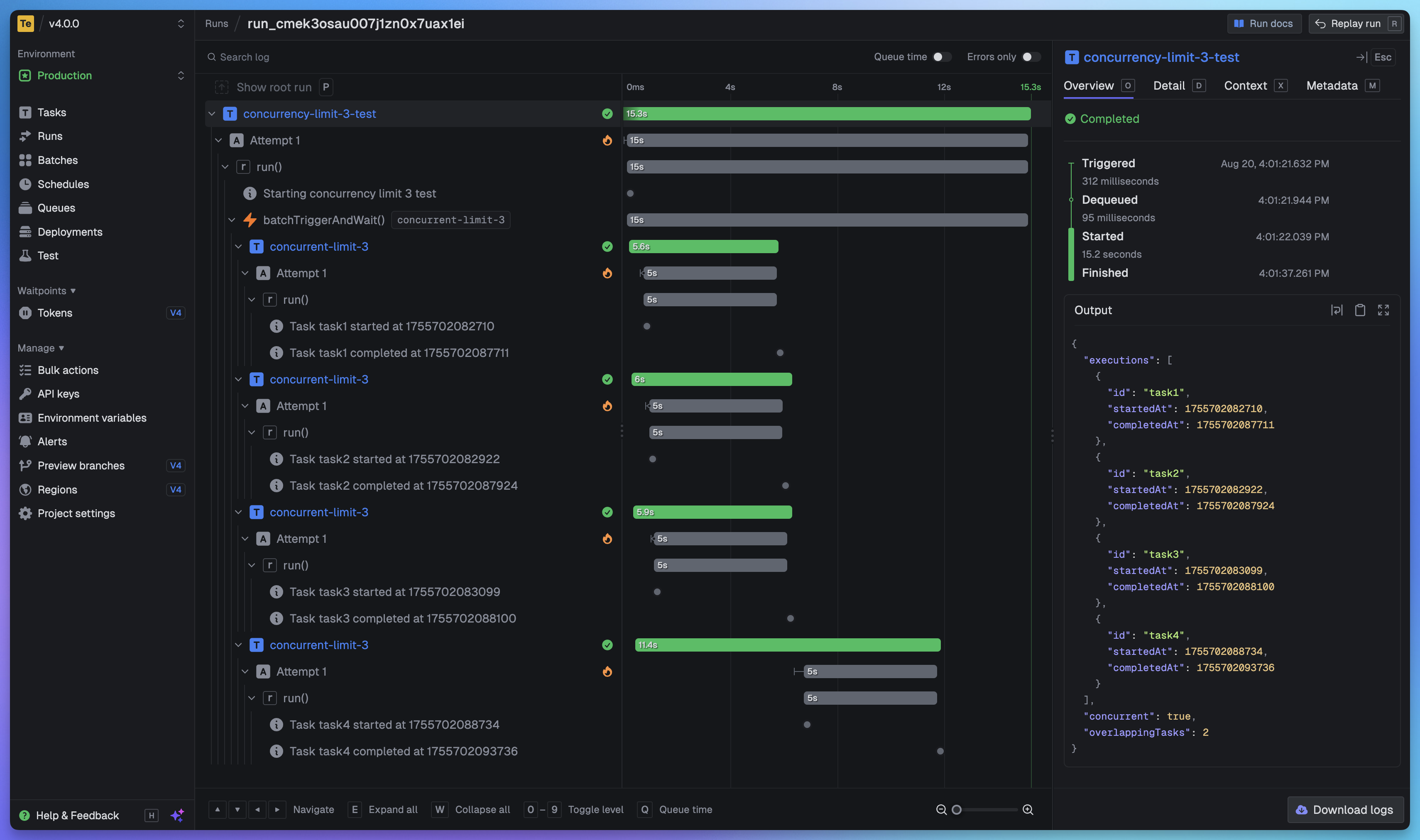
Trigger.dev is an open-source platform that lets TypeScript/JavaScript developers write background tasks, AI agent workflows, and scheduled jobs that run without the timeout limits of conventional serverless platforms. It targets product engineers building AI-heavy applications who need durability, retries, queues, observability, and human-in-the-loop checkpoints without managing their own infrastructure. With ~15.5k GitHub stars, a public roadmap, active Discord, and a managed cloud offering alongside a self-hosting path, it has built a visible community and commercial presence.
Founded in late 2022, Trigger.dev initially focused on event-driven background jobs. It has since pivoted and expanded its positioning toward AI agent infrastructure, reflecting the broader market shift toward LLM-powered workflows in 2024–2026.
Growth accelerated alongside the AI agent wave of 2024–2025. The no-timeout promise directly addresses a well-known pain point with Vercel and Lambda, resonating with developers building AI pipelines. Consistent shipping, an active Discord community, and pragmatic TypeScript-first positioning have sustained steady star accumulation.
The project has a commercial cloud product at trigger.dev, which implies real paying customers beyond hobbyist use. An npm package (@trigger.dev/sdk) with a monthly download badge suggests meaningful SDK adoption. Discord server activity and an examples repository indicate an engaged developer community. However, specific production scale metrics (number of paying customers, monthly run volume) are not publicly documented in the README.
Appears to use a managed container-based execution model with a checkpoint-resume system for durability, enabling long-running tasks to persist state across interruptions. Likely involves a central orchestration server, worker processes, and a SDK that integrates into user codebases. Build extensions suggest Docker-layer customization is supported. The Realtime feature likely uses server-sent events or WebSockets for live run status streaming.
Not documented in README
Last push was 2026-06-26 (same day as analysis), indicating very active daily development. With 15k+ stars, 1.3k forks, a public roadmap, and regular feature additions visible in the README, the project shows strong maintenance signals. The team appears to be actively iterating on AI agent capabilities.
ADOPT IF: you are a TypeScript developer building AI agent pipelines, long-running background jobs, or workflows that hit serverless timeout limits, and you want managed infrastructure with strong observability without maintaining Temporal or similar. AVOID IF: you need polyglot support, have strict data residency requirements that make the managed cloud unsuitable and self-hosting complex, or require enterprise-grade SLAs with proven large-scale references. MONITOR IF: you are evaluating the managed AI workflow infrastructure space but are not yet building long-running tasks — the platform is actively expanding and the feature set may better match your needs within 6–12 months.
Independent dimensions
Mainstream potential
6/10
Technical importance
8/10
Adoption evidence
5/10
- Vendor lock-in risk: the SDK and task model are tightly coupled to Trigger.dev's runtime; migrating away would require significant refactoring.
- Commercial sustainability: as a VC-backed startup offering a managed service, pricing model changes or funding gaps could affect platform reliability for dependent production systems.
- Crowded market: Inngest, Temporal, and cloud-native alternatives are all competing for the same durable workflow developer mindset, which may limit Trigger.dev's ability to achieve dominant market share.
- Self-hosting complexity: while self-hosting is documented, operating a checkpoint-resume system and container orchestration layer in production adds meaningful ops burden compared to the managed offering.
- AI positioning dependency: the pivot toward AI agent infrastructure means growth is partially tied to the continued momentum of the AI agent market; a slowdown in that space could reduce inbound interest.
Trigger.dev is likely to grow steadily as AI agent workflows become a standard backend concern. It may consolidate into a recognized tier-two choice for TypeScript-heavy teams, potentially alongside rather than displacing Temporal.
Newsletter
Get analyses like this every Monday
Free weekly digest of the most interesting open-source discoveries.
Languages
Information
- Website
- https://trigger.dev/changelog
- Language
- TypeScript
- License
- Apache-2.0
- Last updated
- 8h ago
- Created
- 44mo ago
- Analyzed with
- anthropic/claude-haiku-4-5
Stars over time
Contributors over time
Top 100 contributors only — repos with more will plateau at 100.
Open issues
Kubernetes: run telemetry has empty host — TRIGGER_WORKER_INSTANCE_NAME (spec.nodeName) not forwarded into the run process
v4.5.0 ClickHouse writers require CH ≥25.8, but the Helm chart still bundles ClickHouse 25.7.5 → every insert fails with UNKNOWN_SETTING
Top contributors
Similar repos

TrafficGuard/typedai
TypedAI is a TypeScript-first platform for building and deploying AI agents,...

cloudflare/agents
Cloudflare Agents is a framework for building persistent, stateful AI agents on...
| Repository | Stars | Week Δ | Language | Score | Updated |
|---|---|---|---|---|---|
|
triggerdotdev/trigger.dev
this
|
15.6k | +69 | TypeScript | 7/10 | 8h ago |
|
TrafficGuard/typedai
|
1.2k | — | TypeScript | 7/10 | 7mo ago |
 AgentDock/AgentDock AgentDock/AgentDock
|
1.7k | — | TypeScript | 7/10 | 1mo ago |
|
cloudflare/agents
|
5.2k | — | TypeScript | 8/10 | 17h ago |
 dagger/dagger dagger/dagger
|
16.1k | — | Go | 8/10 | 26 min ago |
 codeaholicguy/ai-devkit codeaholicguy/ai-devkit
|
1.6k | — | TypeScript | 7/10 | 3d ago |
The most direct competitor in the durable background job space for TypeScript developers. Both offer no-timeout tasks, retries, and event-driven triggers. Inngest has a comparable feature set; the choice often comes down to DX preferences and pricing. Trigger.dev appears to be leaning more aggressively into AI agent infrastructure as a differentiator.
Temporal is a mature, polyglot durable workflow engine with deep enterprise adoption. Trigger.dev offers a simpler TypeScript-native DX with managed hosting, whereas Temporal requires more operational overhead and is better suited to teams comfortable running their own cluster or paying for Temporal Cloud.
Dify is a no-code/low-code AI application builder with far broader adoption (146k stars). Trigger.dev targets code-first developers building custom workflows in TypeScript; these tools serve different personas and are not direct substitutes.
Cloudflare's platform offers edge-native durability via Durable Objects, but remains tied to the Workers runtime and its constraints. Trigger.dev offers true arbitrary runtime freedom (Python, browsers, FFmpeg), making it preferable for compute-heavy or non-JS workloads.
Step Functions provides durable orchestration on AWS infrastructure with strong operational guarantees. Trigger.dev trades AWS-native depth for a TypeScript-centric developer experience, faster setup, and no YAML/JSON state machine definitions.