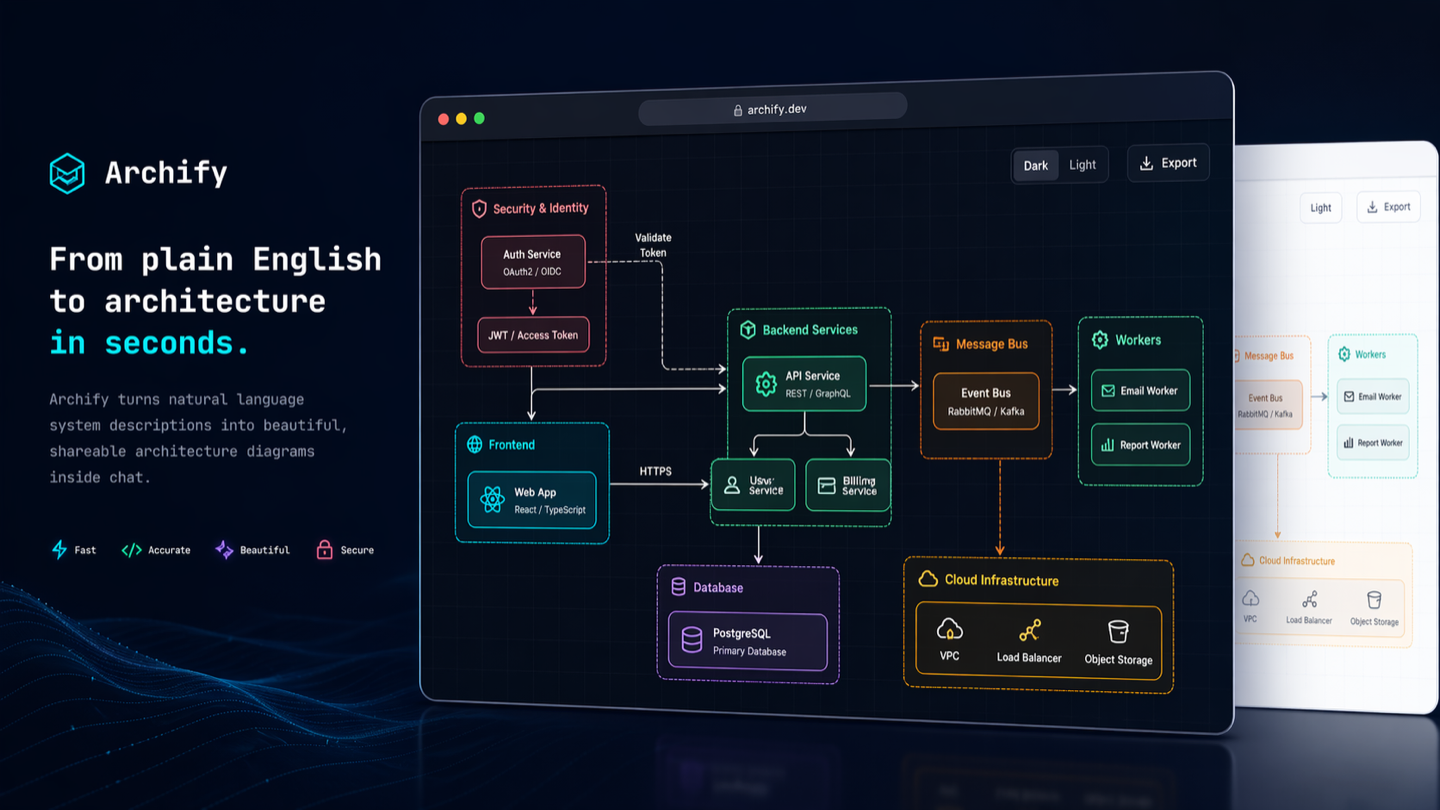
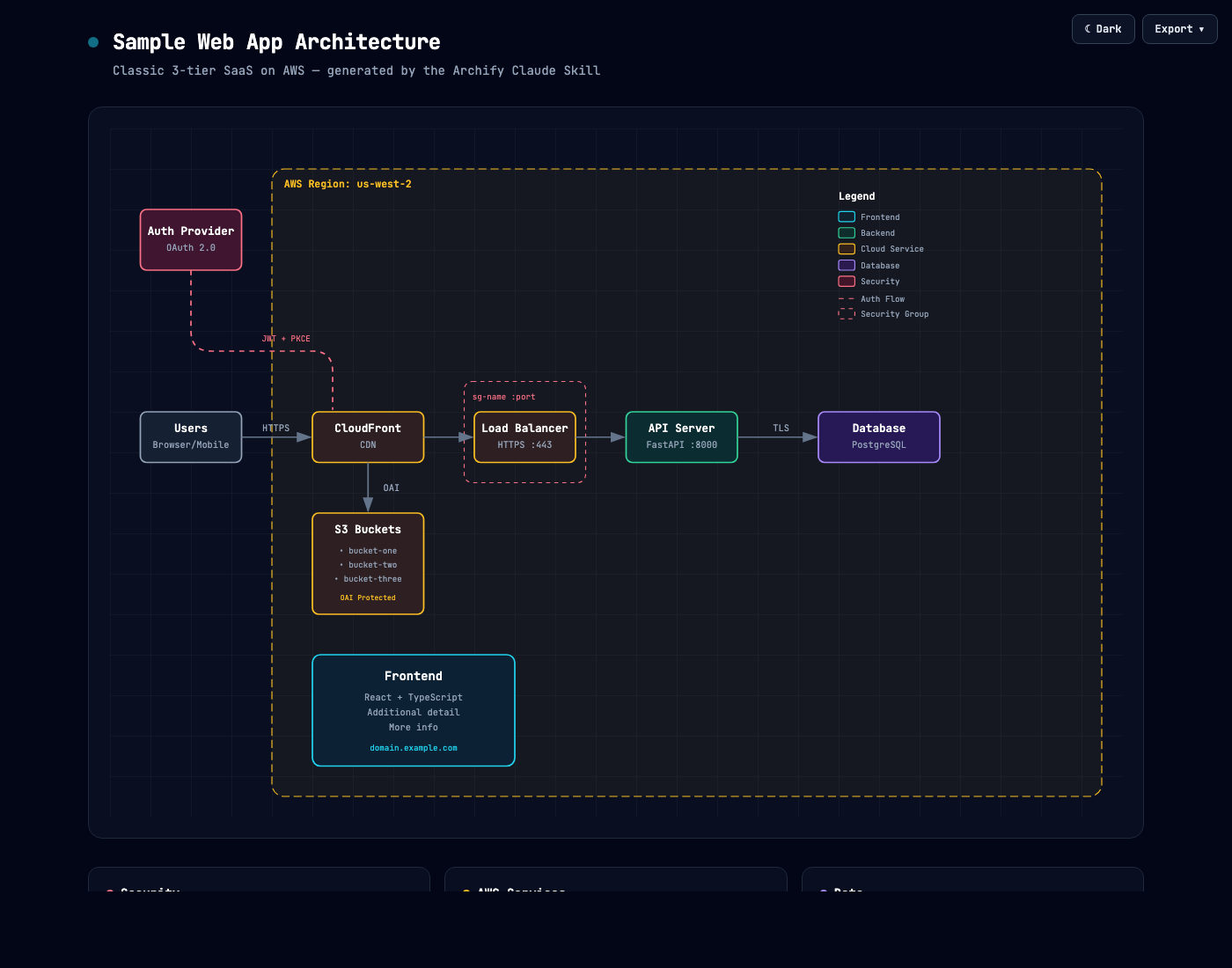
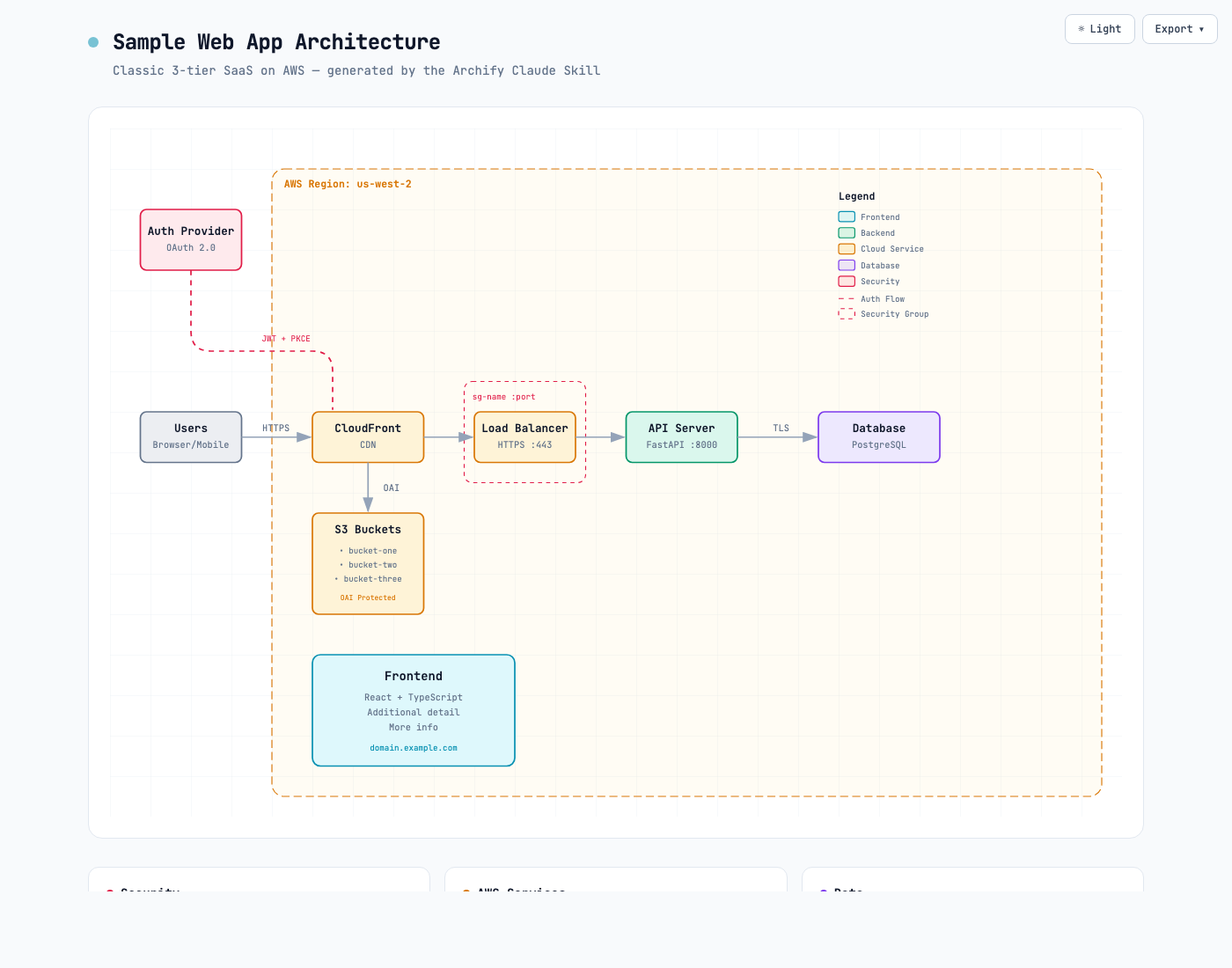
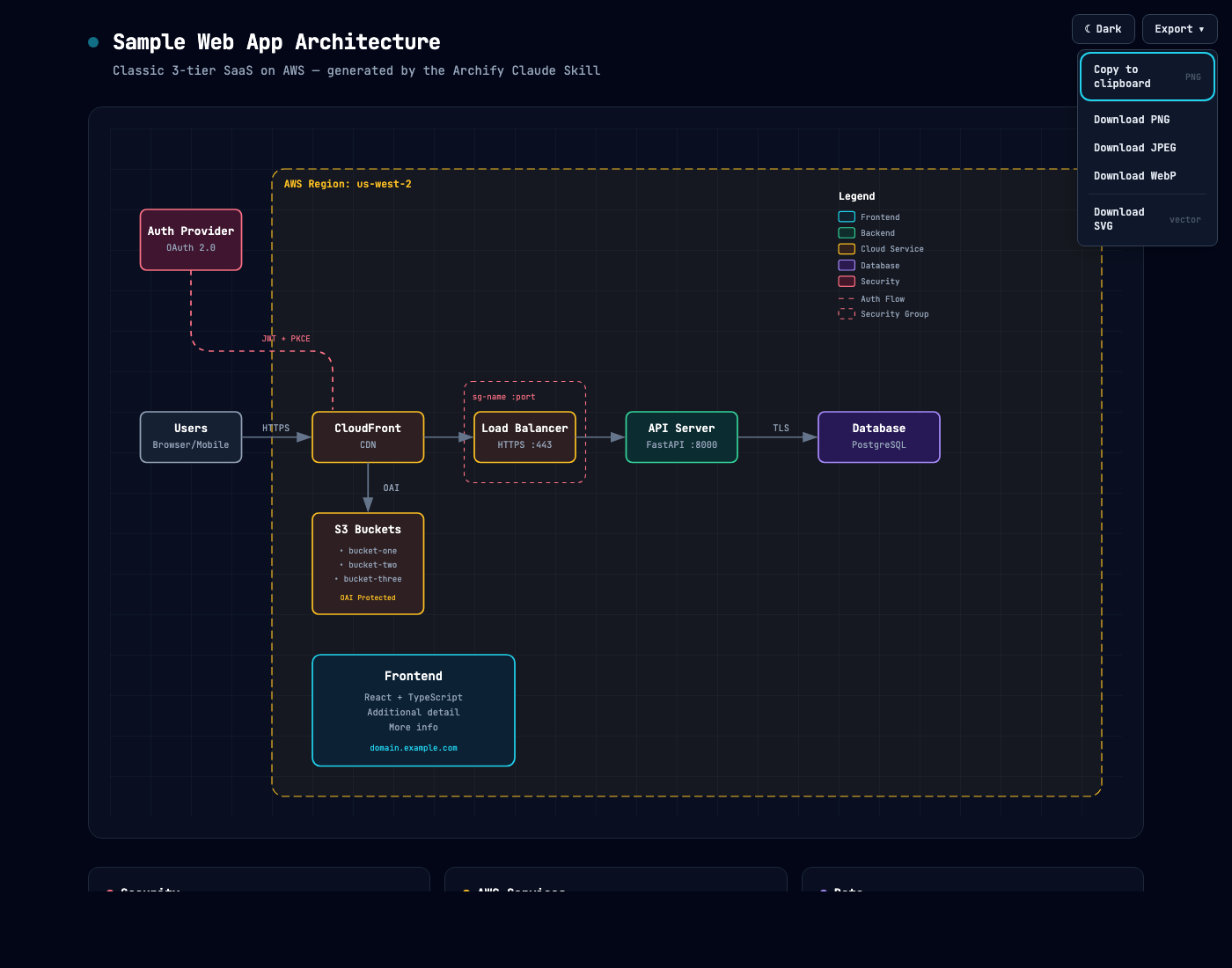
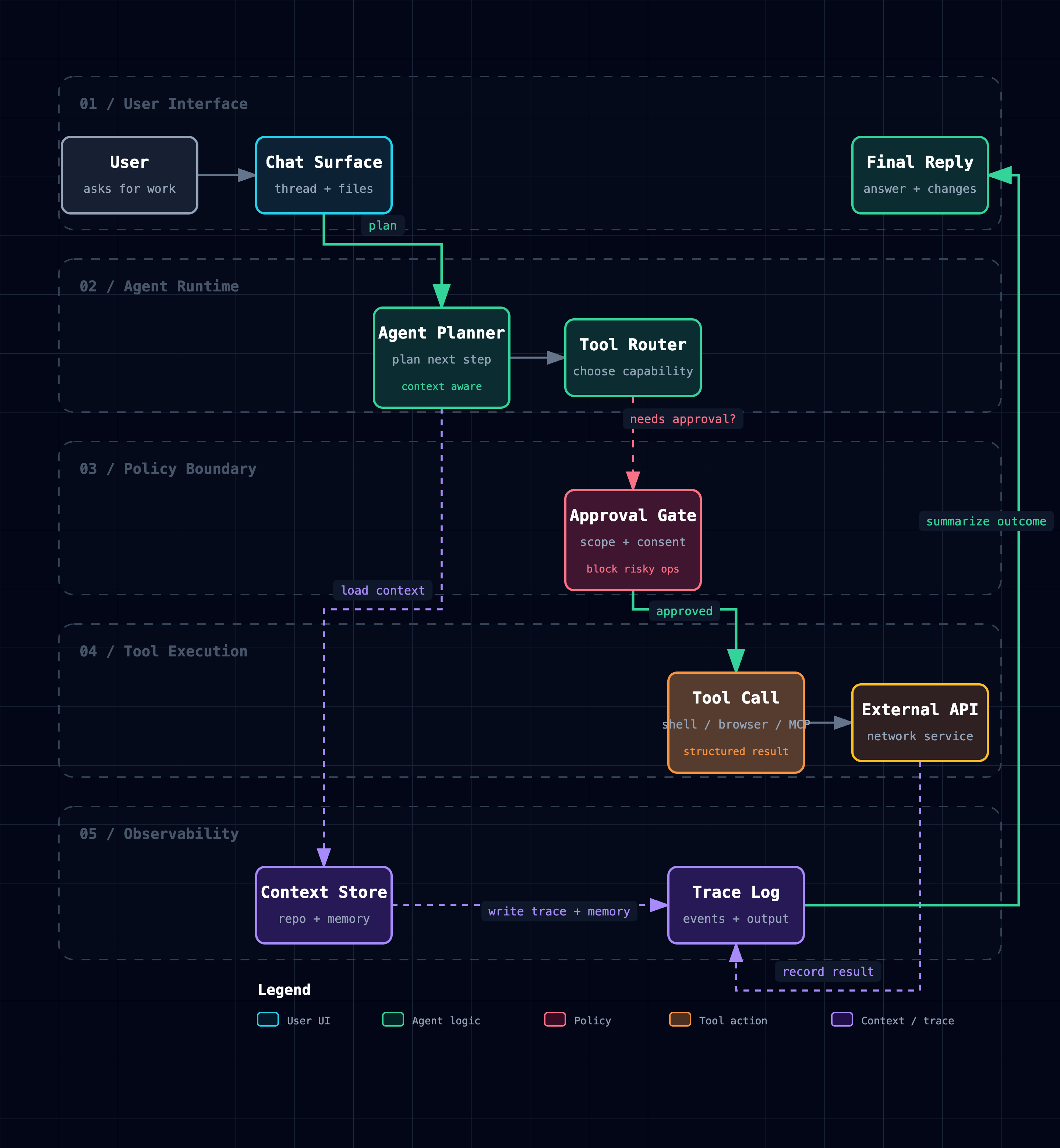
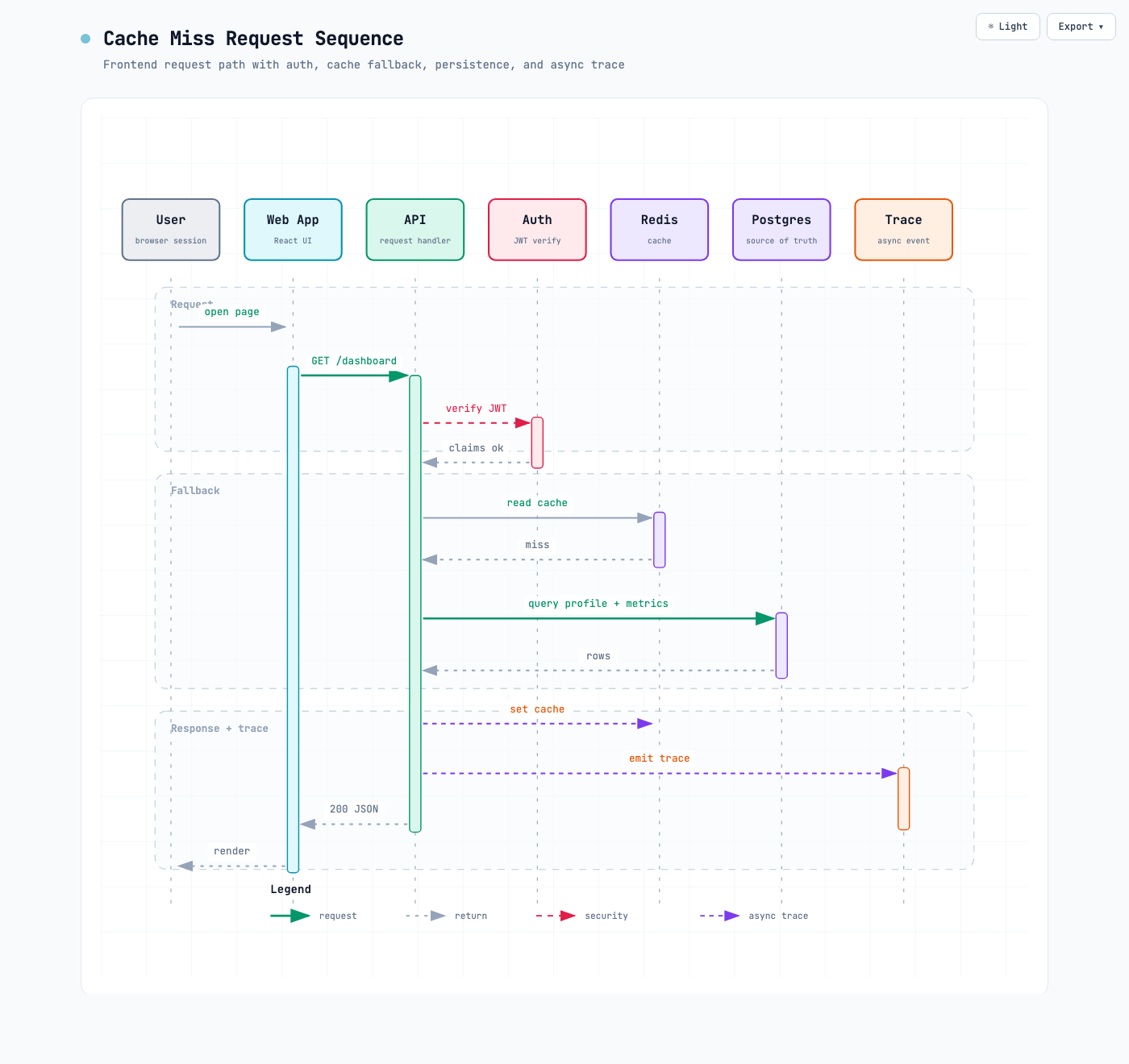
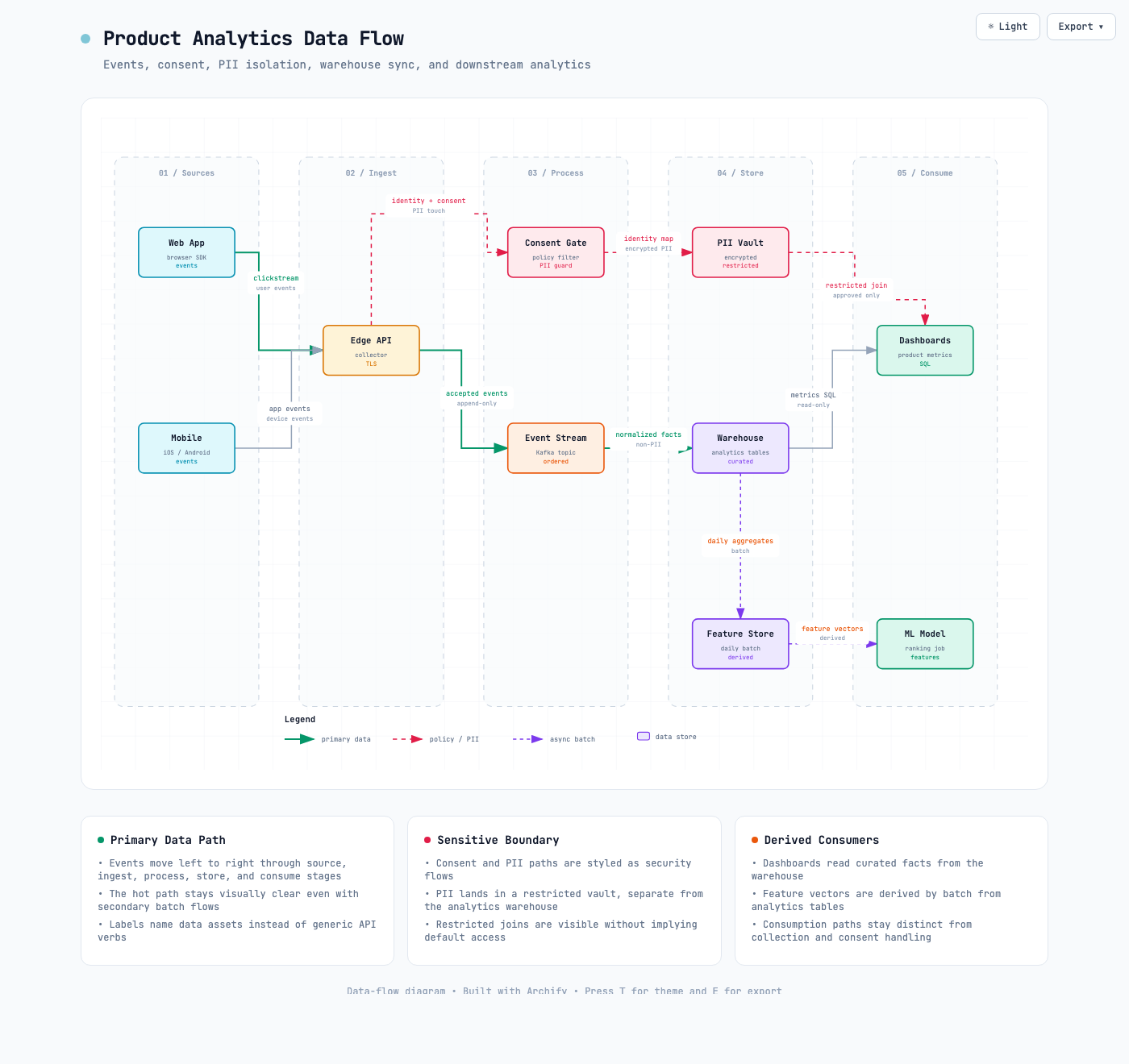
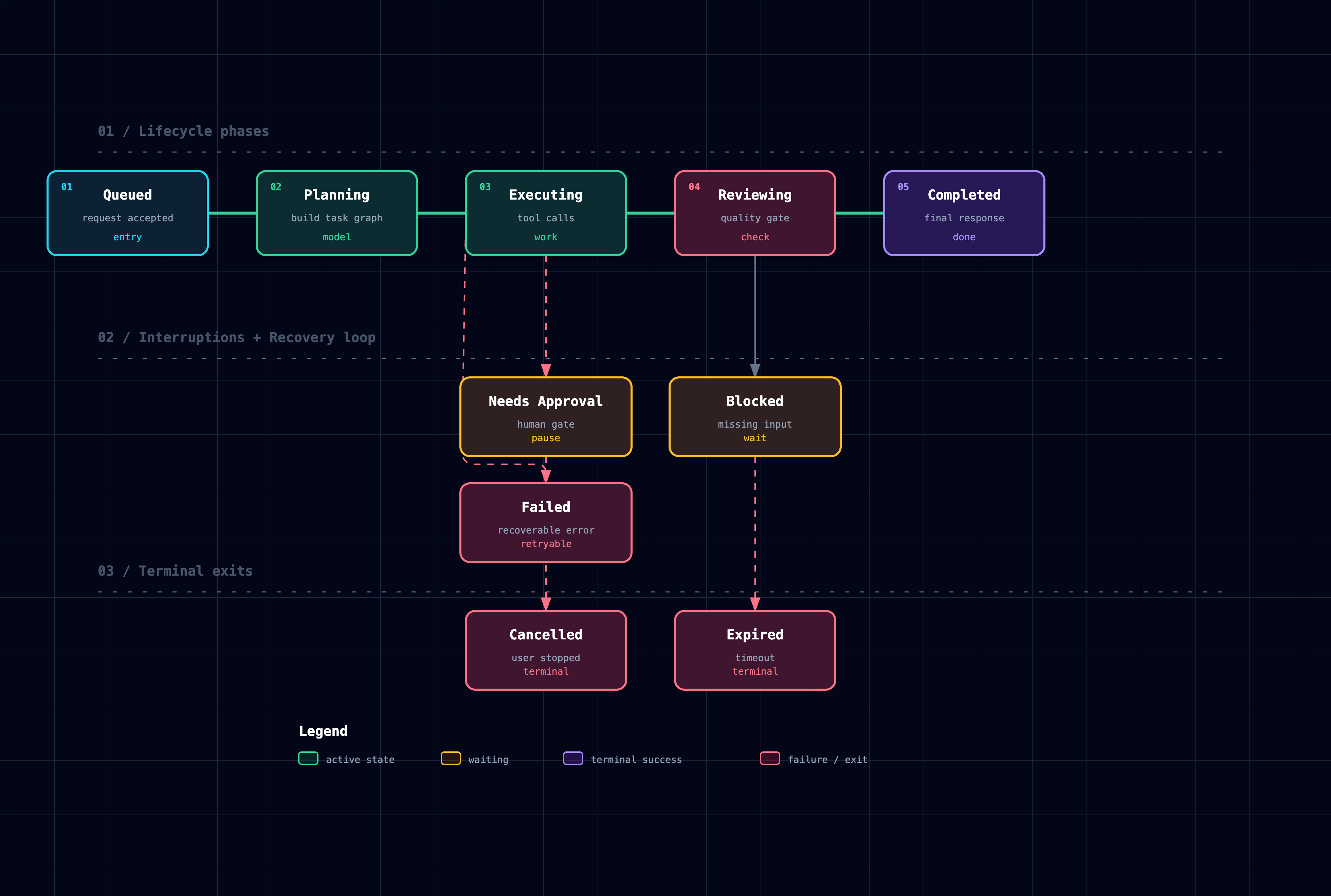
Any agent Skill: generate beautiful architecture diagrams with dark/light theme toggle and PNG/JPEG/WebP/SVG export
3.3k
Stars
227
Forks
10
Open issues
1
Contributors
AI Analysis
Archify is an AI agent skill for Claude that converts plain-English descriptions into polished architecture, workflow, sequence, and data-flow diagrams. It targets technical teams and architects who need to generate system design visuals without specialized design skills, offering theme toggling, clipboard export, and multi-format raster/vector output. This is a specialized tool for diagram-as-code workflows, not a general-purpose diagramming platform.
Inferred from signals mentioned in the README (tests, CI, type safety) — not a review of the actual code.
AI's overall editorial judgment — not an average of the bars above, can weigh other factors too.
AI-native diagram generator for technical flows; rapidly growing agent skill with strong theme and export features
Archify is a JavaScript-based agent skill designed to generate architecture, workflow, sequence, data-flow, and lifecycle diagrams from natural-language descriptions. Built for Claude, Codex CLI, and opencode integrations, it produces self-contained HTML files with built-in dark/light theme toggle and multi-format export (PNG/JPEG/WebP/SVG up to 4× resolution). The project emerged in April 2026 and reached 1,256 stars within 2.5 months, adding 95 stars in the past week alone, suggesting rapid adoption within the AI-agent and technical-documentation communities.
Archify forked from Cocoon-AI/architecture-diagram-generator (v1.0, dark-only), which itself had 6,173 stars. Archify v2.0 rewrote the template around a themeable CSS-variable system and added client-side export; v2.3 fixed image upsampling and achieved true 4× sharpness. The project is positioned as an agent skill—a specialized tool for LLM-based workflows rather than a general-purpose diagramming tool.
Created April 15, 2026, Archify grew to 1,256 stars by late June—roughly 500 stars per month. The 95-star gain in the last 7 days (as of June 27) indicates acceleration, likely driven by increasing adoption of Claude/Codex integration patterns and interest in AI-native technical communication. Growth appears to track with broader adoption of agent skills rather than viral momentum.
Adoption not verified through explicit case studies or user testimonials in README. However: (1) integration with multiple AI platforms (Claude, Codex CLI, opencode) suggests ecosystem adoption; (2) rapid star growth and recent acceleration indicate emerging community interest; (3) five example files and detailed diagram taxonomy suggest real usage patterns; (4) version history (2.0–2.6.0 in ~2.5 months) implies active internal/partner use. Adoption appears real but not yet publicly documented at enterprise or large-org scale.
Based on README: self-contained HTML output with no runtime dependencies; client-side canvas/SVG rendering using likely Mermaid or similar diagram primitives; theme state managed via CSS variables and localStorage. Likely modular input parsing (natural language to diagram AST). Appears to emphasize rendering quality (4× rasterization, font fallback) and UX (keyboard shortcuts, clipboard API integration).
Not documented in README. No mention of test suite, CI pipeline, or coverage metrics.
Last push June 14, 2026 (13 days ago relative to current date June 27). Version 2.6.0 indicates active iterative development. README is comprehensive with six example files, clear diagram-type taxonomy, and feature changelog. MIT license, public project page. Appears actively maintained with recent commits, though issue/PR velocity not visible in metadata.
ADOPT IF: You need technical diagrams generated from natural-language prompts within Claude/Codex/opencode workflows, prioritize light/dark theme support and high-resolution export, and prefer self-contained HTML files with no external dependencies. AVOID IF: You need a standalone, non-agent-integrated diagramming tool, require programmatic API control (not chat-driven), or demand extensive third-party integration libraries. MONITOR IF: You are evaluating agent-skill ecosystems and want to track adoption patterns; the project shows growth but long-term stability and ecosystem lock-in are not yet tested at scale.
Independent dimensions
Mainstream potential
5/10
Technical importance
7/10
Adoption evidence
4/10
- Agent-skill positioning creates dependency on Claude/Codex/opencode adoption—if these platforms stall or consolidate, Archify's primary use case may shrink.
- No documented test coverage; quality assurance approach unclear. Export pipeline correctness (especially 4× rasterization) relies on manual validation or undocumented CI.
- Nascent project (2.5 months old). Long-term maintenance commitment and breaking-change policy not yet established; version jumps (1.0→2.0→2.6.0) suggest rapid iteration that may destabilize early adopters.
- Natural-language input quality depends entirely on LLM prompt engineering; no schema validation or error recovery documented. Garbage-in-garbage-out risk if user descriptions are ambiguous.
- SVG export with `@media (prefers-color-scheme)` is clever but may not render correctly in all platforms (GitHub, Slack, Notion); widespread testing across real docs not yet public.
Archify will likely consolidate within agent-skill ecosystems (Claude plugins, Codex add-ons) over the next 6–12 months. If multi-platform agent adoption accelerates, it could reach 5,000+ stars by Q4 2026. Risk: if a larger player (Anthropic, OpenAI, GitHub) ships native diagram generation, Archify may plateau or fragment into niche use. Likely remains a specialized, high-quality tool rather than a mass-market category leader.
Newsletter
Get analyses like this every Monday
Free weekly digest of the most interesting open-source discoveries.
Languages
Information
- Language
- JavaScript
- License
- MIT
- Last updated
- 12h ago
- Created
- 3mo ago
- Analyzed with
- anthropic/claude-haiku-4-5
Stars over time
Contributors over time
Top 100 contributors only — repos with more will plateau at 100.
Open issues
会出Obsidian插件吗?
[P3] Support high-level DSL or markdown input as alternative to JSON
[P2] CJK text width estimation may be inaccurate
[P2] Support component grouping and visual clusters
[P2] Support nested boundaries (region within region)
Open pull requests
No open pull requests.
Top contributors
Similar repos

Cocoon-AI/architecture-diagram-generator
Architecture Diagram Generator is a Claude AI skill that converts plain-text...

coleam00/excalidraw-diagram-skill
A specialized skill that enables Claude Code and other coding agents to...

oh-my-mermaid/oh-my-mermaid
Oh-my-mermaid is a CLI tool that leverages AI (Claude Code) to automatically...
| Repository | Stars | Week Δ | Language | Score | Updated |
|---|---|---|---|---|---|
|
tt-a1i/archify
this
|
3.3k | +1k | JavaScript | 8/10 | 12h ago |
|
Cocoon-AI/architecture-diagram-generator
|
6.4k | — | HTML | 7/10 | 2mo ago |
 Agents365-ai/drawio-skill Agents365-ai/drawio-skill
|
5.6k | — | Python | 8/10 | 2d ago |
|
coleam00/excalidraw-diagram-skill
|
4k | — | Python | 7/10 | 4mo ago |
|
oh-my-mermaid/oh-my-mermaid
|
1.5k | — | TypeScript | 7/10 | 3mo ago |
 nicobailon/visual-explainer nicobailon/visual-explainer
|
9.2k | — | HTML | 7/10 | 2w ago |
Direct predecessor (6,173 stars). Archify adds light theme, multi-format export, and agent-skill positioning. Cocoon's larger star count reflects older launch; Archify's growth rate suggests faster recent adoption in agent-first workflows.
Broader HTML-based explanation tool. Archify is narrower (diagrams only) but deeper (five diagram types, theme toggle, high-resolution export, natural-language agent integration).
Python-based technical graph visualization. Archify is JavaScript/browser-native, agent-skill-focused, and designed for chat-driven iteration rather than programmatic graph construction.
Design tool category, broader scope. Archify is specialized to technical diagrams and agent skills; less direct competitor.
Established DSL-based diagram tools. Archify differentiates via natural-language input (requires LLM intermediary) and agent-skill integration; targets different user workflow (chat-driven vs. code-written).