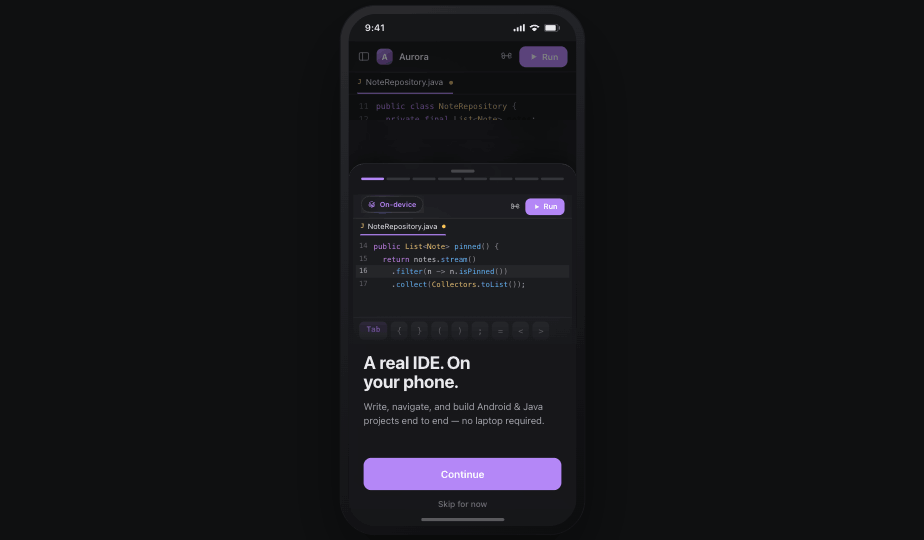
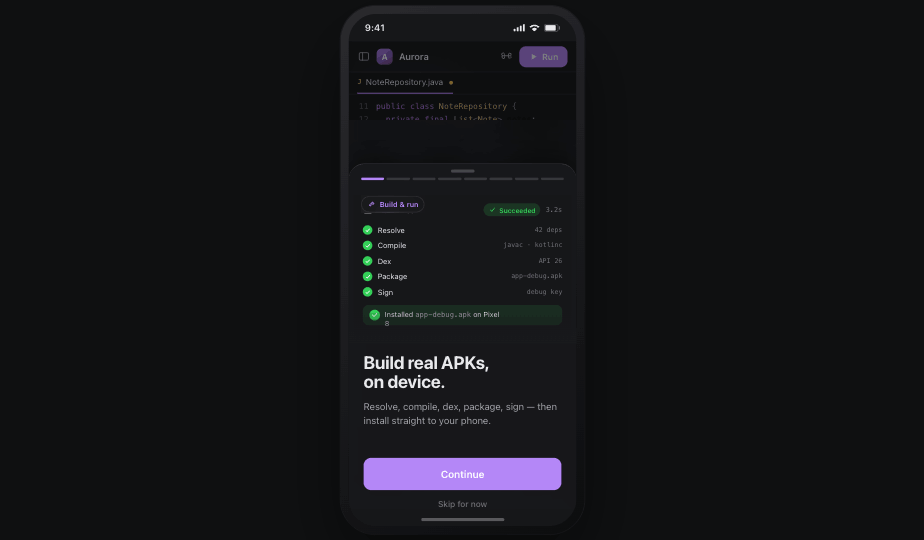
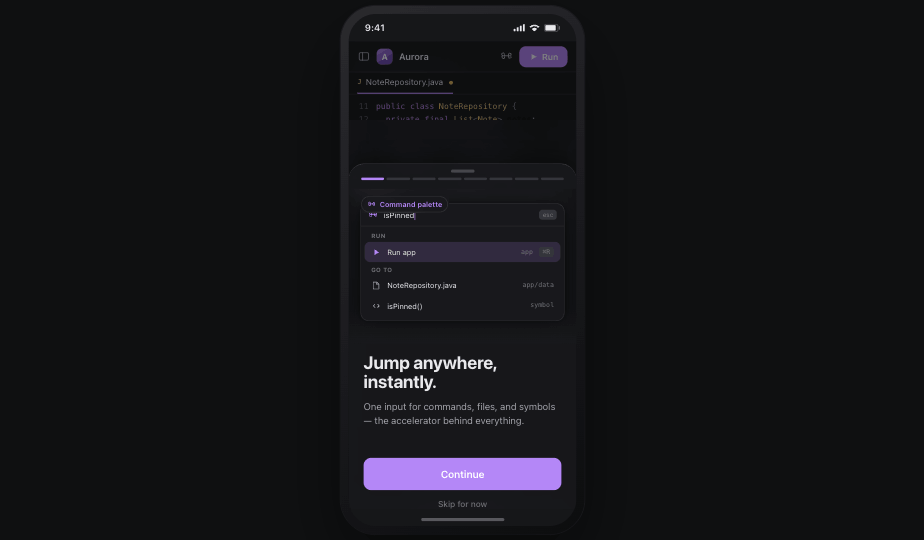
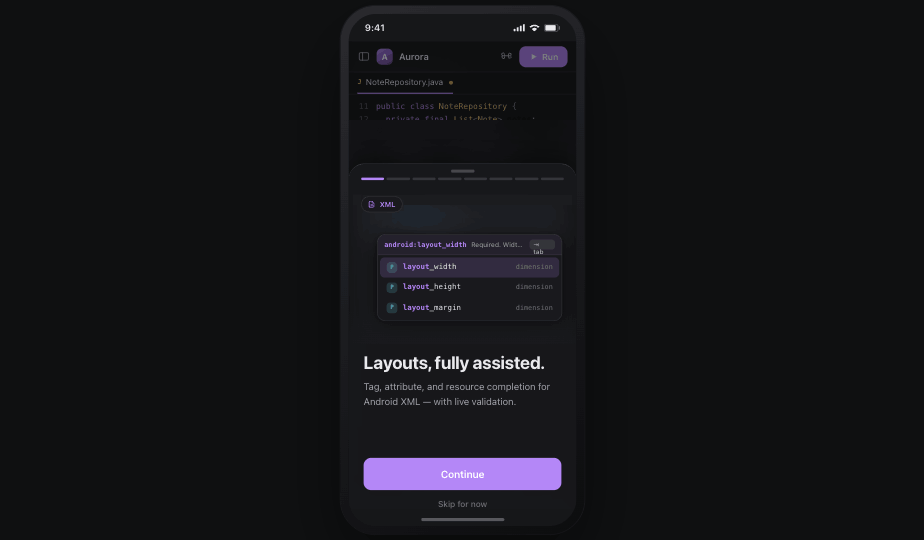
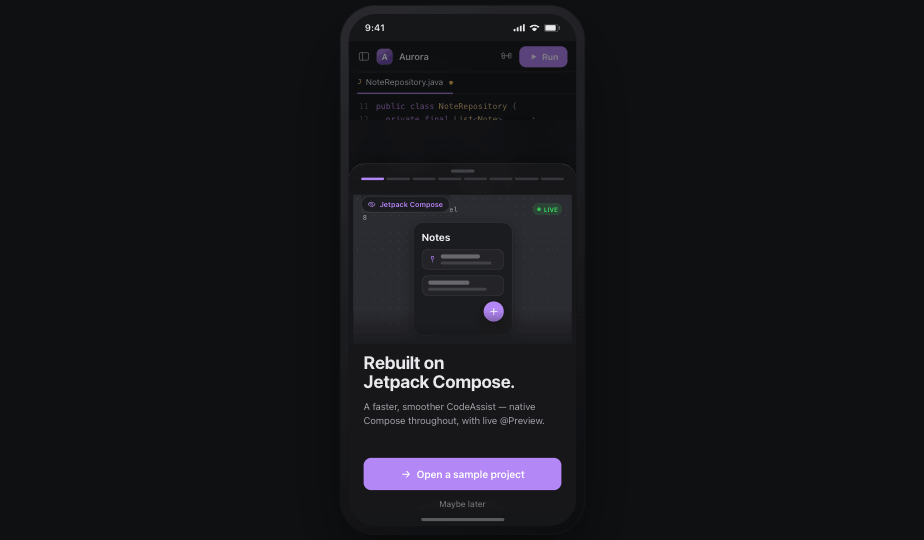
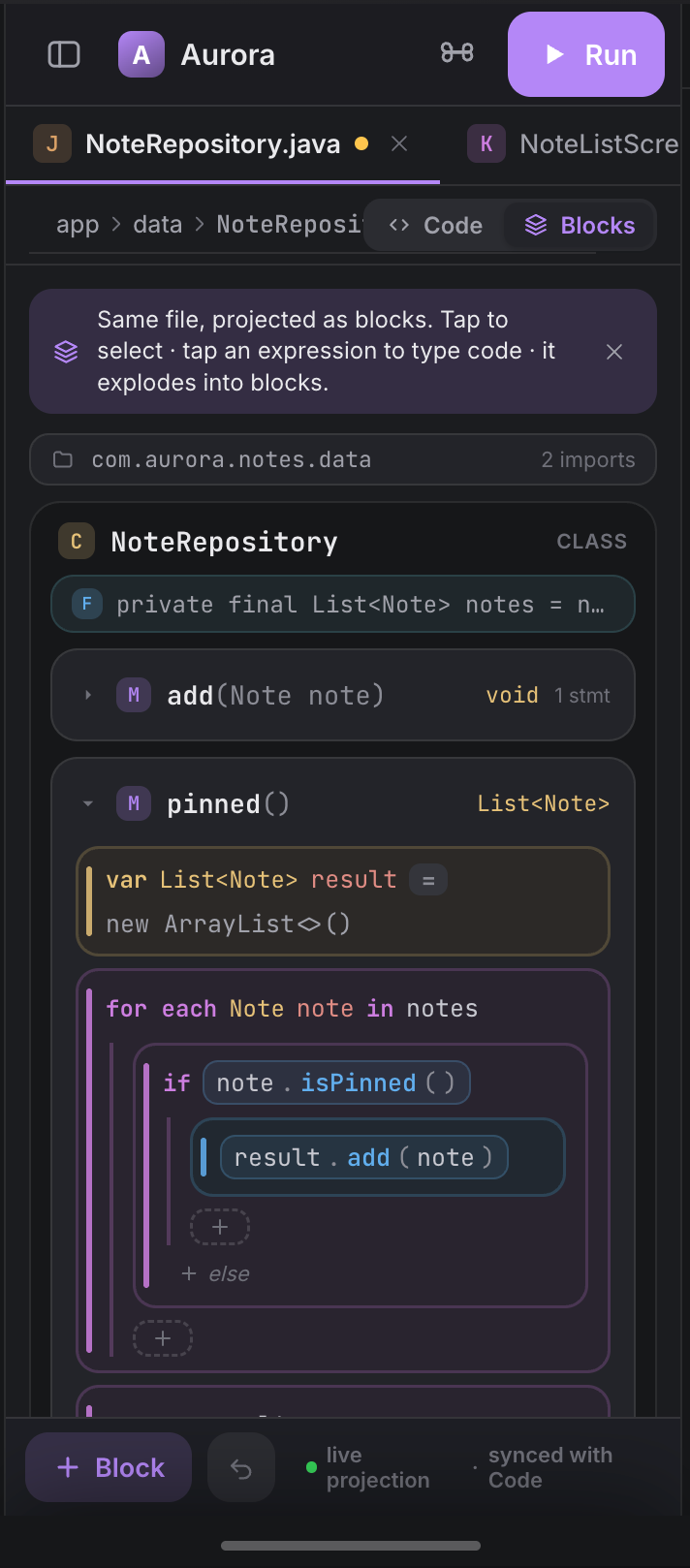
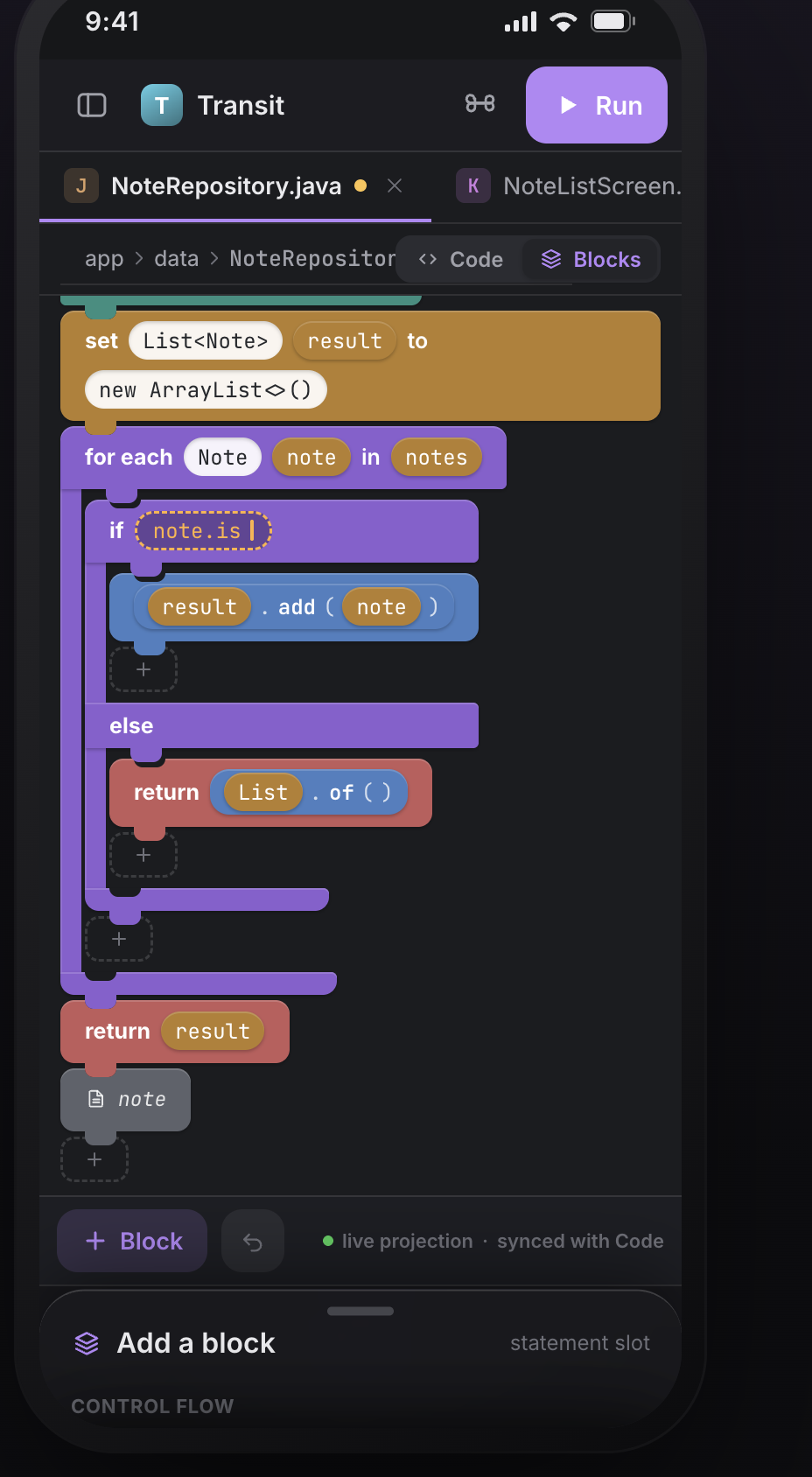
Experimental IDE for building Android applicatons on Android.
1.4k
Stars
358
Forks
132
Open issues
3
Contributors

AI Analysis
CodeAssist is a lightweight, on-device IDE that compiles and builds Android/Java projects directly on Android devices without requiring a laptop or Gradle daemon. It targets mobile developers and enthusiasts who want a self-contained development environment on their phone, and is not suitable for projects requiring full desktop IDE capabilities or complex enterprise tooling.
Inferred from signals mentioned in the README (tests, CI, type safety) — not a review of the actual code.
AI's overall editorial judgment — not an average of the bars above, can weigh other factors too.
On-device Android IDE that builds APKs without Gradle, targeting phones and tablets as development machines
CodeAssist is an extensible IDE framework designed to run entirely on Android devices, enabling real compilation and APK building without a Gradle daemon. It targets developers who want to code and build Android projects directly on their phones or tablets. The project replaces Gradle's runtime with a custom incremental task engine and uses pure-Java tooling (Eclipse JDT, D8/R8, aapt2). Adoption appears limited to early adopters and enthusiasts; mainstream adoption is unclear.
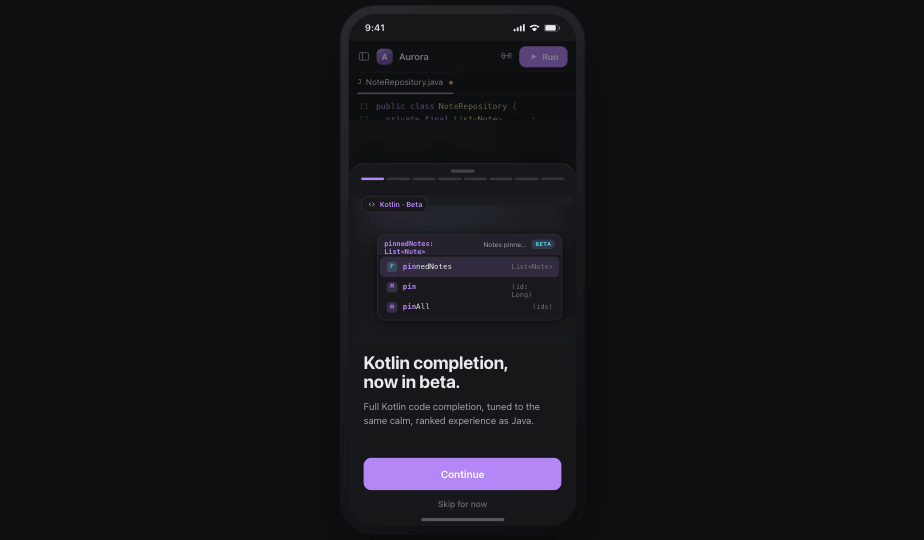
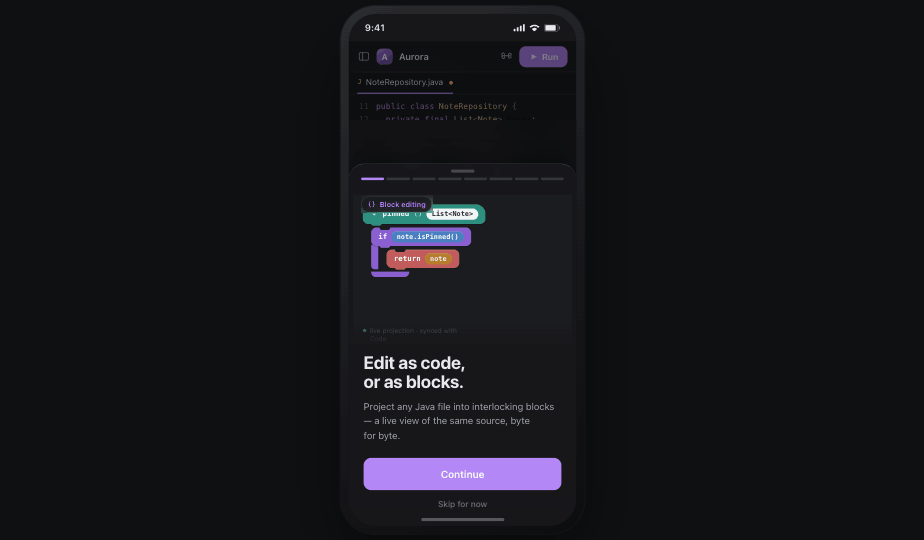
Created August 2021, CodeAssist emerged as an experimental response to the absence of capable on-device development environments for Android. The project has evolved from a proof-of-concept to a feature-rich framework with Kotlin completion (beta), block editing, and Compose Multiplatform UI across desktop and Android.
The project gained 1,342 stars over ~5 years with 349 forks, averaging modest but consistent interest. Recent activity (46 stars in 7 days, latest push 2026-06-28) suggests sustained development. The star curve does not indicate explosive adoption, but the project appears to maintain an active, engaged contributor base and recent feature additions (Kotlin completion, block editing).
Adoption not verified. README describes the product as 'experimental' and presents capabilities rather than documented user testimonials, case studies, or deployment statistics. No mention of enterprise adoption, known production projects, or user communities beyond a Discord link. The 1,342 stars and 349 forks suggest interest, but real-world usage in production Android development workflows is not documented.
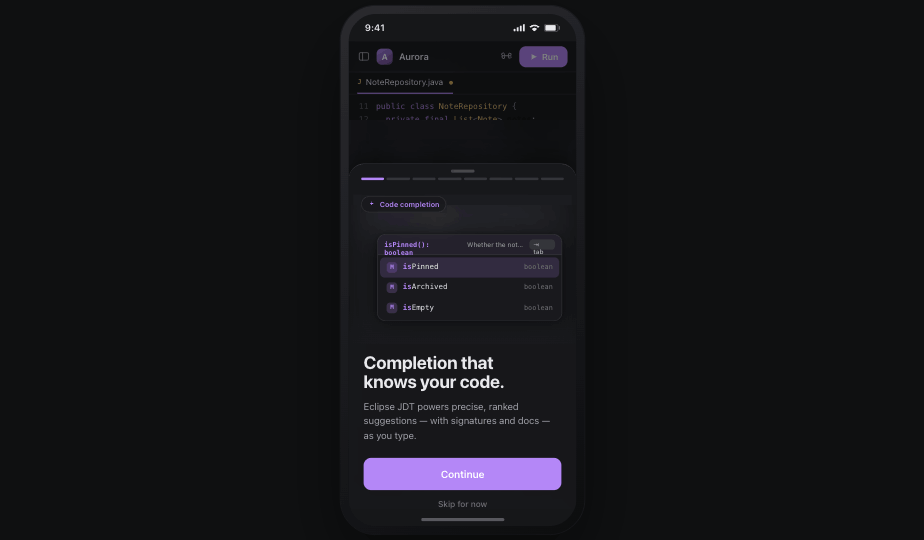
Based on README, CodeAssist uses a declarative project model compiled into an incremental task DAG with fingerprint-based up-to-date checks and persistent caching. Indexing employs disk-backed immutable segments with bounded block cache to keep heap usage flat. It drives native Android tooling (aapt2, D8/R8, apksigner) as subprocesses and embeds Eclipse JDT for Java analysis. Kotlin completion appears to use a custom ranked suggestion system. Architecture is explicitly designed for low memory footprint and incremental re-execution. Implementation details beyond README are not inspectable.
README references a `regressionTest` suite with CI integration and mentions benchmarking for completion quality, editor latency, indexing, and build performance tracked against committed baselines. Test badges exist but are incomplete in the truncated README excerpt. Specific coverage metrics not documented.
Project shows active maintenance as of 2026-06-28 (push date). CI status badge present and monitored. Benchmark and test badges indicate automated validation infrastructure. Contributors appear engaged (349 forks, 46 stars in last 7 days). However, long-term velocity is not directly visible from metadata alone. Lack of explicit roadmap or release-note pattern in README excerpt limits forward-looking maintenance assessment.
ADOPT IF: you are an early-adopter developer interested in on-device Android development, want to experiment with mobile-first coding workflows, or are curious about tooling architecture. AVOID IF: you rely on Gradle's full plugin ecosystem, need strict compatibility with enterprise Android build pipelines, or require mainstream tool support and documentation. MONITOR IF: you are interested in specialized mobile development tools, want to see if on-device development gains traction in the broader Android community, or need to evaluate whether this architecture scales to complex multi-module projects.
Independent dimensions
Mainstream potential
3/10
Technical importance
7/10
Adoption evidence
2/10
- Adoption not verified in production; unclear if real Android teams use this for shipping apps.
- Likely to struggle with large multi-module projects and complex Gradle plugin dependencies due to custom build engine.
- Single-maintainer or small-core-team risk not evident from metadata; sustainability under maintainer availability unclear.
- Kotlin completion is marked beta; full language feature parity with Java intelligence not yet confirmed.
- On-device resource constraints (memory, CPU, battery) may create hard limits for project complexity regardless of engineering quality.
CodeAssist will likely remain a specialized, intentional-use tool for on-device Android development rather than a mainstream IDE replacement. Its value proposition (Gradle-free, on-device) appeals to a permanent niche of mobile-first developers and tool enthusiasts. Success will depend on ecosystem maturity (plugin count, library support, tutorials) rather than star count.
Newsletter
Get analyses like this every Monday
Free weekly digest of the most interesting open-source discoveries.
Languages
Information
- Language
- Kotlin
- License
- GPL-3.0
- Last updated
- 1d ago
- Created
- 60mo ago
- Analyzed with
- anthropic/claude-haiku-4-5
Stars over time
Contributors over time
Top 100 contributors only — repos with more will plateau at 100.
Open issues
Open pull requests
No open pull requests.
Top contributors
Similar repos

AndroidCSOfficial/android-code-studio
Android Code Studio is a self-hosted IDE that runs natively on Android devices,...

Acode-Foundation/Acode
Acode is a powerful code editor application for Android devices that enables...

vhqtvn/VHEditor-Android
VHEditor Android runs code-server on Android devices, enabling a web-based code...
| Repository | Stars | Week Δ | Language | Score | Updated |
|---|---|---|---|---|---|
|
tyron12233/CodeAssist
this
|
1.4k | +53 | Kotlin | 7/10 | 1d ago |
|
AndroidCSOfficial/android-code-studio
|
1.1k | — | Java | 6/10 | 22h ago |
|
Acode-Foundation/Acode
|
5.9k | — | JavaScript | 7/10 | 7h ago |
|
vhqtvn/VHEditor-Android
|
1k | — | Kotlin | 6/10 | 2w ago |
 pbreault/adb-idea pbreault/adb-idea
|
2.2k | — | Kotlin | 6/10 | 2mo ago |
 JetBrains/android JetBrains/android
|
1.1k | — | Kotlin | 8/10 | 17h ago |
Acode is a general-purpose Android code editor with broader language support but appears not to natively build/compile projects on device. CodeAssist is narrower (Android/Java focus) but includes real compilation and APK building.
Android Studio is the dominant desktop IDE; CodeAssist trades full IDE breadth for on-device mobility and zero-Gradle design. Direct feature parity is not the goal; use cases differ (development *on the device* vs. development *for the device*).
Similar in-scope competitor, also Kotlin-based Android editor. CodeAssist differentiates via incremental build system, block editing, and more detailed code intelligence. Relative feature completeness and performance not directly comparable from metadata.
CodeAssist explicitly avoids hosting Gradle, replacing it with a custom incremental model. This removes memory overhead but requires CodeAssist's custom build engine to be feature-complete; gap may limit adoption to simpler projects.