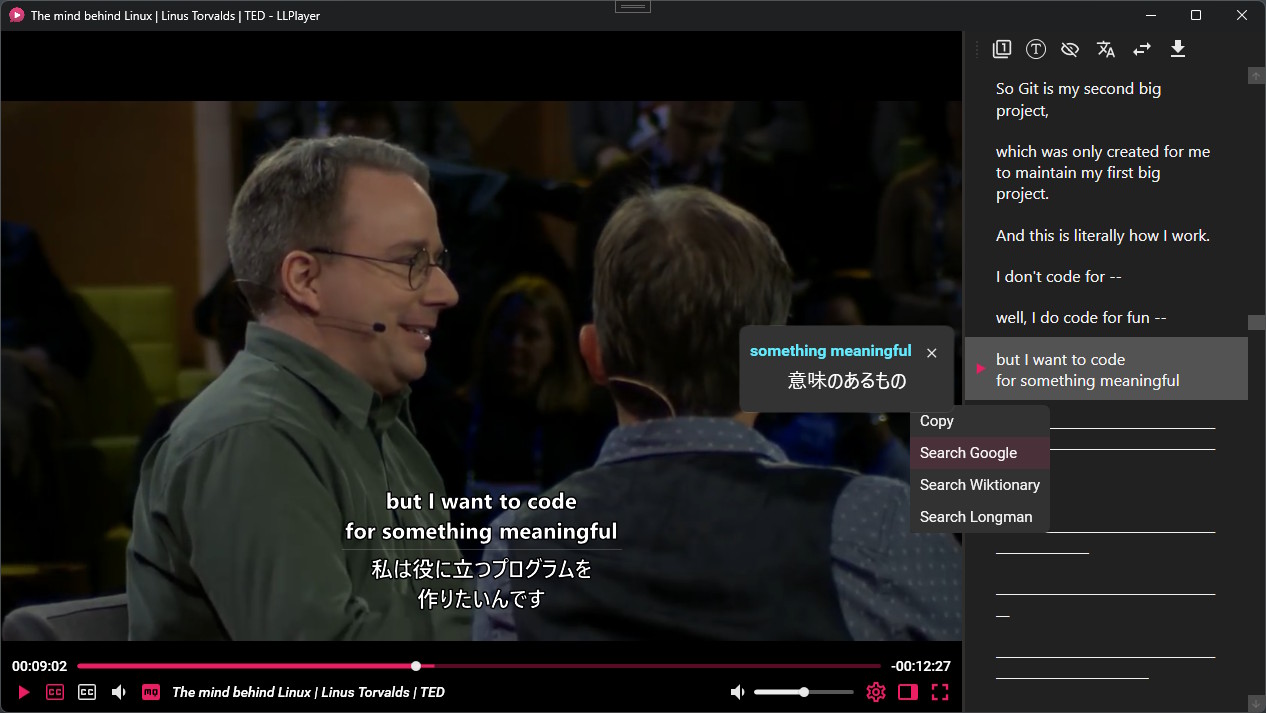
The media player for language learning, with dual subtitles, AI-generated subtitles, real-time translation, and more!
3.9k
Stars
222
Forks
56
Open issues
4
Contributors


AI Analysis
LLPlayer is a desktop video player built specifically for language learners, offering dual subtitles, AI-generated subtitles via Whisper, real-time translation through multiple engines (Google, DeepL, Ollama, OpenAI), and OCR subtitle conversion. It serves learners and educators who need granular control over subtitle presentation and translation during video playback; it is not a general-purpose media player for casual viewing.
Inferred from signals mentioned in the README (tests, CI, type safety) — not a review of the actual code.
AI's overall editorial judgment — not an average of the bars above, can weigh other factors too.
Windows-native video player for language learners with AI subtitles, dual captions, and real-time translation
LLPlayer is a C#/WPF desktop media player designed specifically for language learning. It integrates ASR (Whisper-based automatic subtitle generation), real-time translation via multiple engines (Google, DeepL, Ollama, OpenAI), dual subtitle rendering, OCR for bitmap subtitles, and word lookup tied to external dictionaries. Target audience: self-directed language learners who watch video content. Adoption appears concentrated in East Asian markets (based on GitHub activity patterns and README localization hints), though adoption metrics are not publicly documented.
Repository created January 31, 2025; 5 months old as of July 2026. Entered a competitive space already occupied by Translumo (5,470 stars, C#) and VideoLingo (17,596 stars, Python). Unlike VideoLingo's focus on bulk video translation for content creation, LLPlayer targets interactive learning workflows.
Gained 3,875 stars in ~17 months, with steady recent activity (21 stars in last 7 days as of June 18, 2026 — the most recent push). Growth trajectory is linear rather than explosive; no evidence of viral adoption or mainstream press coverage. Relative to similar projects, star velocity is moderate. Suggests adoption driven by targeted marketing to language-learning communities rather than broad consumer awareness.
Adoption not verified. No case studies, user testimonials, organizational deployments, or community metrics (Discord, forums) mentioned in README. Star count (3,875) is non-negligible but does not confirm active usage — download counts, user surveys, or GitHub Discussions activity not visible. Language learning niche communities (Reddit, Discord language servers) are likely sources of reach, but quantified adoption absent.
C# WPF desktop application. Modular integration with external ASR engines (whisper.cpp, faster-whisper), translation APIs, OCR providers (Tesseract, Microsoft), and yt-dlp for online video playback. README indicates flexible plugin/configuration model. Likely uses .NET Desktop Runtime 10; requires Windows 10/11 x64. Architecture appears well-decomposed based on feature breadth.
not documented in README. No CI/CD pipeline mentioned; no badge or reference to automated testing.
Last push June 18, 2026 — active within last 2 weeks relative to current date (July 2, 2026). Releases section shows ongoing builds. README is comprehensive with setup guides, feature explanations, and wiki links. Maintenance posture is active but not frenetic — patches appear driven by user requests rather than rapid iteration. Indicator: healthy steady-state maintenance rather than crisis-driven development.
ADOPT IF: you are a Windows user learning languages through video, comfortable with setup (model downloads, API keys for translation), and value integrated ASR + translation + word lookup in one interface. AVOID IF: you need cross-platform support (macOS/Linux), prefer minimal dependencies, rely on proprietary SaaS integrations, or want a tool with proven production reliability and community support. MONITOR IF: you are evaluating language-learning tools for organizational deployment — adoption metrics, stability track record, and long-term maintenance clarity are insufficient to recommend for team adoption yet.
Independent dimensions
Mainstream potential
4/10
Technical importance
7/10
Adoption evidence
2/10
- Windows-only deployment severely limits addressable market and adoption velocity; macOS/Linux users represent significant language-learning demographic but are excluded.
- Setup complexity (Whisper model downloads, translation engine API configuration, .NET runtime prerequisite) creates friction for non-technical users; likely suppresses organic adoption.
- Adoption metrics (production usage, user retention, active community) are opaque; star count may reflect wishlist-adding rather than sustained usage.
- Dependency on external services (translation APIs) for core features introduces operational risk; if APIs fail or pricing changes, user experience degrades without control.
- Relatively immature project (17 months old, small team signal) carries uncertainty on long-term maintenance and roadmap stability; language learning niche may not generate sustainable revenue to justify ongoing investment.
Likely to remain a specialized tool with steady but modest adoption in language-learning communities, particularly East Asia. Mainstream consumer adoption unlikely without macOS/Linux ports and reduced setup friction. Project may consolidate into a stable, low-velocity maintenance mode, or pivot toward organizational/classroom deployment if adoption barriers are systematically addressed.
Explore similar
Newsletter
Get analyses like this every Monday
Free weekly digest of the most interesting open-source discoveries.
Languages
Information
- Website
- https://llplayer.com
- Language
- C#
- License
- GPL-3.0
- Last updated
- 6d ago
- Created
- 18mo ago
- Analyzed with
- anthropic/claude-haiku-4-5
Stars over time
Contributors over time
Top 100 contributors only — repos with more will plateau at 100.
Open issues
WhisperCpp ASR repetition loop — subtitles stick on one repeated line
Remember/resume last playback position per file or URL
Add VAD (Voice Activity Detection) support
large-v3-turbo + "Translate to English" silently outputs source language (no indication translation didn't happen)
Audio plays fast/skips for ~1-2s after resuming from pause (local files), then settles
Open pull requests
No open pull requests.
Recent releases
Similar repos
| Repository | Stars | Week Δ | Language | Score | Updated |
|---|---|---|---|---|---|
|
umlx5h/LLPlayer
this
|
3.9k | +18 | C# | 8/10 | 6d ago |
 ramjke/Translumo ramjke/Translumo
|
5.5k | — | C# | 8/10 | 4w ago |
 Huanshere/VideoLingo Huanshere/VideoLingo
|
17.7k | — | Python | 7/10 | 1w ago |
 undreamai/LLMUnity undreamai/LLMUnity
|
1.7k | — | C# | 7/10 | 2mo ago |
 SciSharp/LLamaSharp SciSharp/LLamaSharp
|
3.7k | — | C# | 8/10 | 1w ago |
Also C# desktop, subtitle-focused. Translumo appears more generalist; LLPlayer adds ASR + translation engine integration, positioning as an all-in-one learning player rather than subtitle extraction tool.
Larger audience; targets content creators bulk-translating videos for distribution. LLPlayer targets individual learners. Different workflow; VideoLingo likely used for batch processing, LLPlayer for interactive viewing.
VLC + Yomitan/10ten combo covers much of the same use case at zero cost and with cross-platform support. LLPlayer adds integrated ASR and translation, reducing context-switching. Adoption friction: Windows-only, requires .NET runtime, setup overhead.
Highly customizable but steeper learning curve. LLPlayer offers GUI convenience and pre-integrated workflows; trade-off is less configurability for non-programmers.
Closed-source, subscription models, tied to specific platforms. LLPlayer is free, open-source, works offline (except translation engines). Different business model; lower adoption friction but no revenue model or long-term sustainability signal.