vitobotta/hetzner-k3s
Crystal MIT Single maintainer riskThe easiest and fastest way to create production-ready Kubernetes clusters on Hetzner Cloud
3.6k
Stars
222
Forks
26
Open issues
5
Contributors


AI Analysis
hetzner-k3s automates the creation of production-ready Kubernetes clusters on Hetzner Cloud infrastructure, combining k3s (lightweight Kubernetes) with cost-effective cloud resources. It's ideal for DevOps engineers and teams seeking to deploy managed Kubernetes without major cloud provider lock-in or expenses.
Inferred from signals mentioned in the README (tests, CI, type safety) — not a review of the actual code.
AI's overall editorial judgment — not an average of the bars above, can weigh other factors too.
Specialized Kubernetes provisioning for Hetzner Cloud; narrow but mature niche player
hetzner-k3s is a CLI tool that provisions k3s Kubernetes clusters on Hetzner Cloud infrastructure. It targets cost-conscious teams and those seeking to avoid major cloud providers, emphasizing speed (3-node cluster in 2–3 minutes) and simplicity (single YAML config, no Terraform). Adoption appears concentrated in European and budget-constrained segments; no evidence of mainstream enterprise use. Maintained actively by a single developer since 2021.
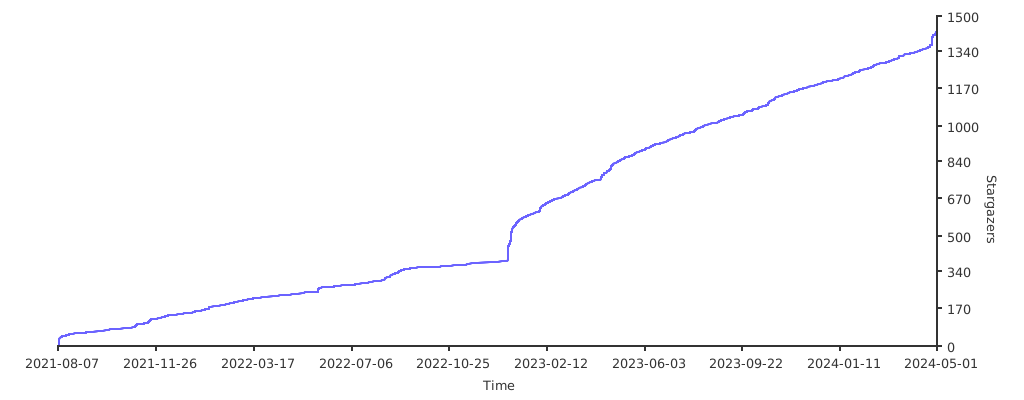
Created August 2021 as a wrapper around k3s and Hetzner Cloud APIs. Emerged during the wave of lightweight Kubernetes tooling and cost-optimization interest. Remained niche, growing slowly but steadily to ~3,600 stars by mid-2026, reflecting its stable but narrow positioning.
Initial growth likely driven by Hetzner Cloud's rising adoption in Europe and among developers seeking alternatives to AWS/GCP. Growth has plateaued at modest levels (~10 stars/week as of June 2026), suggesting saturation within its target audience rather than declining interest. No evidence of acceleration or widening use cases.
README includes a 'Who Uses hetzner-k3s?' section (text truncated in provided excerpt), suggesting claimed users exist, but specific adoption details, company names, or deployment scale are not visible in truncated README. No independent verification of production usage provided in repository metadata. Adoption not verified at enterprise scale, though cost-optimization messaging suggests SMB and indie developer adoption is plausible.
Appears to be a single-developer CLI application written in Crystal that orchestrates Hetzner Cloud API calls and k3s provisioning. Based on README, it performs direct node provisioning, network configuration, and component deployment without requiring a management cluster or Terraform intermediate layer. Likely uses Hetzner Cloud Go SDK bindings or direct HTTP calls. Crystal choice suggests prioritization of developer productivity over ecosystem reach.
not documented in README
Last commit 2026-06-14 (16 days before evaluation date), indicating active maintenance. Project continues receiving updates and issue/PR activity, though metadata on current issue backlog and PR review speed is not provided. Single-maintainer model is a structural risk but not evidence of abandonment given recent commits.
ADOPT IF: you operate on Hetzner Cloud, prioritize cost and deployment speed, want to avoid vendor lock-in to managed Kubernetes services, and are comfortable with single-maintainer open-source tooling. AVOID IF: you require multi-cloud portability, need enterprise support SLAs, operate at scale requiring dedicated platform teams, or depend on frequent major feature additions. MONITOR IF: you use Hetzner Cloud but haven't evaluated this yet—it appears fit-for-purpose in its niche and unlikely to disappear soon, but bet only on maintenance continuity, not feature velocity.
Independent dimensions
Mainstream potential
3/10
Technical importance
6/10
Adoption evidence
4/10
- Single-developer maintenance model creates sustainability risk; project would stall if maintainer becomes unavailable
- Narrow platform scope (Hetzner-only) limits adoption ceiling and prevents cross-cloud flexibility
- No visible evidence of real-world production usage at meaningful scale; adoption claims not independently verifiable
- Crystal language choice may reduce contributor pool and long-term maintainability compared to Go or Python alternatives
- Dependency on k3s and Hetzner Cloud API stability; breaking changes upstream could require rapid adaptation
Project will likely remain a stable, specialized tool for cost-conscious teams on Hetzner Cloud, with slow organic growth but low churn. May see modest adoption increases if Hetzner Cloud's European presence grows or if cost optimization becomes more critical in market downturn. Unlikely to reach mainstream status outside its niche unless maintainer significantly expands scope or team structure changes.
Explore similar
Newsletter
Get analyses like this every Monday
Free weekly digest of the most interesting open-source discoveries.
Languages
Information
- Website
- https://hetzner-k3s.com/
- Language
- Crystal
- License
- MIT
- Last updated
- 4w ago
- Created
- 60mo ago
- Analyzed with
- anthropic/claude-haiku-4-5
Stars over time
Contributors over time
Top 100 contributors only — repos with more will plateau at 100.
Open issues
External generic nodes: Why has private network to be disabled?
[ENH] Declarative removal of static worker node pools
Autoscaler, adding new_pod_scale_up_delay
Support configuring gVisor (runsc) as an additional container runtime
configure `k3s server --cluster-domain=...`
Top contributors
Recent releases
Similar repos
| Repository | Stars | Week Δ | Language | Score | Updated |
|---|---|---|---|---|---|
|
vitobotta/hetzner-k3s
this
|
3.6k | — | Crystal | 8/10 | 4w ago |
 loft-sh/vcluster loft-sh/vcluster
|
11.2k | — | Go | 9/10 | 22h ago |
 k3s-io/k3s k3s-io/k3s
|
33.4k | — | Go | 9/10 | 16h ago |
 kubernetes-sigs/kubespray kubernetes-sigs/kubespray
|
18.6k | — | Jinja | 8/10 | 1d ago |
hetzner-k3s is a distribution/provisioning layer *for* k3s, not a replacement. k3s is the Kubernetes runtime; hetzner-k3s automates its deployment on Hetzner. k3s is platform-agnostic; hetzner-k3s is Hetzner-specific.
Both provision Kubernetes clusters. Kubespray is cloud-agnostic, uses Ansible, requires manual configuration. hetzner-k3s is Hetzner-only, uses YAML config, fully automated. Trade-off: flexibility vs. speed/simplicity.
vcluster creates lightweight virtual clusters inside existing Kubernetes; hetzner-k3s creates full Kubernetes clusters on bare infrastructure. Different problem domains (multi-tenancy/testing vs. cluster provisioning).
hetzner-k3s is DIY open-source tooling; managed services offer platform fees and convenience. hetzner-k3s costs less but requires operational ownership.
Both provision infrastructure on Hetzner. Terraform is general-purpose IaC; hetzner-k3s is k3s-specific. hetzner-k3s claims faster setup and no need to learn Terraform.