A high-performance inference engine for LLM, VLM, DiT and REC models, optimized for diverse AI accelerators. It is hosted in OpenAtom Foundation.
1.5k
Stars
256
Forks
172
Open issues
30
Contributors


AI Analysis
xLLM is a high-performance inference engine optimized for LLM, VLM, and other AI models, specifically designed for Chinese AI accelerators and enterprise deployment. It serves organizations needing efficient model inference on specialized hardware rather than general-purpose LLM application developers; primary beneficiaries are infrastructure teams and enterprises using non-NVIDIA accelerators.
Inferred from signals mentioned in the README (tests, CI, type safety) — not a review of the actual code.
AI's overall editorial judgment — not an average of the bars above, can weigh other factors too.
C++ LLM inference engine optimized for Chinese AI accelerators, deployed in JD.com production
xLLM is a C++-based inference engine designed specifically for LLM, VLM, DiT, and recommendation models running on Chinese AI accelerators (e.g., Ascend, MLU). Built by JD.com and released as open source in August 2025, it emphasizes low-latency, high-throughput inference through service-engine decoupling, graph optimization, KV cache management, and speculative inference. The project targets enterprises deploying large models in cost-constrained environments where Western GPU availability is limited. Evidence indicates production deployment within JD.com's retail operations, though public adoption metrics remain limited.
xLLM emerged in August 2025 as JD.com's response to the need for efficient LLM serving on domestic Chinese accelerators. The project was positioned against the Python-dominated vLLM and MLCLLMs ecosystems, which lack native optimization for non-NVIDIA hardware. Release of an arXiv technical report (October 2025) signals maturation of the underlying research.
The project gained 1,370 stars over ~10 months, with 21 stars in the most recent 7-day period (as of June 2026). Growth appears modest relative to mainstream inference engines, but consistent. Recent activity shows rapid model support expansion (DeepSeek-V4 day-0 support in April 2026, MiniMax-M3 in June 2026, GLM series integration throughout late 2025), suggesting active development driven by customer model adoption rather than organic community growth. The project remains concentrated within JD.com's ecosystem.
README explicitly states 'xLLM has been fully deployed in JD.com's real core retail businesses, covering a variety of scenarios including intelligent customer service, risk control, supply chain optimization, ad recommendation, and more.' This is verifiable production adoption within a Fortune 500 company. However, public deployments, case studies, or third-party production usage are not documented. Adoption outside JD.com not verified.
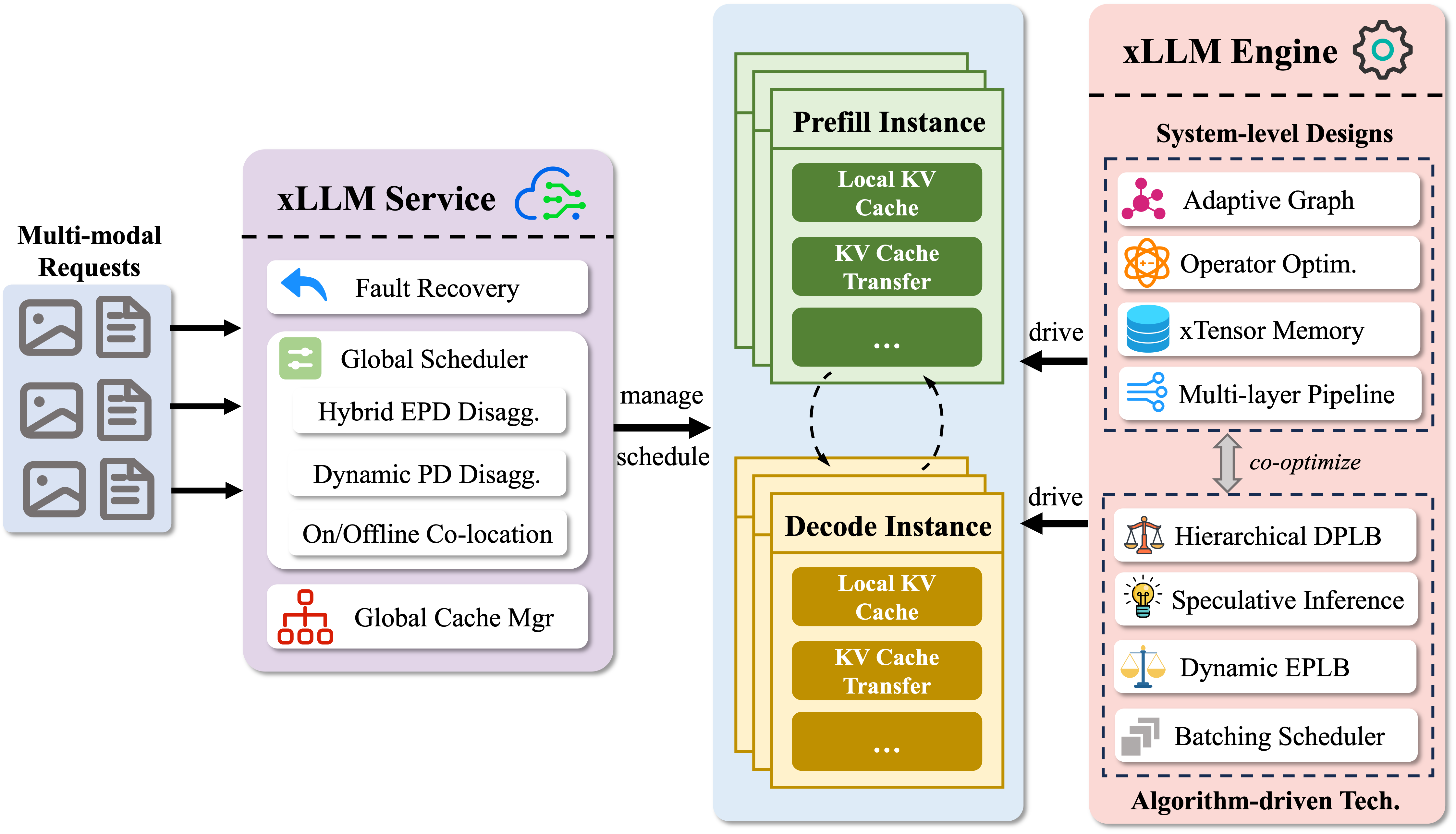
Based on README: service-engine decoupled architecture with asynchronous request scheduling, multi-stream parallel computation, graph fusion optimization, dynamic shape adaptation via parameterized multi-graph caching, PageAttention integration, discrete-to-virtual memory mapping, and hybrid KV cache management inspired by Mooncake. Appears to be a production-grade inference runtime with operator specialization for Chinese accelerators (Ascend, MLU). Likely implements a static/dynamic graph optimization pipeline similar to TensorRT or TVM but specialized for inference-heavy workloads.
Not documented in README. No mention of test suite, benchmarking framework, or validation procedures.
Last push 2026-06-29, less than 24 hours before analysis date. High commit frequency with model support landing regularly. README updated with recent model announcements (MiniMax-M3 on 2026-06-13). Technical report published October 2025. Project shows sustained active development, though velocity appears developer-team-driven rather than community-driven. No evidence of open GitHub Issues/PRs or community contribution workflows in README.
ADOPT IF: (1) You deploy LLMs/VLMs on Chinese AI accelerators (Ascend, MLU, etc.) in production and require proven low-latency, high-throughput serving; (2) You operate within a JD.com-compatible ecosystem or have engineering capacity to integrate C++ inference engines; (3) Your model portfolio aligns with supported architectures (GLM, DeepSeek, QWen, Llama). AVOID IF: (1) You require multi-accelerator portability (GPU, TPU, NPU across vendors) and value ecosystem breadth over peak efficiency on one platform; (2) Your team is Python-only and lacks C++ infrastructure expertise; (3) You need extensive open-source community support, debugging resources, or third-party integrations. MONITOR IF: (1) You are evaluating cost-per-inference on Chinese domestic hardware for future large-scale deployments; (2) You anticipate Ascend/MLU adoption within 12–24 months as part of vendor diversification; (3) You want to track whether community adoption outside JD.com materializes.
Independent dimensions
Mainstream potential
4/10
Technical importance
7/10
Adoption evidence
4/10
- Vendor concentration risk: Development appears primarily driven by JD.com's internal needs. If JD.com deprioritizes the project or shifts to alternative hardware, community momentum may stall.
- Limited adoption transparency: Real-world adoption outside JD.com is not documented. No public case studies, benchmark reports, or independent benchmarks against competitors. Difficult to assess market traction.
- Accelerator availability risk: xLLM's value proposition depends on Ascend and MLU proliferation in global enterprises. If Western enterprises continue NVIDIA/AMD dominance and Chinese enterprises remain concentrated, the addressable market may plateau.
- Ecosystem integration gap: Appears to lack integrations with popular frameworks (Hugging Face Transformers, vLLM API compatibility, etc.). Adoption may require bespoke deployment workflows.
- Documentation and community onboarding: README is thorough, but actual production deployment documentation, troubleshooting guides, and community support channels not evident. Early adopters may face integration friction.
xLLM will likely remain a specialized, high-performance choice for cost-sensitive LLM deployments on Chinese accelerators. Within the next 12–24 months, adoption will probably expand modestly within JD.com ecosystem and peer enterprises (other Chinese tech companies, e-commerce). Mainstream global adoption appears unlikely unless Ascend/MLU gain significant foothold outside China or JD.com significantly invests in ecosystem building (SDKs, reference architectures, community programs). The project will continue to receive updates tied to model release cycles (DeepSeek, GLM, QWen) but may not attract independent open-source contributors at scale.
Newsletter
Get analyses like this every Monday
Free weekly digest of the most interesting open-source discoveries.
Languages
Information
- Website
- https://xllm-ai.com/
- Language
- C++
- License
- Apache-2.0
- Last updated
- 9h ago
- Created
- 11mo ago
- Analyzed with
- anthropic/claude-haiku-4-5
Stars over time
Contributors over time
Top 100 contributors only — repos with more will plateau at 100.
Open issues
Top contributors
Similar repos
| Repository | Stars | Week Δ | Language | Score | Updated |
|---|---|---|---|---|---|
|
xLLM-AI/xllm
this
|
1.5k | +89 | C++ | 7/10 | 9h ago |
 vllm-project/vllm vllm-project/vllm
|
85.9k | — | Python | 10/10 | 8 min ago |
 ztxz16/fastllm ztxz16/fastllm
|
4.8k | — | C++ | 7/10 | 2w ago |
 mlc-ai/mlc-llm mlc-ai/mlc-llm
|
22.9k | — | Python | 8/10 | 3d ago |
|
mlc-ai/web-llm
|
18.3k | — | TypeScript | 8/10 | 1mo ago |
 SemiAnalysisAI/InferenceX SemiAnalysisAI/InferenceX
|
1.2k | — | Python | 8/10 | 7h ago |
vLLM (Python, 84.8k stars) dominates the open-source inference landscape but primarily targets NVIDIA/AMD GPUs. xLLM's C++ foundation and domestic-accelerator specialization represents orthogonal positioning, not replacement. vLLM has vastly larger community and ecosystem; xLLM focuses on cost/efficiency in non-NVIDIA environments.
MLCLLMs (Python, 22.8k stars) offers compiler-driven optimization across diverse hardware. xLLM appears more purpose-built for inference at scale on specific domestic accelerators, whereas MLCLLMs emphasizes generality. xLLM likely offers better throughput on target hardware; MLCLLMs offers wider hardware portability.
FastLLM (C++, 4.8k stars) is also C++-based and Chinese-community-oriented but appears less actively maintained and with narrower Chinese accelerator support. xLLM's enterprise backing (JD.com) and recent model support suggest more aggressive development.
NVIDIA's TensorRT-LLM is closed-ecosystem, NVIDIA-only. xLLM is open-source and targets Chinese hardware, serving a distinct market segment where TensorRT is unavailable or uneconomical.
LMDeploy supports diverse backends including Chinese accelerators but is less specialized than xLLM. xLLM's vertical integration with JD.com workloads likely yields better performance on that specific hardware stack; LMDeploy prioritizes breadth.